
Leviticus 16 and Leviticus 17:11 · Debate · Featured Study
How the Cross Saves: The Views of the Atonement
From Irenaeus in the second century to Horace Bushnell in 1866, the church's teachers have read the death of Christ through the Day of Atonement and the blood of the altar.
Hebrews 9:12 says that Christ entered the Most Holy Place once for all by His own blood, and the church has given more than one account of how that blood saves.
- The question
- How does the death of Christ take away sin and reconcile sinners to God?
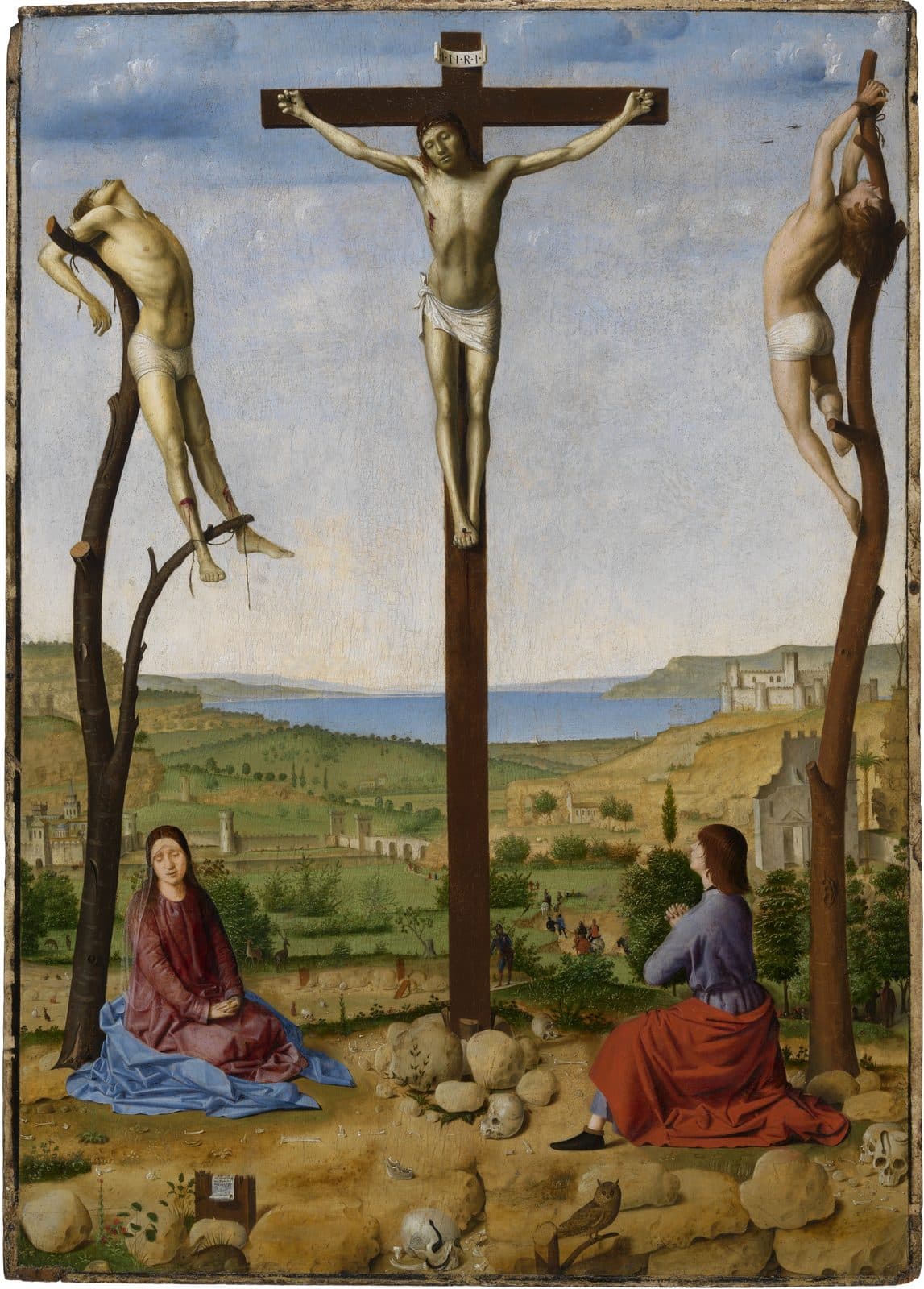
Antonello da Messina, Calvary, 1475, Antwerp. Public domain by date.
THE ARTWORKAntonello painted Christ crucified between two criminals on a hill of skulls and bones, the place John 19:17 calls The Place of the Skull.
Summary
Seven readings of the atonement answer how the death of Christ saves, and they differ on what sin has done and toward whom the cross chiefly looks.
- Irenaeus and Gregory of Nyssa read the cross as a ransom from the power of the devil and death, and Irenaeus taught that Christ sums up in Himself the human race that fell in Adam.
- Anselm of Canterbury taught that Christ rendered to God the satisfaction that sinners owed, and John Calvin and Charles Hodge taught that He bore the penalty of sin in the sinner's place.
- Peter Abelard and Horace Bushnell taught that the cross saves by moving sinners to repentance and love.
- Hugo Grotius held that the cross upholds God's government of the world, and Athanasius read the death of Christ within the Incarnation of the Word.
The Texts Every Reading Turns On
Eight passages, from the Day of Atonement to the letter to the Hebrews, carry the weight of the question.
For the life of the flesh is in the blood, and I have given it to you to make atonement for your souls upon the altar; for it is the blood that makes atonement for the soul.God gives the blood of the altar to make atonement for the soul, and every reading asks how the blood of Christ does what this blood pictured.
Then he is to lay both hands on the head of the live goat and confess over it all the iniquities and rebellious acts of the Israelites in regard to all their sins. He is to put them on the goat’s head and send it away into the wilderness by the hand of a man appointed for the task. The goat will carry on itself all their iniquities into a solitary place, and the man will release it into the wilderness.The iniquities of Israel are confessed over the live goat and carried away, and every reading gives its own account of that picture.
But He was pierced for our transgressions, He was crushed for our iniquities; the punishment that brought us peace was upon Him, and by His stripes we are healed.The Servant is pierced for our transgressions, and the verse sets punishment and healing side by side in one sentence.
For even the Son of Man did not come to be served, but to serve, and to give His life as a ransom for many.”Jesus calls His own death a ransom, and the ransom reading takes its name from this word.
God presented Him as the atoning sacrifice through faith in His blood, in order to demonstrate His righteousness, because in His forbearance He had passed over the sins committed beforehand. He did this to demonstrate His righteousness at the present time, so as to be just and to justify the one who has faith in Jesus.Paul says God presented Christ to demonstrate His righteousness, and every reading has to account for a cross that shows God just.
God made Him who knew no sin to be sin on our behalf, so that in Him we might become the righteousness of God.Paul says God made the sinless One to be sin on our behalf, and the readings differ over what that making means.
And having disarmed the powers and authorities, He made a public spectacle of them, triumphing over them by the cross.Paul dates the defeat of the hostile powers to the crucifixion, the point on which the victory reading builds.
He did not enter by the blood of goats and calves, but He entered the Most Holy Place once for all by His own blood, thus securing eternal redemption.Hebrews reads Leviticus 16 through Christ in this chapter, and every reading of the cross builds on it.
Seven Readings Side by Side
The readings differ first on what went wrong, and so on what had to be put right.
| Reading | What sin has done | What the cross does | Toward whom it looks |
|---|---|---|---|
| Ransom and victory | Given the human race over to the devil and to death. | Pays the ransom and breaks the captor's hold. | The captives and their captor. |
| Recapitulation | Broke the first man's obedience, and the race fell with him. | Sums up the race in Christ, who obeys where Adam disobeyed. | Humanity, made new in its head. |
| Satisfaction | Robbed God of the honor owed to Him. | Renders to God a satisfaction greater than the debt. | God, whose honor is restored. |
| Penal substitution | Made the sinner guilty and liable to punishment. | Bears the penalty in the sinner's place. | God's justice and the sinner's guilt. |
| Moral influence | Turned the heart away from God. | Shows a love that moves the sinner to repentance and love. | The sinner's heart. |
| Governmental | Struck at the authority of God's law. | Sets out an example of God's hatred of sin, so that He may pardon and keep His law. | God as ruler of the world. |
| The cross within the Incarnation | Brought corruption and death on human nature. | Joins God to human nature and undoes death from within it. | Human nature, joined to God in Christ. |
- Reading
- Ransom and victory
- What sin has done
- Given the human race over to the devil and to death.
- What the cross does
- Pays the ransom and breaks the captor's hold.
- Toward whom it looks
- The captives and their captor.
- Reading
- Recapitulation
- What sin has done
- Broke the first man's obedience, and the race fell with him.
- What the cross does
- Sums up the race in Christ, who obeys where Adam disobeyed.
- Toward whom it looks
- Humanity, made new in its head.
- Reading
- Satisfaction
- What sin has done
- Robbed God of the honor owed to Him.
- What the cross does
- Renders to God a satisfaction greater than the debt.
- Toward whom it looks
- God, whose honor is restored.
- Reading
- Penal substitution
- What sin has done
- Made the sinner guilty and liable to punishment.
- What the cross does
- Bears the penalty in the sinner's place.
- Toward whom it looks
- God's justice and the sinner's guilt.
- Reading
- Moral influence
- What sin has done
- Turned the heart away from God.
- What the cross does
- Shows a love that moves the sinner to repentance and love.
- Toward whom it looks
- The sinner's heart.
- Reading
- Governmental
- What sin has done
- Struck at the authority of God's law.
- What the cross does
- Sets out an example of God's hatred of sin, so that He may pardon and keep His law.
- Toward whom it looks
- God as ruler of the world.
- Reading
- The cross within the Incarnation
- What sin has done
- Brought corruption and death on human nature.
- What the cross does
- Joins God to human nature and undoes death from within it.
- Toward whom it looks
- Human nature, joined to God in Christ.
Each Reading in Its Own Words
Seven readings are set out in the terms their own teachers used, from Irenaeus to Horace Bushnell.
Ransom and victoryIrenaeus, Against Heresies (about 180); Gregory of Nyssa, The Great Catechism (about 385)
The ransom reading starts from the passages of Scripture that show fallen humanity in bondage to the prince of darkness, as Charles Hodge describes the fathers' theory. Irenaeus wrote in Against Heresies 5.1 that the Word redeemed us by His own blood and gave Himself as a redemption for those led into captivity. He added that the Word took back His own by persuasion and not by violence. Origen asked to whom the ransom of Mark 10:45 was given and answered that it was given to the evil one, who was deceived into thinking he could hold the soul of Jesus.
Gregory of Nyssa wrote in The Great Catechism, chapter 22, that justice required a ransom the master of the slave would accept. In chapter 24 he wrote that the Deity was hidden under the veil of our nature as a hook is hidden in bait. In the victory form, as Hodge describes it, Christ becomes man and conquers Satan in our nature.
Now since the children have flesh and blood, He too shared in their humanity, so that by His death He might destroy him who holds the power of death, that is, the devil, and free those who all their lives were held in slavery by their fear of death.This verse gives the victory reading a text that names the devil as the enemy whom the death of Christ defeats.
Ambrose of Milan read the cancelled debt of Colossians 2:14 as a debt Christ took on and paid for all.
“But Christ, who was sold, is held by the assumption of the condition, not by the price of guilt, because He Himself did not commit sin. Therefore, He contracted our debt, not His own money; He took away the handwriting, removed the lender, stripped off the debtor: He alone paid what was owed by all. It was not lawful for us to escape from servitude. He undertook this for us, to repel the servitude of the world, restore the freedom of paradise, and bestow a new grace of His fellowship in honor. This is by way of mystery.”
Ambrose of Milan · On Joseph the Patriarch · on Colossians 2:14Patristic
RecapitulationIrenaeus, Against Heresies (about 180)
Irenaeus taught that when the Son became incarnate He commenced afresh the long line of human beings. What we had lost in Adam, to be according to the image and likeness of God, we might then recover in Christ Jesus.
For just as through the disobedience of the one man the many were made sinners, so also through the obedience of the one man the many will be made righteous.Irenaeus cites this verse in Against Heresies 3.18.7, where the Word made man undoes by His obedience what Adam's disobedience did.
Irenaeus joined the flesh and the blood of Christ in one redemption when he answered the teachers who denied that Christ came in the flesh.
“Remember, therefore, my beloved friend, that thou hast been redeemed by the flesh of our Lord, re-established by His blood; and ‘holding the Head, from which the whole body of the Church, having been fitted together, takes increase’ -that is, acknowledging the advent in the flesh of the Son of God, and [His] divinity, and looking forward with constancy to His human nature, availing thyself also of these proofs drawn from Scripture-thou dost easily overthrow, as I have pointed out, all those notions of the heretics which were concocted afterwards.”
Irenaeus · Against Heresies Book V · on Colossians 2:19Patristic
SatisfactionAnselm, Why God Became Man (1098)
Anselm taught in Why God Became Man that to sin is to fail to render to God His due, and that the sinner must pay back the honor he has taken and more besides. The satisfaction owed is greater than all the universe besides God, so it is one which none but God can make and none but man ought to make, and the God-man makes it.
Penal substitutionJohn Calvin, Institutes (1559); Charles Hodge, Systematic Theology (1872)
John Calvin taught in the Institutes 2.16.5 that our acquittal lies in this, that the guilt which made us liable to punishment was transferred to the head of the Son of God. He read the curse of the cross as the curse due to us, laid on Christ, and he took the guilt offering of Isaiah 53:10 as a propitiatory victim for sin. Charles Hodge wrote that Christ satisfied the demands of the law for His people and bore its penalty in their stead.
Calvin added, from Augustine, that God's love for sinners came first, and that the Father did not begin to love because the Son died.
Yet it was the LORD’s will to crush Him and to cause Him to suffer; and when His soul is made a guilt offering, He will see His offspring, He will prolong His days, and the good pleasure of the LORD will prosper in His hand.The Servant's soul is made a guilt offering, and the penal reading takes the word as the sacrifice the law gave for guilt.
Matthew Henry found the justice of God shown most plainly in the propitiation itself.
“He declares his righteousness, First, In the propitiation itself. Never was there such a demonstration of the justice and holiness of God as there was in the death of Christ. It appears that he hates sin, when nothing less than the blood of Christ would satisfy for it.”
Matthew Henry · Commentary on the Whole Bible · on Romans 3:26Puritan
Moral influenceHorace Bushnell, The Vicarious Sacrifice (1866); Hastings Rashdall, The Idea of Atonement in Christian Theology (1919)
Peter Abelard, commenting on Romans in the twelfth century, wrote that the Son took our nature and taught us by word and example even to death, and so bound us to Himself by love. Hastings Rashdall, who translated the passage in his Bampton Lectures of 1915, notes that the Council of Sens condemned propositions of Abelard in 1141. Horace Bushnell called Christ a Saviour as the Moral Power of God upon us.
But God proves His love for us in this: While we were still sinners, Christ died for us.Paul says God proves His love in the death of Christ for sinners, and the moral reading makes that proof the heart of the cross.
GovernmentalHugo Grotius, A Defence of the Catholic Faith (1617)
Hugo Grotius wrote his Defence of the Catholic Faith against Faustus Socinus. He held that God must be treated in this matter as a Ruler, since to punish or to free from punishment belongs to the ruler. He wrote that God chose the way by which He could show both clemency and severity, His hatred of sin and His care for the preservation of His law. Charles Hodge records that the Remonstrants as a body did not take up the theory.
The cross within the IncarnationAthanasius, On the Incarnation of the Word (about 318)
Athanasius taught in On the Incarnation of the Word that the Word took a body of our nature, because all were under the penalty of the corruption of death. He gave that body over to death in the stead of all and offered it to the Father. By that death He satisfied the debt and clothed all with incorruption by the promise of the resurrection. He wrote that the Word was made man that we might be made God.
Through these He has given us His precious and magnificent promises, so that through them you may become partakers of the divine nature, now that you have escaped the corruption in the world caused by evil desires.Peter's promise that believers become partakers of the divine nature is the goal the Eastern reading sees in the Incarnation and the cross.
Athanasius drew from Isaiah 53 that the Word did not heal humanity from outside.
“It did not say, ‘He remedied our infirmities,’ lest, as being external to the body and only healing it, as he has always done, he should leave people subject still to death. Rather, he carries our infirmities, and he himself bears our sins, that it might be shown that he has become human for us, and that the body that in him bore them was his own body.”
Athanasius of Alexandria · Discourses Against the Arians 3.31 · on Isaiah 53:5Patristic
The readings often stand together in one teacher. Calvin joined the victory over death to the substitution in the Institutes 2.16.7, where Christ in our place delivered Himself into the power of death.
The Day and the Blood
Three texts of the law stand behind every reading, and the readings take each of them in their own way.
The life is in the bloodLeviticus 17:11
Rashi, Rabbi Shlomo Yitzchaki of Troyes in France (1040 to 1105), read Leviticus 17:11 as life given for life. He wrote that God placed the blood on the altar to make expiation for the life of man. He read the verse as the law of Israel's altar. John Wesley noted on the verse that the blood made atonement typically, as it represented the blood of Christ by which the atonement is really made.
Instead, those sacrifices are an annual reminder of sins, because it is impossible for the blood of bulls and goats to take away sins.Hebrews says the yearly sacrifices could only remind Israel of sin, and every reading agrees that the blood of the altar pointed beyond itself.
The two goatsLeviticus 16:8 to 10
After Aaron casts lots for the two goats, one for the LORD and the other for the scapegoat, he shall present the goat chosen by lot for the LORD and sacrifice it as a sin offering. But the goat chosen by lot as the scapegoat shall be presented alive before the LORD to make atonement by sending it into the wilderness as the scapegoat.One goat is sacrificed as a sin offering and the other is sent alive into the wilderness to make atonement, so one day sets a death and a removal side by side.
Tertullian read the two goats of the day as a figure of Christ Himself.
“May I offer, moreover, an interpretation of the two goats which were presented on ‘the great day of atonement’? Do they not also prefigure the two natures of Christ? They were of like size and very similar in appearance, owing to the Lord's identity of aspect. He is not to come in any other form. He had to be recognized by those by whom he was also wounded and pierced.”
Tertullian · Against Marcion 3.7.7 · on Leviticus 16:8Patristic
The mercy seatLeviticus 16:15 and Romans 3:25
Aaron shall then slaughter the goat for the sin offering for the people and bring its blood behind the veil, and with its blood he must do as he did with the bull’s blood: He is to sprinkle it against the mercy seat and in front of it.Aaron carries the people's blood behind the veil, the step Hebrews 9:12 says Christ fulfilled with His own.
The Greek word Paul uses for the atoning sacrifice in Romans 3:25, hilasterion, stands only twice in the New Testament, and the other place is Hebrews 9:5, where it names the mercy seat. The King James Version renders it both ways, propitiation in Romans and mercyseat in Hebrews, as James Strong's concordance of 1890 records.
How the Readings Came Down
Nine dated marks trace the readings from Irenaeus in the second century to Hastings Rashdall in the twentieth.
From Irenaeus to Anselmfour marks, about 180 to 1098
- About 180Irenaeus of Lyons, Against Heresies
- About 318Athanasius of Alexandria, On the Incarnation of the Word
- About 385Gregory of Nyssa, The Great Catechism
- 1098Anselm of Canterbury, Why God Became Man
A timeline of four dated marks from the second century to the eleventh, each row giving the year, the writer and the work.
From Calvin to Rashdallfive marks, 1559 to 1919
- 1559John Calvin, Institutes of the Christian Religion
- 1617Hugo Grotius, A Defence of the Catholic Faith concerning the Satisfaction of Christ
- 1866Horace Bushnell, The Vicarious Sacrifice
- 1872 to 1873Charles Hodge, Systematic Theology
- 1919Hastings Rashdall, The Idea of Atonement in Christian Theology, the Bampton Lectures for 1915
A timeline of five dated marks from the Reformation to the twentieth century, each row giving the year, the writer and the work.
What the Text Leaves Unsaid
Scripture leaves three questions about the atonement without a stated answer.
Scripture names no one to whom the ransom of Mark 10:45 is paid, and the law of Leviticus 17:11 does not say how the blood atones. No verse of the New Testament joins its pictures of ransom, sacrifice, reconciliation and victory into a single account.
What Every Reading Holds
The seven readings share four teachings about the death of Christ, and each holds them in its own terms.
FOR OUR SINS
Every reading confesses with Paul that Christ died for our sins, and each explains in its own way how His death was for them.
ONCE FOR ALL
Every reading holds that Christ died once and that His death is never repeated.
RECONCILED TO GOD
Every reading holds that the death of Christ brings sinners back to God, whether it changes God's dealing with them or changes them.
LOVE FIRST
Every reading begins, as John begins in this verse, from God's love in sending the Son.
How the Teachers Read the Cross
Four teachers, from Athanasius in the fourth century to Jamieson, Fausset & Brown in 1871, read the cross through Isaiah 53, 2 Corinthians 5, Colossians 2 and Mark 10.
AthanasiusOn the Incarnation of the Word 34, on Isaiah 53:3
Athanasius found the death of Christ foretold in the Scriptures and saw in it the loving-kindness of the Word, dishonored that we might be honored.
“Nor is even his death passed over in silence: on the contrary, it is referred to in the divine Scriptures, even exceedingly clearly.… He suffers it not for his own sake but for the immortality and salvation of all, and the counsels of the Jews against him and the indignities offered him at their hands.… O marvel at the loving-kindness of the Word, that for our sakes he is dishonored, that we may be brought to honor.”
Athanasius of Alexandria · On the Incarnation of the Word 34:1-2 · on Isaiah 53:3Patristic
Cyril of AlexandriaLetter 50, on 2 Corinthians 5:14
Cyril of Alexandria held that one death could be worth the life of all only because the one who died is God made flesh.
“But how is it that ‘one died for all,’ one who is worth all others, if the suffering is considered simply that of some man? If he suffered according to his human nature, since he made the sufferings of his body his own.… The death of him alone according to the flesh is known to be worth the life of all, not the death of one who is as we are, even though he became like to us, but we say that he, being God by nature, became flesh and was made man according to the confession of the Fathers.”
Cyril of Alexandria · LETTER 50 · on 2 Corinthians 5:14Patristic
Matthew Henryon Colossians 2:15, 1710
Matthew Henry joined the victory of Colossians 2:15 to the promise of Genesis 3:15, where God says of the woman's seed, He will crush your head.
“The devil and all the powers of hell were conquered and disarmed by the dying Redeemer. The first promise pointed at this; the bruising of the heel of Christ in his sufferings was the breaking of the serpent's head, Gen. iii. The expressions are lofty and magnificent: let us turn aside and see this great sight.”
Matthew Henry · Commentary on the Whole Bible · on Colossians 2:15Puritan
Jamieson, Fausset & Brownon Mark 10:45, 1871
Jamieson, Fausset & Brown read the many of Mark 10:45 as the many sinners set against the one Son of Man.
“The Served of all came to be the Servant of all; and His last act was the grandest Service ever beheld by the universe of God--‘HE GAVE HIS LIFE A RANSOM FOR MANY!’, &c. ‘Many’ is here to be taken, not in contrast with few or with all, but in opposition to one--the one Son of man for the many sinners.”
Jamieson, Fausset & Brown · Commentary Critical and Explanatory on the Whole Bible · on Mark 10:45Reformed
The Seven Readings Weighed
Each reading faces one objection that its critics press hardest.
| Reading | Held by | Tradition | Representative work |
|---|---|---|---|
| Ransom and victory | Irenaeus of Lyons; Origen; Gregory of Nyssa | The church fathers of the East and the West | Irenaeus, Against Heresies 5.1 (about 180); Gregory of Nyssa, The Great Catechism 22 to 24 (about 385) |
| Recapitulation | Irenaeus of Lyons | The church fathers | Irenaeus, Against Heresies 3.18 (about 180) |
| Satisfaction | Anselm of Canterbury | Medieval Latin theology | Anselm, Why God Became Man 1.11 and 2.6 (1098) |
| Penal substitution | John Calvin; Charles Hodge; Matthew Henry | Reformed and evangelical churches | Calvin, Institutes 2.16.5 to 6 (1559); Hodge, Systematic Theology, volume 2 (1872) |
| Moral influence | Peter Abelard; Horace Bushnell; Hastings Rashdall | Abelard in the medieval schools; liberal Protestant theology | Bushnell, The Vicarious Sacrifice (1866); Rashdall, The Idea of Atonement in Christian Theology (1919) |
| Governmental | Hugo Grotius | Protestant theology after the Reformation | Grotius, A Defence of the Catholic Faith concerning the Satisfaction of Christ (1617) |
| The cross within the Incarnation | Athanasius of Alexandria; Cyril of Alexandria | Eastern Christian theology | Athanasius, On the Incarnation of the Word (about 318) |
- Reading
- Ransom and victory
- Held by
- Irenaeus of Lyons; Origen; Gregory of Nyssa
- Tradition
- The church fathers of the East and the West
- Representative work
- Irenaeus, Against Heresies 5.1 (about 180); Gregory of Nyssa, The Great Catechism 22 to 24 (about 385)
- Reading
- Recapitulation
- Held by
- Irenaeus of Lyons
- Tradition
- The church fathers
- Representative work
- Irenaeus, Against Heresies 3.18 (about 180)
- Reading
- Satisfaction
- Held by
- Anselm of Canterbury
- Tradition
- Medieval Latin theology
- Representative work
- Anselm, Why God Became Man 1.11 and 2.6 (1098)
- Reading
- Penal substitution
- Held by
- John Calvin; Charles Hodge; Matthew Henry
- Tradition
- Reformed and evangelical churches
- Representative work
- Calvin, Institutes 2.16.5 to 6 (1559); Hodge, Systematic Theology, volume 2 (1872)
- Reading
- Moral influence
- Held by
- Peter Abelard; Horace Bushnell; Hastings Rashdall
- Tradition
- Abelard in the medieval schools; liberal Protestant theology
- Representative work
- Bushnell, The Vicarious Sacrifice (1866); Rashdall, The Idea of Atonement in Christian Theology (1919)
- Reading
- Governmental
- Held by
- Hugo Grotius
- Tradition
- Protestant theology after the Reformation
- Representative work
- Grotius, A Defence of the Catholic Faith concerning the Satisfaction of Christ (1617)
- Reading
- The cross within the Incarnation
- Held by
- Athanasius of Alexandria; Cyril of Alexandria
- Tradition
- Eastern Christian theology
- Representative work
- Athanasius, On the Incarnation of the Word (about 318)
Anselm on the devil's claim
Anselm answered in Why God Became Man 1.7 that neither the devil nor man belongs to any but God, so God owed the devil no price for His own creature. Charles Hodge wrote that the fathers' theory sought only deliverance from Satan and contemplated neither the removal of guilt nor the restoration of divine life.
Boso on the pictures
Anselm himself listed the correspondences in book 1, chapter 3. Death came by a man's disobedience and life by a man's obedience, and the devil who conquered by a tree was conquered on a tree. Boso, who questions Anselm in the dialogue, answered in 1.4 that such things are like pictures, and that a picture needs something solid to be painted on.
Isaiah 53:5 and the punishment
Anselm set satisfaction and punishment as the two ways that may follow sin. The penal reading answers from Isaiah 53:5, where the punishment that brought us peace was upon the Servant.
Bushnell and Abelard on compensation
Horace Bushnell held that Christ's work ends in the transformation of character and not in the release of penalties by due compensation. Rashdall reports that Abelard denied any substitutionary or expiatory atonement and explained the death of Christ by its influence on the sinner's mind.
Hodge on expiation
Charles Hodge answered that the Bible presents Christ as a priest offering Himself for the expiation of sins, bearing our sins in His body and made a curse for us. The moral view, he held, leaves this out. He added that Scripture is full of promises of forgiveness, which a reading that only cures the soul cannot explain.
Hodge on the martyrs
Charles Hodge objected that suffering inflicted for the good of others is not punishment. On that ground, he held, the cross on Grotius's reading would show God's hatred of sin no more than the sufferings of the martyrs.
Hodge on the inward change
Charles Hodge objected to later writers who rested salvation on the union of God and man in the Incarnation that they made the work of Christ an inward change in the sinner. The Eastern reading answers from Athanasius, who called the body the Word took an offering and sacrifice free from any stain.
Read the Great Books
Seven works state the readings in their holders' own words, and each can be read free online.
Against Heresies
Irenaeus of Lyons · about 180
Irenaeus wrote its five books against the Gnostic teachers, and New Advent gives them in the English of Alexander Roberts and William Rambaut.
READ IT FREE →On the Incarnation of the Word
Athanasius of Alexandria · about 318
New Advent gives the treatise in the English of Archibald Robertson.
READ IT FREE →Why God Became Man
Anselm of Canterbury · 1098
Anselm wrote it as a dialogue with Boso, and Sidney Norton Deane put it into English in 1903.
READ IT FREE →Institutes of the Christian Religion
John Calvin · 1559
Book 2, chapter 16 sets out how Christ performed the office of Redeemer, in Henry Beveridge's English of 1845.
READ IT FREE →A Defence of the Catholic Faith concerning the Satisfaction of Christ
Hugo Grotius · 1617
Frank Hugh Foster translated it in 1889 and wrote an introduction on its history.
READ IT FREE →The Vicarious Sacrifice
Horace Bushnell · 1866
Bushnell grounded his reading, as the full title says, in principles of universal obligation.
READ IT FREE →Systematic Theology, volume 2
Charles Hodge · 1872
Part 3, chapter 9 sets five theories of the atonement side by side, beginning from the view Hodge calls the orthodox one.
READ IT FREE →Be Reconciled to God
Every reading of the cross calls the reader to come to God through the blood of Jesus.
Whichever reading a student holds, the text asks the same of every reader. Paul ends his account of the exchange at the cross with an appeal, and Hebrews ends its reading of the Day of Atonement with an invitation.
Therefore we are ambassadors for Christ, as though God were making His appeal through us. We implore you on behalf of Christ: Be reconciled to God.Therefore, brothers, since we have confidence to enter the Most Holy Place by the blood of Jesus, by the new and living way opened for us through the curtain of His body, and since we have a great priest over the house of God, let us draw near with a sincere heart in full assurance of faith, having our hearts sprinkled to cleanse us from a guilty conscience and our bodies washed with pure water.Keep studying
Places1
Doctrines14