

Election Thread · Genesis → Obadiah → Malachi → Romans
Jacob Have I Loved
A single divine word, spoken over two unborn twins wrestling in Rebekah's womb, becomes a nation's rise and a nation's ruin, becomes the canon's own retrospective on its own history, and becomes Paul's Exhibit A for a grace that runs ahead of merit. Four stations, canonical order — the same election, spoken, enacted, remembered, and theologized.
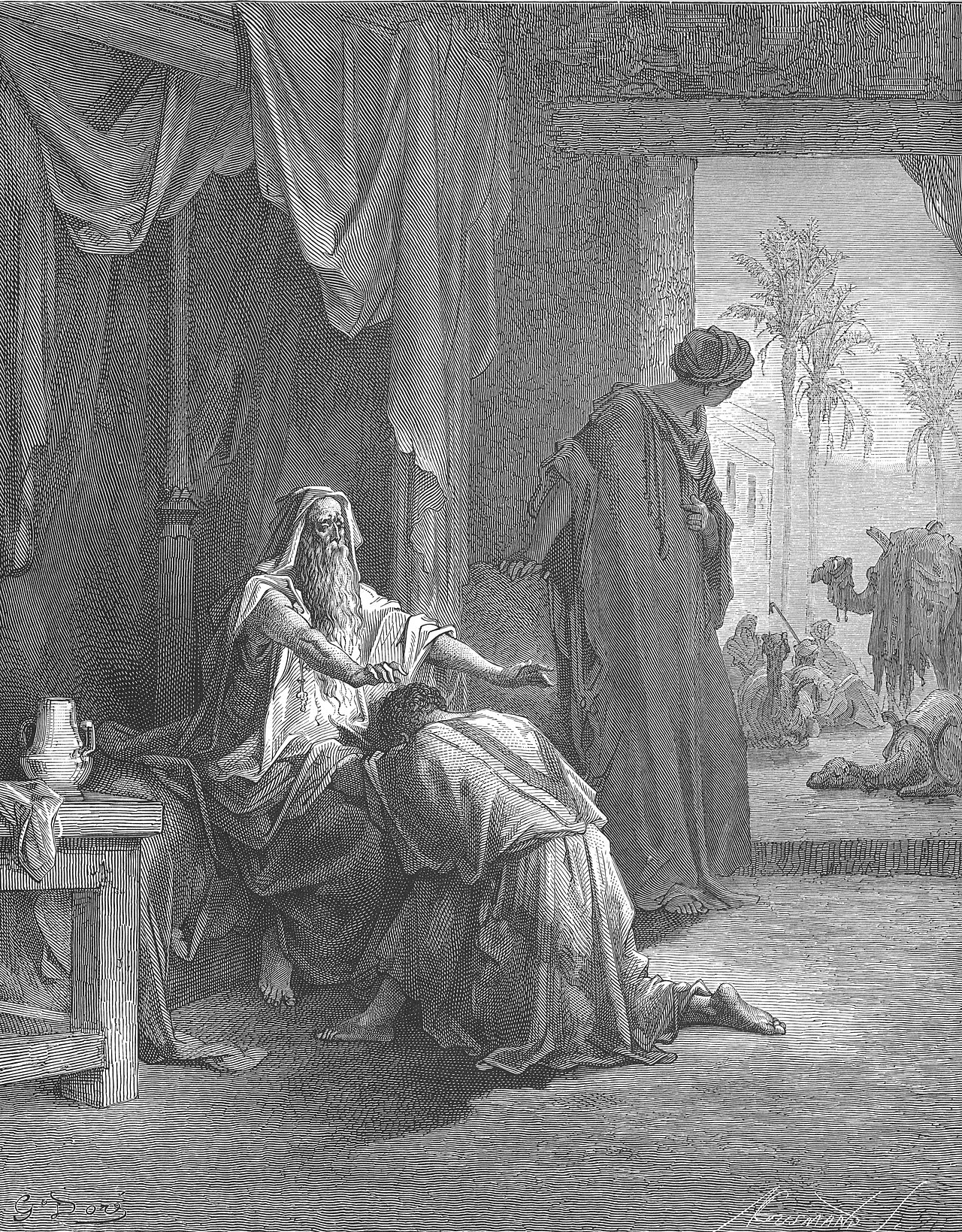
José de Ribera, Jacob Receives Isaac's Blessing (1637) — Public domain, via Wikimedia Commons
Summary
This page follows one election word across four stations: the oracle spoken over Jacob and Esau before birth, Obadiah's outworking centuries later, Malachi's retrospective, and Paul's use of it all in Romans 9.
- The oracle in Genesis 25:23 comes before either twin had done anything good or bad, and the twins' own choices, the sold birthright and the stolen blessing, play it out.
- Esau's red birth and red stew tie him to the name Edom, a thread that runs forward to Herod's Idumean ancestry at Jesus's birth.
- Obadiah and Malachi read the same election nationally, Edom judged and Israel preserved, not as a verdict on either man's soul.
- The hard question, what 'hated' means in Romans 9:13, is held at full strength between the comparative-national reading and the Reformed individual-election reading.
The Thread
one election, spoken once, enacted, remembered, and theologized, in canonical order
- IGenesis 25:23before either twin had done anything
“Two nations are in your womb, and two peoples from within you will be separated; one people will be stronger than the other, and the older will serve the younger.”
The oracle comes to Rebekah while Jacob and Esau are still wrestling inside her, before birth, before either has done anything good or bad (Paul's own gloss, Rom 9:11). The choosing is announced first; everything that follows works it out in ordinary, unpretty human history.
“God is a free agent in dispensing his grace; it is his prerogative to make a difference between those who have not as yet themselves done either good or evil. This the apostle infers hence, Rom. ix.”
Matthew Henry, Commentary on the Whole Bible (1710), on Genesis 25:23 — public domain, quoted verbatim.
Between I and II: the twins' own story enacts the oracle
The birthright, sold for stewGenesis 25:29–34“And Esau said, Behold, I am about to die: and what profit shall the birthright do to me?” … So Esau despised his birthright.
The blessing, taken by deceptionGenesis 27:36“Is not he rightly named Jacob? for he hath supplanted me these two times: he took away my birthright; and, behold, now he hath taken away my blessing.”
The oracle names no villain and no hero. It names an outcome. What follows is two ordinary men making ordinary, self-interested choices: one who traded a birthright for a bowl of stew, one who took a blessing by deceiving his blind father. Genesis does not flatter Jacob to make the election look earned.
- IIObadiah 1:10the outworking, centuries downstream
“Because of the violence against your brother Jacob, you will be covered with shame and cut off forever.”
Obadiah dramatizes the oracle rather than discussing it: Edom (Esau's nation) betrays Judah (Jacob's) at Jerusalem's darkest hour, and the LORD answers with total judgment: “no survivor will remain from the house of Esau” (Obad 1:18). This is Genesis 25:23 running its course in real geopolitics, not a doctrine yet, just a brother's treachery and its cost. But the book does not stop at Edom's ruin. Its last verse turns the whole thing toward a kingdom: “The deliverers will ascend Mount Zion to rule over the mountains of Esau. And the kingdom will belong to the LORD” (Obad 1:21). The oracle that began by ranking two brothers ends by dissolving the ranking, the mountain in question is judged, and the throne over it belongs to neither twin.
- IIIMalachi 1:2–3the canon's own retrospective
“I have loved you, says the LORD. But you ask, How have You loved us? Was not Esau Jacob's brother? declares the LORD. Yet Jacob I have loved, but Esau I have hated, and I have made his mountains a wasteland and left his inheritance to the desert jackals.”
Centuries after Obadiah, Malachi answers a doubting post-exilic Israel not with a feeling but with the record: Jacob preserved, Edom desolated. God does not defend His love by asserting it. He points at history and lets it testify (Mal 1:4–5 continues: Edom may vow to rebuild, but “They may build, but I will demolish”).
- IVRomans 9:11–13Paul's use: election apart from works
“for the children being not yet born, neither having done anything good or bad, that the purpose of God according to election might stand, not of works, but of him that calleth… it was said unto her, The elder shall serve the younger. Even as it is written, Jacob I loved, but Esau I hated.”
Paul reaches back past Malachi to Genesis itself, using both the original oracle and Malachi's retrospective as one continuous witness. His conclusion: “it is not of him that willeth, nor of him that runneth, but of God that hath mercy” (Rom 9:16). Whatever else the thread means, it was never a reward for merit; none had been earned yet.
The Red Man and the Red Nation
Esau's name-thread, and where Edom's line finally meets Jacob's Messiah
Genesis does not let Esau's story rest on the oracle alone. It ties him to a colour and then never unties him. He is born red — “And the first came forth red, all over like a hairy garment; and they called his name Esau” (Gen 25:25). He sells the birthright for something red — “Feed me, I pray thee, with that same red pottage; for I am faint: therefore was his name called Edom” (Gen 25:30). And the nickname sticks hard enough to become a nation: “Esau is Edom” (Gen 36:8). Edom means red. The man who traded a covenant future for a bowl of red stew was named after the stew, and his descendants carried the name of that trade for a thousand years.
Where the thread lands in the New Testament
Follow that name forward and it does not simply fade out of the story. Edom became, in Greek, Idumaea — and the king sitting in Jerusalem when the Messiah of Jacob's line was born was an Idumean. Herod the Great's Idumean descent is on the historical record (Josephus), which means the ruler who “sent forth, and slew all the male children that were in Bethlehem” (Matt 2:16) was, by ancestry, Esau's line reaching for the throat of Jacob's promised seed one last time. The oracle spoken over two unborn twins is still running in Matthew 2. This is a historical observation about lineage, not a claim that Herod stood under Genesis 25:23 personally — but it is the reason the elder-and-younger thread does not feel finished until the child it was aimed at survives the night.
The Hard Question
what does “hated” mean, and what does Romans 9 do with it?
Comparative / covenantal reading
“Jacob I loved, but Esau I hated” is national and historical, not a verdict on either man's eternal soul — the Hebrew idiom carries relative-preference force (“loved less,” cf. Luke 14:26's “hate” his own family) and Malachi 1:2–5 makes the referent explicit: nations, covenant roles, Edom's desolation against Israel's preservation. Wesley rules the eternal-destiny reading out flatly in his note on 9:13: “Nor does it relate to the eternal state either of them or their posterity. Thus far the apostle has been proving his proposition, namely, that the exclusion of a great part of the seed of Abraham, yea, and of Isaac, from the special promises of God, was so far from being impossible, that, according to the scriptures themselves, it had actually happened.” The exclusion in view, on this reading, is exclusion from a covenant promise — a line drawn through Abraham's own descendants in history — not a sentence passed on souls. (Wesley, Explanatory Notes upon the Bible (1765), on Romans 9:13 — public domain, quoted verbatim.)
Reformed: unconditional individual election
Paul's own argument moves from the twins to the individual will and back to the potter's “right over the clay” (Rom 9:20–21), a scope too large, on this reading, to stop at nations. R. C. Sproul, Chosen by God (1986): “If there is one single molecule in this universe running around loose, totally free of God's sovereignty, then we have no guarantee that a single promise of God will ever be fulfilled”. Piper and Spurgeon read “foreknew” (8:29) as electing love, not foreseen faith, on the same logic.
A synthesis some traditions hold: Within the Wesleyan-Arminian confessional stream, God's electing grace is real and sovereign — the purpose according to election precedes either twin's birth (9:11) — and it is exercised through, not against, genuine human responsibility and faith. Malachi's own use of the Jacob/Esau material is explicitly national (Edom versus Israel, history as the proof), which is real evidence the primary referent is corporate and covenantal, but Paul's individual-scope language in 9:16–23 is real too, and both stand. The fuller case for both readings, and for how election and human responsibility hold together across Romans 9–11 (the remnant, the olive tree, "all Israel shall be saved"), belongs on its own page.
The Words the Thread Rests On
two Hebrew verbs, echoed in Paul's Greek, and the word for the choosing itself
Paul's Greek in Romans 9:13 renders Malachi's Hebrew word-for-word (agapaō for ahav, miseō for sane), which is why the same "hard question" about the force of "hated" reappears identically in both testaments rather than being a translation artifact.
Keep studying
Read it1
On this page
By subject
The patriarchs7 pages