
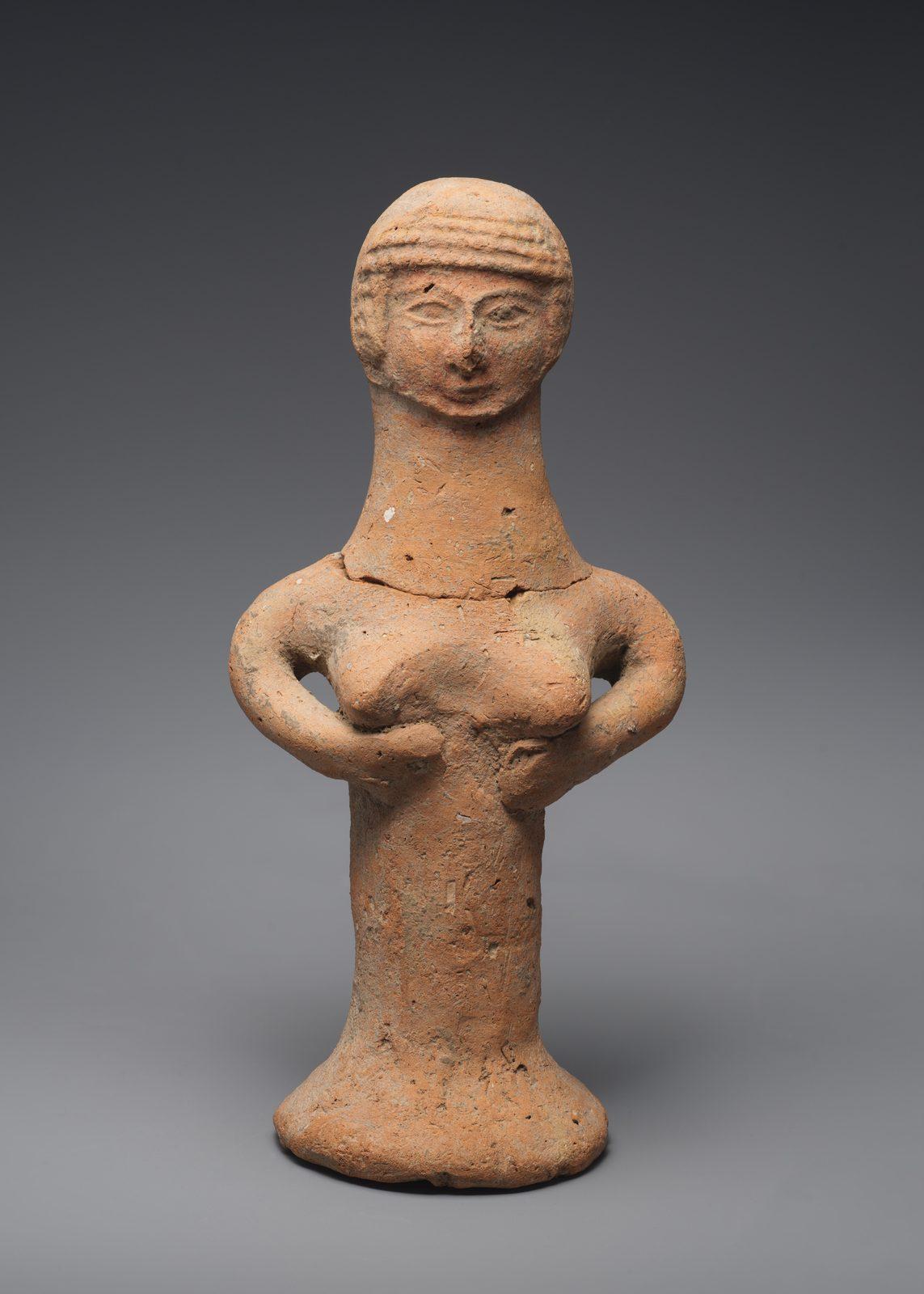
Unknown potter of Judah, Judean pillar figurine, about 800 to 600 BC. Public domain.
Jeremiah 7 and 44 · Subject · Featured Study
The Queen of Heaven
Jeremiah 7 and 44 tell how the people of Judah served the Queen of Heaven, first in Jerusalem and then in Egypt.
Jeremiah was told not to pray for the people who baked cakes for the Queen of Heaven.
Instead, we will do everything we vowed to do: We will burn incense to the Queen of Heaven and offer drink offerings to her, just as we, our fathers, our kings, and our officials did in the cities of Judah and in the streets of Jerusalem. At that time we had plenty of food and good things, and we saw no disaster.
Instead, we will do everything we vowed to do: We will burn incense to the Queen of Heaven and offer drink offerings to her, just as we, our fathers, our kings, and our officials did in the cities of Judah and in the streets of Jerusalem. At that time we had plenty of food and good things, and we saw no disaster.
- Book
- Jeremiah
- Hold in memory
- Jeremiah 44:23
Summary
Jeremiah names a goddess called the Queen of Heaven. Families baked cakes for her, burned incense to her and poured out drink offerings.
- Her name stands in five verses of the Berean text, all of them in Jeremiah.
- Commentators disagree about which goddess she was.
- An Aramaic letter found in Egypt greets a temple named for her.
Cakes for the Queen of Heaven
Jeremiah 7:18 shows a whole family at work for her in the streets of Jerusalem.
The sons gather wood, the fathers light the fire, and the women knead the dough to make cakes for the Queen of Heaven; they pour out drink offerings to other gods to provoke Me to anger.Jerusalem and Egypt
The book shows the worship twice, before the fall of Jerusalem and after it.
The same offerings moved from the streets of Jerusalem to the Jews living in Egypt.
| The question | Jeremiah 7, in Jerusalem | Jeremiah 44, in Egypt |
|---|---|---|
| Where | The cities of Judah and the streets of Jerusalem | The land of Egypt and Pathros |
| Who serves her | Sons, fathers and women | Men and women stand together in a great assembly |
| What they give her | Cakes, and drink offerings to other gods | Incense, drink offerings, and cakes in her image |
| The LORD's word | Jeremiah is not to pray for them | Go ahead and do what you have promised |
The People's Claim and Jeremiah's Answer
In Egypt the people gave four reasons to keep serving her, and Jeremiah answered each one.
Each claim of the people in Jeremiah 44:17 to 19 meets an answer in Jeremiah 44:21 to 25.
| The people's claim | Jeremiah's answer |
|---|---|
| We will keep our vows to her. | The LORD remembered the incense of your fathers and your kings. |
| Life went well while we served her. | The LORD could no longer endure your deeds, and the land is a desolation. |
| Since we stopped, we have lacked everything. | This disaster came because you burned incense and did not obey. |
| Our husbands knew of the cakes we made. | You and your wives have done what you said. |
Since We Stopped
The people dated their troubles from the day the offerings stopped.
Albert Barnes, in his Notes on Jeremiah 44:18, held that Josiah had put down this worship and that many people resented it.
He thought Jehoiakim allowed it again and Zedekiah forbade it, so that the people blamed the fall of Jerusalem on the goddess they had neglected.
Josiah also did away with the idolatrous priests ordained by the kings of Judah to burn incense on the high places of the cities of Judah and in the places all around Jerusalem—those who had burned incense to Baal, to the sun and moon, to the constellations, and to all the host of heaven.Josiah's Revival: the reform of 2 Kings 23
Gedaliah and the Remnant in Egypt: how the Jews came to Egypt
Queen or Work, and the Cakes
The Hebrew word for queen has been read two ways, and the word for the cakes is rare.
Adam Clarke gave the Hebrew word for queen here as melecheth (מלכת). The Masoretic vowels are the marks Jewish scribes later added to the Hebrew letters. The Cambridge Bible notes that they give the word as work, apparently to avoid the sense of queen.
John Calvin reported readers who took the word as the works of heaven, and he kept the reading Queen. The Pulpit Commentary says the context requires a person.
The Septuagint is the ancient Greek translation of the Old Testament. The same Cambridge note records that it has the host of heaven in Jeremiah 7 and the queen of heaven in Jeremiah 44.
The Pulpit Commentary calls the word for the cakes, kavvanim, peculiar. Keil and Delitzsch say the word came in with the foreign worship, and the Greek translators carried it over as chauonas.
Clay Figures from the Houses of Judah
Clay figures of women are common finds in the houses of Judah of the 8th and 7th centuries BC.
Archaeologists call them Judean pillar figurines. The figurine in the picture above is held by the Metropolitan Museum of Art.
Erin Darby, in Archaeology and History of Eighth-century Judah (2018), records that most scholars have taken them as the goddess Asherah, and she proposes other identifications.
Ryan Byrne, in Near Eastern Archaeology (2004), suggests they were taken up to encourage childbearing as the Assyrian threat of exile grew.
Origen and Matthew Henry
Origen cited Jeremiah 7 against Celsus, and Matthew Henry wrote on the people's claim in Jeremiah 44:18.
Origen of Alexandria (died 253)
“You will find at least in the book of Jeremiah the words of God censuring by the mouth of the prophet the Jewish people for doing obeisance to such objects and for sacrificing to the queen of heaven and to all the host of heaven. The writings of the Christians, moreover, show, in censuring the sins committed among the Jews, that when God abandoned that people on account of certain sins, these sins of idol worship also were committed by them.”
Origen of Alexandria · Against Celsus 5:8 · on Jeremiah 7:17 to 18Patristic
Matthew Henry (1662 to 1714)
“Since we forsook our idolatries we have wanted all things, and have been consumed by the sword, the true reason of which was because they still retained their idols in their heart and an affection to their old sins; but they would have it thought that it was because they had forsaken the acts of sin.”
Matthew Henry · Commentary on the Whole Bible · on Jeremiah 44:18Puritan
Who Was the Queen of Heaven?
The text gives her title and her offerings, and the commentators name different goddesses behind them.
Eight commentators give five readings of the title.
| Reading | Held by |
|---|---|
| The moon | |
| The moon, worshipped as a goddess and akin to Astarte | Keil and Delitzsch, in their note on the cakes for the queen |
| The moon, as the sun was the king of heaven | John Wesley and John Gill, in their notes on the same verse |
| The moon, with cakes shaped as a crescent | Albert Barnes, in his notes on the cakes and on the women's answer |
| A named goddess | |
| The planet Venus, the Ishtar of Babylon | The Cambridge Bible, in its note on Jeremiah 7 |
| Astarte, also called Ashtaroth | Jamieson, Fausset and Brown, in their note on Jeremiah 44 |
| Ishtar or Beltis, or the Egyptian Neith, left open | The Pulpit Commentary, in its note on Jeremiah 7 |
| The stars | |
| The whole host of heaven | John Calvin, on Jeremiah 44, after he leaned to the moon on Jeremiah 7 |
Astarte, also called Ashtaroth, Ishtar or Beltis, or the Egyptian Neith, left open, The stars, The whole host of heaven
Outside the Bible, an Aramaic letter found at Hermopolis in Egypt in 1945 greets two temples. They are the Temple of Bethel and the Temple of the Queen of Heaven. E. Bresciani and M. Kamil published them in 1966, in Le lettere aramaiche di Hermopoli.
Books to Read Next
Two older commentaries discuss the Queen of Heaven verse by verse.
Biblical Commentary on the Old Testament: Jeremiah
Carl Friedrich Keil and Franz Delitzsch · 1857 to 1878
It weighs the Hebrew word and the people's argument in Jeremiah 44.
Read it free at BibleHubNotes, Explanatory and Practical, on the Old and New Testaments
Albert Barnes · 1832 to 1869
Barnes comments on Jeremiah 7 and 44.
Read it free at BibleHubThey Spite Themselves
Jeremiah 7:19 gives the LORD's own verdict on the worship.
The people credited the goddess with their years of plenty. The LORD answered that the harm fell on the worshippers themselves.
But am I the One they are provoking? declares the LORD. Is it not themselves they spite, to their own shame?Sources
Scripture is the Berean Standard Bible.
- Carl Friedrich Keil and Franz Delitzsch, Biblical Commentary on the Old Testament (1857 to 1878), on Jeremiah 7:18 and 44:18 to 23; public domain.
- The Cambridge Bible for Schools and Colleges, on Jeremiah 7:18 and 44:18 to 22; public domain.
- The Pulpit Commentary, its note on the cakes and the goddess at Jeremiah 7:18; public domain.
- John Calvin, his commentary on Jeremiah 7:18 and 44:17; public domain.
- John Gill, Exposition of the Old Testament (1748 to 1763), where he reads the queen as the moon.
- Albert Barnes, Notes, Explanatory and Practical (1832 to 1869), on Jeremiah 7:18, 44:18 and 44:19.
- John Wesley, Explanatory Notes upon the Old Testament (1765), on Jeremiah 7:18.
- Jamieson, Fausset and Brown, Commentary Critical and Explanatory on the Whole Bible (1871), on Jeremiah 44:17.
- Adam Clarke, Commentary on the Bible (1832), on Jeremiah 44:19.
- Origen, Against Celsus 5:8.
- Matthew Henry, Commentary on the Whole Bible (1710), on Jeremiah 44:18.
- The Hermopolis Aramaic letters, letter Bresciani-Kamil 4 (TAD A2.1), in the translation of Porten and Yardeni; first published by E. Bresciani and M. Kamil, Le lettere aramaiche di Hermopoli (1966)
- E. Darby, Judean Pillar Figurines (JPFs), in Z. I. Farber and J. L. Wright, eds., Archaeology and History of Eighth-century Judah (SBL Press, 2018), pp. 405 to 410, cite-only.
- R. Byrne, Lie Back and Think of Judah: The Reproductive Politics of Pillar Figurines, Near Eastern Archaeology 67:3 (2004), cite-only.
Keep Studying
Doctrines1
Church history1
People and groups3