
Genesis 18 to 3 John · Subject · Featured Study
Hospitality in Israel and the Early Church
How the law of Moses, the sending of the disciples and the letters of the apostles made the welcome of strangers a duty, and how the first churches lodged their travelling teachers.
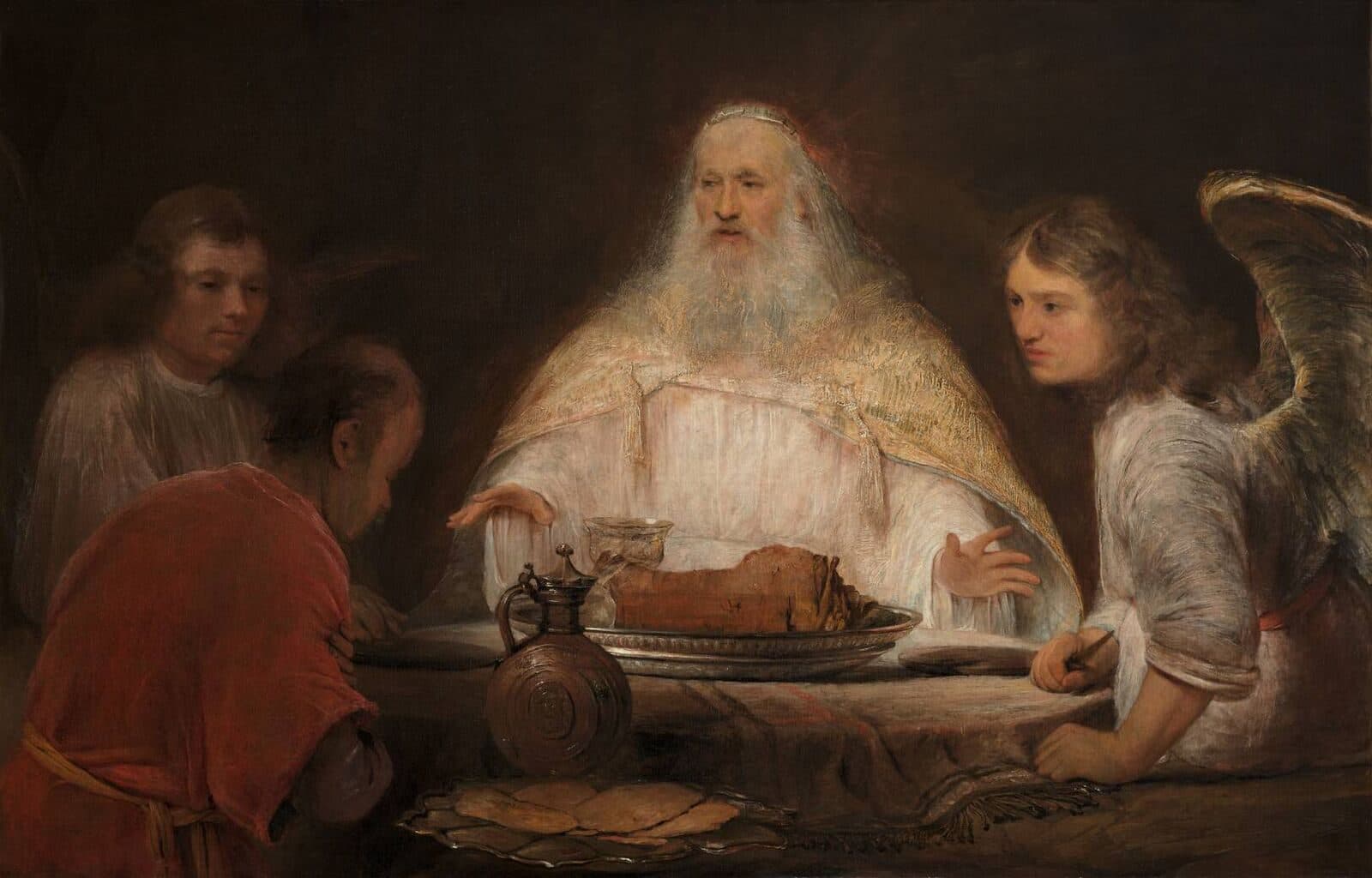
Aert de Gelder, Abraham Entertaining the Three Angels, 1680s, Museum Boijmans Van Beuningen, Rotterdam. Public domain, via Wikimedia Commons.
THE ARTWORKDe Gelder painted the meal of Genesis 18 by candle-dark light. A white-bearded figure in a pale robe sits at the centre with open hands, a winged angel leans on the table at the right, and a young man stands behind at the left. In front, the host in a red robe bows over the table, and a roast on a dish, a jug and flat loaves wait between them.
Abraham ran from his tent in the heat of the day to bring three strangers water and bread.
Summary
Hospitality is the welcome of a stranger or a guest into one's home. Scripture makes it a duty for Israel and for the church.
- The law tells Israel to love the foreigner, because Israel had been a foreigner in Egypt.
- Abraham, Lot, Rahab, Lydia and Gaius are among the hosts Scripture names.
- Paul and Peter command hospitality, and an overseer must be hospitable.
- John praises Gaius for receiving travelling teachers and rebukes Diotrephes for refusing them.
- Lucian and the emperor Julian, who did not share the faith, both wrote about Christian care for strangers.
The Command to Receive the Stranger
Seven passages, from the law of Moses to the letters of Paul and Peter, set out the duty and one man's keeping of it.
When a foreigner resides with you in your land, you must not oppress him. You must treat the foreigner living among you as native-born and love him as yourself, for you were foreigners in the land of Egypt. I am the LORD your God.At Sinai, among the laws that open with the call to be holy.
He executes justice for the fatherless and widow, and He loves the foreigner, giving him food and clothing. So you also must love the foreigner, since you yourselves were foreigners in the land of Egypt.Moses gives this charge east of the Jordan, in the land of Moab.
but no stranger had to lodge on the street, for my door has been open to the traveler—Job counts his open door to the traveller among the proofs of his integrity.
Whatever house you enter, begin by saying, ‘Peace to this house.’ If a man of peace is there, your peace will rest on him; if not, it will return to you. Stay at the same house, eating and drinking whatever you are offered. For the worker is worthy of his wages. Do not move around from house to house.Jesus gives this charge to the seventy-two he sends ahead of him two by two.
Share with the saints who are in need. Practice hospitality.Paul lists it among the marks of sincere love in Romans 12.
Show hospitality to one another without complaining.Peter writes to exiles scattered through Pontus, Galatia, Cappadocia, Asia and Bithynia.
An overseer, then, must be above reproach, the husband of but one wife, temperate, self-controlled, respectable, hospitable, able to teach,Paul writes to Timothy at Ephesus, and Titus 1:8 sets the same requirement for the elders of Crete.
Hosts and Guests in Scripture
Nine hosts, from Abraham's tent to Philemon's guest room.
| Host | Guest | What was given | Verse |
|---|---|---|---|
| Abraham | Three men at the oaks of Mamre | Water for their feet, bread, a calf, curds and milk | Genesis 18:2 to 8 |
| Lot | Two angels at the gate of Sodom | His house for the night and a feast | Genesis 19:1 to 3 |
| Rahab | Two spies sent by Joshua | A place to stay in Jericho | Joshua 2:1 |
| An old man of Gibeah | A Levite left in the square | Food for the donkeys, water for the feet, a meal | Judges 19:15 to 21 |
| Martha | Jesus | A welcome into her home | Luke 10:38 |
| Lydia | Paul and his companions | A stay at her house | Acts 16:15 |
| Gaius | Paul and the whole church | His house | Romans 16:23 |
| Gaius | Brothers who were strangers to him | Help on their way | 3 John 1:5 to 6 |
| Philemon | Paul, expected | A guest room made ready | Philemon 1:22 |
- Host
- Abraham
- Guest
- Three men at the oaks of Mamre
- What was given
- Water for their feet, bread, a calf, curds and milk
- Verse
- Genesis 18:2 to 8
- Host
- Lot
- Guest
- Two angels at the gate of Sodom
- What was given
- His house for the night and a feast
- Verse
- Genesis 19:1 to 3
- Host
- Rahab
- Guest
- Two spies sent by Joshua
- What was given
- A place to stay in Jericho
- Verse
- Joshua 2:1
- Guest
- A Levite left in the square
- What was given
- Food for the donkeys, water for the feet, a meal
- Verse
- Judges 19:15 to 21
- Host
- Martha
- Guest
- Jesus
- What was given
- A welcome into her home
- Verse
- Luke 10:38
- Host
- Lydia
- Guest
- Paul and his companions
- What was given
- A stay at her house
- Verse
- Acts 16:15
- Host
- Gaius
- Guest
- Paul and the whole church
- What was given
- His house
- Verse
- Romans 16:23
- Host
- Gaius
- Guest
- Brothers who were strangers to him
- What was given
- Help on their way
- Verse
- 3 John 1:5 to 6
- Host
- Philemon
- Guest
- Paul, expected
- What was given
- A guest room made ready
- Verse
- Philemon 1:22
Gaius and Diotrephes
The third letter of John sets a host beside a man who shut his door.
The elder wrote to Gaius and praised him for the help he gave the brothers, though they were strangers to him. They had gone out for the sake of the Name and accepted nothing from the Gentiles, so the elder says the church ought to support such men and so work with them for the truth.
Diotrephes, who loved to be first, refused to welcome the brothers. He forbade those who wanted to receive them and put them out of the church.
Jamieson, Fausset and Brown read the Greek of 3 John 1:7 to mean that the workers chose to take nothing from the new churches among the Gentiles.
It would have been inexpedient to have taken aught (the Greek "meden" implies, not that they got nothing, though they had desired it, but that it was of their own choice they took nothing) from the infant churches among the heathen: the case was different in receiving hospitality from Gaius.
Jamieson, Fausset & Brown · Commentary Critical and Explanatory on the Whole Bible · on 3 John 1:7Reformed
The limit of welcome in 2 John
If anyone comes to you but does not bring this teaching, do not receive him into your home or even greet him. Whoever greets such a person shares in his evil deeds.The elder tells the church to refuse a home to anyone who comes without the teaching of Christ.
John Wesley read the verse of one who comes as a teacher or a brother and advances anything contrary to that teaching.
If any came to you - Either as a teacher or a brother. And bring not this doctrine - That is, advance anything contrary to it. Receive him not into your house - As either a teacher or a brother- Neither bid him God speed - Give him no encouragement therein.
John Wesley · Explanatory Notes upon the New Testament · on 2 John 1:10Evangelical
How the Didache tested a guest
The Didache, a Christian writing kept among the early fathers, gives rules for the same case. It tells the church to receive an apostle as the Lord for one day, or two if there is need. An apostle who stays three days or asks for money is a false prophet.
A traveller passing through is helped for two or three days. One who wishes to settle must work for his food, and the Didache calls one who will not a Christ-monger.
Guests and Hosts in the Ancient World
The roads, the Jewish teachers and the outsiders who watched the church.
Adam Clarke wrote that in those early times there were scarcely any public inns, so receiving and lodging travellers was an office of charity. Jamieson, Fausset and Brown add that the precept weighed most in times of persecution.
The Mishnah keeps the teaching of Yose ben Yochanan of Jerusalem that a house should stand wide open and the poor be members of the household. The Talmud records Rav's saying that receiving guests is greater than receiving the Divine Presence, drawn from Abraham's words to his visitors in Genesis 18:3.
Clement of Rome on Abraham, Lot and Rahab
What outsiders saw
Lucian of Samosata, in The Death of Peregrine, mocked Christians as easy prey for an impostor, because they despised worldly goods and held them as common property.
The emperor Julian wrote to Arsacius, high priest of Galatia, that Christian benevolence to strangers had done most to increase their faith. He ordered hostels in every city so that strangers might profit from pagan benevolence, and called it a disgrace that the Christians supported the pagan poor as well as their own.
The Words for Hospitality
The Greek and Hebrew words behind the English hospitality, stranger and host.
PHILOXENIA (GREEK, G5381)
A noun for hospitality, used in the letters to the Romans and to the Hebrews.
PHILOXENOS (GREEK, G5382)
An adjective meaning hospitable, used of the overseer and of every believer.
XENOS (GREEK, G3581)
A stranger or foreigner, and by extension a guest or the host who receives one. Paul tells Gentile believers they are strangers no longer but members of God's household.
XENODOCHEO (GREEK, G3580)
A verb meaning to receive strangers, said of the widow the church enrolled.
GER (HEBREW, H1616)
A sojourner, a foreigner living among Israel, whom the law commands Israel to love.
Philoxenia joins the words for love and for stranger, but the New Testament uses it for the practice of receiving guests, and the lexicon gives its meaning as hospitality.
What the Text Leaves Unsaid
Three questions the text leaves open.
Scripture names no number of days a guest may stay.
The third letter of John gives no office to Gaius and names no teaching of Diotrephes.
The letter to the Hebrews names no host who entertained angels; Calvin and Adam Clarke, in their commentaries on the verse, name Abraham and Lot.
Receiving Christ in the Guest
Jesus ties the welcome of his messengers and of the stranger to the welcome of himself.
Hebrews tells the church to keep showing hospitality to strangers, because some have entertained angels without knowing it. So the church received its travelling teachers as Israel was told to receive the foreigner and as Abraham received his guests.
Truly, truly, I tell you, whoever receives the one I send receives Me, and whoever receives Me receives the One who sent Me.”Jesus says this at supper, after he has washed the disciples' feet.
For I was hungry and you gave Me something to eat, I was thirsty and you gave Me something to drink, I was a stranger and you took Me in,Jesus speaks these words on the Mount of Olives, of the day the nations are gathered before him.
An unknown guest
Jamieson, Fausset and Brown, on the same verse, say an unknown guest may be a messenger of God and, if a Christian, represents Christ himself.
To obviate the natural distrust felt of strangers, Paul says, an unknown guest may be better than he looks: he may be unexpectedly found to be as much a messenger of God for good, as the angels (whose name means messenger) are; nay more, if a Christian, he represents Christ Himself.
Jamieson, Fausset & Brown · Commentary Critical and Explanatory on the Whole Bible · on Hebrews 13:2Reformed
Voices on Hospitality
Five teachers on the verses of this subject, earliest first.
Ambrosiaster, the Latin commentator on Paul's letters, read Paul's command to practise hospitality through the examples of Abraham and Lot.
The imitator and lover of the saints will practice hospitality following the examples of Abraham and Lot as righteous men.
Ambrosiaster · Commentary on Paul's Epistles · on Romans 12:13Patristic
John Chrysostom, preaching on the letter to the Hebrews, noted that the writer says do not forget hospitality, because affliction made it easy to forget.
He did not say, "Be hospitable," as if they were not, but, "Be not forgetful of hospitality," for this was likely to happen owing to their afflictions. Therefore (he says) "some have entertained angels unawares." Seest thou how great was the honor, how great the gain! What is "unawares"? They entertained them without knowing it. Therefore the reward also was great, because he entertained them, not knowing that they were Angels. For if he had known it, it would have been nothing wonderful. Some say that he here alludes to Lot also.
John Chrysostom · Homily on Hebrews 33 · on Hebrews 13:2Patristic
Gregory the Great read 3 John 1:8 to mean that one who supplies a travelling worker shares in his spiritual work.
Hence it is said to Gaius through John concerning certain traveling brothers: "For they went forth for the name of Christ, taking nothing from the Gentiles. We therefore ought to receive such persons, that we may be fellow workers for the truth." For he who provides temporal assistance to those who have spiritual gifts becomes a fellow worker in those very spiritual gifts.
Gregory the Dialogist · 40 Homilies on the Gospels, Homily 20 · on 3 John 1:8Patristic
John Calvin, on Genesis 18, held that Abraham received the angels as men so that his charity could be proved.
And this was done designedly, in order that he, receiving them as men, might give proof of his charity. For angels do not need those services of ours, which are the true evidences of charity. Moreover, hospitality holds the chief place among these services; because it is no common virtue to assist strangers, from whom there is no hope of reward.
John Calvin · Commentaries · on Genesis 18:2Reformed
John Wesley, on Paul's words in Romans 12, told believers to pursue hospitality and seek chances to show it, beyond receiving those who come. On 3 John 1:6 he took the sending forward of the brothers to mean supplying them with what they need.
Who have testified of thy love before the church - The congregation with whom I now reside. Whom if thou send forward on their journey - Supplied with what is needful.
John Wesley · Explanatory Notes upon the New Testament · on 3 John 1:6Evangelical
Which Gaius?
Two readings of the name in Romans 16 and 3 John, each with its holders.
Scripture names a Gaius of Macedonia, a Gaius of Derbe, a Gaius whom Paul baptized at Corinth, the host of Romans 16:23 and the Gaius of 3 John.
One Gaius, host of the church
Ambrosiaster, on Romans 16:23, takes Paul's host to be the same Gaius to whom John wrote, praised for meeting the brothers' needs.
Thomas Aquinas, in his Commentary on Romans, names Paul's host as the Gaius of John's third letter, and the whole church as those who met in his house.
Several men named Gaius
Adam Clarke notes that Gaius was a very common name among the Romans.
A. R. Fausset, introducing 2 and 3 John in the commentary of Jamieson, Fausset and Brown, writes that it is hard to decide which Gaius John addressed. He records John Mill's view that it was Gaius, bishop of Pergamum.
Reading Further
Six older works on hospitality, each free to read.
The Didache
tr. M. B. Riddle · 1886
It is a short manual of church order, with chapters on baptism, fasting and prayer, the Eucharist and travelling teachers.
Read at New AdventThe First Epistle of Clement
Clement of Rome, tr. John Keith · 1896
It is the letter of the church at Rome to the church at Corinth.
Read at New AdventHomilies on Romans, Homily 21
John Chrysostom · 1889
The sermon on Paul's command to practise hospitality urges believers to run to meet strangers as Abraham did.
Read at New AdventCommentary on Romans
John Calvin, tr. John Owen · 1849
Calvin counts hospitality among the acts of love and owes it most to strangers far from their friends.
Read at CCELThe Death of Peregrine
Lucian of Samosata, tr. H. W. and F. G. Fowler · 1905
It is Lucian's account of Peregrinus, who called himself Proteus.
Read at Project GutenbergLetters, Letter 22 To Arsacius
The emperor Julian, tr. W. C. Wright · 1923
It belongs to the letters in which Julian urged pagan priests to imitate Christian virtues.
Read at the Internet ArchiveThe Open Door
From Abraham's tent to the house of Gaius, Scripture treats the guest as one God sends. The church opened its homes to those who went out for the name of Christ, and Christ counts the welcome as given to him.
These texts ask the reader to practise hospitality without complaining, to receive the stranger as one would receive Christ, and to support those who carry the gospel.
Keep studying
Read it4
Studies5
Peoples and groups1