
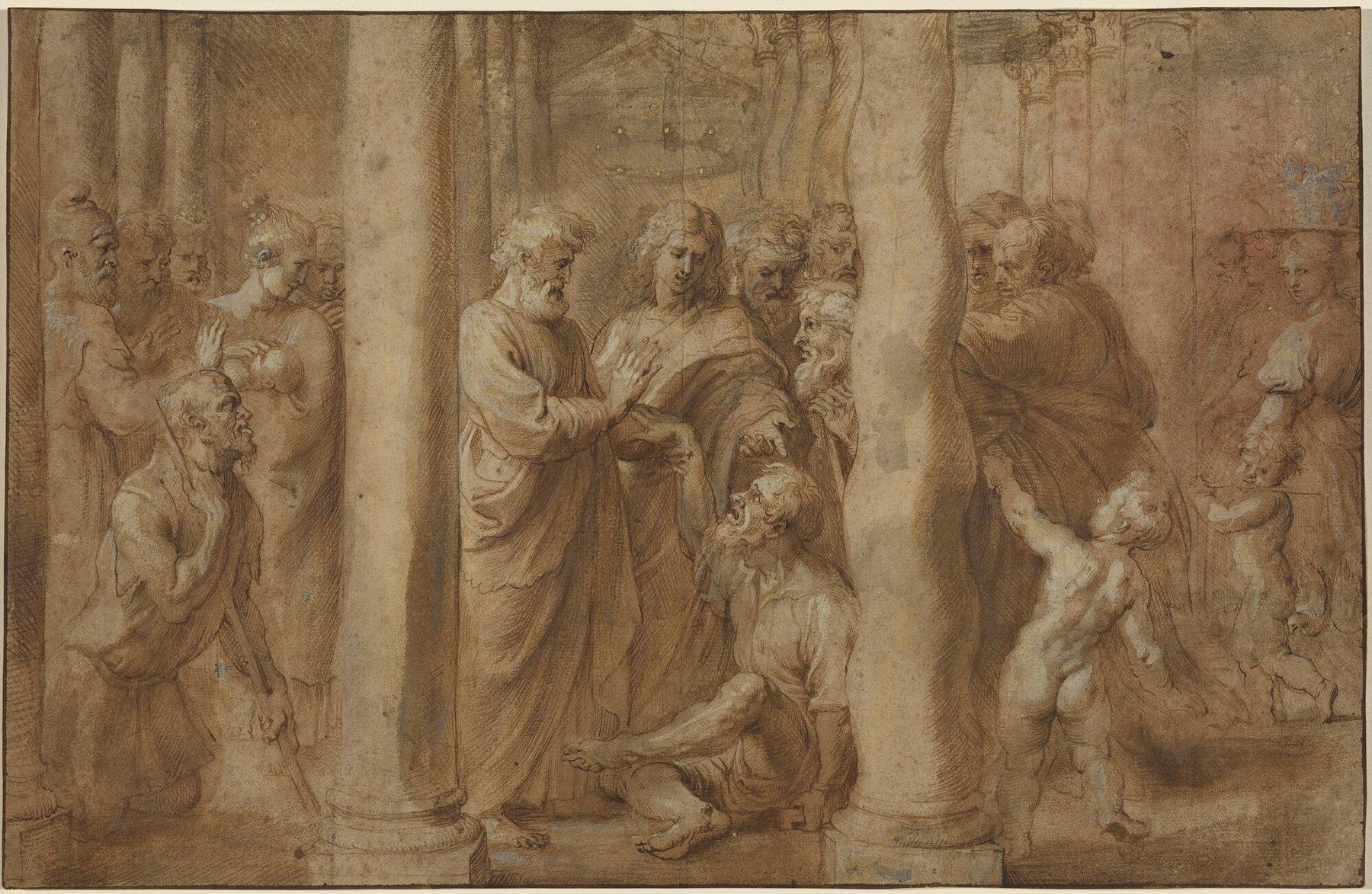
Peter Paul Rubens, over an Italian drawing after Raphael, 1606 to 1608. Public domain.
Acts 3 and 4 · Subject · Featured Study
The Name of Jesus in Acts
In Acts the apostles heal, preach, baptize and suffer in the name of Jesus.
Salvation exists in no one else, for there is no other name under heaven given to men by which we must be saved.”
Josephus wrote that God revealed His holy name to Moses, a name the historian judged it unlawful to say more about.
Summary
In Acts the name of Jesus stands for Jesus Himself and His power. Peter healed a lame man by that name and told the rulers so. The rulers then told the apostles to stop speaking in that name.
- Saul, who later suffered for the name, had once done all he could to oppose it.
- Luke records baptisms done in that name at Jerusalem, Samaria, Caesarea and Ephesus.
- Seven exorcists at Ephesus used the name without faith and were overpowered.
Three Texts on the Name
Pentecost, the healed man and the flogging give the name its weight in Acts.
Each of these verses ties a different act to the name.
And everyone who calls on the name of the Lord will be saved.’Peter quotes Joel at Pentecost and then shows that the Lord to call on is Jesus.
By faith in the name of Jesus, this man whom you see and know has been made strong. It is Jesus’ name and the faith that comes through Him that has given him this complete healing in your presence.Peter turns the crowd's eyes from himself to Jesus.
The apostles left the Sanhedrin, rejoicing that they had been counted worthy of suffering disgrace for the Name.Luke calls the cause of the apostles' suffering simply the Name.
What Was Done in the Name
Luke ties the name to six kinds of act, from Jerusalem to Ephesus.
In Acts the name goes with every part of the church's work, and with its suffering.
| Where | Who | What was done in the name |
|---|---|---|
| Baptized in the name | ||
| Jerusalem | Peter | Peter tells the crowd to repent and be baptized |
| Samaria | Philip's converts | The converts had been baptized into the name of the Lord Jesus |
| Caesarea | Peter | Peter orders the household of Cornelius to be baptized |
| Ephesus | Paul | About twelve disciples of John are baptized into the name |
| Healed in the name | ||
| The temple gate | Peter and John | Peter tells the lame man to get up and walk |
| Jerusalem | The believers | The church prays for healing, signs and wonders |
| Preached in the name | ||
| Damascus | Saul | Saul speaks boldly in the name of Jesus |
| Jerusalem | Saul | Saul moves about the city speaking boldly |
| Forbidden in the name | ||
| The council | The rulers | The rulers command silence in the name |
| The council | The high priest | The high priest says the apostles filled Jerusalem with the teaching |
| The council | The council | The apostles are flogged and ordered to be silent |
| Suffered for the name | ||
| Damascus | The Lord | The Lord says Saul must suffer for His name |
| Jerusalem | The apostles and elders | The council's letter says Barnabas and Paul risked their lives |
| Caesarea | Paul | Paul is ready to die in Jerusalem for the name |
| Spirits commanded in the name | ||
| Philippi | Paul | Paul commands the spirit to come out of a slave girl |
| Ephesus | The sons of Sceva | Jewish exorcists try the name without faith |
The temple gate, Jerusalem, Preached in the name, Damascus, Forbidden in the name, The council, Suffered for the name, Caesarea and 3 more
By What Power or What Name
Teachers have read the answer as Peter's refusal of any credit for himself.
The rulers arrested Peter and John after the healing and asked them by what power they had done it.
then let this be known to all of you and to all the people of Israel: It is by the name of Jesus Christ of Nazareth, whom you crucified but whom God raised from the dead, that this man stands before you healed.Peter names the crucified and risen Jesus as the power, before the men who condemned Him.
Calvin read Peter as calling himself only a servant, with Christ the author of the miracle. John Chrysostom noted that the apostles said the man was healed in the name, and that it was in Jesus Himself that the man believed.
What a Name Meant to a Jewish Hearer
A Jew of Peter's day heard in the name the person and authority of the one named.
The name of the LORD is a strong tower; the righteous run to it and are safe.The proverb treats the Lord's name as the Lord Himself, a refuge to run to.
Philo of Alexandria wrote that the gold plate on the high priest's turban bore a name of four letters. He said only holy men with purified ears and tongues might speak or hear it.
John Calvin wrote that in Acts the name means power and rule. He warned that no magic lies in the sound of the word.
Adolf Deissmann printed a later book of pagan spells that adjures a demon by Jesus. He judged that a pagan had put the name there, and he called it a usurpation of the name of Jesus.
The Voices
Matthew Henry on the healed man and on Peter's words to the council.
Matthew Henry (1662 to 1714)
Matthew Henry drew from the healing a lesson about how sinners are justified.
“It explains likewise the great gospel mystery of our salvation by Christ; it is his name that justifies us, that glorious name of his, The Lord our righteousness; but we, in particular, are justified by that name, through faith in it, applying it to ourselves.”
Matthew Henry · Commentary on the Whole Bible · on Acts 3:16Puritan
On Acts 4:12 Henry left one question open.
“It is given among men, who need salvation, men who are ready to perish. We may be saved by his name, that name of his, The Lord our righteousness; and we cannot be saved by any other. How far those may find favour with God who have not the knowledge of Christ, nor any actual faith in him, yet live up to the light they have, it is not our business to determine.”
Matthew Henry · Commentary on the Whole Bible · on Acts 4:12Puritan
Where Readers Differ
Two questions about the name in Acts, with the writers who answer them.
Did the apostles baptize with other words than Matthew 28:19?4 paragraphs
The Didache, a church manual of the early centuries, orders baptism into the name of the Father, the Son and the Holy Spirit. It also calls the baptized those baptized into the name of the Lord.
Cyprian of Carthage wrote that Peter named Jesus Christ without leaving out the Father, and that the Gentiles are commanded the whole Trinity. Ambrose held a baptism in the name of Christ valid where the three Persons are believed.
Thomas Aquinas held that the Trinity must now be named. He explained the apostles' practice by a special revelation for the early church. John Calvin denied that Acts 2:38 gives a form of words at all.
The United Pentecostal Church International, a Oneness body, lists water baptism in the name of Jesus Christ among the steps by which its members obey the gospel. It confesses one God revealed as Father, Son and Spirit, with Jesus Christ as God made flesh.
What does "no other name" mean for those who never heard?2 paragraphs
Calvin read Acts 4:12 as shutting out every other means of salvation, which he placed in Christ alone. John Wesley, on Acts 10:35, wrote that a person who fears God is accepted through Christ though he does not know Him.
The Second Vatican Council taught in Lumen Gentium, in 1964, that those who through no fault of their own do not know the gospel can attain salvation. It names those who seek God sincerely and try by grace to do His will.
Books to Read Next
Three works, each free to read online.
Commentary upon the Acts of the Apostles, volume 1
John Calvin, translated by Christopher Fetherstone · 1844 edition
Calvin explains what the name means at Acts 3:6 and at Acts 4:12.
Free at the Christian Classics Ethereal LibraryHomilies on the Acts of the Apostles
John Chrysostom · Nicene and Post-Nicene Fathers, 1889
Chrysostom preaches in Homilies 9 and 10 on the healing and on Peter's answer to the council.
Free at New AdventLight from the Ancient East
Adolf Deissmann · 1910
Deissmann prints the magical papyrus that borrows the name of Jesus.
Free at the Internet ArchiveWhat the Name Carried
The apostles spoke the name of Jesus as the name of the risen Lord. They acted under His authority, and they counted it an honor to suffer for Him.
Sources
Scripture is the Berean Standard Bible.
- The Holy Bible, Berean Standard Bible (read 2026)
- John Calvin, Commentary upon the Acts of the Apostles, volume 1, translated by Christopher Fetherstone, edited by Henry Beveridge (1844)
- John Chrysostom, Homilies 9, 10 and 41 on Acts, Nicene and Post-Nicene Fathers, first series, volume 11 (1889)
- The Didache, 7.1 and 9.5, Ante-Nicene Fathers, volume 7.
- Cyprian of Carthage, Epistle 72 (73) to Jubaianus, 17 and 18, Ante-Nicene Fathers, volume 5.
- Ambrose, On the Holy Spirit 1.3, Nicene and Post-Nicene Fathers, second series, volume 10.
- Thomas Aquinas, Summa Theologiae III, question 66, article 6, translated by the Fathers of the English Dominican Province (1920)
- United Pentecostal Church International, Our Beliefs.
- John Wesley, Explanatory Notes upon the New Testament (1755), on Acts 10:35.
- Second Vatican Council, Lumen Gentium 16 (21 November 1964)
- Josephus, Antiquities 2.275 to 276 [Whiston 2.12.4], translated by William Whiston.
- Philo, On the Life of Moses 2.114 to 115, translated by C. D. Yonge.
- Adolf Deissmann, Light from the Ancient East, translated by Lionel R. M. Strachan (1910)
- Matthew Henry, Commentary on the Whole Bible (1710), on Acts 3:16 and 4:12.
Keep Studying
Studies8
People and groups7
Show the next 1 title
Symbols1
Subjects1
Doctrines2