
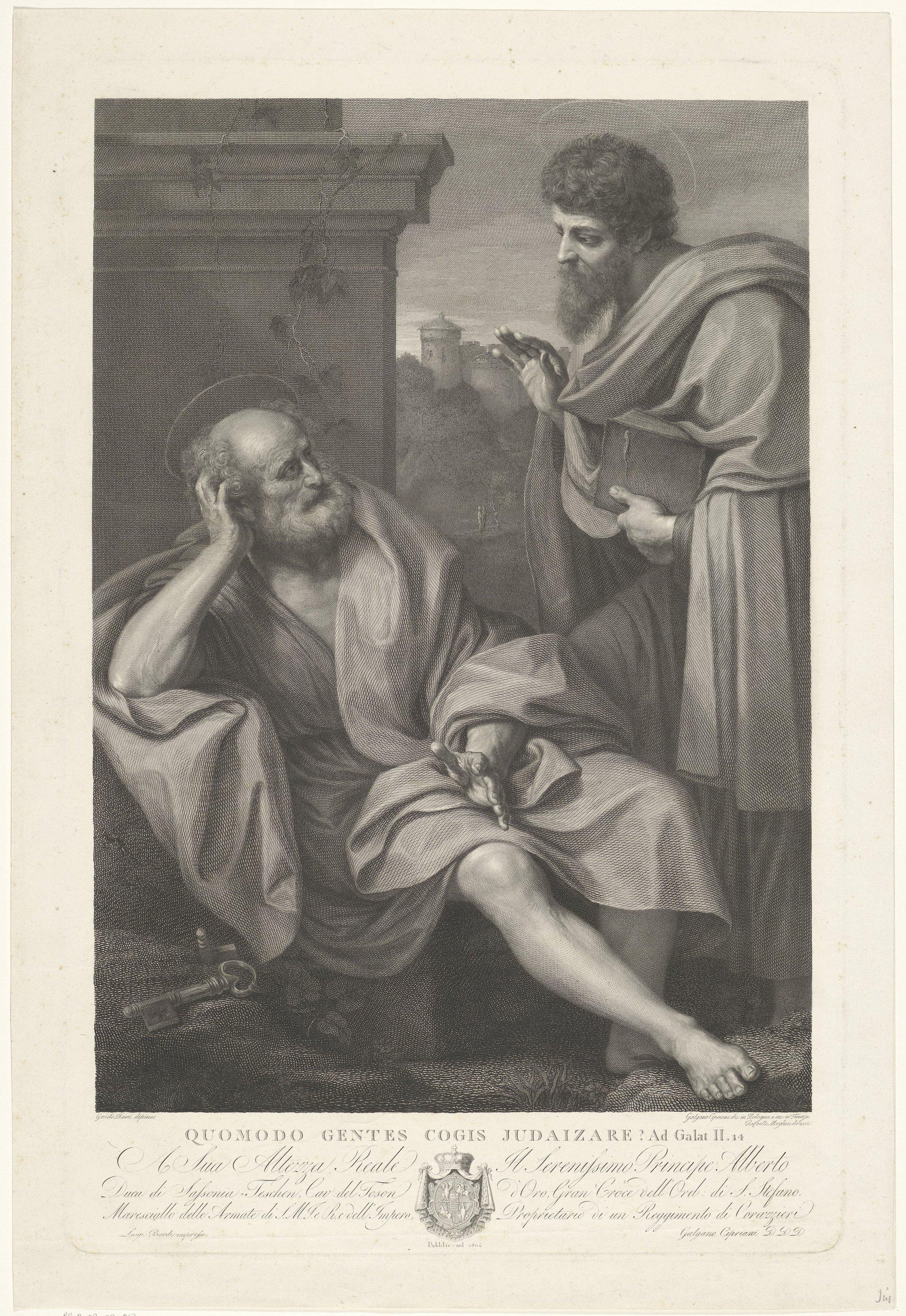
Galgano Cipriani after Guido Reni, Peter and Paul, 1804. Public domain.
Galatians, Romans and Acts 15 · Debate · Featured Study
The Law of Moses and the Christian
Christians agree that no one is justified by keeping the law of Moses, and they differ over how much of it still guides a believer.
Paul wrote that he was not under the law, and in the next verse that he was under the law of Christ.
Do we, then, nullify the law by this faith? Certainly not! Instead, we uphold the law.
Do we, then, nullify the law by this faith? Certainly not! Instead, we uphold the law.
- The question
- Is a Christian bound to keep the law God gave Israel through Moses, and if in part, which part?
Summary
In Acts 15 the apostles gave Gentile believers four things to avoid. They laid no other burden on them.
- The Westminster Confession splits the law into three parts.
- Thomas Aquinas held that the ceremonies pointed to Christ and “had need to cease” when He came.
- Jamieson, Fausset and Brown read the four things as rules the Gentiles kept to spare the feelings of the Jews.
The Texts Every Reading Answers
Jesus and Paul both spoke of the law's fulfillment and of its end.
The law of Moses is the body of commands God gave Israel through Moses.
Do not think that I have come to abolish the Law or the Prophets. I have not come to abolish them, but to fulfill them.Every reading must account for this saying.
For Christ is the end of the law, to bring righteousness to everyone who believes.The commentators read its word end in three ways.
To the Jews I became like a Jew, to win the Jews. To those under the law I became like one under the law (though I myself am not under the law), to win those under the law. To those without the law I became like one without the law (though I am not outside the law of God but am under the law of Christ), to win those without the law.Barnes and Gill read the law of Christ in two ways.
Four Readings
Each reading answers what has ended and what still binds the believer.
Each reading gives its own answer to two questions.
| The question | The moral law abides | Law and grace as two dispensations | The Ten Commandments, the Sabbath with them | Jewish believers may keep the law |
|---|---|---|---|---|
| What has ended? | The ceremonial laws are abrogated, and the judicial laws expired with the state of Israel. | Law as the rule of a dispensation; grace began with the death and resurrection of Christ. | None of the ten; the seventh-day Sabbath still stands. | Nothing is laid on Gentile believers; the law's institutions were given for the hardness of the people's hearts. |
| What binds the believer? | The moral law doth forever bind all, as well justified persons as others. | Accepting the Savior, with good deeds following. | All ten commandments, the fourth with them. | Christ, with the eternal and natural acts of righteousness and piety. |
Each Reading in Its Own Words
Each reading is stated in the words of those who hold it.
The moral law abides as a rule of lifeThomas Aquinas; John Calvin; the Westminster Confession; the Formula of Concord; John Wesley
Thomas Aquinas divided the precepts of the law into moral precepts, “dictated by the natural law,” ceremonial precepts of divine worship, and judicial precepts of justice among men.
He held that the Old Law is for ever as regards its moral precepts.
Calvin called the third use of the law its principal use, one that “has respect to believers in whose hearts the Spirit of God already flourishes and reigns.”
The Formula of Concord teaches that believers, though freed from the curse and coercion of the law, “are not on this account without Law.”
Preaching on Matthew 5:17, Wesley said that the moral law of the Ten Commandments “He did not take away,” while the ceremonial law the Lord came to abolish.
Law and grace as two dispensationsC. I. Scofield
Scofield's note on John 1:17 sets grace “in contrast to law, under which God demands righteousness from man, as, under grace, he gives righteousness to man.”
He wrote that “Law is connected with Moses and works; grace with Christ and faith.”
On his reading, under grace “the point of testing is no longer legal obedience as the condition of salvation, but acceptance or rejection of Christ, with good works as a fruit of salvation.”
The Ten Commandments, the Sabbath with themEllen G. White
In The Great Controversy, Ellen G. White wrote that the law of God, “being a revelation of His will, a transcript of His character, must forever endure.”
She wrote that those who studied the question could find no evidence in the Scriptures that the fourth commandment had been abolished or the Sabbath changed.
Christians also differ over which day of the week to keep.
Jewish believers may keep the lawJustin Martyr; Acts 21
In his Dialogue with Trypho, Justin was asked whether a man who believes in Christ and obeys Him, and still wishes to keep the institutions of Moses, will be saved. He answered: “In my opinion, Trypho, such an one will be saved, if he does not strive in every way to persuade other men.”
He named some Christians who would not share a table with such believers, and he said that he did not agree with them.
At the elders' request Paul purified himself along with the men they named.
When they heard this, they glorified God. Then they said to Paul, “You see, brother, how many thousands of Jews have believed, and all of them are zealous for the law.The elders speak to Paul in Jerusalem.
Take these men, purify yourself along with them, and pay their expenses so they can have their heads shaved. Then everyone will know that there is no truth to these rumors about you, but that you also live in obedience to the law.Their request follows.
What the Texts Say
The commentators read two phrases of Paul in more than one way.
The end of the law, Romans 10:41 paragraph
The Greek word for end in Romans 10:4 is telos. Ellicott's Commentary reads it as end “in the proper sense of termination or conclusion.” Jamieson, Fausset and Brown read it as the object or aim. The Pulpit Commentary lists termination, fulfilment and aim, and judges that aim best suits the line of Paul's thought.
The law of Christ, 1 Corinthians 9:211 paragraph
Albert Barnes reads Paul's words as showing that the obligation to the rites of the law had been done away. John Gill reads the law Paul is under as the moral law, from whose curse he was delivered and from whose matter he was not.
How the Question Was Argued
The apostles met over the question in Jerusalem, and the church's teachers took it up after them.
The council at JerusalemActs 15
Men from Judea taught the brothers that a Gentile who was not circumcised could not be saved.
But some believers from the party of the Pharisees stood up and declared, “The Gentiles must be circumcised and required to obey the law of Moses.”Luke names the party that pressed the demand.
Now then, why do you test God by placing on the necks of the disciples a yoke that neither we nor our fathers have been able to bear? On the contrary, we believe it is through the grace of the Lord Jesus that we are saved, just as they are.”Peter speaks at the council.
It seemed good to the Holy Spirit and to us not to burden you with anything beyond these essential requirements: You must abstain from food sacrificed to idols, from blood, from the meat of strangled animals, and from sexual immorality. You will do well to avoid these things. Farewell.The council's letter closes the dispute in Acts 15.
How the Teachers Read It
Origen, Gennadius, Theodore of Mopsuestia and John Wesley read Romans 10:4, 1 Corinthians 9:21 and 1 Timothy 1:8.
Origen of Alexandria (died 253)
COMMENTARY ON THE EPISTLE TO THE ROMANS
Origen took the word end in the sense of fulfilment.
“For Christ is the end of the law: that is, the perfection of the law and righteousness is Christ, but for those who believe. Those, however, who do not believe, since they do not have Christ, do not have the perfection of the law; and therefore neither will they be able to attain to righteousness.”
on Romans 10:4Patristic
Theodore of Mopsuestia (died 428)
Pauline Commentary from the Greek Church
Theodore of Mopsuestia read the verse as a guard against a misreading of Paul.
“Paul states, somewhat surprisingly, that he is under the law of Christ, lest anyone think that he is under the law of Moses.”
on 1 Corinthians 9:21Patristic
Gennadius of Constantinople (died 471)
PAULINE COMMENTARY FROM THE GREEK CHURCH
Gennadius of Constantinople took it in the sense of aim.
“Christ fulfilled the law's purpose by granting the righteousness which comes by faith in him to all those who accepted him.”
on Romans 10:4Patristic
John Wesley (1703 to 1791)
Explanatory Notes upon the New Testament
Wesley is among the holders of the reading that the moral law abides.
“We grant the whole Mosaic law is good, answers excellent purposes, if a man use it in a proper manner. Even the ceremonial is good, as it points to Christ; and the moral law is holy, just, and good, on its own nature; and of admirable use both to convince unbelievers, and to guide believers in all holiness.”
on 1 Timothy 1:8Evangelical
The Readings Weighed
Each reading meets an objection from Scripture or from the church's teachers.
Three of the four readings rest on a single teacher.
| Reading | Held by | Tradition | Representative work |
|---|---|---|---|
| The moral law abides | Aquinas; Calvin; the Westminster Confession; the Formula of Concord; Wesley | Roman Catholic, Reformed, Lutheran and Wesleyan | The Westminster Confession, chapter 19 |
| Law and grace as two dispensations | C. I. Scofield | Dispensational | Scofield's note on John 1:17 |
| The Ten Commandments, the Sabbath with them | Ellen G. White | Seventh-day Adventist | White, The Great Controversy, chapter 25 |
| Jewish believers may keep the law | Justin Martyr | The early church | Justin, Dialogue with Trypho, chapter 47 |
Against the third use1 quotation, 1 paragraph
Severian of Gabala took the word end in the sense of termination.
“This does not mean that Christ is a part of the law but rather that he is the beginning of a new life. The law has come to an end; it has ceased.”
Severian of Gabala · Pauline Commentary from the Greek Church · on Romans 10:4Patristic
Against the dispensations1 paragraph
The Westminster Confession, in its nineteenth chapter, holds that the uses it names “do sweetly comply with” the grace of the gospel.
Against the seventh-day reading1 quotation, 1 paragraph
Matthew Henry answers the seventh-day reading from Colossians 2:16.
“Much of the ceremonies of the law of Moses consisted in the distinction of meats and days. It appears by Rom. xiv. that there were those who were for keeping up those distinctions: but here the apostle shows that since Christ has come, and has cancelled the ceremonial law, we ought not to keep it up.”
Matthew Henry · Commentary on the Whole Bible · on Colossians 2:16Puritan
Against Justin's answer1 paragraph
Ignatius wrote to the Magnesians: “It is absurd to profess Christ Jesus, and to Judaize.”
Books to Read Next
Four of the works this question rests on are free to read.
Summa Theologiae, First Part of the Second Part, question 99
Thomas Aquinas · 1920 translation
Question 99 sets out the precepts of the Old Law.
Read at New AdventInstitutes of the Christian Religion, book 2, chapter 7
John Calvin · 1845 translation
Calvin treats the law in this chapter, here in Henry Beveridge's translation.
Read at the Christian Classics Ethereal LibraryDialogue with Trypho
Justin Martyr · 1885 translation
Chapter 47 gives Justin's answer on believers who keep the law of Moses.
Read at New AdventSermon 25, Upon Our Lord's Sermon on the Mount, Discourse 5
John Wesley · 1872 edition
Wesley preaches on Matthew 5:17 to 20 and the moral law.
Read at the Wesley Center OnlineThe Law Written on the Heart
Paul names love as the one debt a believer keeps owing.
Be indebted to no one, except to one another in love. For he who loves his neighbor has fulfilled the law. The commandments “Do not commit adultery,” “Do not murder,” “Do not steal,” “Do not covet,” and any other commandments, are summed up in this one decree: “Love your neighbor as yourself.” Love does no wrong to its neighbor. Therefore love is the fulfillment of the law.Verse 9 names four of the Ten Commandments.
Sources
Scripture is the Berean Standard Bible.
- Greek word tags for Romans 10:4.
- Thomas Aquinas, Summa Theologiae, I-II q.99 a.4 and q.103 a.3.
- The Westminster Confession of Faith, chapter 19.
- John Calvin, Institutes of the Christian Religion, 2.7.12, translated by Henry Beveridge.
- The Formula of Concord, Epitome, article 6, Of the Third Use of the Law.
- John Wesley, Sermon 25, Upon Our Lord's Sermon on the Mount, Discourse 5.
- C. I. Scofield, Scofield Reference Notes, on John 1:17.
- Ellen G. White, The Great Controversy, chapter 25, God's Law Immutable.
- Justin Martyr, Dialogue with Trypho, chapter 47.
- Ignatius of Antioch, To the Magnesians, chapters 8 to 10.
- On Romans 10:4: Ellicott's Commentary; Jamieson, Fausset and Brown; the Pulpit Commentary.
- On 1 Corinthians 9:21: Barnes' Notes; Gill's Exposition.
- On Acts 15:28: Jamieson, Fausset and Brown.
- Origen of Alexandria, Commentary on the Epistle to the Romans, on Romans 10:4.
- Gennadius of Constantinople, Pauline Commentary from the Greek Church, on Romans 10:4.
- Theodore of Mopsuestia, Pauline Commentary from the Greek Church, on 1 Corinthians 9:21.
- John Wesley, Explanatory Notes upon the New Testament, 1755, on 1 Timothy 1:8.
- Severian of Gabala, Pauline Commentary from the Greek Church, on Romans 10:4.
- Matthew Henry, Commentary on the Whole Bible, 1710, on Colossians 2:16.
Keep Studying
Studies7
People and groups4
Places2
Doctrines7