
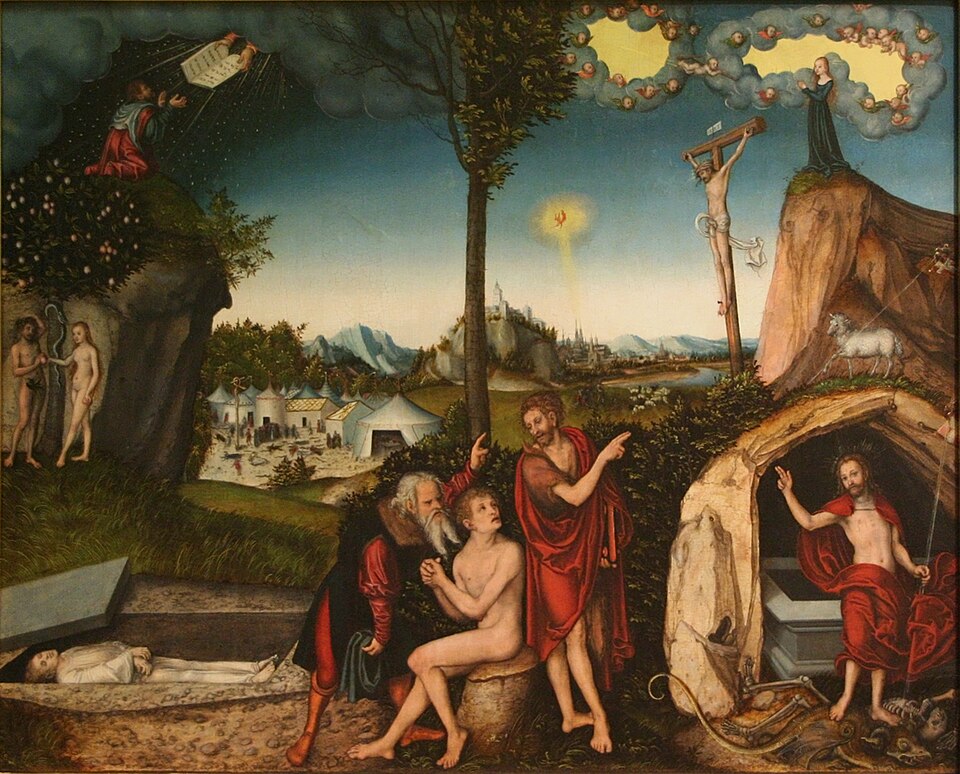
Galatians 3:19-25 · Featured Study
The Law as Tutor
If salvation was always by promise and faith, why did God give the law at all? Paul asks the question himself and answers it. The law was added for a season, with an office: a tutor to bring us unto Christ. This page walks the answer in order: added because of transgressions, till the seed should come; given through angels by the hand of a mediator; standing with the promises, never against them; a guard, a custody, and a walk to school that ends at the Teacher’s door.
Summary
Having proven that God justified Abraham by faith four centuries before Sinai, Paul answers the question his own argument raises: wherefore then the law? It was added because of transgressions, for an appointed season, till the seed should come, and its office was that of the paidagogos, the household tutor who walked the child to school, bringing us unto Christ that we might be justified by faith.
- The law was "added because of transgressions, till the seed should come": a stated purpose with a stated term (3:19)
- It came through angels, by the hand of a mediator, while the promise came from God directly (3:19-20)
- "Is the law then against the promises of God? God forbid": the two stand together, each doing its own work (3:21)
- The scripture shut up all things under sin so the promise by faith would be the one open door (3:22-23)
- The tutor's whole office was to deliver us to Christ; now that faith is come, the walk to school is over (3:24-25)
Wherefore Then the Law?
3:19: added because of transgressions, till the seed should come
“What then is the law? It was added because of transgressions, till the seed should come to whom the promise hath been made; and it was ordained through angels by the hand of a mediator.” Galatians 3:19
Paul has just argued that the covenant with Abraham came 430 years before Sinai and that the law “doth not disannul” it (3:17). The obvious objection follows: then why did God give the law at all? Paul’s answer has three parts packed into one verse. The law was added, laid alongside a promise already standing, so it was never the foundation. It was added because of transgressions, to name sin as sin and hold it in check. And it ran till the seed should come, Christ, whom Paul identified as the promised seed back in 3:16. A purpose and a term, both stated in the law’s own commissioning.
“‘Wherefore then serveth the law?’ as it is of no avail for justification, is it either useless, or contrary to the covenant of God? [CALVIN].”
Jamieson, Fausset & Brown · Commentary Critical and Explanatory on the Whole Bible, 1871Reformed
Gal 3:19
“Was added - To the promise. Because of transgressions - Probably, the yoke of the ceremonial law was inflicted as a punishment for the national sin of idolatry, Exod. xxxii, 1, at least the more grievous parts of it; and the whole of it was a prophetic type of Christ.”
John Wesley · Explanatory Notes upon the New Testament, 1755Evangelical
Gal 3:19
“The apostle adds that the law was given for this purpose till the seed should come to whom the promise was made; that is, either till Christ should come (the principle seed referred to in the promise, as he had before shown), or till the gospel dispensation should take place, when Jews and Gentiles, without distinction, should, upon believing, become the seed of Abraham.”
Matthew Henry · Commentary on the Whole Bible, 1710Presbyterian
Gal 3:19
By the Hand of a Mediator
3:19b-20: angels, Moses, and a promise God spoke alone
“Now a mediator is not a mediator of one; but God is one.” Galatians 3:20
The law reached Israel through a chain: ordained through angels (Deut 33:2 in the Greek; Acts 7:53; Heb 2:2), by the hand of a mediator, Moses, who stood between God and the people at Sinai because the people begged him to (Ex 20:19). The promise to Abraham traveled no chain at all. God spoke it himself, directly, to one man, with no second party negotiating terms. That contrast is Paul’s point: a mediated covenant depends on both parties keeping terms, and Israel’s history is the record of one party failing. The promise depends on God alone, and God is one.
“Now the mediator is not a mediator of one - There must be two parties, or there can be no mediator between them; but God who made the free promise to Abraham is only one of the parties. The other, Abraham, was not present at the time of Moses.”
John Wesley · Explanatory Notes upon the New Testament, 1755Evangelical
Gal 3:20
An honest note: 3:20 is famously hardSpurgeon, 1890
Verse 20 is one of the most debated single sentences in Paul’s letters, and this page holds Wesley’s plain reading without pretending the debate away. Spurgeon opened his own sermon on the verse by owning the difficulty:
“THE text does not strike you as difficult, but it is exceedingly perplexing to the interpreter. I was looking at one very old commentator who is a great favorite of mine and I noticed that he said that there were 250 different meanings given by expositors to this verse. John Prime, in 1587, called it, ‘an endless labyrinth.’ ‘Oh,’ I thought, ‘here is a nice wood to lose oneself in! Two hundred and fifty meanings!’ Turning to a more modern author—a great reader, however—he said he believed that more than 400 different interpretations had been put upon the passage.”
Charles Spurgeon · The Metropolitan Tabernacle Pulpit, Sermon No. 2180: “A Mediator”, 1890
Gal 3:20
Amid the many readings, the shared center holds: the law came through intermediaries and mutual obligation; the promise rests on God alone. Every major reading of the verse lands on some form of that contrast.
God Forbid
3:21-22: the law and the promises stand together
“Is the law then against the promises of God? God forbid: for if there had been a law given which could make alive, verily righteousness would have been of the law.” Galatians 3:21
“But the scripture shut up all things under sin, that the promise by faith in Jesus Christ might be given to them that believe.” Galatians 3:22
Paul hears the conclusion someone might draw from his own argument, that law and promise are enemies, and he slams the door on it with his strongest denial: God forbid. The two were given by the same God and serve the same end. The law simply holds a different office. It could command righteousness and expose its absence, and a written code can do no more; making the dead live was never in its commission. So the scripture “shut up all things under sin,” closing every exit a self-saving person might try, so that the one door left open would be the promise, received by faith in Jesus Christ.
“Is the law (which involves a mediator) against the promises of God (which are without a mediator, and rest on God alone and immediately)? God forbid.”
Jamieson, Fausset & Brown · Commentary Critical and Explanatory on the Whole Bible, 1871Reformed
Gal 3:21
“The law is by no means inconsistent with the promise, but subservient to it, as the design of it is to discover men's transgressions, and to show them the need they have of a better righteousness than that of the law.”
Matthew Henry · Commentary on the Whole Bible, 1710Presbyterian
Gal 3:21
“But, on the contrary, the scripture wherein that law is written hath concluded all under sin - Hath shut them up together, (so the word properly signifies,) as in a prison, under sentence of death, to the end that all being cut off from expecting justification by the law, the promise might be freely given to them that believe.”
John Wesley · Explanatory Notes upon the New Testament, 1755Evangelical
Gal 3:22
Kept in Ward
3:23: custody with a destination
“But before faith came, we were kept in ward under the law, shut up unto the faith which should afterwards be revealed.” Galatians 3:23
The custody language is deliberate, and so is its direction. Israel under the law was kept in ward the way a garrison keeps a city, guarded and held; but the holding was “unto the faith which should afterwards be revealed.” The confinement had a forward door. The law kept Israel distinct, kept the promise’s line intact, and kept the need for a Savior in plain sight, until the Savior came.
“THIS is a condensed history of the Jews before the Gospel was fully preached to them. Before the clear and plain revelation of the way of salvation—that is to say, before Jesus Christ, Himself, actually appeared among the sons of men—the Hebrew nation was put under the tutorship and governance of the Mosaic Law. So far as salvation was to be obtained by it, that Law was a total failure. It did not make the Jews a holy people—whenever they reached any point of excellence, they soon went back from it, for they were bent on backsliding.”
Charles Spurgeon · The Metropolitan Tabernacle Pulpit, Sermon No. 2402: “Under Arrest”, 1895Particular (Reformed) Baptist
Gal 3:23
“Came, we were kept - As in close custody. Under the law - The Mosaic dispensation. Shut up unto the faith which was to be revealed - Reserved and prepared for the gospel dispensation.”
John Wesley · Explanatory Notes upon the New Testament, 1755Evangelical
Gal 3:23
An early reader: Clement of Alexandria, c. 198The Instructor, Book 1
Within about 150 years of the letter, the passage was already being taught in the church’s first great catechetical school, and taught as good news for everyone:
“For that faith is the one universal salvation of humanity, and that there is the same equality before the righteous and loving God, and the same fellowship between Him and all, the apostle most clearly showed, speaking to the following effect: ‘Before faith came, we were kept under the law, shut up unto the faith which should afterwards be revealed, so that the law became our schoolmaster to bring us to Christ, that we might be justified by faith; but after that faith is come, we are no longer under a schoolmaster.’”
Clement of Alexandria · The Instructor, Book 1, 198
Gal 3:23-25
The Tutor
3:24: paidagogos, the slave who walked the child to school
“So that the law is become our tutor to bring us unto Christ, that we might be justified by faith.” Galatians 3:24
ASV says “tutor”; KJV says “schoolmaster”; Paul’s word is paidagogos. In a Greek or Roman household the paidagogos was a trusted slave charged with a boy from about age six to sixteen. He walked the child to school and home again, carried his things, guarded his conduct, and corrected him, strictly and sometimes severely. The one thing he did not do was teach the lessons. That was the schoolmaster’s work, at the destination. So the picture Paul draws is exact: the law disciplined, guarded and escorted, and its whole office was to deliver the child to the Teacher.
“The law was our schoolmaster - Ὁ νομος παιδαγωγος ἡμων γεγονεν εις Χριστον· The law was our pedagogue unto Christ. The παιδαγωγος, pedagogue, is not the schoolmaster, but the servant who had the care of the children to lead them to and bring them back from school, and had the care of them out of school hours. Thus the law did not teach us the living, saving knowledge; but, by its rites and ceremonies, and especially by its sacrifices, it directed us to Christ, that we might be justified by faith.”
Adam Clarke · Commentary on the Bible, 1832Methodist
Gal 3:24
“NEITHER the Jewish Law of Ten Commandments, nor its Law of ceremonies were ever intended to save anybody. It was not the intent of the ceremonial Law, in itself to effect the redemption of the soul—by a set of pictures it set forth the way of salvation—but it was not, itself, the way. It was a map, not a country. It was a model of the road, not the road itself. The blood of bulls and goats, nor the ashes of a heifer could take away sin!”
Charles Spurgeon · The Metropolitan Tabernacle Pulpit, Sermon No. 1196: “The Stern Teacher”, 1874Particular (Reformed) Baptist
Gal 3:24
“Wherefore the law was our schoolmaster unto Christ - It was designed to train us up for Christ. And this it did both by its commands, which showed the need we had of his atonement; and its ceremonies, which all pointed us to him.”
John Wesley · Explanatory Notes upon the New Testament, 1755Evangelical
Gal 3:24
No Longer Under a Tutor
3:25: the office ends because it succeeded
“But now that faith is come, we are no longer under a tutor.” Galatians 3:25
The tutor’s job description contained its own ending. Once the child stands in front of the Teacher, the escort is complete; keeping the boy at the tutor’s side after arrival would defeat the errand. The verses that follow say what arrival means: through faith, in Christ Jesus, the escorted children have become sons of God (3:26), and sons relate to the Father by a standing the household slave was never able to give.
“‘But now that faith is come,’ &c. Moses the lawgiver cannot bring us into the heavenly Canaan though he can bring us to the border of it. At that point he is superseded by Joshua, the type of Jesus, who leads the true Israel into their inheritance.”
Jamieson, Fausset & Brown · Commentary Critical and Explanatory on the Whole Bible, 1871Reformed
Gal 3:25
“But after that faith is come - The scheme of salvation by faith. After that is revealed; see the note at Gal 3:23. We are no longer under a schoolmaster - Under the poedagogus, or pedagogue. We are not kept in restraint, and under bondage, and led along to another to receive instruction. We are directly under the great Teacher, the Instructor himself; and have a kind of freedom which we were not allowed before.”
Albert Barnes · Notes, Explanatory and Practical, on the Old and New Testaments, 1832-1869Presbyterian
Gal 3:25
The Law's Office in the Story
what this passage teaches about God's faithfulness
This passage describes an office in redemptive history: what the law was appointed to do, and for how long. Paul guards his own argument at exactly this point, and the page keeps his guard. The promises of God stand. The covenant spoken to Abraham 430 years before Sinai was confirmed by God and stays confirmed (3:17); the law served that promise for its appointed season; and the same apostle who wrote this chapter wrote of Israel, “God did not cast off his people which he foreknew” (Rom 11:2). The tutor’s term ending says something about the tutor’s assignment. It says nothing against the family, and this site’s tradition holds with Paul that God’s plan for Israel stands.
Read this way, the passage becomes a testimony to God’s long faithfulness. He made a promise, guarded it through fifteen centuries with a law that named sin and pointed past itself, and kept the promise in Christ. The law did its whole office well: every command exposed the need, every sacrifice drew the picture, and the escort ended at the Teacher’s own door.
The Voices
with the work named
Commentary on the Bible (1832) · public domain
Gives the passage's key cultural fact: the paidagogos was the household servant who walked the child to school, distinct from the schoolmaster who taught him.
Explanatory Notes upon the New Testament (1755) · public domain
Reads "added... to the promise" and "shut them up together, as in a prison," holding the law's custody and the promise's freedom in one frame.
Commentary on the Whole Bible (1710) · public domain
Holds 3:21 firmly: the law is subservient to the promise, discovering transgression and driving the sinner to a better righteousness.
Commentary Critical and Explanatory on the Whole Bible (1871) · public domain
Carries Calvin's question at 3:19 and the Moses-and-Joshua picture at 3:25: the lawgiver brings Israel to the border; Joshua, the type of Jesus, leads them in.
The Metropolitan Tabernacle Pulpit, Sermons No. 1196 (1874), No. 2180 (1890), No. 2402 (1895) · public domain
Preaches the law as "a map, not a country," and reports with a smile that expositors had found 250 meanings for 3:20.
The Instructor, Book 1 (c. 198) · Ante-Nicene Fathers translation, public domain
One of the earliest readers of the passage: faith is the one universal salvation of humanity, and the schoolmaster's charge ends when faith comes.
Notes, Explanatory and Practical, on the Old and New Testaments (1832-1869) · public domain
On 3:25: the believer is now directly under the great Teacher himself, with a freedom the custody years never allowed.
Marcus Brown's own commentary leads above all; within a tier, all voices are equal. Modern roster voices appear in this chapter's quote pool only on 3:13, outside this page's passage; the relevance gate holds them for the redemption study that verse belongs to.
Word studies
The Hebrew and Greek under this study, each word in its own room.
Keep Studying
Read it1
On this page
Studies3
Doctrines8
- No Other Gospel: chapter 1's alarm, where the letter begins
- Justification by Faith: the verdict the tutor walks us toward
- The Just Shall Live by Faith: Habakkuk's line, quoted in 3:11
- Gerizim and Ebal: the blessing and the curse
- How Scripture Shapes Christian Ethics
- The Book of the Covenant