
Genesis 10 · Genesis 12 · Revelation 7 · Subject · Featured Study
God and the Nations, from Abraham to the New Jerusalem
The nations in Scripture, from the Table of Nations and the promise to Abram to the multitude before the throne and the city of Revelation 21.
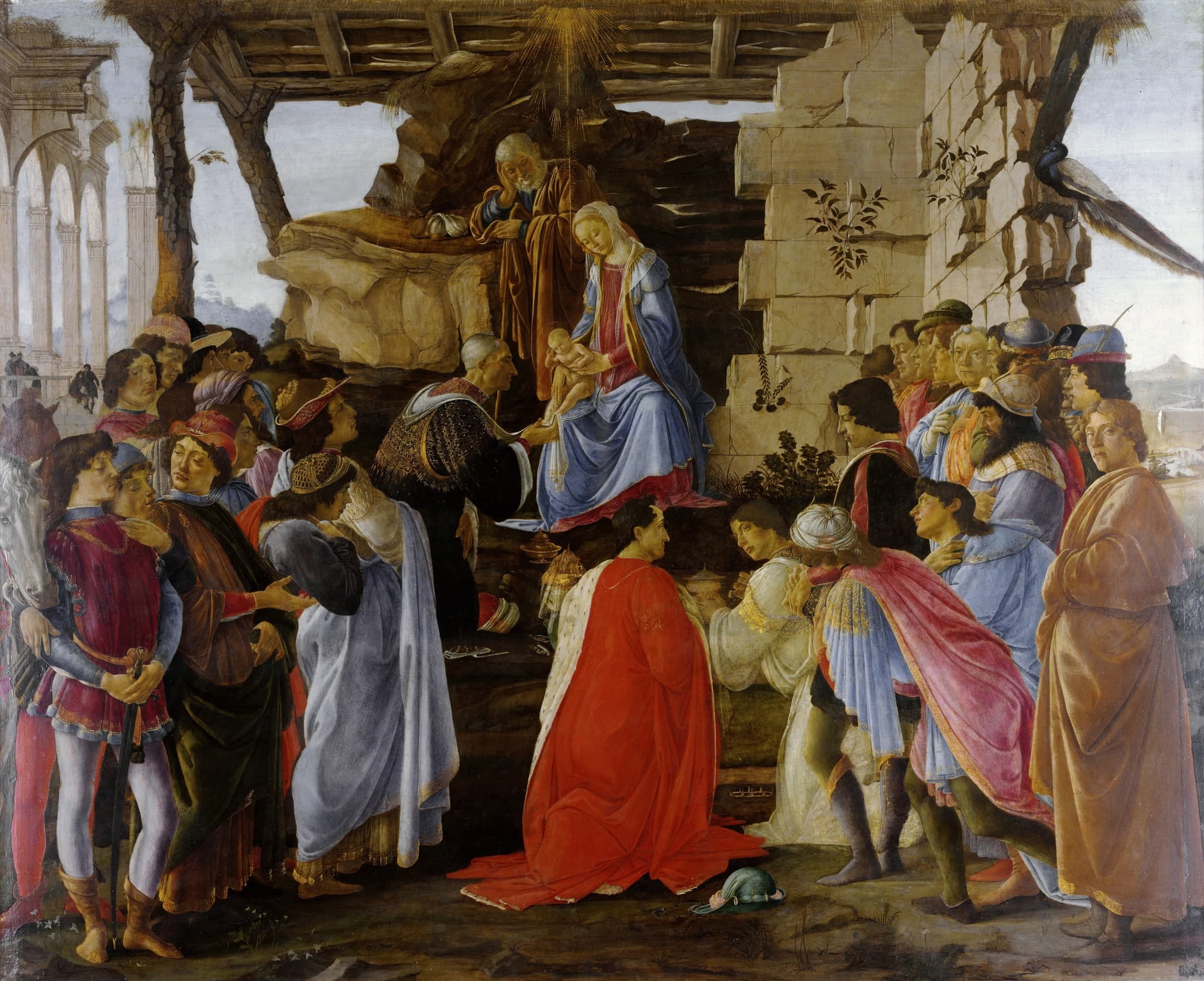
Sandro Botticelli, Adoration of the Magi, between about 1474 and 1476. Public domain (published before 1930), via Wikimedia Commons.
THE ARTWORKBotticelli painted the wise men of Matthew's Gospel come from the east to worship the child, with a crowd of onlookers pressed close around them. Here the men from the nations have come to kneel before Israel's King.
Babel scattered one people over the face of the earth, and John saw a crowd from every nation standing before one throne.
Summary
The promise that all the families of the earth will be blessed through Abraham carries the nations through the whole of Scripture.
- Genesis 10 lists seventy descendants of Noah's three sons when the Philistines of verse 14 are left out of the count.
- Paul writes that in that promise Scripture foretold the gospel to Abraham.
- Solomon prayed for the foreigner, and Isaiah called the temple a house of prayer for all the nations.
- The curse of Genesis 9:25 falls on Canaan, one of Ham's four sons, whose clans lived between Sidon and Gaza.
Six Verses on the Nations
Two from Genesis, one from Isaiah, one from Matthew and two from Revelation, in the order Scripture gives them
All these are the clans of Noah’s sons, according to their generations and nations. From these the nations of the earth spread out after the flood.This verse closes the Table of Nations and says where the nations of the earth came from.
I will bless those who bless you and curse those who curse you; and all the families of the earth will be blessed through you.”Every later text on the nations goes back to this promise.
He says: “It is not enough for You to be My Servant, to raise up the tribes of Jacob, and to restore the protected ones of Israel. I will also make You a light for the nations, to bring My salvation to the ends of the earth.”Isaiah widens the Servant's mission to take in every people.
Therefore go and make disciples of all nations, baptizing them in the name of the Father, and of the Son, and of the Holy Spirit,This command turns the promise to Abraham into the church's work among the peoples.
After this I looked and saw a multitude too large to count, from every nation and tribe and people and tongue, standing before the throne and before the Lamb. They were wearing white robes and holding palm branches in their hands.The vision answers the scattering of Genesis 10 with a gathering before the throne.
By its light the nations will walk, and into it the kings of the earth will bring their glory.Scripture's last vision of the city still has a place for the nations.
The Seventy Names of Genesis 10
A table of the names in Genesis 10 under each son of Noah, with the total in the last row
The count leaves out the Philistines, whom Genesis 10:14 names in a bracket as the people who came from the Casluhites. It counts Nimrod under Cush, and it counts Shelah, Eber, Peleg and Joktan in the line of Arphaxad.
From Babel to the City
A timeline of the promise, then the stages of the story with the verses that carry them
Each stage reaches further than the one before it: the promise goes to one family for the sake of all, Israel prays and sings for the nations, and the apostles carry the gospel to them.
The promise in eleven textsGenesis 11 to Revelation 7
- After the floodThe LORD scatters the builders of Babel over the face of all the earth.Genesis 11:8 to 9
- The call of AbramThe LORD calls Abram to leave his country for a land He will show him.Genesis 12:1 to 3
- Mount MoriahThe promise is renewed through Abraham's offspring for all nations.Genesis 22:18
- Solomon's templeSolomon asks God to hear the foreigner who prays toward the house.1 Kings 8:41 to 43
- The prophetsThe house is to be called a house of prayer for all the nations.Isaiah 56:7
- The prophetsThe LORD asks Jonah whether He should not care about Nineveh.Jonah 4:11
- After the resurrectionThe risen Jesus sends the eleven from a mountain in Galilee.Matthew 28:16 to 20
- PentecostJews from every nation hear the apostles in their own languages.Acts 2:5 to 11
- The council at JerusalemThe apostles and elders hear how God first visited the Gentiles.Acts 15:14 to 17
- AthensPaul tells the Areopagus that God made every nation from one man.Acts 17:26
- The endA multitude from every nation stands before the throne and the Lamb.Revelation 7:9
A timeline of eleven texts on the nations, from the scattering at Babel to the multitude of Revelation 7, each with its verse.
Babel and the scatteringGenesis 11
The builders of Babel wanted to make a name for themselves, and in the next chapter God promises to make Abram's name great.
So the LORD scattered them from there over the face of all the earth, and they stopped building the city. That is why it is called Babel, for there the LORD confused the language of the whole world, and from that place the LORD scattered them over the face of all the earth.Babel is the last event Genesis tells before the line of Shem leads to Abram.
The promise to AbrahamGenesis 22, Galatians 3
And through your offspring all nations of the earth will be blessed, because you have obeyed My voice.”The promise of Genesis 12:3 returns after Moriah, now given through Abraham's offspring.
The Scripture foresaw that God would justify the Gentiles by faith, and foretold the gospel to Abraham: “All nations will be blessed through you.”Paul finds the gospel already present in the words of Genesis 12:3.
Israel among the nations1 Kings 8, Psalms 67 and 87, Isaiah 2, 56 and 60
And as for the foreigner who is not of Your people Israel but has come from a distant land because of Your name— for they will hear of Your great name and mighty hand and outstretched arm—when he comes and prays toward this temple, then may You hear from heaven, Your dwelling place, and do according to all for which the foreigner calls to You. Then all the peoples of the earth will know Your name and fear You, as do Your people Israel, and they will know that this house I have built is called by Your Name.Solomon's prayer at the dedication asks a hearing for the foreigner as well as for Israel.
May God be gracious to us and bless us, and cause His face to shine upon us, Selah that Your ways may be known on earth, Your salvation among all nations.Israel's prayer here looks past Israel to the peoples beyond it.
“I will mention Rahab and Babylon among those who know Me— along with Philistia, Tyre, and Cush— when I say, ‘This one was born in Zion.’”The psalm counts old enemies of Israel among those born in Zion.
In the last days the mountain of the house of the LORD will be established as the chief of the mountains; it will be raised above the hills, and all nations will stream to it. And many peoples will come and say: “Come, let us go up to the mountain of the LORD, to the house of the God of Jacob. He will teach us His ways so that we may walk in His paths.” For the law will go forth from Zion, and the word of the LORD from Jerusalem.Isaiah sees the nations going up to learn the ways of the LORD at the house of the God of Jacob.
And the foreigners who join themselves to the LORD to minister to Him, to love the name of the LORD, and to be His servants—all who keep the Sabbath without profaning it and who hold fast to My covenant— I will bring them to My holy mountain and make them joyful in My house of prayer. Their burnt offerings and sacrifices will be accepted on My altar, for My house will be called a house of prayer for all the nations.”The promise opens the temple to outsiders who bind themselves to the LORD.
Nations will come to your light, and kings to the brightness of your dawn.Nations and kings come to the light that rises on Zion.
The gospel to the nationsActs 2 and 15
Now there were dwelling in Jerusalem God-fearing Jews from every nation under heaven. And when this sound rang out, a crowd came together in bewilderment, because each one heard them speaking his own language. Astounded and amazed, they asked, “Are not all these men who are speaking Galileans? How is it then that each of us hears them in his own native language? Parthians, Medes, and Elamites; residents of Mesopotamia, Judea and Cappadocia, Pontus and Asia, Phrygia and Pamphylia, Egypt and the parts of Libya near Cyrene; visitors from Rome, both Jews and converts to Judaism; Cretans and Arabs—we hear them declaring the wonders of God in our own tongues!”Luke names fifteen peoples and lands in the crowd at Pentecost.
Simon has told us how God first visited the Gentiles to take from them a people to be His own. The words of the prophets agree with this, as it is written: ‘After this I will return and rebuild the fallen tent of David. Its ruins I will rebuild, and I will restore it, so that the remnant of men may seek the Lord, and all the Gentiles who are called by My name, says the Lord who does these thingsThe council's decision rests on this reading of Amos 9:11 to 12.
The nations in the cityRevelation 22
down the middle of the main street of the city. On either side of the river stood a tree of life, bearing twelve kinds of fruit and yielding a fresh crop for each month. And the leaves of the tree are for the healing of the nations.The healing of the nations is the last work Scripture gives to the tree of life.
What Genesis Says of Canaan
Four cards on the curse of Genesis 9:25, each with the verse that tests it
THE CURSE NAMES CANAAN
Adam Clarke notes that only the Arabic version reads Ham the father of Canaan in this verse, and he calls that reading a gloss.
CANAAN IS ONE SON OF FOUR
Genesis 10:6 names Cush, Mizraim, Put and Canaan as the sons of Ham, and the curse falls on the last of them alone.
CANAAN'S CLANS AND THEIR LAND
Genesis 10 sets Sidon and ten peoples under Canaan and draws their border from Sidon to Gaza and east to Sodom.
THE CURSE SETS CANAAN UNDER SHEM AND JAPHETH
Noah's next words make Canaan the servant of Shem and of Japheth, the two brothers of his father.
The Seventy Nations and Deuteronomy 32:8
Three readings of the number by which God set the boundaries of the peoples, each with its holder
The Berean text of Deuteronomy 32:8 reads the sons of God, and the Hebrew text Rashi read has the sons of Israel in the same place.
When the Most High gave the nations their inheritance, when He divided the sons of man, He set the boundaries of the peoples according to the number of the sons of God. But the LORD’s portion is His people, Jacob His allotted inheritance.The question turns on the last words of verse 8.
The seventy who went down to EgyptRashi on Deuteronomy 32:8
Rashi ties the boundaries of the peoples to the seventy souls of Israel who went down to Egypt, and he counts seventy nations.
And with the two sons who had been born to Joseph in Egypt, the members of Jacob’s family who went to Egypt were seventy in all.Exodus 1:5 gives the same number for the household that went down.
The objection: Genesis 10 states no number, and the names come to seventy only when the Philistines of verse 14 are left out.
The number of the angelsJerome, Commentary on Daniel, on Daniel 7:2 to 3
Jerome quotes the verse with the number of the angels and reads the angels as powers set over the nations. He brings that reading to the four winds of Daniel 7.
The objection: Rashi's Hebrew text reads the sons of Israel, so this reading rests on the wording that Jerome and the Berean text follow.
A division by lot among the sons of NoahAdam Clarke, Commentary on the Bible, 1832
Clarke, after Dr. Kennicott, reads the verse as a division of the earth by lot. In that reading Africa fell to Ham, Europe to Japheth and Asia to Shem, with Palestine kept as the LORD's portion.
The objection: Genesis 10:19 puts the clans of Canaan, a son of Ham, in the land this reading gives to Shem.
The Words for the Nations
Three words from the lexicon, each in a verse where it stands
MISHPACHAH, FAMILY (HEBREW, H4940)
The lexicon gives a circle of relatives and, by extension, a tribe or people, and Genesis 12:3 uses it for the families of the earth.
GOY, NATION (HEBREW, H1471)
The lexicon gives a foreign nation and hence a Gentile, and Genesis 22:18 uses it where the promise names all nations.
ETHNOS, NATION (GREEK, G1484)
Paul uses it twice in Galatians 3:8, and the Berean text renders it Gentiles the first time and nations the second.
What the Text Leaves Unsaid
Three questions the verses leave open
Luke counts the believers added at Pentecost, and he does not say from which of the nations they came.
Those who embraced his message were baptized, and about three thousand were added to the believers that day.The verse closes the account of Peter's sermon at Pentecost.
Genesis 9 leaves unexplained why Noah cursed Canaan for what his father Ham had done.
And Ham, the father of Canaan, saw his father’s nakedness and told his two brothers outside.This is the only act the chapter records before the curse.
So should I not care about the great city of Nineveh, which has more than 120,000 people who cannot tell their right hand from their left, and many cattle as well?”God's care here reaches a city whose wickedness He had named in Jonah 1:2.
One New Man in Christ
Ephesians 2 and Romans 15, where Paul tells what Christ made of Jew and Gentile
For He Himself is our peace, who has made the two one and has torn down the dividing wall of hostility by abolishing in His flesh the law of commandments and decrees. He did this to create in Himself one new man out of the two, thus making peace and reconciling both of them to God in one body through the cross, by which He extinguished their hostility.Paul gives the cross as the place where the two were made one.
Three verses later Paul calls the Gentile believers fellow citizens with the saints and members of God's household.
And once more, Isaiah says: “The Root of Jesse will appear, One who will arise to rule over the Gentiles; in Him the Gentiles will put their hope.”Paul ends a chain of four quotations with this one from Isaiah.
Three Teachers on the Nations
Matthew Henry, Albert Barnes, and Jamieson, Fausset & Brown, each with the work named
Writing in 1710, Henry reads the old enemies of Psalm 87 as Gentiles made citizens of Zion.
“God says, ‘ I will reckon Egypt and Babylon with those that know me. I will reckon them my people as much as Israel when they shall receive the gospel of Christ, and own them as born in Zion, born again there, and admitted to the privileges of Zion as freely as a true-born Israelite.’ Those that were strangers and foreigners became fellow-citizens with the saints, Eph. ii.”
Matthew Henry · Commentary on the Whole Bible · on Psalm 87:4Puritan
Barnes finds the reason for Solomon's prayer for the stranger in the Law of Moses.
“Nothing is more remarkable in the Mosaic Law than its liberality with regard to strangers, both in general Exo 22:21; Lev 25:35; Deu 10:19 and in religious matters Num 15:14-16; Deu 31:12. It is quite in the spirit of these enactments that Solomon, having first prayed to God on behalf of his fellow-countrymen, should next go on to intercede for the strangers, and to ask for their prayers the same acceptance which he had previously begged for the prayers of faithful Israelites.”
Albert Barnes · Notes, Explanatory and Practical, on the Old and New Testaments (1832-1869) · on 1 Kings 8:41Evangelical
Jamieson, Fausset & Brown explain what the dividing wall of Ephesians 2:14 stood for.
“Thus this twofold wall represented the Sinaitic law, which both severed all men, even the Jews, from access to God (through sin, which is the violation of the law), and also separated the Gentiles from the Jews. As the term ‘wall’ implies the strength of the partition, so ‘fence’ implies that it was easily removed by God when the due time came.”
Jamieson, Fausset & Brown · Commentary Critical and Explanatory on the Whole Bible · on Ephesians 2:14Reformed
Israel and the Church after Christ
Two readings of how Israel and the nations stand after Christ, each with its case and the strongest objection
The church as the whole Israel of GodJohn Calvin, Commentary on Romans, 1539, translated by John Owen
Calvin extends the word Israel in Romans 11:26 to all the people of God, gathered from Jews and Gentiles, and he still gives the Jews the first place as the first-born. He reads the Israel of God in Galatians 6:16 the same way.
The objection comes from Calvin's English editor, John Owen, who notes that taking Israel as the people of God in general breaks the contrast between Israel and the Gentiles that runs through Paul's argument.
Regarding the gospel, they are enemies on your account; but regarding election, they are loved on account of the patriarchs. For God’s gifts and His call are irrevocable.Paul still sets Israel beside the Gentiles in these verses, loved on account of the patriarchs.
A future for the people of IsraelJamieson, Fausset & Brown, Commentary Critical and Explanatory, 1871
This reading holds that the promises to Israel will be kept to the people of Israel, beside the church gathered from the nations. Jamieson, Fausset & Brown argue it from Isaiah 2.
“If the curse foretold against Israel has been literally fulfilled, so shall the promised blessing be literal. We Gentiles must not, while giving them the curse, deny them their peculiar blessing by spiritualizing it.”
Jamieson, Fausset & Brown · Commentary Critical and Explanatory on the Whole Bible · on Isaiah 2:3Reformed
The objection: Paul writes that Christ made the two one, and that in Christ there is neither Jew nor Greek.
There is neither Jew nor Greek, slave nor free, male nor female, for you are all one in Christ Jesus. And if you belong to Christ, then you are Abraham’s seed and heirs according to the promise.Paul ends his argument from Abraham with these verses.
Books on the Nations
Three commentaries to read whole, earliest first
Commentary on the Epistle of Paul the Apostle to the Romans
John Calvin · 1539
Calvin wrote this commentary at Strasbourg, and the English edition prints John Owen's notes beneath his text.
Read Calvin on Romans 11:25 to 27 at the Christian Classics Ethereal LibraryCommentary on the Whole Bible
Matthew Henry · 1710
Henry lists three things that Psalm 67:2 prays for the Gentiles.
Commentary Critical and Explanatory on the Whole Bible
Robert Jamieson, A. R. Fausset and David Brown · 1871
The commentary covers the whole Bible, and its note on Genesis 10:1 reads the names of the Table of Nations as names of tribes and nations.
Every Tribe and Tongue
The story that began with the families scattered at Babel ends with a new song to the Lamb. Paul names Christ as the seed of Abraham to whom the promises were spoken. The text asks the reader to do what Jesus commanded, to “go and make disciples of all nations.”
And they sang a new song: “Worthy are You to take the scroll and open its seals, because You were slain, and by Your blood You purchased for God those from every tribe and tongue and people and nation.The new song gives the reason the nations stand before the throne, the blood of the Lamb.
Keep studying
Studies5
Symbols1
Doctrines11
Peoples and groups2