

Isaiah 65:17–66:24 · Featured Study
New Heavens and a New Earth
Seven centuries before the Apocalypse, Isaiah ends his book on the sentence the Bible will end on: Behold, I create new heavens and a new earth. It is the first time the phrase appears in Scripture, and when John reaches for words to describe what he sees, these are the words he uses. Read the two passages as facing pages and the correspondence is not thematic but verbal: no more weeping, no sun needed, gates never shut, nothing unclean, the thirsty invited freely. And where the two do notmatch. Isaiah's city still holds a funeral; John's does not, that difference is the most interesting thing on the page.
Edward Hicks, Peaceable Kingdom (c. 1834) — Public domain, via Wikimedia Commons
Summary
Isaiah 65-66 and Revelation 21-22 are set as facing pages, line answering line, because John's vision of a new heaven and new earth reuses Isaiah's own phrase and images. The page also names honestly where the two texts differ: Isaiah's city still holds a funeral, and Revelation's does not.
- Ten facing-page pairs match Isaiah's promises to Revelation's vision word for word, from 'no more weeping' to gates that never shut to the free invitation to drink.
- A comparison table lays out what ceases and what continues in each text, flagging that Isaiah 65:20 still allows death while Revelation 21:4 abolishes it outright.
- Two readings of that difference are given at full strength: a poetic reading where both texts describe one final state, and a sequential reading where Isaiah describes the millennial kingdom and Revelation the eternal state after it.
- A ten-stop rail traces the 'new exodus' shape running through Isaiah 40-66, and a side-by-side shows Isaiah 11's wolf-and-lamb picture compressed and echoed in 65:25.
Michelangelo's Isaiah, from the Sistine Chapel ceiling (1508–1512), sits with a finger holding his place in the book while he turns to listen, the painter's way of saying the prophet is mid-revelation. It is the right face for this page: a man interrupted by something better than what he was reading.
Facing Pages
Isaiah's promise, and John's vision, line answering line, ten correspondences walking the covenant rainbow
A new creation
The Bible's first explicit new creation, and its last. Isaiah supplies John the phrase.
And it will last
Permanence is the point of both: not a better arrangement, but one that does not end.
Death swallowed up
Paul quotes the Isaiah line for the resurrection (1 Cor 15:54); John hands it its final scene.
No more weeping
The same three sounds abolished in the same order. Isaiah's city is John's city.
No sun needed
John adds one word Isaiah could not: the lamp is the Lamb.
Gates never shut
An open gate in the ancient world meant one thing: no enemy left to fear.
The nations come in
Isaiah's universal horizon is not a footnote to the book; it is where the book ends up.
Nothing unclean
Holiness is not suspended in the end; it is finally uncontested.
The free invitation
The Bible's two great open invitations use the same three words: thirst, come, freely.
The curse undone
Genesis 3 is answered in both texts, and only in Revelation is the answer total.
Scripture is the Berean Standard Bible throughout, lightly compressed where a line runs long, and every reference is a door to the verse itself. Revelation is not adding a new ending to the Bible; it is finishing a sentence Isaiah started.
What Ceases, What Continues
the honest comparison. Isaiah's city still holds a funeral
| In the new world… | Isaiah 65–66 | Revelation 21–22 |
|---|---|---|
| Weeping and crying | Ceases, 65:19 | Ceases, 21:4 |
| Infant mortality | Ceases, 65:20 | Ceases (with death itself), 21:4 |
| Death itself | Continues, but deferred, the one who dies at a hundred is reckoned a youth (65:20) | Abolished, death shall be no more (21:4) |
| Building and planting | Continues, they shall build and inhabit, plant and eat (65:21–22) | Service continues, his servants shall serve him (22:3) |
| Childbearing | Continues, they shall not labour in vain, nor bring forth for calamity (65:23) | Not mentioned |
| The sinner and the curse | Present but marked, the sinner being a hundred years old shall be accursed (65:20) | Absent, there shall be no curse any more (22:3) |
| The nations | Stream in, they shall come and see my glory (66:18) | Walk in the light of it (21:24) |
| Ongoing worship | From new moon to new moon, all flesh shall come to worship (66:23) | They shall see his face (22:4) |
the two texts agree ·the two texts differ
One state, the poetic reading
Isaiah is a poet, and prophetic poetry describes the unimaginable with the materials of the imaginable. On this reading the child who dies at a hundred years old is not a demographic statement but an idiom for immeasurable life, the strongest picture of fullness available to a culture where a child dying young was ordinary. Isaiah 65 and Revelation 21 describe the same final state; Isaiah in the vocabulary of a farming village, John in the vocabulary of a city. Pressing 65:20 for a mortality rate, the argument goes, is reading a poem like a census.
Two stages, the sequential reading
Or Isaiah is describing something genuinely earlier. His picture has houses being built, vineyards planted, children born, long life, and a sinner who can still be accursed, a restored earth under the Messiah's reign, not the final state. John describes what comes after: no death at all, no curse at all, no sea, no night. Revelation itself puts a thousand-year reign between the present age and the new heavens and new earth (Rev 20), which is exactly the room the two pictures need.
The sequential reading, in the premillennial framework, Isaiah 65:20–25 describes the millennial kingdom, where death is rare and astonishing rather than absent; Revelation 21–22 describes the eternal state that follows it, where death is gone. The poetic reading is given at full strength because it is answering something true: Isaiah is a poet, and the language is not a spreadsheet. But a poem is still allowed to mean what it says, and this one says someone dies.
What the Painters Saw
two very different centuries tried to paint this page
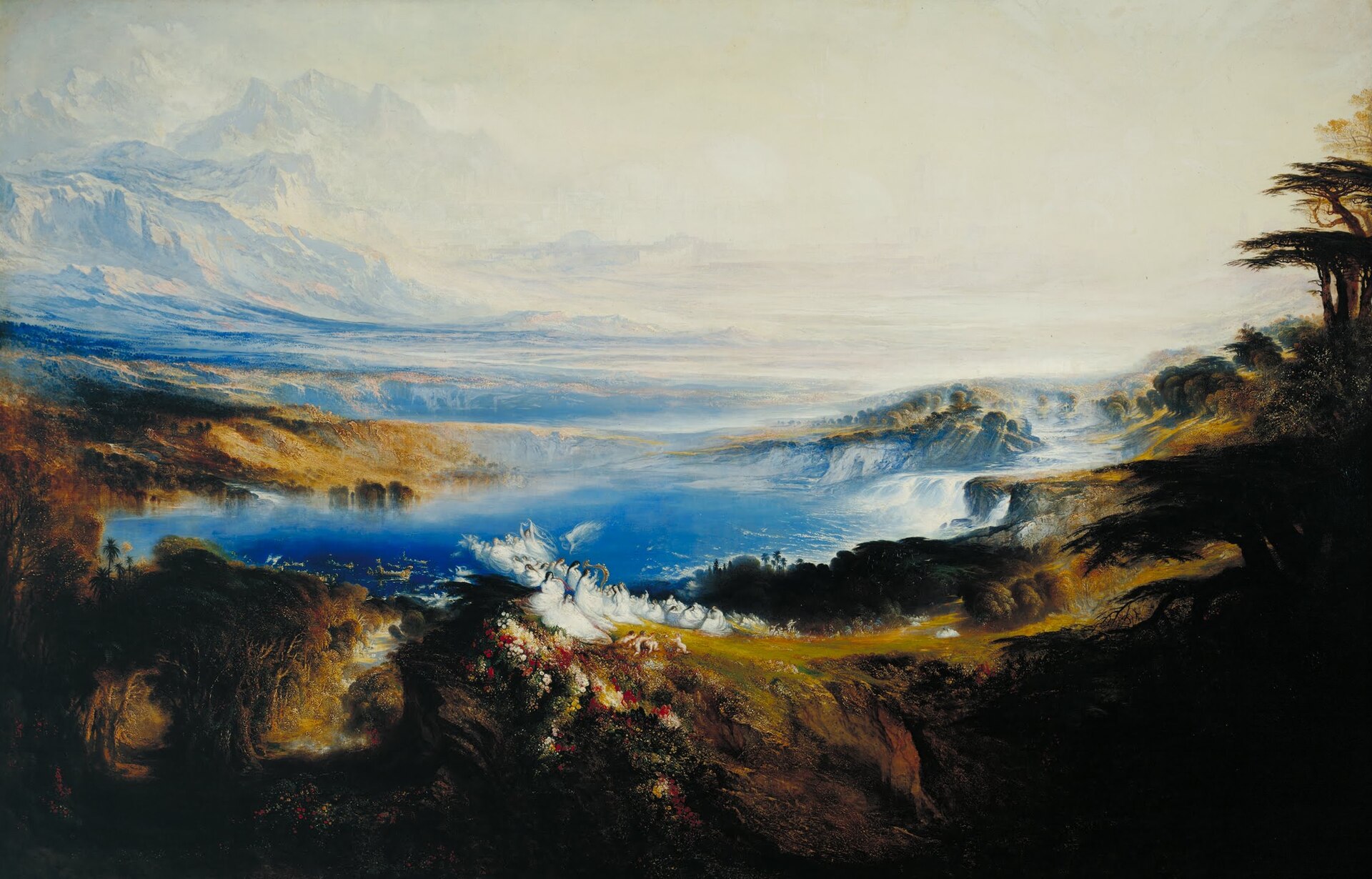
THE ARTWORK
John Martin painted this as the final panel of his Last Judgment triptych, after the catastrophe canvases comes this: a renewed landscape under an enormous sky, the redeemed small in the foreground because the world itself is the subject. It is Victorian England's most famous attempt at Revelation 21:1, and its answer to what “a new earth” might look like is simply the old one, healed.
John Martin, The Plains of Heaven (1851–1853), Tate Britain. Public domain, via Wikimedia Commons.
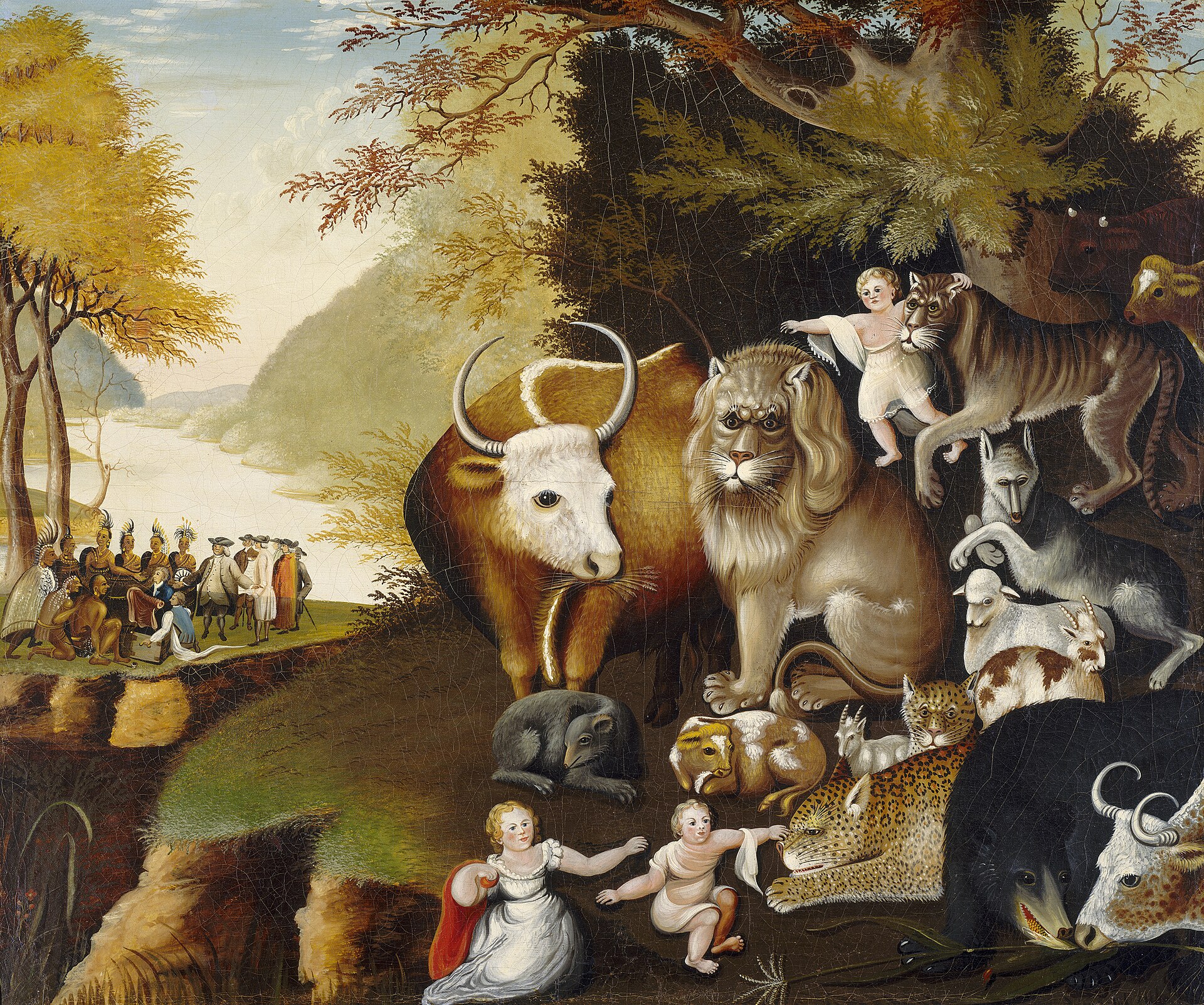
THE ARTWORK
Edward Hicks, a Quaker preacher-painter, painted Isaiah 11's menagerie more than sixty times, wolf and lamb, leopard and kid, lion and ox, and the little child leading them, exactly as the verse orders the procession. He kept repainting it because he believed the verse was a promise, not a decoration; the wide-eyed animals sit like a congregation still surprised to be at peace.
Edward Hicks, Peaceable Kingdom (c. 1834), National Gallery of Art. Public domain, via Wikimedia Commons.
The Road That Gets There
the new exodus of chapters 40–66, in ten stops
The new creation is not dropped into the end of Isaiah out of nowhere. The whole second panel is a journey: a road built through a desert, water where there was none, a people told to leave Babylon, and a homecoming that keeps widening until the destination is not a city but a cosmos. Isaiah takes the exodus, the defining act of Israel's past, and makes it the shape of the future.
- 1Isaiah 40:3A highway prepared in the wilderness, the road out begins as a voice.
- 2Isaiah 41:18I will open rivers on the barren heights… I will turn the desert into a pool of water, and the dry land into flowing springs.
- 3Isaiah 43:19Behold, I am about to do something new… Indeed, I will make a way in the wilderness and streams in the desert.
- 4Isaiah 44:3I will pour out My Spirit on your descendants, and My blessing on your offspring.
- 5Isaiah 48:20Leave Babylon! Flee from the Chaldeans!
- 6Isaiah 51:11So the redeemed of the LORD will return and enter Zion with singing.
- 7Isaiah 52:12For you will not leave in a hurry nor flee in haste, for the LORD goes before you, and the God of Israel is your rear guard.
- 8Isaiah 55:12You will indeed go out with joy… the mountains and hills will burst into song before you, and all the trees of the field will clap their hands.
- 9Isaiah 61:4They will rebuild the ancient ruins… they will renew the ruined cities, the desolations of many generations.
- 10Isaiah 65:17New heavens and a new earth, the exodus ends in a new creation.
The Wolf and the Lamb
11:6–9 and 65:25, the same reign, stated twice
Isaiah 11:6–9, under the Branch
- 11:6The wolf will live with the lamb, and the leopard will lie down with the goat; the calf and young lion and fatling will be together, and a little child will lead them.
- 11:7The cow will graze with the bear, their young will lie down together, and the lion will eat straw like the ox.
- 11:8The infant will play by the cobra’s den, and the toddler will reach into the viper’s nest.
- 11:9They will neither harm nor destroy on all My holy mountain, for the earth will be full of the knowledge of the LORD as the sea is full of water.
Isaiah 65:25, in the new creation
The wolf and the lamb will feed together, and the lion will eat straw like the ox, but the food of the serpent will be dust. They will neither harm nor destroy on all My holy mountain, says the LORD.
The one line Isaiah adds
Chapter 65 compresses the whole menagerie of chapter 11 into a single verse and closes it with five words that were not there before: dust shall be the serpent's food. That is a quotation of Genesis 3:14, the sentence passed on the serpent in the garden. The predators are reconciled; the serpent is not. Isaiah's last picture of peace is careful to say that the peace is not an amnesty.
The Words Underneath
the vocabulary of comfort and redemption
The second word decides the tone of the whole ending. A goel is not a benefactor at a distance, he is the nearest relative, the one obliged by blood to buy back what his family has lost. Isaiah calls God that, repeatedly, in exactly the chapters where He promises a new world. The new heavens and the new earth are not a replacement for what was lost. They are a redemption of it.
Word studies
The Hebrew and Greek under this study, each word in its own room.
Keep studying
Read it1
On this page
Words1