
Exodus 1 to 14 · Person · Featured Study
Pharaoh
The king of Egypt in Exodus: the king who did not know Joseph, and the king who refused to let Israel go and lost his army in the sea.
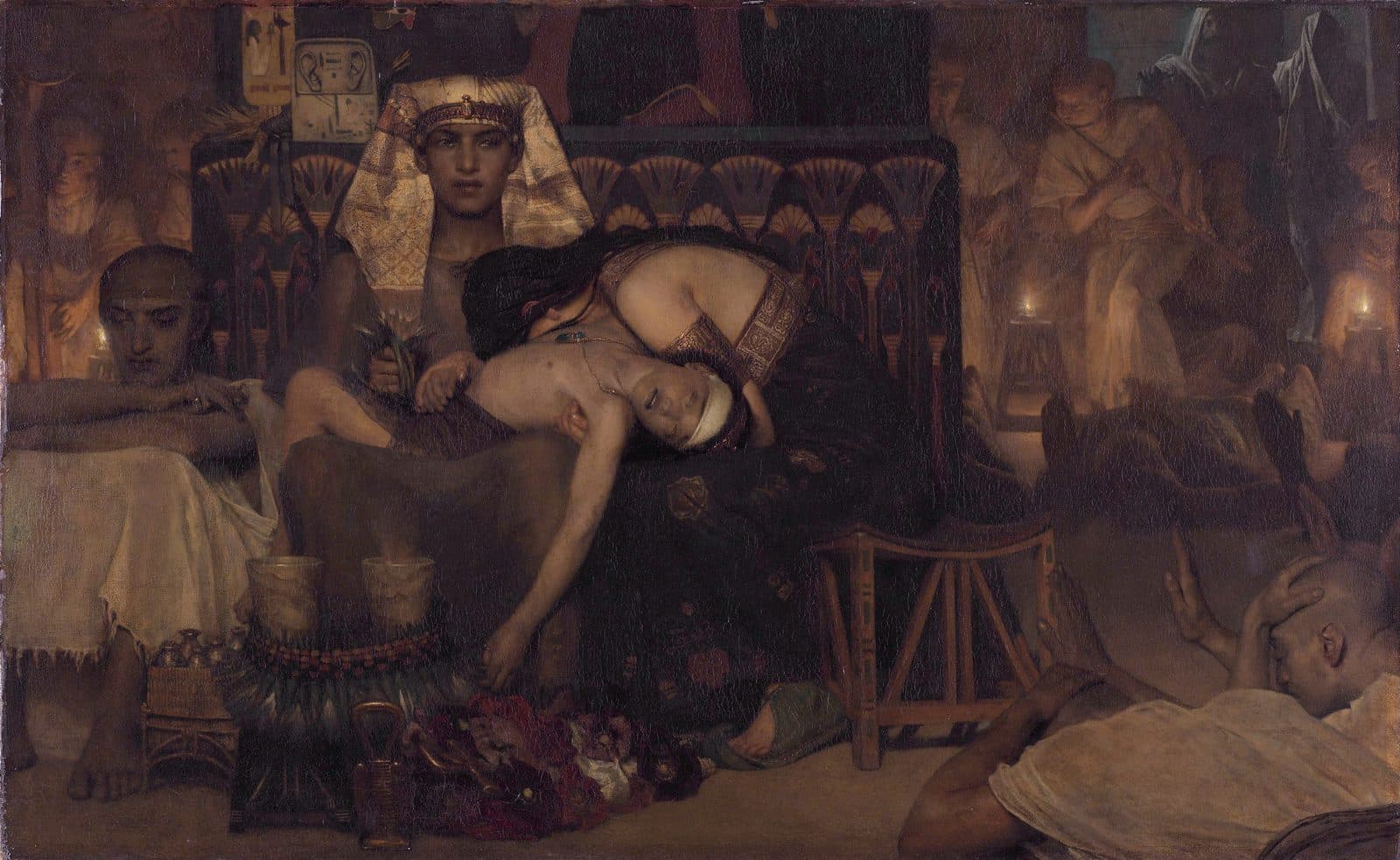
Lawrence Alma-Tadema, The Death of the Pharaoh's Firstborn Son, 1872, Rijksmuseum, Amsterdam. Public domain.
THE ARTWORKAlma-Tadema painted the night of Exodus 12:29, when the last plague reached the firstborn of Pharaoh who sat on his throne.
He asked Moses who the LORD was, and ten plagues and the sea gave him the answer.
Summary
Pharaoh is the title of the king of Egypt, and Exodus gives it to two kings in turn.
- The first king forced Israel into slave labor and ordered every Hebrew son thrown into the Nile, and he died while Moses was in Midian.
- The second king refused the LORD's demand to let Israel go, and ten plagues fell on Egypt before he sent the people out.
- Exodus speaks of the hardening in twenty verses: eighteen of Pharaoh's heart, one of his stubborn refusal and one of the hearts of the Egyptians.
- The sea covered the chariots and horsemen of his army, and Paul reads God's dealings with him in Romans 9.
Where Pharaoh Stands in Scripture
His first verse in Exodus, four later words on him, and Paul's use of him in Romans 9
What Scripture says of him
- Stephen says this king exploited Israel and forced them to abandon their infants.
- The Philistine priests warn their people not to harden their hearts as Pharaoh did.
- Nehemiah's prayer says God did signs against Pharaoh, his officials and his people, who had acted with arrogance against Israel's fathers.
- A psalm praises God for the signs and wonders He sent against Pharaoh and all his servants.
Then a new king, who did not know Joseph, came to power in Egypt.Exodus opens the oppression with a king who did not know Joseph, so the favor Joseph won for his family ends here.
For the Scripture says to Pharaoh: “I raised you up for this very purpose, that I might display My power in you, and that My name might be proclaimed in all the earth.”Paul quotes God's word to Pharaoh from Exodus 9:16 as his proof that God shows His power through those who resist Him.
The Two Kings, Turn by Turn
Thirteen turns from the new king's fear of Israel to the army under the sea
- A new king who did not know Joseph comes to powerEgypt, Exodus 1:8
- Sets taskmasters over Israel, who build Pithom and Ramesesthe store cities, Exodus 1:11
- Orders every Hebrew son thrown into the Nilethe first king's last order, Exodus 1:22
- Seeks to kill Moses, who fleesMoses aged 40, by Acts 7:23, Exodus 2:15
- The king of Egypt diesafter a long time, Exodus 2:23
- Asks who the LORD is and refuses to let Israel gothe first audience with Moses, Exodus 5:2
- Makes the work of the Hebrew men harderthe brick fields, Exodus 5:9
- Calls his magicians against the sign of the staffhis court, Exodus 7:11
- Ten plagues fall on Egyptfrom the Nile to the firstborn, Exodus 7:14
- Says for the first time that he has sinnedafter the hail, Exodus 9:27
- Sends Israel out and asks to be blessedthe night of the firstborn, Exodus 12:31
- Pursues Israel with his chariotsby the sea near Pi-hahiroth, Exodus 14:9
- The sea covers his armythe Red Sea, Exodus 14:28
The first five turns belong to the first king, and the last eight to the king of the contest.
From the Brick Kilns to the Sea
Exodus 1 to 14
The new king feared that Israel, grown too numerous, would join Egypt's enemies in a war and leave the land.
Before he gave his order to all his people, he told the Hebrew midwives to kill the boys at birth. Shiphrah and Puah feared God and let the boys live.
The king who did not know JosephExodus 1:8 to 2:23
Then Pharaoh commanded all his people: “Every son born to the Hebrews you must throw into the Nile, but every daughter you may allow to live.”The order turns the whole nation of Egypt against the Hebrew sons, and the boy it would have killed becomes the deliverer.
After a long time, the king of Egypt died. The Israelites groaned and cried out under their burden of slavery, and their cry for deliverance from bondage ascended to God.In the next verse God hears this groaning and remembers His covenant with Abraham, Isaac and Jacob.
The first audience and the strawExodus 5:1 to 23
But Pharaoh replied, “Who is the LORD that I should obey His voice and let Israel go? I do not know the LORD, and I will not let Israel go.”The whole contest turns on this refusal, for at Exodus 7:5 the LORD promises that the Egyptians will come to know Him.
That same day he ordered the taskmasters to stop supplying straw and to keep the quota of bricks. When the Hebrew foremen were beaten and came to complain, he called them slackers. Basil of Caesarea, in his Exegetic Homilies 18.8, reads that charge as Pharaoh's own knowledge that a man seeks God when he is at leisure.
The contest of the signsExodus 7:8 to 11:10
Pharaoh's wise men, sorcerers and magicians matched the first sign and the first two plagues by their magic arts. At the third plague they could not produce the gnats, and they told Pharaoh it was the finger of God.
But the LORD will make a distinction between the livestock of Israel and the livestock of Egypt, so that no animal belonging to the Israelites will die.’”At the fifth plague the LORD sets the livestock of Israel apart from the livestock of Egypt, so Pharaoh could see where the plagues were aimed.
The night of the firstbornExodus 11:1 to 12:32
Now at midnight the LORD struck down every firstborn male in the land of Egypt, from the firstborn of Pharaoh, who sat on his throne, to the firstborn of the prisoner in the dungeon, as well as all the firstborn among the livestock.The LORD had warned Pharaoh at Exodus 4:23 that He would kill his firstborn son for refusing to let Israel, His firstborn, go.
Take your flocks and herds as well, just as you have said, and depart! And bless me also.”The ruler who would not obey the voice of the LORD in Exodus 5:2 now asks the servants of the LORD for a blessing.
The seaExodus 14:1 to 31
And I will harden Pharaoh’s heart so that he will pursue them. But I will gain honor by means of Pharaoh and all his army, and the Egyptians will know that I am the LORD.” So this is what the Israelites did.God tells Moses in advance why Pharaoh will pursue, and what Egypt will learn when he does.
And I will harden the hearts of the Egyptians so that they will go in after them. Then I will gain honor by means of Pharaoh and all his army and chariots and horsemen. The Egyptians will know that I am the LORD when I am honored through Pharaoh, his chariots, and his horsemen.”The LORD repeats the purpose at the water's edge, and the honor is to come by means of Pharaoh's own chariots and horsemen.
The Hardening, Verse by Verse
Twenty verses of Exodus 4 to 14, with the Hebrew verb and its subject in each
Exodus uses three Hebrew verbs for the hardening. Chazaq, to make strong or firm, stands in twelve of the twenty verses. Kabed, to make heavy, stands in six, and qashah, to make hard, stands in two.
God is the one who hardens in ten verses, four of them spoken before the event and six of them told as done. Pharaoh is the subject in four, one of them his stubborn refusal at Exodus 13:15, and in six the heart of Pharaoh is simply said to be hard. The first verse in which the LORD hardens the heart as a deed done is Exodus 9:12, at the sixth plague.
| Verse | Plague or scene | Hebrew verb | Who hardens |
|---|---|---|---|
| Exodus 4:21 | God's charge to Moses at the bush | chazaq | God, foretold |
| Exodus 7:3 | God's charge before the signs | qashah | God, foretold |
| Exodus 7:13 | the staff that became a serpent | chazaq | the heart |
| Exodus 7:14 | 1. the Nile, as the LORD announces it | kabed | the heart |
| Exodus 7:22 | 1. the Nile turned to blood | chazaq | the heart |
| Exodus 8:15 | 2. frogs | kabed | Pharaoh |
| Exodus 8:19 | 3. gnats | chazaq | the heart |
| Exodus 8:32 | 4. flies | kabed | Pharaoh |
| Exodus 9:7 | 5. death of the livestock | kabed | the heart |
| Exodus 9:12 | 6. boils | chazaq | God |
| Exodus 9:34 | 7. hail | kabed | Pharaoh, with his officials |
| Exodus 9:35 | 7. hail | chazaq | the heart |
| Exodus 10:1 | 8. locusts, announced | kabed | God |
| Exodus 10:20 | 8. locusts | chazaq | God |
| Exodus 10:27 | 9. darkness | chazaq | God |
| Exodus 11:10 | 10. the firstborn, announced | chazaq | God |
| Exodus 13:15 | 10. the firstborn, remembered | qashah | Pharaoh, who stubbornly refused |
| Exodus 14:4 | the pursuit, foretold | chazaq | God, foretold |
| Exodus 14:8 | the pursuit | chazaq | God |
| Exodus 14:17 | the sea, foretold | chazaq | God, of the Egyptians' hearts |
- Verse
- Exodus 4:21
- Plague or scene
- God's charge to Moses at the bush
- Hebrew verb
- chazaq
- Who hardens
- God, foretold
- Verse
- Exodus 7:3
- Plague or scene
- God's charge before the signs
- Hebrew verb
- qashah
- Who hardens
- God, foretold
- Verse
- Exodus 7:13
- Plague or scene
- the staff that became a serpent
- Hebrew verb
- chazaq
- Who hardens
- the heart
- Verse
- Exodus 7:14
- Plague or scene
- 1. the Nile, as the LORD announces it
- Hebrew verb
- kabed
- Who hardens
- the heart
- Verse
- Exodus 7:22
- Plague or scene
- 1. the Nile turned to blood
- Hebrew verb
- chazaq
- Who hardens
- the heart
- Verse
- Exodus 8:15
- Plague or scene
- 2. frogs
- Hebrew verb
- kabed
- Who hardens
- Pharaoh
- Verse
- Exodus 8:19
- Plague or scene
- 3. gnats
- Hebrew verb
- chazaq
- Who hardens
- the heart
- Verse
- Exodus 8:32
- Plague or scene
- 4. flies
- Hebrew verb
- kabed
- Who hardens
- Pharaoh
- Verse
- Exodus 9:7
- Plague or scene
- 5. death of the livestock
- Hebrew verb
- kabed
- Who hardens
- the heart
- Verse
- Exodus 9:12
- Plague or scene
- 6. boils
- Hebrew verb
- chazaq
- Who hardens
- God
- Verse
- Exodus 9:34
- Plague or scene
- 7. hail
- Hebrew verb
- kabed
- Who hardens
- Pharaoh, with his officials
- Verse
- Exodus 9:35
- Plague or scene
- 7. hail
- Hebrew verb
- chazaq
- Who hardens
- the heart
- Verse
- Exodus 10:1
- Plague or scene
- 8. locusts, announced
- Hebrew verb
- kabed
- Who hardens
- God
- Verse
- Exodus 10:20
- Plague or scene
- 8. locusts
- Hebrew verb
- chazaq
- Who hardens
- God
- Verse
- Exodus 10:27
- Plague or scene
- 9. darkness
- Hebrew verb
- chazaq
- Who hardens
- God
- Verse
- Exodus 11:10
- Plague or scene
- 10. the firstborn, announced
- Hebrew verb
- chazaq
- Who hardens
- God
- Verse
- Exodus 13:15
- Plague or scene
- 10. the firstborn, remembered
- Hebrew verb
- qashah
- Who hardens
- Pharaoh, who stubbornly refused
- Verse
- Exodus 14:4
- Plague or scene
- the pursuit, foretold
- Hebrew verb
- chazaq
- Who hardens
- God, foretold
- Verse
- Exodus 14:8
- Plague or scene
- the pursuit
- Hebrew verb
- chazaq
- Who hardens
- God
- Verse
- Exodus 14:17
- Plague or scene
- the sea, foretold
- Hebrew verb
- chazaq
- Who hardens
- God, of the Egyptians' hearts
HE ASKED FOR PRAYER FOUR TIMES
Pharaoh asked Moses to pray to the LORD for him after the frogs, the flies, the hail and the locusts.
FOUR OFFERS OF TERMS
He offered to let Israel sacrifice inside Egypt, then not very far away, then the men alone, then everyone without the flocks and herds.
HIS OFFICIALS GAVE WAY FIRST
Before the locusts came, his own officials asked him how long Moses would be a snare to them and told him Egypt was in ruins.
A JUDGMENT ON THE GODS OF EGYPT
The LORD calls His last plague a judgment against all the gods of Egypt.
The King of Egypt
The title, the river and the court the plagues struck
Par'oh, Pharaoh, is a general title of the kings of Egypt, and the Hebrew Bible uses it 274 times. Exodus names Pharaoh in 111 verses.
The first plague struck the Nile. Albert Barnes, in his note on Exodus 7:15, writes that the river was worshipped under various names, at Memphis as Hapi.
A later king who is namedJeremiah 44:30
This is what the LORD says: Behold, I will deliver Pharaoh Hophra king of Egypt into the hands of his enemies who seek his life, just as I delivered Zedekiah king of Judah into the hand of Nebuchadnezzar king of Babylon, the enemy who was seeking his life.”The title stands with a personal name only for later kings, such as Hophra in the days of Jeremiah and Neco in 2 Kings 23:29.
The chariots of EgyptExodus 14:7
He took 600 of the best chariots, and all the other chariots of Egypt, with officers over all of them.The size of the force shows how much of Egypt's strength Pharaoh staked on bringing back the slaves he had released.
The Household of Pharaoh
Three ties, each with its verse
| Person | Tie to Pharaoh | Verse |
|---|---|---|
| Pharaoh's daughter | The first king's daughter, who drew Moses from the Nile. | Exodus 2:5 |
| Moses | Raised as her son and named by her. | Exodus 2:10 |
| The firstborn of Pharaoh | The second king's son, struck down on the night of the Passover. | Exodus 12:29 |
- Person
- Pharaoh's daughter
- Tie to Pharaoh
- The first king's daughter, who drew Moses from the Nile.
- Verse
- Exodus 2:5
- Person
- Moses
- Tie to Pharaoh
- Raised as her son and named by her.
- Verse
- Exodus 2:10
- Person
- The firstborn of Pharaoh
- Tie to Pharaoh
- The second king's son, struck down on the night of the Passover.
- Verse
- Exodus 12:29
The Places of His Reign
Six places, from Egypt to the sea
| Place | What happened there | Verse |
|---|---|---|
| Egypt | Israel lived there as slaves under both kings. | Exodus 1:13 |
| Pithom and Rameses | Israel built them as store cities for Pharaoh. | Exodus 1:11 |
| The Nile | Its water turned to blood and its fish died. | Exodus 7:21 |
| Goshen | The LORD spared it from the flies, the land where His people lived. | Exodus 8:22 |
| Pi-hahiroth | Pharaoh's army overtook Israel there, camped by the sea. | Exodus 14:9 |
| The Red Sea | His chariots and army were cast into it. | Exodus 15:4 |
- Place
- Egypt
- What happened there
- Israel lived there as slaves under both kings.
- Verse
- Exodus 1:13
- Place
- Pithom and Rameses
- What happened there
- Israel built them as store cities for Pharaoh.
- Verse
- Exodus 1:11
- Place
- The Nile
- What happened there
- Its water turned to blood and its fish died.
- Verse
- Exodus 7:21
- Place
- Goshen
- What happened there
- The LORD spared it from the flies, the land where His people lived.
- Verse
- Exodus 8:22
- Place
- Pi-hahiroth
- What happened there
- Pharaoh's army overtook Israel there, camped by the sea.
- Verse
- Exodus 14:9
- Place
- The Red Sea
- What happened there
- His chariots and army were cast into it.
- Verse
- Exodus 15:4
Questions His Reign Raises
Three questions on the king's succession, his death and his relapse
Was the king of Exodus 5 the king of Exodus 1?Exodus 2:23; Keil and Delitzsch
The king of Egypt dies in Exodus 2:23, before the LORD sends Moses back, so the king of the contest is a later king. Keil and Delitzsch, in their commentary on the Pentateuch of 1866, hold that the king who died was the king of the orders in Exodus 1:15 to 22. They leave open whether that king had reigned since Exodus 1:8 or followed the one who did.
Did Pharaoh drown with his army?Exodus 14:28; Psalm 136:15; Pirkei de-Rabbi Eliezer 43
The waters flowed back and covered the chariots and horsemen—the entire army of Pharaoh that had chased the Israelites into the sea. Not one of them survived.The verse counts the whole army of Pharaoh that followed Israel into the sea, and it does not name the king among the dead.
but swept Pharaoh and his army into the Red Sea. His loving devotion endures forever.The psalm puts Pharaoh himself in the sea with his army, and Exodus 15:19 says his horses, chariots and horsemen went into it.
Pirkei de-Rabbi Eliezer, a work of rabbinic midrash composed between about 630 and 1030, says in chapter 43 that God delivered Pharaoh from among the dead and that he went on to rule in Nineveh. Gerald Friedlander's English translation of 1916 gives the passage in full.
Why did he confess and still refuse?Exodus 9:27 to 35
Then Pharaoh summoned Moses and Aaron. “This time I have sinned,” he said. “The LORD is righteous, and I and my people are wicked.Pharaoh names the LORD righteous and himself wicked while the hail is still falling.
But as for you and your officials, I know that you still do not fear the LORD our God.”Moses names the cause of the relapse before it comes, and Exodus 9:34 shows it when the hail stops.
What Exodus Leaves Unsaid
The names of the kings and the end of the magicians
Exodus gives neither king a personal name, though it names the store cities Pithom and Rameses.
After the boils of Exodus 9:11 the magicians do not appear again in the account of the plagues, and Exodus never says what became of them. Paul names two men who opposed Moses, Jannes and Jambres, in 2 Timothy 3:8, without saying that they were the magicians of Exodus.
Where Pharaoh Points
Paul's reading in Romans 9 and the later Pharaoh of Ezekiel
In Romans 9:15 Paul quotes God's word to Moses on mercy, from Exodus 33:19, before he quotes the word to Pharaoh.
Therefore God has mercy on whom He wants to have mercy, and He hardens whom He wants to harden.The verse is Paul's conclusion, and its second half speaks of hardening as Exodus speaks of Pharaoh.
Origen and Henry on Romans 9:17 to 18Origen; Matthew Henry
Origen, in his Commentary on Romans, reads God's raising up of Pharaoh as the use of a will God foreknew.
“But let us also see of what sort is this which is said to Pharaoh: ‘For this very purpose have I raised thee up, that I might show in thee my power.’ It is certain that God not only knows the purpose and will of each one, but even foreknows it. And knowing and foreknowing, as a good and just steward, he uses the impulses and purpose of each one for accomplishing those works which the mind and will of each one chooses.”
Origen of Alexandria · Commentary on the Epistle to the Romans · on Romans 9:17Patristic
“But as for what he says, ‘Therefore he has mercy on whom he wills, and whom he wills he hardens,’ he seems to take it from what is written in Exodus. For there he says: ‘I will harden Pharaoh's heart, that he may not let the people go.’ Now Pharaoh's heart was hardened in this way. God was unwilling to bring upon him a sudden and full vengeance.”
Origen of Alexandria · Commentary on the Epistle to the Romans · on Romans 9:18Patristic
Matthew Henry, on Romans 9:18, writes that the Gentiles found mercy because God would have mercy on them. He writes that the Jews were hardened because it was God's own pleasure to deny them softening grace and give them up to their chosen unbelief.
A later Pharaoh in EzekielEzekiel 29:3; Ezekiel 32:2
Ezekiel counts his years from the exile of King Jehoiachin and dates these oracles in the tenth year and the twelfth, so the king they address is a later Pharaoh.
Speak to him and tell him that this is what the Lord GOD says: Behold, I am against you, O Pharaoh king of Egypt, O great monster who lies among his rivers, who says, ‘The Nile is mine; I made it myself.’Ezekiel's word to a later king answers the same pride in the river that the plagues of Exodus answered.
“Son of man, take up a lament for Pharaoh king of Egypt and say to him: ‘You are like a lion among the nations; you are like a monster in the seas. You thrash about in your rivers, churning up the waters with your feet and muddying the streams.’The second oracle against the same king takes the form of a lament, mourned over him before his fall.
Voices on Pharaoh, Earliest First
Origen, Ambrose, Henry, Wesley, and Jamieson, Fausset and Brown on the king
“See whether it is for this reason that God hardens the heart of Pharaoh, so that at a moment when he was not hardened he could say, ‘The Lord is just: I and my people are wicked.’ His heart has to be hardened further, and he has to suffer more, that he may not, because he has been freed of his hardheartedness too quickly, think too lightly of that hardheartedness and so may have to have his heart hardened over and over again.”
Origen of Alexandria · On Prayer 29.16 · on Exodus 9:27Patristic
Ambrose on the word TomorrowAmbrose of Milan
“But Pharaoh, who was devoted to beliefs and vain superstitions (Egypt being filled with frogs, which produced empty sounds and noisy clamor), when Moses said to him: 'Appoint a time for me to pray for you, and for your servants, and for your people, so that the Lord may exterminate the frogs' (Exod. VIII, 9); though he should have been compelled by such great necessity to pray, and not delay any longer, he replied: 'Tomorrow'; idle and negligent, intending to destroy Egypt by incurring the punishment of delay.”
Ambrose of Milan · On Cain and Abel 1.9.33 · on Exodus 8:10Patristic
Three later voicesMatthew Henry; John Wesley; Jamieson, Fausset and Brown
“The prayer of Moses opened and shut heaven, like Elias's ( Jam. v. 17, 18 ), and such is the power of God's two witnesses ( Rev. xi. 6 ); yet neither Moses nor Elias, nor those two witnesses, could subdue the hard hearts of men. Pharaoh was frightened into a compliance by the judgment, but, when it was over, his convictions vanished, and his fair promises were forgotten.”
Matthew Henry · Commentary on the Whole Bible · on Exodus 9:34 to 35Puritan
“Pharaoh desires their prayers that this death only might be taken away, not this sin: he deprecates the plague of locusts, not the plague of a hard heart.”
John Wesley · Explanatory Notes upon the Old Testament · on Exodus 10:17Evangelical
“Appalling judgments in such rapid succession showed plainly that the hand of God was against him. His own family bereavement had so crushed him to the earth that he not only showed impatience to rid his kingdom of such formidable neighbors, but even begged an interest in their prayers.”
Jamieson, Fausset & Brown · Commentary Critical and Explanatory on the Whole Bible · on Exodus 12:32Reformed
How the Hardening and the King Are Read
Two readings of who hardened the heart and three of which king he was, each with its holders
Pharaoh hardened his heart, and God confirmed itOrigen; Adam Clarke; Matthew Henry; Keil and Delitzsch
Origen, in On First Principles, compares God's signs to the sun, whose one heat melts wax and dries mud hard. He reads the hardness as Pharaoh's own, shown by the same works that softened others. Adam Clarke calls the hardening of Exodus 8:32 and 9:34 the effect of Pharaoh's own obstinacy.
“And the briefly recorded fact that the heart of Pharaoh experienced a kind of softening when he said, ‘But you shall not proceed far; you shall go a three days' journey and leave your wives behind,’ and whatever else he spoke when yielding before the marvelous works makes it clear that these signs had some effect even on him, though they did not entirely accomplish their object. Yet not even this would have happened if the idea held by most people about the words, ‘I will harden Pharaoh's heart,’ rightly represented what was wrought by him, that is, by God.”
Origen of Alexandria · On First Principles 3.1.11 · on Exodus 10:11Patristic
Keil and Delitzsch count ten verses that ascribe the hardening to God and ten that ascribe it to Pharaoh or his heart, and they call God's hardening the complement of Pharaoh's own. Matthew Henry states the same order as a rule.
“Note, Wilful hardness is commonly punished with judicial hardness. If men shut their eyes against the light, it is just with God to close their eyes. Let us dread this as the sorest judgment a man can be under on this side hell.”
Matthew Henry · Commentary on the Whole Bible · on Exodus 9:12Puritan
The objection is that God says He will harden Pharaoh's heart at Exodus 4:21 and 7:3, before the first sign is shown.
God's sovereign purpose from the first wordJohn Calvin; Matthew Henry
John Calvin, on Exodus 7:3, calls those who reduce the hardening to a bare permission poor speculators, and he holds that God executes a judgment He knows to be just. He adds that the blame still rests with the men who blind themselves. Matthew Henry, on Exodus 14:17, calls God's words there the language of His sovereignty.
“As the expression is somewhat harsh, many commentators, as I have before said, take pains to soften it. Hence it is that some take the words in connection, ‘I will harden Pharaoh's heart by multiplying my signs;’ as if God were pointing out the external cause of his obstinacy.”
John Calvin · Commentaries · on Exodus 7:3Reformed
The objection is that Exodus says Pharaoh hardened his own heart at Exodus 8:15, 8:32 and 9:34, and holds him to account for it.
A king named TethmosisJosephus; Albert Barnes
Josephus, in Against Apion, reports the Egyptian historian Manetho as saying that the shepherds left Egypt while Tethmosis was king, and he takes them to be Israel. Albert Barnes, in his note on Exodus 5:1, names Tothmosis II as the king of the contest. The objection is that Israel built a city named Rameses, which points to a king of that name.
A king named RamessesAdam Clarke
So the Egyptians appointed taskmasters over the Israelites to oppress them with forced labor. As a result, they built Pithom and Rameses as store cities for Pharaoh.Clarke's reading has this verse on its side, since it gives one of Pharaoh's store cities a royal name.
Adam Clarke, in his note on Exodus 1:8, names Ramesses Miamun or his son Amenophis as the new king. The objection is that a city could carry a later name in the account, as Genesis 47:11 already speaks of the district of Rameses in Joseph's day.
Keil and Delitzsch leave the king unnamedKeil and Delitzsch
Keil and Delitzsch hold that the want of trustworthy accounts of ancient Egypt makes it impossible to decide who the new king was. They add that the question has no direct importance for theology.
In the four hundred and eightieth year after the Israelites had come out of the land of Egypt, in the month of Ziv, the second month of the fourth year of Solomon’s reign over Israel, he began to build the house of the LORD.The objection to leaving it open is this count of 480 years from the exodus to the temple, which gives the question a ground in Scripture.
Books to Read Next
Five books, from Josephus to Keil and Delitzsch
Against Apion
Flavius Josephus · about 97
Josephus answers the writers who slandered the Jewish people or passed over them, in William Whiston's English of 1737.
READ IT FREE AT PROJECT GUTENBERG →On First Principles
Origen · about 230
Book 3, chapter 1, sets out Origen's answer to the hardening of Pharaoh's heart.
READ IT FREE AT NEW ADVENT →Commentaries on the Four Last Books of Moses
John Calvin · 1563
Calvin arranges the books of Moses as a harmony and comments on the plagues in it.
READ IT FREE AT CCEL →Commentary on the Whole Bible
Matthew Henry · 1710
Henry goes through Exodus verse by verse, the plagues and the sea among them.
READ IT FREE AT CCEL →Biblical Commentary on the Old Testament, The Pentateuch, volume 1
C. F. Keil and F. Delitzsch · 1866
The volume covers Genesis and Exodus 1 to 11 from the Hebrew, the plagues among them.
READ IT FREE AT ARCHIVE.ORG →Who Is the LORD?
At the sea Israel saw the great power the LORD had used against Egypt, and the people feared the LORD and believed. Hebrews 3:7 to 8 warns its readers not to harden their hearts when they hear God's voice today. Paul writes in Romans 10:9 that whoever confesses Jesus as Lord and believes that God raised Him from the dead will be saved. Pharaoh's story asks the reader to heed that warning and to call on Christ.
Keep studying
Studies8
Symbols1