
Exodus 33 · Exodus 40 · Numbers 12 · Subject · Featured Study
The Tent of Meeting Outside the Camp
A study of the meeting place of Exodus 33:7 to 11 beyond the camp, and of how it stands to the tabernacle raised in Exodus 40.
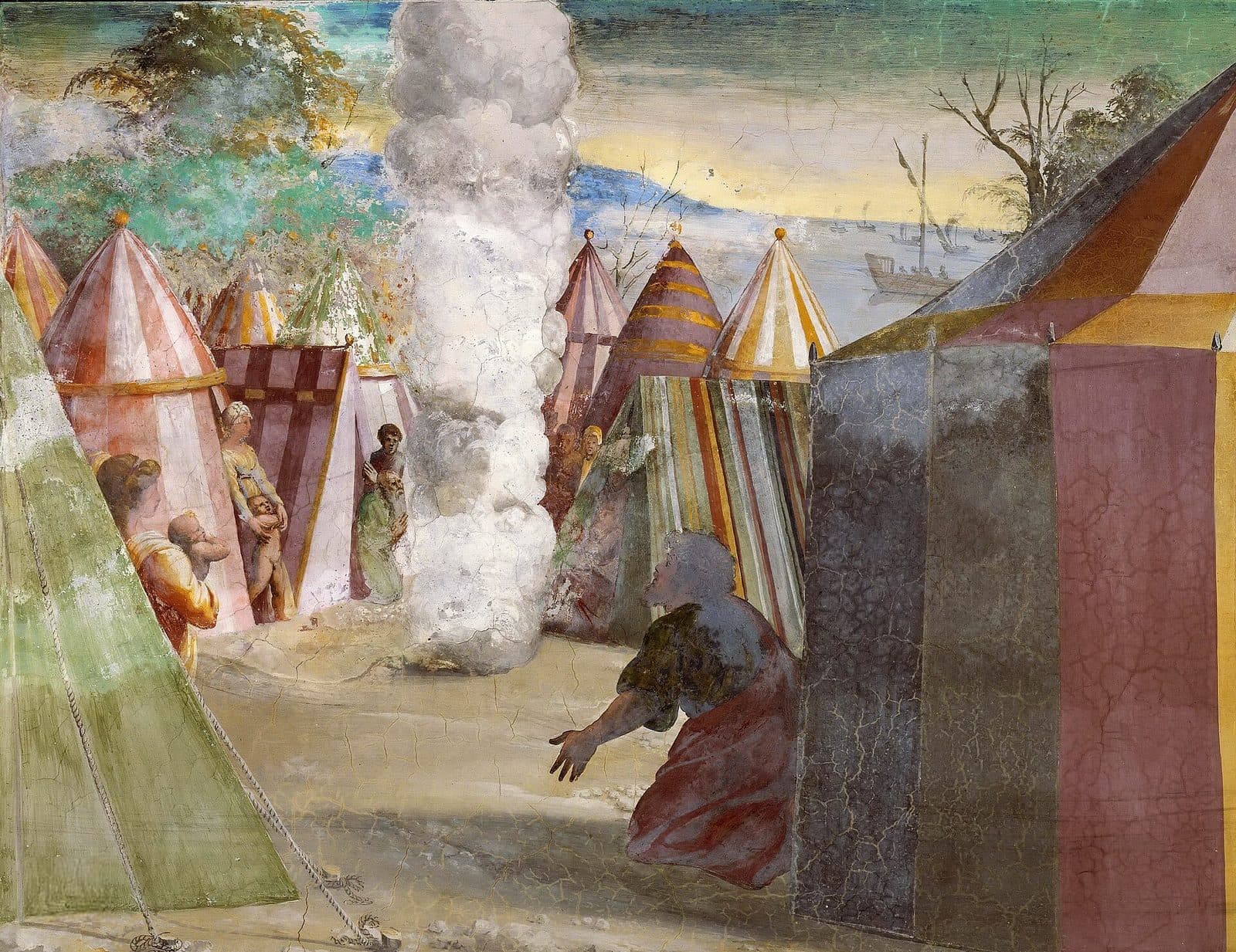
Workshop of Raphael, Moses and the pillar of cloud, fresco in the Loggia of the Vatican Palace, 1519. Public domain by date, published before 1930, via Wikimedia Commons.
THE ARTWORKRaphael's workshop painted the pillar of cloud standing among the tents of the camp, with an old man kneeling toward it and families watching from their tent doors. The fresco sets beside each other the cloud and the people at their own tents, the two sights Exodus 33:10 joins.
In this tent the LORD spoke to Moses face to face, as a man speaks to his friend.
Summary
The Tent of Meeting outside the camp is the tent Moses used to pitch at a distance from the camp in the days after the golden calf.
- Anyone inquiring of the LORD went out to it, and the pillar of cloud stood at its entrance when Moses went in.
- Joshua son of Nun stayed at the tent when Moses returned to the camp.
- In Exodus 40 the cloud covered the finished tabernacle, which is also called the Tent of Meeting, and Moses could not enter it.
- Rashi and Matthew Henry read the tent as one used until the tabernacle was built, and Gerhard von Rad and Brevard Childs read it as an older tradition of the tent.
The Five Verses of Exodus 33
Five verses of Exodus 33 give the tent, the watching camp, the cloud and the words spoken there.
The verbs of these verses tell what Moses used to do, so the scene they describe took place more than once.
Now Moses used to take the tent and pitch it at a distance outside the camp. He called it the Tent of Meeting, and anyone inquiring of the LORD would go to the Tent of Meeting outside the camp.This verse gives the tent its name and its place, and it opens the tent to more than Moses.
Then, whenever Moses went out to the tent, all the people would stand at the entrances to their own tents and watch Moses until he entered the tent.This verse shows the camp kept apart from the tent, watching Moses from its own doors.
As Moses entered the tent, the pillar of cloud would come down and remain at the entrance, and the LORD would speak with Moses. When all the people saw the pillar of cloud standing at the entrance to the tent, they would stand up and worship, each one at the entrance to his own tent.The cloud at the entrance was the sign the people could see from the camp, and they answered it with worship.
Thus the LORD would speak to Moses face to face, as a man speaks to his friend. Then Moses would return to the camp, but his young assistant Joshua son of Nun would not leave the tent.This verse closes the scene and brings Joshua into it.
The Tent and the Tabernacle Side by Side
The tent and the tabernacle share a name and differ in keeper and in who could go in.
| Point | The tent of Exodus 33 | The tabernacle | Verse |
|---|---|---|---|
| Its name | Moses called it the Tent of Meeting | The tabernacle, the Tent of Meeting | Exodus 40:2 |
| Who set it up | Moses, who used to take the tent and pitch it | Moses, on the first day of the first month of the second year | Exodus 40:17 |
| What stood inside | The five verses name nothing inside it, the ark included | The ark, the table, the lampstand and the gold altar | Exodus 40:20 to 26 |
| The cloud | The pillar of cloud came down and stood at the entrance | The cloud covered the tent and the glory filled the tabernacle | Exodus 40:34 |
| Who went in | Moses, each time he went out to it | Moses could not enter while the cloud rested on it | Exodus 40:35 |
| Who served at it | Joshua son of Nun | Aaron and his sons, anointed to serve as priests | Exodus 40:12 to 15 |
- Point
- Its name
- The tent of Exodus 33
- Moses called it the Tent of Meeting
- The tabernacle
- The tabernacle, the Tent of Meeting
- Verse
- Exodus 40:2
- Point
- Who set it up
- The tent of Exodus 33
- Moses, who used to take the tent and pitch it
- The tabernacle
- Moses, on the first day of the first month of the second year
- Verse
- Exodus 40:17
- Point
- What stood inside
- The tent of Exodus 33
- The five verses name nothing inside it, the ark included
- The tabernacle
- The ark, the table, the lampstand and the gold altar
- Verse
- Exodus 40:20 to 26
- Point
- The cloud
- The tent of Exodus 33
- The pillar of cloud came down and stood at the entrance
- The tabernacle
- The cloud covered the tent and the glory filled the tabernacle
- Verse
- Exodus 40:34
- Point
- Who went in
- The tent of Exodus 33
- Moses, each time he went out to it
- The tabernacle
- Moses could not enter while the cloud rested on it
- Verse
- Exodus 40:35
- Point
- Who served at it
- The tent of Exodus 33
- Joshua son of Nun
- The tabernacle
- Aaron and his sons, anointed to serve as priests
- Verse
- Exodus 40:12 to 15
The Tent in Numbers and Deuteronomy
Numbers 11 and 12 and Deuteronomy 31 tell of three more meetings at the Tent of Meeting.
In each scene the LORD appears in the cloud at the tent, as He did in Exodus 33:9.
The seventy eldersNumbers 11
So Moses went out and relayed to the people the words of the LORD, and he gathered seventy of the elders of the people and had them stand around the tent. Then the LORD came down in the cloud and spoke to him, and He took some of the Spirit that was on Moses and placed that Spirit on the seventy elders. As the Spirit rested on them, they prophesied—but they never did so again. Two men, however, had remained in the camp—one named Eldad and the other Medad—and the Spirit rested on them. They were among those listed, but they had not gone out to the tent, and they prophesied in the camp.Joshua son of Nun, the attendant to Moses since youth, spoke up and said, “Moses, my lord, stop them!” But Moses replied, “Are you jealous on my account? I wish that all the LORD’s people were prophets and that the LORD would place His Spirit on them!”Joshua speaks here as Moses' attendant, the role Exodus 33:11 gives him at the tent.
Aaron and MiriamNumbers 12
And suddenly the LORD said to Moses, Aaron, and Miriam, “You three, come out to the Tent of Meeting.” So the three went out, and the LORD came down in a pillar of cloud, stood at the entrance to the Tent, and summoned Aaron and Miriam. When both of them had stepped forward,The LORD calls the three out to the tent before He answers their complaint against Moses.
But this is not so with My servant Moses; he is faithful in all My house. I speak with him face to face, clearly and not in riddles; he sees the form of the LORD. Why then were you unafraid to speak against My servant Moses?”The LORD's answer takes up the words of Exodus 33:11 and gives them to Moses alone.
Joshua commissionedDeuteronomy 31
Then the LORD said to Moses, “Behold, the time of your death is near. Call Joshua and present yourselves at the Tent of Meeting, so that I may commission him.” So Moses and Joshua went and presented themselves at the Tent of Meeting. Then the LORD appeared at the tent in a pillar of cloud, and the cloud stood over the entrance to the tent.The young assistant of Exodus 33:11 is here made the leader who will follow Moses.
What the Text Says of the Tent
Calvin and Henry read three points of the verses, each set beside the verse that tests the reading.
FACE TO FACE
Exodus 33:11 uses the phrase face to face of the LORD's speech with Moses, and Exodus 33:20 says that no one can see Him and live. Calvin reads the first as close and familiar speech and the second as the limit of what a man could bear.
WHO WENT OUT TO THE TENT
Henry reads Exodus 33:7 as making every Israelite who sought the LORD welcome at the tent. Calvin reads it as a going out toward the tent, which the people knew they could not approach.
JOSHUA CALLED YOUNG
Exodus 33:11 calls Joshua young, though he had led the fight against Amalek in Exodus 17:9. Calvin suggests the word shows God's grace in giving a younger man the charge of the tent.
The Time and the Distance
Exodus sets the tent between two events, and Rashi gives its season and its distance.
Exodus places the tent after Moses broke the tablets at the foot of the mountain and before he gathered the people to build the tabernacle.
Then Moses assembled the whole congregation of Israel and said to them, “These are the things that the LORD has commanded you to do:This verse opens the account of the building, which runs to the end of the book.
Rashi's season for the tentRashi on Exodus 33:11
Rashi, the medieval French commentator, reckons that Moses kept this practice from the Day of Atonement until the tabernacle was set up, and no longer. From that day, he writes, God spoke with Moses only from the Tent of Meeting.
So the tabernacle was set up on the first day of the first month of the second year.Rashi's season ends on the date this verse gives for the setting up of the tabernacle.
Rashi's distanceRashi on Exodus 33:7
For the words at a distance, Rashi gives two thousand cubits and cites the space Israel kept from the ark at the Jordan.
But keep a distance of about two thousand cubits between yourselves and the ark. Do not go near it, so that you can see the way to go, since you have never traveled this way before.”This is the verse Rashi cites for his measure.
The Words of the Tent
Seven Hebrew words from the lexicon, each in a verse where it stands.
OHEL, TENT (HEBREW, H168)
The lexicon gives a tent, as clearly conspicuous from a distance, and counts 345 uses; Exodus 33:8 uses it both for the tent Moses entered and for the people's own tents.
MOED, MEETING (HEBREW, H4150)
The lexicon gives an appointment, a fixed time or season, and joined to ohel it names the tent of Exodus 33:7 and the tabernacle of Exodus 40:34 alike.
MISHKAN, TABERNACLE (HEBREW, H4908)
The lexicon gives a residence, and Exodus 40:35 uses it of the tabernacle the glory filled. Albert Barnes notes that the word does not occur in Exodus 33:7 to 11.
BAQASH, TO SEEK (HEBREW, H1245)
The lexicon gives to search out, specifically in worship or prayer, and the Berean text renders it inquiring in Exodus 33:7.
PANIM, FACE (HEBREW, H6440)
The lexicon gives the face, as the part that turns, and Exodus 33:11 sets the word twice in the phrase face to face.
REA, FRIEND (HEBREW, H7453)
The lexicon gives an associate, more or less close, and it is the word the Berean text gives as friend in Exodus 33:11.
SHARATH, TO MINISTER (HEBREW, H8334)
The lexicon gives to attend as a menial or worshipper, and Exodus 33:11 uses its participle for Joshua, Moses' assistant.
What the Text Leaves Unsaid
Exodus 33:7 to 11 leaves open the tent's span of use, its conversations and Joshua's work there.
The text does not say how often Moses went out to the tent or how long it stood outside the camp, and the season Rashi gives is his own reckoning. It gives none of the words the LORD spoke with Moses there, and it does not say where the conversation of Exodus 33:12 to 23 took place.
It says that Joshua did not leave the tent, and it does not say what he did there.
So Moses set out with Joshua his attendant and went up on the mountain of God.This verse shows Joshua already at Moses' side before the calf and the tent.
The Friend and the Son over the House
The meaning of the scene reaches past Exodus to the last chapter of Moses' life and to Christ.
Since that time, no prophet has risen in Israel like Moses, whom the LORD knew face to face—The book closes its account of Moses on this verse and the two after it.
Now Moses was faithful as a servant in all God’s house, testifying to what would be spoken later. But Christ is faithful as the Son over God’s house. And we are His house, if we hold firmly to our confidence and the hope of which we boast.Hebrews takes up Numbers 12:7, which the LORD spoke at the entrance of the tent, and sets Christ above Moses as the Son.
Teachers on the Tent
Ambrose of Milan and Matthew Henry, in three quotations with the work named.
Ambrose reads the tent outside the camp beside Christ's going out of the city.
“Therefore did Jesus go forth out of the city, that you going out of this world may be above the world. Moses alone, who saw God, had his tabernacle without the camp when he talked with God; and the blood indeed of the victims which were offered for sin, was brought to the altar, but the bodies were burnt without the camp; for no one placed amidst the evil of this world can lay aside sin, nor is his blood accepted of God, except he go forth from the defilement of this body.”
Ambrose of Milan · Epistle 63.104 · on Exodus 33:7Patristic
Henry reads the cloud's coming to the tent as a step back toward a camp it had left.
“The cloudy pillar, which had withdrawn itself from the camp when it was polluted with idolatry, now returned to this tabernacle at some distance, coming back gradually.”
Matthew Henry · Commentary on the Whole Bible · on Exodus 33:9Puritan
Henry draws a lesson for worship at home from the people bowing at their own doors.
“Thus must we worship God in our tents with an eye to Christ as the Mediator. Their worshipping in their tent doors declared plainly that they were not ashamed publicly to own their respect to God and Moses, as they had publicly worshipped the calf. God was, in Moses, reconciling Israel to himself, and manifested himself very willing to be at peace.”
Matthew Henry · Commentary on the Whole Bible · on Exodus 33:10Puritan
How the Tent Stands to the Tabernacle
Two readings of the tent with their holders and the strongest objection to each, and a third question on whose tent it was.
A tent used until the tabernacle was builtRashi, eleventh century; Matthew Henry, 1710
This reading takes the tent as one Moses used in the time between the calf and the building of the tabernacle, as Rashi reckons. Henry suggests the tent was a model of the tabernacle to come, drawn from the pattern shown on the mountain and used in the meantime as a place of meeting.
The objection: Numbers 11 and 12 and Deuteronomy 31, set after the tabernacle stood, still tell of going out to the Tent of Meeting. Numbers 2 sets the Tent of Meeting in the middle of the camp.
“The Israelites are to camp around the Tent of Meeting at a distance from it, each man under his standard, with the banners of his family.This order of the camp is the one the objection sets against a tent outside it.
An older tradition of a tent of meetingGerhard von Rad, 1931; Brevard Childs, 1974
This reading takes Exodus 33:7 to 11 as a tradition of a tent outside the camp, older than the account of the tabernacle in Exodus 25 to 40. Gerhard von Rad, in his essay The Tent and the Ark (1931), read the tent as a place of meeting and held that the tent and the ark came from separate traditions. Brevard Childs, in The Book of Exodus (1974), reads the passage as an early tradition of a sacred place outside the camp where people went to seek the LORD. He holds that it was later joined to the priestly account of the tabernacle, and he sets Numbers 12 and Deuteronomy 31 beside it.
The objection: Exodus gives the tent a place in its story before the tabernacle stood, and the reading of an older tradition must set that order aside. Exodus also calls the finished tabernacle the Tent of Meeting.
“On the first day of the first month you are to set up the tabernacle, the Tent of Meeting.The command to set up the tabernacle gives it the same name as the tent of Exodus 33:7.
Whose tent it wasRashi; Albert Barnes; Matthew Henry; John Calvin
Rashi says Moses took his own tent, and Albert Barnes calls it a tent appointed for a temporary purpose, possibly the one Moses lived in. Matthew Henry reads it as the tent where Moses gave audience and inquired of God, and not his family's tent. John Calvin answers the view that it was Moses' own tent with six arguments, among them that God showed His glory there and that the people sought God toward it.
Calvin also gathers from Exodus 33:11 that Moses lived in the camp, since Joshua stayed at the tent when Moses returned.
Books on the Tent
Four works to read whole, earliest first.
Commentaries on the Four Last Books of Moses Arranged in the Form of a Harmony
John Calvin · 1563
The third volume holds Calvin's notes on Exodus 33.
Read it free on CCELCommentary on the Whole Bible
Matthew Henry · 1710
Henry treats the tent as the place where Israel sought peace with God after the calf.
Read it free on CCELThe Problem of the Hexateuch and Other Essays
Gerhard von Rad · 1966
The volume carries in English his essay of 1931 on the tent and the ark.
In print: find it wherever books are sold.
The Book of Exodus
Brevard S. Childs · 1974
Childs wrote a critical and theological commentary on the whole of Exodus.
In print: find it wherever books are sold.
Go to Him Outside the Camp
In Exodus 33 whoever sought the LORD went out of the camp to the tent where He spoke with Moses. Hebrews 13 sets the sin offering burned outside the camp beside Jesus, who suffered outside the city gate.
Therefore let us go to Him outside the camp, bearing the disgrace He bore.This is what the text asks of the reader, and it names Jesus as the one to go out to.
Keep studying
People3
Symbols1