
Ephesians 2 · Doctrine · Featured Study
Saved by Grace Through Faith
Paul sums up the gospel in three verses, which say that salvation comes by grace, is received through faith and not earned by works, and that God made the saved for good works.
Ephesians 2 moves from people dead in their trespasses to people who are God's workmanship.
- First taught
- Ephesians 2:5
- Fullest statement
- Ephesians 2:8 to 10
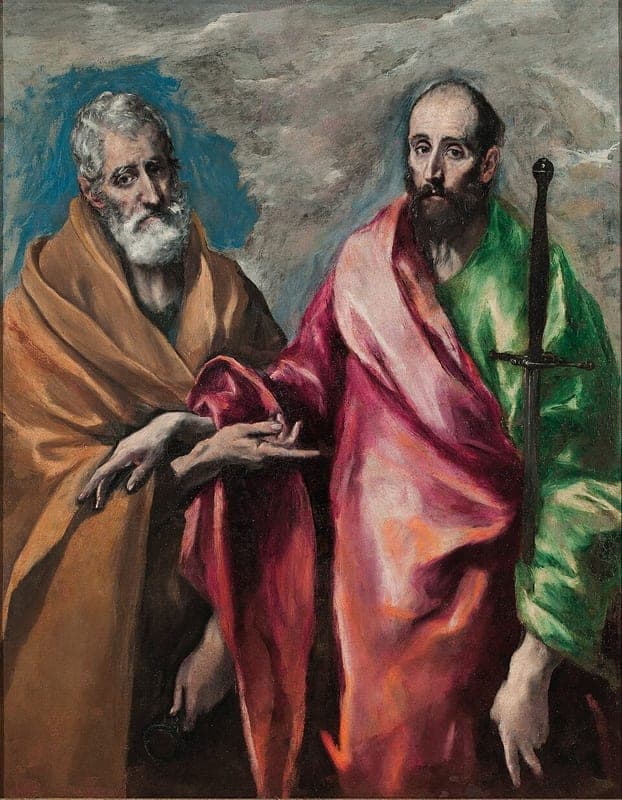
El Greco, Saint Peter and Saint Paul, from 1590. Public domain, via Wikimedia Commons.
THE ARTWORKEl Greco paints the two apostles with their hands joined. At Antioch Paul opposed Peter to his face over whether Gentiles must live like Jews, and the gospel he defended there is the one Ephesians 2 sums up.
Summary
The passage answers what saves a sinner, and its answer leaves no room for boasting.
- Paul first says that it is by grace you have been saved in verse 5, before he explains it.
- "You have been saved" is a perfect participle in the Greek, a form Paul uses only here and in verse 5.
- Readers since the fourth century have asked whether the gift of God is faith itself or the whole salvation.
- Readers from Polycarp of Smyrna to Charles Spurgeon have quoted the line and preached it.
Grace, Faith and Good Works
The three verses in the Berean text.
For it is by grace you have been saved through faith, and this not from yourselves; it is the gift of God, not by works, so that no one can boast.Verse 8 names the source and the means, and verse 9 rules out works and boasting.
For we are God’s workmanship, created in Christ Jesus to do good works, which God prepared in advance as our way of life.Verse 10 gives the reason no one can boast and names what the saved were made to do.
The Same Gospel Across the Canon
Nine texts from Genesis to Titus, each saying part of what the three verses say together.
- What it says
- Abram believed the LORD, and it was credited to him as righteousness
- Ephesians 2
- Through faith
- What it says
- justified freely by His grace through the redemption that is in Christ Jesus
- Ephesians 2
- By grace
- What it says
- Where, then, is boasting? It is excluded
- Ephesians 2
- No one can boast
- What it says
- a man is justified by faith apart from works of the law
- Ephesians 2
- Through faith
- What it says
- to the one who does not work, but believes in Him who justifies the wicked, his faith is credited as righteousness
- Ephesians 2
- The gift of God
- What it says
- if it is by grace, then it is no longer by works
- Ephesians 2
- Not by works
- What it says
- a man is not justified by works of the law, but by faith in Jesus Christ
- Ephesians 2
- Not by works
- What it says
- not because of our works, but by His own purpose and by the grace He granted us in Christ Jesus
- Ephesians 2
- By grace
- What it says
- He saved us, not by the righteous deeds we had done, but according to His mercy
- Ephesians 2
- Not by works
Each numbered card opens its verse in the reader.
The Sentence, Phrase by Phrase
Six phrases of the three verses, each with the Greek word it turns on.
By gracecharis, 1 paragraph, 1 verse card
Grace, charis, stands in twelve verses of Ephesians. Grace is the source of the salvation, and Paul names it first.
in order that in the coming ages He might display the surpassing riches of His grace, demonstrated by His kindness to us in Christ Jesus.The verse shows that the grace of verse 8 is what God means to put on display.
You have been savedsōzō, 1 paragraph, 1 verse card
The Greek is sesōsmenoi, a perfect passive participle of sōzō, to save. This form of the verb stands in only two places in the New Testament, Ephesians 2:5 and Ephesians 2:8. Adam Clarke in his Commentary on the Bible and Matthew Henry in his Commentary on the Whole Bible both read it as a state the readers are now in, brought into a state of salvation.
made us alive with Christ even when we were dead in our trespasses. It is by grace you have been saved!The line breaks into the account of what God did for the dead, before Paul gives the reason.
Through faithpistis, 1 paragraph, 1 verse card
Faith, pistis, is the means. Jamieson, Fausset and Brown call it the instrument on the part of the person saved, with Christ alone the meritorious agent.
Therefore, since we have been justified through faith, we have peace with God through our Lord Jesus Christ, through whom we have gained access by faith into this grace in which we stand. And we rejoice in the hope of the glory of God.Romans 5 makes faith the way into grace, the pairing Ephesians 2:8 makes.
The giftdōron, 1 paragraph
The word for gift, dōron, stands 19 times in the New Testament, most often for an offering brought to the altar. Ephesians 2:8 is its only place in the letters that open with Paul's name. Here God is the giver.
Works and boastingergon, kauchaomai, 1 paragraph, 1 verse card
Paul gives the reason works are ruled out: works would give the saved something to boast of.
If Abraham was indeed justified by works, he had something to boast about, but not before God.Romans 4 applies the same reasoning to Abraham, the father of all who believe.
His workmanship, created for good workspoiēma, 2 paragraphs, 1 quotation
Workmanship, poiēma, means a thing made. It stands only twice in the New Testament: here, of the saved, and in Romans 1:20, of the creation that shows God's power. Prepared in advance, proetoimazō, also stands only twice, here and in Romans 9:23.
The same noun for works, ergon, stands in verse 9 and in verse 10. The verb walk frames the passage: in verse 2 the readers walked in trespasses and sins, and in verse 10 they walk in the good works God prepared. The verb created returns in Ephesians 2:15, where Christ creates one new man out of the two, and in Ephesians 4:24, of the new self.
“‘For good works, which God afore prepared that we should walk in them.’ Not merely that we should begin, but that we should walk in them, for we need a virtue which shall last throughout, and be extended on to our dying day. If we had to travel a road leading to a royal city, and then when we had passed over the greater part of it, were to flag and sit down near the very close, it were of no use to us. This is the hope of our calling; for ‘for good works’ he says. Otherwise it would profit us nothing.”
John Chrysostom · Homily on Ephesians 4 · on Ephesians 2:10Patristic
What the Text Says and What Is Often Said
Two common readings of the passage, each set beside the verse that answers it.
FAITH IS THE WORK THAT EARNS SALVATION
Faith in verse 8 is the hand that receives the gift. A gift is taken, and the one who takes it has nothing to boast of.
GRACE MAKES GOOD WORKS OPTIONAL
The walk in good works is what the new person was made for. Jamieson, Fausset and Brown add that Paul never calls the works of the law good works.
A Prisoner Writes to Gentiles
Paul's chains, his years in Ephesus and his first readers.
Paul calls himself the prisoner of Christ for the sake of the Gentiles, and an ambassador in chains. The letter is commonly dated AD 60 to 62. He had taught in Ephesus for two years, until everyone in the province of Asia had heard the word of the Lord.
His readers had been Gentiles, separate from Christ and strangers to the covenants of the promise. Paul tells them how God saved them before he tells them that they are now fellow citizens with the saints and members of God's household.
Polycarp of Smyrna quotes Ephesians 2:81 paragraph, 1 quotation
His letter to the Philippians sets the words beside Christ's death and resurrection.
“I have greatly rejoiced with you in our Lord Jesus Christ, because ye have followed the example of true love [as displayed by God], and have accompanied, as became you, those who were bound in chains, the fitting ornaments of saints, and which are indeed the diadems of the true elect of God and our Lord; and because the strong root of your faith, spoken of in days long gone by, endureth even until now, and bringeth forth fruit to our Lord Jesus Christ, who for our sins suffered even unto death, [but] ‘whom God raised from the dead, having loosed the bands of the grave.’ ‘In whom, though now ye see Him not, ye believe, and believing, rejoice with joy unspeakable and full of glory;’ into which joy many desire to enter, knowing that ‘by grace ye are saved, not of works,’ but by the will of God through Jesus Christ.”
Polycarp of Smyrna · Epistle to the Philippians 1 · on Ephesians 2:8Patristic
What the Text Leaves Unsaid
What the three verses do not say.
The passage does not define faith or say when it begins. It names neither baptism nor the law of Moses. It gives no list of the good works it names.
Grace and Works Together
James and Philippians, read beside verse 10.
Verse 10 puts God's making first and the walk after it. Philippians 2:12 to 13 keeps the same order.
As you can see, a man is justified by his deeds and not by faith alone.James sets deeds beside faith so that no one can claim a faith that does nothing.
Therefore, my beloved, just as you have always obeyed, not only in my presence, but now even more in my absence, continue to work out your salvation with fear and trembling. For it is God who works in you to will and to act on behalf of His good purpose.The verse answers the fear that grace leaves the believer nothing to do.
Readers Across the Centuries
Ambrose, Jerome, John Chrysostom and Charles Spurgeon on the three verses.
Ambrose of Milan on trusting the grace of ChristOn the Sacraments 5.4.19
“You have become a good son from a wicked servant; therefore, presume not from your own works, but from the grace of Christ: for by grace you have been saved, says the Apostle. Therefore, this is not arrogance, but faith: to preach what you have received is not pride, but devotion.”
Ambrose of Milan · On the Sacraments 5.4.19 · on Ephesians 2:8Patristic
Jerome on what it means to be God's creationCommentary on Ephesians
“We are his creation. This means that it is from him that we live, breathe, understand and are able to believe, because he is the One who made us. And note carefully that he did not say ‘we are his fashioning and molding’ but ‘we are his creation.’ Molding starts with the mud of the earth, but creation from the outset is ‘according to the image and likeness of God.’”
Jerome · Commentary on Ephesians 2:10 · on Ephesians 2:10Patristic
John Chrysostom on the new creationHomily 4 on Ephesians
“‘For we are His workmanship, created in Christ Jesus for good works, which God afore prepared that we should walk in them.’ Observe the words he uses. He here alludes to the regeneration, which is in reality a second creation. We have been brought from non-existence into being. As to what we were before, that is, the old man, we are dead. What we are now become, before, we were not. Truly then is this work a creation, yea, and more noble than the first; for from that one, we have our being; but from this last, we have, over and above, our well being.”
John Chrysostom · Homily on Ephesians 4 · on Ephesians 2:10Patristic
Charles Spurgeon on grace and good works side by sideMetropolitan Tabernacle Pulpit, sermon 2210
“I shall call your attention to the near neighborhood of these two phrases, ‘Not of works’ and, ‘Created in Christ Jesus unto good works.’ The text reads with a singular sound, for it seems strange to the ear that good works should be given such a negative description as to the cause of salvation and then should be spoken of as the great end of it! You may put it down among what the Puritans called, ‘Orthodox Paradoxes,’ if you please, though it is hardly so difficult a matter as to deserve the name.”
Charles Spurgeon · The Metropolitan Tabernacle Pulpit, Sermon No. 2210: “The Agreement Of Salvation By Grace With Walking In Good Works” (lightly modernized text, CCEL edition) · on Ephesians 2:9 to 10
Where Readers Differ
Six readings on three questions, each with its holders and the strongest objection.
Every reader below holds that salvation is by grace and not by works. The first two readings answer what the gift of God names, the next two how grace and believing relate, and the last two how Paul and James agree.
Faith itself is God's giftJohn Chrysostom, Jerome, Jamieson, Fausset and Brown
Chrysostom in his Homily on Ephesians 4 and Jerome in his Commentary on Ephesians read faith as part of the gift. Jamieson, Fausset and Brown, in their Commentary Critical and Explanatory, name it the act of believing.
“‘For by grace,’ saith he ‘have ye been saved.’ In order then that the greatness of the benefits bestowed may not raise thee too high, observe how he brings thee down: ‘by grace ye have been saved,’ saith he, ‘Through faith;’ Then, that, on the other hand, our free-will be not impaired, he adds also our part in the work, and yet again cancels it, and adds, ‘And that not of ourselves.’ Neither is faith, he means, ‘of ourselves.’ Because had He not come, had He not called us, how had we been able to believe? for ‘how,’ saith he, ‘shall they believe, unless they hear?’ So that the work of faith itself is not our own. ‘It is the gift,’ said he, ‘of God,’ it is ‘not of works.’ Was faith then, you will say, enough to save us? No; but God, saith he, hath required this, lest He should save us, barren and without work at all. His expression is, that faith saveth, but it is because God so willeth, that faith saveth. Since, how, tell me, doth faith save, without works? This itself is the gift of God.”
John Chrysostom · Homily on Ephesians 4 · on Ephesians 2:8Patristic
The objection is the grammar. This, touto, is neuter in the Greek, while grace and faith are both feminine nouns, so the word does not point to faith alone.
The whole salvation comes from GodJohn Wesley, Marius Victorinus, Adam Clarke
Wesley in his Explanatory Notes upon the New Testament (1755) reads this, touto, as the whole clause before it, that you are saved through faith. Marius Victorinus in his commentary on Ephesians reads the gift as the salvation itself, and Adam Clarke in his Commentary on the Bible says the salvation is in no sense of ourselves.
“The fact that you Ephesians are saved is not something that comes from yourselves. It is the gift of God. It is not from your works, but it is God's grace as God's gift, not from anything you have deserved. Our works are one thing, …”
Gaius Marius Victorinus · Epistle to the Ephesians 1.2.9 · on Ephesians 2:9Patristic
The objection is that the whole includes the faith, so on this reading faith is still given by God. Both readings agree that nothing in the salvation comes from the one who is saved.
God gives faith to those dead in sinJohn Calvin, John Piper
Calvin's note on Ephesians 2:1 in his Commentaries is the premise of this reading. John Piper draws the conclusion for faith: our faith is a gift of God, the work of grace when we were dead (A Whole World Hangs on a Word, 2013).
“But what has this to do with the kingdom of God? What has it to do with a happy life, so long as every sentiment of the mind, and every act of the will, is death? Let this, then, be held as a fixed principle, that the union of our soul with God is the true and only life; and that out of Christ we are altogether dead, because sin, the cause of death, reigns in us.”
John Calvin · Commentaries · on Ephesians 2:1Reformed
The objection is that Scripture commands belief, as Paul and Silas tell the jailer to believe in the Lord Jesus, and a command assumes a real act of the person addressed.
Grace goes before and enables a will that answersJohn Wesley, John Chrysostom, Jerome
Chrysostom and Jerome both keep free choice: God calls, and the one called believes. Wesley, in his Explanatory Notes on Matthew 13:20, speaks of the preventing grace of God, the grace that comes first and draws the hearer, and the Wesleyan-Pentecostal tradition stands in his line.
“Paul says this in case the secret thought should steal upon us that ‘if we are not saved by our own works, at least we are saved by our own faith, and so in another way our salvation is of ourselves.’ Thus he added the statement that faith too is not in our own will but in God's gift. Not that he means to take away free choice from humanity … but that even this very freedom of choice has God as its author, and all things are to be referred to his generosity, in that he has even allowed us to will the good.”
Jerome · Commentary on Ephesians 2:8-9 · on Ephesians 2:8Patristic
The objection is verse 5, where God made the dead alive with Christ, an act in which the dead do nothing. Jamieson, Fausset and Brown hold the two together, calling the responsibility of man and the sovereign grace of God coexistent.
Paul and James agree: works follow true faithJohn Wesley, Jamieson, Fausset and Brown, Augustine
Wesley in his Explanatory Notes upon the New Testament writes that faith justifies not as a work but as it receives Christ. Jamieson, Fausset and Brown, in their Commentary Critical and Explanatory, write that justifying faith includes obedience in germ from the first. Augustine's note on Romans 3:28 guards the same line from the other side.
“This must not be understood in such a way as to say that a man who has received faith and continues to live is righteous, even though he leads a wicked life.”
Augustine of Hippo · QUESTIONS 76.1 · on Romans 3:28Patristic
The objection is that James 2:24 uses justified of deeds, the same word Paul uses of faith in Romans 3:28.
Faith and the works grace gives justify togetherThe Council of Trent, Augustine
The Council of Trent teaches that justification begins from God's prevenient grace, apart from any merit, and that the justified grow in it through good works. Augustine's line from The Spirit and the Letter stands behind the Catholic reading of grace and works.
“Grace is given not because we have done good works but in order that we may have power to do them, not because we have fulfilled the law but in order that we may be able to fulfill it.”
Augustine of Hippo · The Spirit and the Letter 16.10 · on Romans 11:6Patristic
The objection is Ephesians 2:9 with Romans 11:6, where grace and works are set apart as two grounds that cannot be mixed. The debate Faith and Works sets out this question in full.
Books to Read Next
Three works on Ephesians 2, from the fourth century to the nineteenth.
Homilies on Ephesians
John Chrysostom · before 407
Homily 4 reads Ephesians 2:4 to 10 phrase by phrase and asks how faith saves without works.
Explanatory Notes upon the New Testament
John Wesley · 1755
Wesley gives the Wesleyan reading of grace, faith and works on Ephesians 2 in a few short notes.
The Agreement of Salvation by Grace with Walking in Good Works
Charles Spurgeon · 1891
Sermon 2210 in the Metropolitan Tabernacle Pulpit preaches verses 9 and 10 together.
The Gift and the Walk
What the passage asks of its reader.
The salvation is God's work in Christ. The text asks three things of its reader: to take salvation as God's gift, to give God the credit for it, and to live the life He prepared.
As a prisoner in the Lord, then, I urge you to walk in a manner worthy of the calling you have received:Paul turns from the gospel of chapters 1 to 3 to the life it calls for, the walk worthy of the calling received.
Keep studying
Doctrines9
Go further1