
Isaiah 44 and 45 · Ezra 1 · Person · Featured Study
Cyrus, the LORD's anointed
The king of Persia who took Babylon in 539 BC and sent the exiles of Judah home.
Isaiah calls a Persian king the LORD's anointed, and in the same speech God tells him that he does not know Him.
- The name means
- The sun, as the Greek writers gave it, Albert Barnes writes
- Died
- about 530 BC (probable)
- Family
- father: Cambyses, king of Anshan; son: Cambyses
- Places
- Anshan, Babylon, Ecbatana, Jerusalem
- First named
- 2 Chronicles 36:22
- Last named
- Daniel 10:1
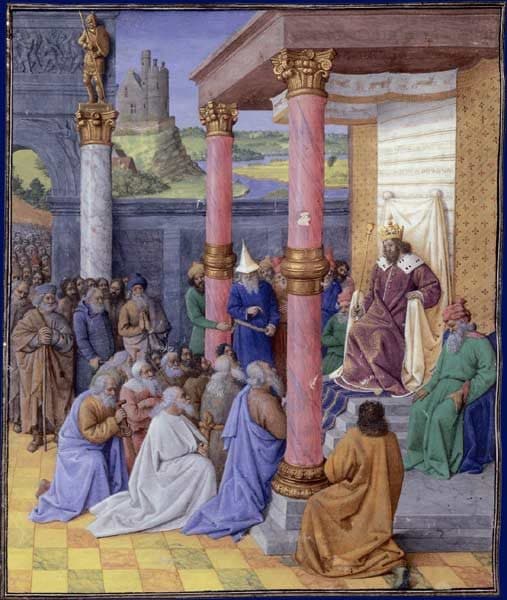
Jean Fouquet, Cyrus and the Hebrews, about 1470, from Les Antiquités judaïques, Bibliothèque nationale de France, Français 247. Public domain, via Wikimedia Commons.
THE ARTWORKFouquet painted the king on his throne receiving the elders of the exiles.
Summary
Four books of Scripture name Cyrus: Isaiah, 2 Chronicles, Ezra and Daniel.
- Isaiah also calls him the LORD's shepherd.
- In his first year he ordered the house of God rebuilt at Jerusalem.
- He sent back 5,400 gold and silver articles that Nebuchadnezzar had taken.
- Ezra says his decree fulfilled the word the LORD spoke through Jeremiah.
- The building stopped in his reign and waited until Darius.
Where Cyrus Stands in Scripture
Where 2 Chronicles, Ezra and Daniel name him, and the two verses of Isaiah that give his name
Second Chronicles ends with his decree, and Ezra opens with the same words. Daniel names him in three verses: Daniel 1:21, Daniel 6:28 and Daniel 10:1.
who says of Cyrus, ‘My shepherd will fulfill all that I desire,’ who says of Jerusalem, ‘She will be rebuilt,’ and of the temple, ‘Let its foundation be laid.’”Here the name comes a verse before the title, so the reader meets Cyrus as shepherd before he is called anointed.
This is what the LORD says to Cyrus His anointed, whose right hand I have grasped to subdue nations before him, to disarm kings, to open the doors before him, so that the gates will not be shut:A foreign king receives here the title that Israel gave its anointed kings and priests.
The Reign, Turn by Turn
From his rise in Persia to his death
- Begins to reign in Persiaabout 559 BC
- Babylon falls; Belshazzar is slain539 BC, Daniel 5:30
- The decree to build the househis first year, Ezra 1:1
- The temple articles counted out to Sheshbazzarhis first year, Ezra 1:8
- Daniel remains at courtuntil his first year, Daniel 1:21
- Cedar from Lebanon by his grantafter the return, Ezra 3:7
- Daniel's vision of a great conflicthis third year, Daniel 10:1
- Hired counselors frustrate the buildingthrough his reign, Ezra 4:5
- Dies, after 29 years of ruleabout 530 BC
The first and last dates come from Herodotus and from Anderson's chronological table; the other rows carry their verse.
From the Prophecy to the Decree
Daniel 5 and Ezra 1 to 6
Daniel 5 gives Belshazzar's kingdom to the Medes and Persians, as the writing on the wall had said.
The decree in two formsEzra 1:2 to 4 and Ezra 6:3 to 5
The first is a proclamation sent in writing through his whole kingdom, and the second is a memorandum found in the fortress of Ecbatana in Media, in the days of Darius.
“This is what Cyrus king of Persia says: ‘The LORD, the God of heaven, who has given me all the kingdoms of the earth, has appointed me to build a house for Him at Jerusalem in Judah. Whoever among you belongs to His people, may his God be with him, and may he go to Jerusalem in Judah and build the house of the LORD, the God of Israel; He is the God who is in Jerusalem. And let every survivor, wherever he lives, be assisted by the men of that region with silver, gold, goods, and livestock, along with a freewill offering for the house of God in Jerusalem.’”This form is addressed to the exiles, and calls them to go up and their neighbors to give.
In the first year of King Cyrus, he issued a decree concerning the house of God in Jerusalem: Let the house be rebuilt as a place for offering sacrifices, and let its foundations be firmly laid. It is to be sixty cubits high and sixty cubits wide, with three layers of cut stones and one of timbers. The costs are to be paid from the royal treasury. Furthermore, the gold and silver articles of the house of God, which Nebuchadnezzar took from the temple in Jerusalem and carried to Babylon, must also be returned to the temple in Jerusalem and deposited in the house of God.This form is addressed to the royal treasury, and sets the size of the house and pays its cost, which the first form leaves to the neighbors' gifts.
The articles of the house sent backEzra 1:7 to 11
Ezra says they came out of the temple of Nebuchadnezzar's gods, names the treasurer who counted them, Mithredath, and calls Sheshbazzar the prince of Judah. He lists the articles by kind before he gives the sum.
In all, there were 5,400 gold and silver articles. Sheshbazzar brought all these along when the exiles went up from Babylon to Jerusalem.The building stoppedEzra 4:1 to 5 and Ezra 4:24
The leaders of the return refused the help of their adversaries, citing the command of Cyrus.
Thus the construction of the house of God in Jerusalem ceased, and it remained at a standstill until the second year of the reign of Darius king of Persia.Here Ezra closes the building under Cyrus, and Ezra 5 and 6 take it up again under Darius until the house is finished.
What the Text Says of Cyrus
Four things the verses state plainly
HE CALLS ON MY NAME
Isaiah 41 says the one raised up from the north and the east calls on the LORD's name.
NAMED FOR JACOB'S SAKE
The reason given for the call is Israel: for the sake of Jacob My servant.
THE LORD STIRRED HIM
Ezra credits the decree to the LORD, who stirred the spirit of Cyrus.
FREED WITHOUT A PRICE
Isaiah says the man God raises will set the exiles free, but not for payment or reward.
Babylon in 539 BC
What a Babylonian chronicle, the Cyrus Cylinder and Herodotus tell
A Babylonian chronicle records that Cyrus defeated the army of Babylon at Opis. Sippar fell without a fight, and his army under Ugbaru entered Babylon without resistance.
His own clay cylinder says that Marduk, Babylon's god, sought a righteous prince and took him by the hand, and called Cyrus, king of Anshan, by name. Isaiah uses the same two pictures of the LORD and Cyrus.
What the cylinder says of the peoplesCyrus Cylinder, lines 30 to 32
The cylinder says Cyrus returned the gods of cities beyond the Tigris to their places and gathered their peoples back to their homes. Every place it names lies in Mesopotamia or east of the Tigris.
It shows the same policy that Ezra describes.
Herodotus on the fall of the cityHistories 1.191
Herodotus says Cyrus drew the Euphrates off into a marsh, and his men entered along the riverbed while the city held a festival.
The two accounts of how the city was entered do not agree.
Questions Cyrus Raises
Three questions answered from their sources
Did Cyrus read Isaiah?Josephus, Antiquities 11.1
Josephus says yes, and that what Cyrus read moved him to fulfil it.
A Christian writer of the sixth century tells the same story.
“For taking into his hands the book of Isaiah he found as he read the section which contained the prophecy concerning himself; since Isaiah says in that section: Thus saith the Lord to his Anointed, to Cyrus, whose right hand I have holden to subdue …”
Cosmas Indicopleustes · The Christian Topography, Book 8 · on Isaiah 45:1 to 4Patristic
Why does Ezra name Jeremiah?Jeremiah 29:10; Ezra 1:1
Ezra reads the decree as the end of the seventy years Jeremiah set for Babylon. Jamieson, Fausset and Brown note that the words about Jeremiah are the historian's, and were not part of the proclamation.
For this is what the LORD says: “When Babylon’s seventy years are complete, I will attend to you and confirm My promise to restore you to this place.The promise of a return to this place is what makes the call to go up to Jerusalem a fulfilment.
How did Cyrus die?Herodotus 1.214; Xenophon, Cyropaedia 8.7
Herodotus says he fell in battle against the Massagetae and their queen Tomyris. Xenophon has him die at home in old age, speaking to his sons.
What the Text Leaves Unsaid
Three things Scripture leaves open
Scripture never says that Cyrus turned to worship the LORD alone. On Isaiah 45:4 Jamieson, Fausset and Brown say Cyrus came to know God in some degree after God called him.
Scripture does not say whether Cyrus ever learned of the prophecy that named him. No book of Scripture records his death.
Why Isaiah Calls Him Anointed
The word mashiach, and how it has been read
Strong's Hebrew lexicon defines mashiach, the Hebrew word for anointed, as usually a consecrated person such as a king, priest or saint, and specifically the Messiah.
John Calvin, commenting on Isaiah 45:1, calls Cyrus a heathen king and a worshipper of idols. He says God gives Cyrus the title for a time, because he did the work of a redeemer in setting the people free.
Three Jewish readings of Isaiah 45:1Rashi; Ibn Ezra; the Talmud, Megillah 12a
Rashi says that every title of greatness is called anointing. Ibn Ezra allows that the word may mean the prophet or Cyrus.
The Talmud, in Megillah 12a, reads Isaiah 45:1 as God speaking to the Messiah about Cyrus. God complains that Cyrus only let the exiles go up and did not build.
A type of ChristJamieson, Fausset and Brown, 1871
On Isaiah 45:13 Jamieson, Fausset and Brown read the release of the exiles as a picture of the Messiah redeeming the captives of Satan.
On Isaiah 48:14 they hold that the LORD's words about Cyrus are too strong for Cyrus alone and fit him only as a type of the Messiah.
How the Anointed King Has Been Taught
Five teachers in their own words, from Tertullian to Albert Barnes
TertullianOn Isaiah 45:1
Tertullian reads Isaiah 45:1 in a text that has Lord where the Hebrew has Cyrus.
“‘Thus says the Lord God to my Christ [the] Lord, whose right hand I have held, that the nations may hear him, 'the powers of kings will I burst asunder; I will open before him the gates, and the cities shall not be closed to him.' ‘ This very thing we see now fulfilled. For whose right hand does God the Father hold but Christ's, his Son? All nations have heard of him, that is, people of all nations have believed. Their preachers, the apostles, are pointed to in the psalms of David: ‘Into the entire earth,’ he says, ‘is gone out their sound, and to the ends of the earth their words.’ For on whom else have nations the world over believed but on the Christ who has now already come?… In all these places the name of the Christ has already come to reign. He is the one before whom the gates of all cities have been opened and to whom none are closed, before whom iron bars have been crumbled and brazen gates opened. There is a spiritual sense affixed to these expressions. The hearts of individuals, having been blockaded in various ways by the devil, are now unbarred by the faith of Christ. This promise has already been evidently fulfilled, inasmuch as in all these places there are people who live believing in the name of Christ.”
Tertullian · An Answer to the Jews 7 · on Isaiah 45:1Patristic
JeromeOn Isaiah 44:28
Jerome explains why the Greek reads otherwise than the Hebrew at this verse.
“And he who restores Jerusalem, destroys Babylon. He also says to Cyrus, the king of the Persians, who first destroyed Babylon and the Chaldeans: you are my shepherd, or as the Septuagint translated, so that you may understand. The reason for this difference is clear. For the Hebrew word Roi, if we read it with the letter Res (ר), it is understood as my shepherd; if we read it with the letter Daleth (ד), it means my knowing or understanding, which are distinguished by a small apex, and therefore are often confused.”
Jerome · Commentary on Isaiah · on Isaiah 44:28Patristic
Cyril of AlexandriaOn Isaiah 45:1
Cyril of Alexandria answers how a foreign king can bear the name anointed.
“What is most clear is the power of the prophecy or the prophetic preaching. We should look at each of the lines to see clearly what seems obscure. For it calls Cyrus ‘Christ’ and not as if he were one of the saints, who could bear this name, but it functions to mean that he bears the name as anointed by God, in that God was in the habit of anointing those called to the kingdom even if they were not saints or worshipers. For we find the holy prophets saying to those who have received this, ‘The Lord has anointed you king over Israel.’ So Cyrus is the anointed one, anticipating Christ as king. Only through God has he triumphed and been brought to this triumphal song so as to reflect that since he is called ‘anointed,’ that is, by chrism and selection, he is called by God to the kingdom … so that you might know.… ‘I am the Lord God who calls your name, the God of Israel, for the sake of Jacob my servant/son and Jacob my chosen. I, God alone, have called you for this, and I have honored you with radiance, that you will be civil to my servant Israel. I have called you and have crowned you with glory, even though you do not know that I am the Lord and that there is no God other than me.’”
Cyril of Alexandria · Commentary on Isaiah · on Isaiah 45:1Patristic
TheodoretOn Isaiah 45:1
Theodoret answers from Scripture's own use of the word.
“The divine Scripture designates under the name ‘anointed’ not only those who are brought forward for unction but also those whom the God of the universe has singled out with a view toward [fulfilling] a required function. Thus, referring to the patriarchs who lived before …”
Theodoret of Cyrus · Commentary on Isaiah · on Isaiah 45:1Patristic
Albert BarnesOn Isaiah 45:1
Barnes stands with those who hold that one Isaiah spoke the whole book.
“Thus saith the Lord to his anointed - This is a direct apostrophe to Cyrus, though it was uttered not less than one hundred and fifty years before Babylon was taken by him. The word ‘anointed’ is that which is usually rendered ‘Messiah’ (משׁיח mâshı̂yach), and here is rendered by the Septuagint, Τῷ χριστῷ μου Κύρῳ Tō christō mou Kurō - ‘To Cyrus, my Christ,’ i. e, my anointed.”
Albert Barnes · Notes, Explanatory and Practical, on the Old and New Testaments (1832-1869) · on Isaiah 45:1Evangelical
Two Contested Questions
Who spoke Isaiah 44 and 45, and where Daniel's seventy weeks begin
One Isaiah, naming Cyrus beforehandJohn Wesley, Explanatory Notes upon the Old Testament; Jamieson, Fausset and Brown, Commentary Critical and Explanatory
John Wesley held that God names Cyrus two hundred years before his birth, as proof of His foreknowledge against the idols.
Jamieson, Fausset and Brown put the naming a hundred and fifty years before his reign.
The objection, from S. R. Driver's Introduction to the Literature of the Old Testament: Ezra, giving the decree, names no prophecy of Isaiah.
A prophet of the exileS. R. Driver, An Introduction to the Literature of the Old Testament
Driver dated Isaiah 40 to 66 to the exile, because the chapters speak of Cyrus as already stirred up and come. He wrote that the prophet does not claim to foreknow Cyrus, only what Cyrus will do.
The objection, from Jamieson, Fausset and Brown on Isaiah 48:6: the prediction was uttered long before its fulfilment.
Come together, all of you, and listen: Which of the idols has foretold these things? The LORD’s chosen ally will carry out His desire against Babylon, and His arm will be against the Chaldeans. I, even I, have spoken; yes, I have called him. I have brought him, and he will succeed in his mission.The one-Isaiah reading and the exile reading both turn on these verses, where the power to announce Cyrus in advance is the test the idols fail.
The seventy weeks begin with CyrusJohn Calvin, Commentary on Daniel
Calvin gives the reason: a free return was granted under Cyrus. He reads the first seven weeks as the repair of the city and temple under Cyrus and Darius.
The objection, from Sir Robert Anderson's The Coming Prince: the edict of Cyrus concerned the temple alone, and so could not begin Daniel's weeks.
The seventy weeks begin with ArtaxerxesSir Robert Anderson, The Coming Prince
Anderson counted 173,880 days from 14 March 445 BC, in the twentieth year of Artaxerxes.
The objection, from Isaiah 44:28: the LORD names Cyrus in the verse that says of Jerusalem, ‘She will be rebuilt.’
Books to Read Next
Seven works, from Herodotus to Rogers
The Histories, Book 1
Herodotus · Macaulay translation, 1890
Herodotus gives a Greek account of the reign of Cyrus.
Read free at Project GutenbergCyropaedia
Xenophon · about 365 BC
Xenophon draws Cyrus as the model of a king.
Read free at Project GutenbergAntiquities of the Jews, Book 11
Flavius Josephus · the thirteenth year of Domitian
Josephus tells the return from Babylon and the building of the temple.
Read free at Project GutenbergCommentary on Isaiah, Volume 3
John Calvin · sixteenth century
Calvin comments here on Isaiah 44:28 and Isaiah 45:1.
Read free at CCELThe Coming Prince
Sir Robert Anderson · eleventh edition, 1900
Anderson sets out his whole reckoning, with a chronological table.
Read free at the Internet ArchiveAn Introduction to the Literature of the Old Testament
S. R. Driver · fourth edition, 1892
Driver sets out the date and authorship of every book of the Old Testament.
Read free at the Internet ArchiveCuneiform Parallels to the Old Testament
Robert William Rogers · 1912
Rogers translates the Cyrus Cylinder and the chronicle of the fall of Babylon.
Read free at the Internet ArchiveThe Shepherd and the Good Shepherd
Isaiah 45:5 and Isaiah 45:6 give the purpose of the LORD's equipping him: so that all may know, from where the sun rises to where it sets, that there is none but Me.
In John 10:3 and John 10:11 Jesus calls Himself the good shepherd, who lays down His life for the sheep, calls his own sheep by name and leads them out. The text asks the reader to trust the LORD who rules kings, and to follow that Shepherd.
Keep studying
Studies8
Symbols1
Peoples and groups1