
Genesis 41:50 to 52 and 48:1 to 22 · Subject · Featured Study
Ephraim and Manasseh, the two tribes of Joseph
Joseph's two sons, born in Egypt, whom Jacob counted as his own and who became two tribes of Israel.
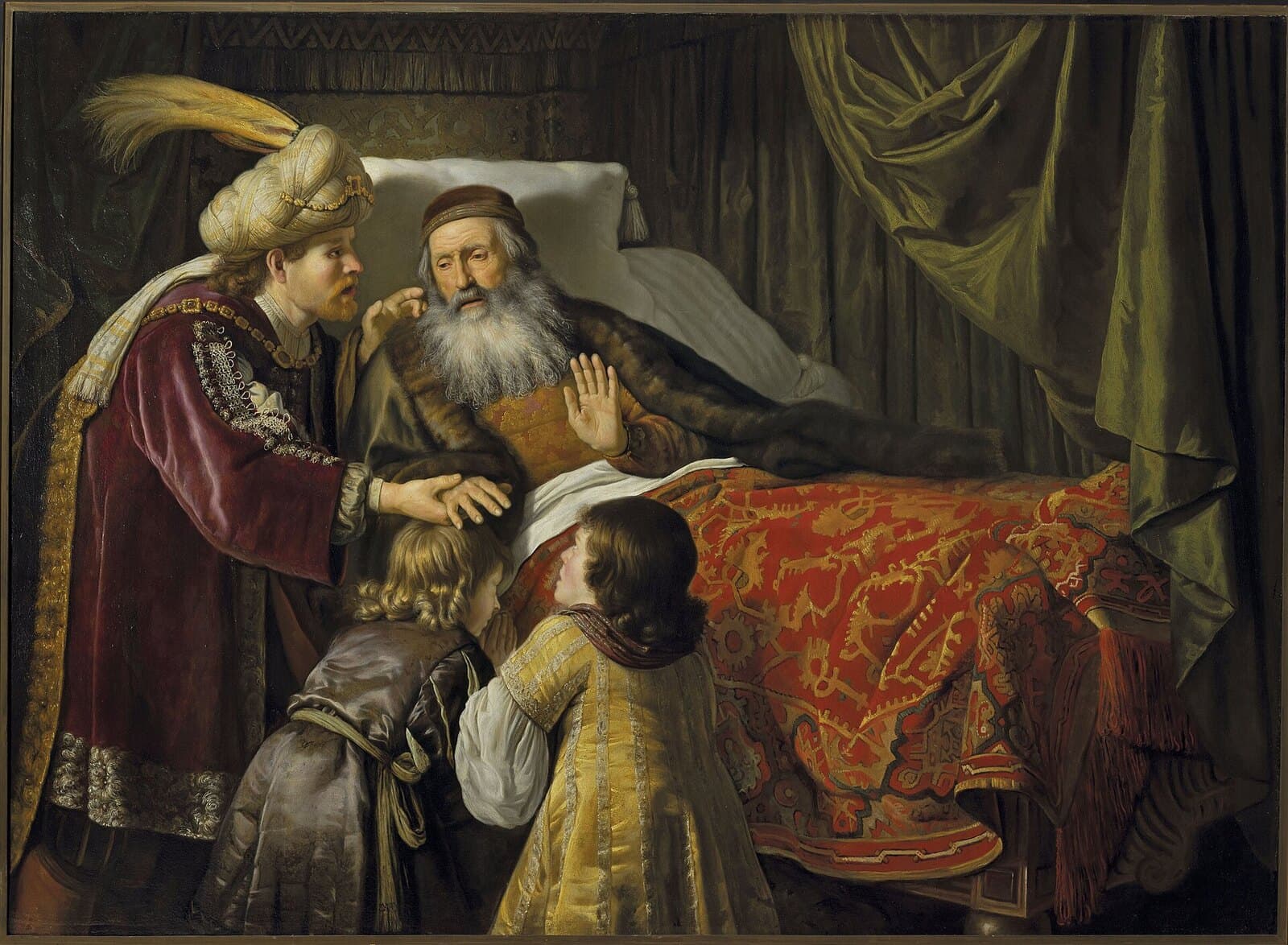
Jan Victors, Jacob Blessing the Sons of Joseph, 1650, National Museum in Warsaw. Public domain, via Wikimedia Commons.
THE ARTWORKVictors painted Joseph taking hold of his father's right hand to move it from the younger boy's head, while Jacob lifts his other hand to refuse him.
The plot at Shechem, bought for a hundred pieces of silver, held Joseph's bones and passed to his descendants as an inheritance.
Summary
Ephraim and Manasseh entered the tribes of Israel by Jacob's adoption in Genesis 48, and the younger, Ephraim, was set first.
- Both boys were born in Egypt before the famine, to Asenath daughter of Potiphera, priest of On.
- The first census in the wilderness counted more fighting men in Ephraim, and the second, on the plains of Moab, counted more in Manasseh.
- Half the tribe of Manasseh settled east of the Jordan in Gilead and Bashan, and Ephraim and the rest of Manasseh held the hill country west of it.
- The Chronicler says the birthright that Reuben lost was given to the sons of Joseph.
Two Sons Born in Egypt
Genesis 41, 46 and 48 tell of the boys' birth, their names and their adoption by Jacob.
Pharaoh gave Joseph a new name and a wife from the household of the priest of On.
Before the years of famine arrived, two sons were born to Joseph by Asenath daughter of Potiphera, priest of On. Joseph named the firstborn Manasseh, saying, “God has made me forget all my hardship and all my father’s household.” And the second son he named Ephraim, saying, “God has made me fruitful in the land of my affliction.”Each name gives thanks for something God did for Joseph in Egypt.
Years later Jacob's whole household came down to Egypt.
And with the two sons who had been born to Joseph in Egypt, the members of Jacob’s family who went to Egypt were seventy in all.Joseph's sons are counted in the household of Jacob from the first, and their count makes the seventy.
When Jacob fell ill, he spoke first of God's promise to him at Luz and then of the two boys.
And now your two sons born to you in Egypt before I came to you here shall be reckoned as mine; Ephraim and Manasseh shall be mine, just as Reuben and Simeon are mine. Any children born to you after them shall be yours, and they shall be called by the names of their brothers in the territory they inherit.Any later sons of Joseph would inherit under these two names, so Joseph's house would stand in Israel as two tribes.
But Israel stretched out his right hand and put it on the head of Ephraim, the younger; and crossing his hands, he put his left on Manasseh’s head, although Manasseh was the firstborn.The order of the two names in the blessing that follows rests on this act.
Sforno, a Jewish commentator of the sixteenth century, explains Joseph's protest in his commentary on Genesis: a blessing given with the right hand was held to be the stronger.
But his father refused. “I know, my son, I know!” he said. “He too shall become a people, and he too shall be great; nevertheless, his younger brother shall be greater than he, and his offspring shall become a multitude of nations.” So that day Jacob blessed them and said: “By you shall Israel pronounce this blessing: ‘May God make you like Ephraim and Manasseh.’” So he put Ephraim before Manasseh.Jacob's answer turns the blessing of two boys into a word about the two peoples they will become.
The Two Tribes Counted and Settled
Numbers and Joshua set Ephraim and Manasseh side by side.
| The text | Ephraim | Manasseh |
|---|---|---|
| First census, in the Wilderness of Sinai | 40,500 | 32,200 |
| Second census, on the plains of Moab | 32,500 | 52,700 |
| Land west of the Jordan | South of the Brook of Kanah | North of the Brook of Kanah |
| Land east of the Jordan | No share | Gilead and Bashan, for the clan of Machir |
- Ephraim
- 40,500
- Manasseh
- 32,200
- Ephraim
- 32,500
- Manasseh
- 52,700
- The text
- Land west of the Jordan
- Ephraim
- South of the Brook of Kanah
- Manasseh
- North of the Brook of Kanah
- The text
- Land east of the Jordan
- Ephraim
- No share
- Manasseh
- Gilead and Bashan, for the clan of Machir
The House of Joseph Through Scripture
Five passages after Genesis 48 return to Joseph's two sons.
Joseph is a fruitful vine—a fruitful vine by a spring, whose branches scale the wall.Jacob's word for fruitful here is the verb of Ephraim's name, spoken over Joseph among the twelve.
His majesty is like a firstborn bull, and his horns are like those of a wild ox. With them he will gore the nations, even to the ends of the earth. Such are the myriads of Ephraim, and such are the thousands of Manasseh.”Moses keeps Jacob's order, Ephraim first, and gives Ephraim the larger number.
The descendants of Joseph became two tribes, Manasseh and Ephraim. And no portion of the land was given to the Levites, except for cities in which to live, along with pasturelands for their flocks and herds.Joseph's two tribes fill the place in the land that Levi, given cities and no territory, leaves open.
These were the sons of Reuben the firstborn of Israel. Though he was the firstborn, his birthright was given to the sons of Joseph son of Israel, because Reuben defiled his father’s bed. So he is not reckoned according to birthright. And though Judah prevailed over his brothers and a ruler came from him, the birthright belonged to Joseph.The Chronicler explains why Reuben, the firstborn, is not listed first, and gives the birthright to Joseph's sons.
Radak, the Jewish commentator David Kimhi of about 1200, reads the return to the land in Genesis 48:21 as bringing Joseph an extra share. He calls it the share befitting the firstborn, which Jacob names in 48:22. He explains in his commentary on Genesis that Joseph's sons would inherit as if they were Jacob's own sons.
They will come with weeping, and by their supplication I will lead them; I will make them walk beside streams of waters, on a level path where they will not stumble. For I am Israel’s Father, and Ephraim is My firstborn.”Long after the tribes were settled, God calls Ephraim His firstborn in a promise to lead His people.
The Land of the House of Joseph
Joshua 16 and 17 set the bounds of the two tribes and record the inheritance of Machir, the claim of Zelophehad's daughters and the protest of Joseph's sons over their one portion.
The lot for Joseph's descendants was drawn as one, from the Jordan at Jericho to the Sea, and was then divided between the two tribes.
The places of Ephraim's lotJoshua 16
Ephraim's lot held places the later history of Israel would return to.
Matthew Henry, in his Commentary on the Whole Bible on Joshua 16:8, places Samaria, long the royal city of the kingdom of the ten tribes, in this tribe. He names Shechem, Mount Ebal and Mount Gerizim nearby, and Sychar by Jacob's well, where Christ talked with the woman of Samaria.
Machir and the land east of the JordanNumbers 32 and Joshua 17
Manasseh's son Machir was the father of Gilead, and under Moses his clan took Gilead from the Amorites and settled there.
Now this was the allotment for the tribe of Manasseh as Joseph’s firstborn son, namely for Machir the firstborn of Manasseh and father of the Gileadites, who had received Gilead and Bashan because Machir was a man of war.The verse names Manasseh as Joseph's firstborn even after Ephraim has been set first.
Matthew Henry, in his Commentary on the Whole Bible on Joshua 17:1, reports Bishop Patrick's view that the verse should read "though he was the first-born of Joseph". On that reading Manasseh took the second lot because Jacob had preferred Ephraim.
Albert Barnes, in his notes on Joshua 17:1, holds that Manasseh received the double portion of the firstborn, though Ephraim took precedence.
He saw Ephraim’s sons to the third generation, and indeed the sons of Machir son of Manasseh were brought up on Joseph’s knees.Joseph lived to see the sons of Machir, the clan that would take Gilead.
The daughters of ZelophehadJoshua 17:3 to 6
Zelophehad, of the clan of Hepher in Manasseh, had five daughters and no sons, and they asked Joshua for the inheritance the LORD had commanded Moses to give them.
Thus ten shares fell to Manasseh, in addition to the land of Gilead and Bashan beyond the Jordan, because the daughters of Manasseh received an inheritance among his sons. And the land of Gilead belonged to the rest of the sons of Manasseh.The daughters' claim is the reason the text gives for Manasseh's ten shares.
The complaint of the house of JosephJoshua 17:14 to 18
Then the sons of Joseph said to Joshua, “Why have you given us only one portion as an inheritance? We have many people, because the LORD has blessed us abundantly.” Joshua answered them, “If you have so many people that the hill country of Ephraim is too small for you, go to the forest and clear for yourself an area in the land of the Perizzites and the Rephaim.”The two tribes plead their numbers, and Joshua turns the plea back on them.
On Joshua 17:15 Barnes writes that Joshua reproves his kinsmen and bids them clear the wooded country to make room for their people.
The Hebrew of the Two Names
Both names come from Hebrew verbs, and Genesis and Chronicles use two words for the place of the firstborn.
In Genesis 41:51 the name Manasseh stands beside nashshani, from nashah, to make forget.
Ephraim stands beside hiphrani, from parah, to be fruitful, and the verse names the land of Joseph's affliction as the place of that fruit.
“It had been the land of his affliction, and in some sense it was still so, for it was not Canaan, the land of promise. His distance from his father was still his affliction. Note, Light is sometimes sown for the righteous in a barren and unlikely soil; and yet if God sow it, and water it, it will come up again.”
Matthew Henry · Commentary on the Whole Bible · on Genesis 41:50 to 52Puritan
Bekhor, the firstborn, is the word Genesis uses of Manasseh at his naming, at the crossing of the hands and in Joseph's protest.
Its companion bekhorah, the birthright, stands twice in 1 Chronicles 5:1 and once in 5:2.
The verb of Genesis 48:14 that the Berean text renders as crossing his hands is sikkel, glossed in the tagged Hebrew text as he laid cross-wise.
What the Text Leaves Unsaid
Genesis leaves three matters unexplained, and Revelation 7 leaves one.
Jacob tells Joseph that the younger brother shall be greater, and Genesis gives no reason why the younger was chosen.
Genesis 48:6 provides for sons born to Joseph after these two and gives them no names.
Asenath is named three times, each time as the daughter of Potiphera, priest of On, and Genesis tells nothing of her faith or of her life with Joseph.
The sealed tribes of Revelation 7Revelation 7:5 to 8
From the tribe of Judah 12,000 were sealed, from the tribe of Reuben 12,000, from the tribe of Gad 12,000, from the tribe of Asher 12,000, from the tribe of Naphtali 12,000, from the tribe of Manasseh 12,000, from the tribe of Simeon 12,000, from the tribe of Levi 12,000, from the tribe of Issachar 12,000, from the tribe of Zebulun 12,000, from the tribe of Joseph 12,000, and from the tribe of Benjamin 12,000.The list names Joseph and Manasseh among the sealed tribes and leaves out Ephraim and Dan, and the text gives no reason.
Ephraim, a Name for Israel
Two leaders of Israel came from the tribe of Ephraim, and the prophets use the tribe's name for the northern kingdom.
Joshua son of Nun was of the tribe of Ephraim, and so was Jeroboam son of Nebat, who rebelled against Solomon.
Isaiah calls the kingdom of Pekah, king of Israel, by the name Ephraim.
How could I give you up, O Ephraim? How could I surrender you, O Israel? How could I make you like Admah? How could I treat you like Zeboiim? My heart is turned within Me; My compassion is stirred!God's grief over Ephraim is grief over Israel, the two names set side by side.
Voices on the Two Sons
Three readings follow the crossed hands, Jacob's word over Joseph and the second census.
“The tree of life that was planted by God in paradise prefigured this honorable cross, for, since death came by a tree, it was necessary for life and the resurrection to be bestowed by a tree. It was Jacob who first prefigured the cross, when he adored the top of the rod of Joseph. And when he blessed Joseph's sons with his hands crossed, he most clearly described the sign of the cross.”
John Damascene · Orthodox Faith 4.11 · on Hebrews 11:21Patristic
“His two sons were as branches of a vine, or other spreading plant, running over the wall. Note, God can make those fruitful, great comforts to themselves and others, who have been looked upon as dry and withered. More is recorded in the history concerning Joseph than concerning any other of Jacob's sons; and therefore what Jacob says of him is historical as well as prophetical.”
Matthew Henry · Commentary on the Whole Bible · on Genesis 49:22Puritan
“Jacob had crossed hands upon their heads, and had preferred Ephraim before Manasseh, which perhaps the Ephraimites had prided themselves too much in, and had trampled upon their brethren the Manassites; but, when the Lord saw that Manasseh was despised, he thus multiplied him exceedingly, for it is his glory to help the weakest, and raise up those that are cast down.”
Matthew Henry · Commentary on the Whole Bible · on Numbers 26:28Puritan
Why the Younger Stands First
Commentators give two readings of Jacob's crossed hands, and each has its holders.
Readers of Genesis 48 have asked what the crossing of Jacob's hands rests on.
God's free choice of the youngerJohn Calvin; Matthew Henry
John Calvin comments on Genesis 48:17 in his Commentaries on the First Book of Moses Called Genesis. He writes that God gives the honor to the younger to show that He is bound by no claims of human merit and gives His gifts freely, as it seems good to Him.
Matthew Henry, in his Commentary on the Whole Bible, writes on Genesis 48:17 to 18 that grace does not keep the order of nature and that God prefers whom He pleases.
Yet before the twins were born or had done anything good or bad, in order that God’s plan of election might stand, not by works but by Him who calls, she was told, “The older will serve the younger.”Paul quotes the word Rebekah heard in Genesis 25:23 before her twins were born, and this reading takes Jacob, the younger twin, as the pattern for Jacob's own choice of Ephraim.
The objection is that Jacob gives the content of the blessing as the future size of two peoples. Calvin meets it in his comment on Genesis 48:19, where Jacob only pronounces what God had decreed and says that Ephraim will be more greatly multiplied than Manasseh.
A prophecy of Ephraim's later greatnessAdam Clarke; John Wesley
Adam Clarke, in his Commentary on the Bible, writes on Numbers 1:33 that Ephraim's larger number at the first census fulfilled the word of Genesis 48:19.
John Wesley, in his Explanatory Notes upon the Old Testament, counts Ephraim's eight thousand more at that census as a step toward the promise of Genesis 48:20. On Genesis 48:19 he says the division of Manasseh across the Jordan made it the less powerful tribe.
Numbers 26:34 and 26:37 count Manasseh the larger tribe at the second census, by 20,200 men.
Books on the Two Tribes
Four commentaries written between 1554 and 1869 follow the two tribes.
Commentaries on the First Book of Moses Called Genesis
John Calvin · 1554
Calvin holds that the Holy Spirit directed Jacob's hands at Genesis 48:14, and he reads the Angel of Genesis 48:16 as Christ.
Commentary on the Whole Bible
Matthew Henry · 1710
Henry follows the two brothers from Genesis 41 through the second census of Numbers to the lots of Joshua.
Commentary on the Bible
Adam Clarke · 1810 to 1826
Clarke traces the two sons in his notes on Genesis 41:50, Numbers 1:33 and Joshua 14:4, from their naming to the count of the tribes.
Notes, Explanatory and Practical, on the Old Testament
Albert Barnes · 1832 to 1869
Barnes's notes on Joshua 16 and 17 weigh the border between the two tribes and the cities Ephraim held inside Manasseh.
Blessed by Faith
By faith Jacob, when he was dying, blessed each of Joseph’s sons and worshiped as he leaned on the top of his staff.Hebrews sets this blessing between Isaac's blessing of Jacob and Esau concerning the future and Joseph's word about the exodus, each done by faith.
He predestined us for adoption as His sons through Jesus Christ, according to the good pleasure of His will,Jacob made two boys born outside the land his own sons, and Paul writes that God makes believers His sons through Jesus Christ.
Keep studying
Studies5
People8
Symbols5
Doctrines6
Peoples and groups2