
Genesis 22 · The Aqedah · An Iconic Story
The Binding of Isaac
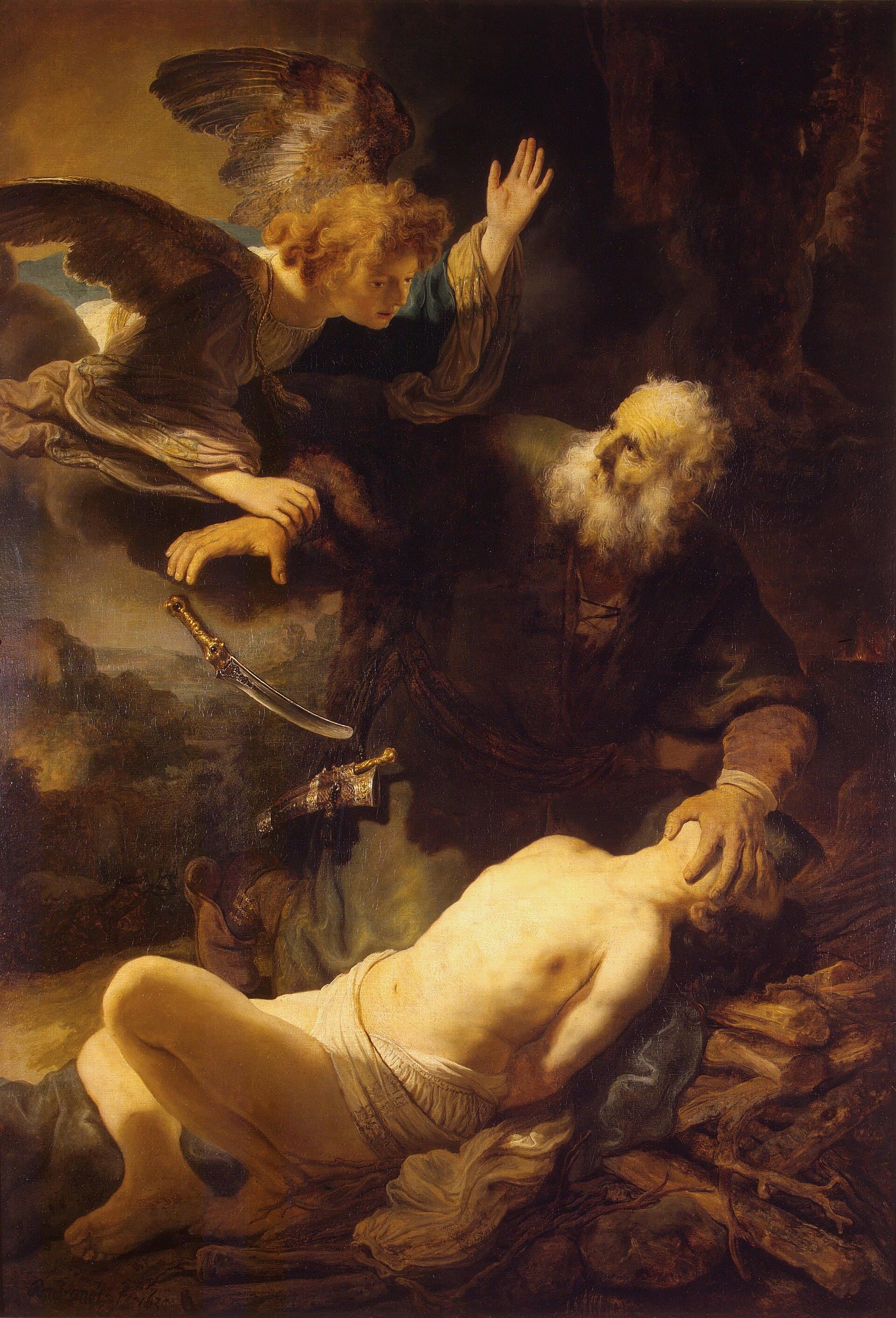
Rembrandt, The Sacrifice of Isaac (1635), Hermitage Museum. Public domain, via Wikimedia Commons.
THE ARTWORKRembrandt paints the exact second the story turns: the angel has seized Abraham's wrist and the knife is falling, still in the air, no longer in anyone's hand. Abraham's other hand covers Isaac's whole face, as if the old man could not obey and watch at once. The painting knows what the text knows: this sacrifice was never going to be completed, and the knife had to be already falling when heaven spoke.
Summary
Summary
This page walks Genesis 22 on the six-beat iconic-story pattern, drawing the road to Moriah as a walk and the Isaac-to-Christ pattern as a two-column chart that jumps both ways.
- Abraham was tested, never tempted: the text tells the reader it is a trial in verse 1, a fact Abraham himself never learns.
- Isaac is not a small child in the text: he carries the wood for his own burnt offering and asks the one question that names the whole chapter.
- The substitution itself rests on one preposition, tachat, "in the place of": the ram dies tachat the son.
- The Jewish reading of the Aqedah (Rosh Hashanah, the merit of the fathers) is presented at its own real weight, held distinct from the church's Christ-typology reading.
God Asks Back the Son He Promised
Genesis 22:1–19, told plainly
Abraham waited twenty-five years for Isaac. God had promised him a son, and descendants like the stars, and that through his family every nation on earth would be blessed, and every one of those promises ran through this one boy. Then one day God spoke again: take your son, your only son, whom you love, and offer him as a burnt offering on a mountain I will show you.
Some time later God tested Abraham and said to him, “Abraham!” “Here I am,” he answered. “Take your son,” God said, “your only son Isaac, whom you love, and go to the land of Moriah. Offer him there as a burnt offering on one of the mountains, which I will show you.”The text says “tested” before anything else happens, the reader knows what Abraham does not.
Abraham got up early the next morning. He saddled the donkey, split the wood with his own hands, and walked three days toward the mountain: long enough to turn back a thousand times. He told the servants to wait. He laid the wood on Isaac's back, carried the fire and the knife himself, and the two of them walked on together. Isaac asked the only question there was to ask: the fire and the wood are here: where is the lamb? And Abraham answered with the sentence the rest of the Bible spends its whole length unfolding: God Himself will provide the lamb.
On the mountain Abraham built the altar, arranged the wood, bound his son, and took the knife. The voice from heaven stopped his hand at the last possible instant — and there, caught in a thicket by its horns, was a ram. Abraham offered it in place of his son, and named the mountain The LORD Will Provide. Then God swore by Himself (the only oath big enough), that through this man's offspring all the nations of the earth would be blessed.
Eight stops from Beersheba to the oath, a walk of roughly fifty miles that the text crosses in three days and nineteen verses. Every stop opens in the reader.
For the great source of grief to him was not his own bereavement, not that he was commanded to slay his only heir, the hope of future memorial and of name, the glory and support of his family; but that, in the person of this son, the whole salvation of the world seemed to be extinguished and to perish.
John Calvin· Commentary on Genesis (1554), on Gen 22:1
Five Places the Retellings Drift
what the text actually says, against what the story has become
TESTED: NEVER TEMPTED
The first verse tells the reader what Abraham is never told: this is a test (Hebrew nissah: to prove, the same word for Israel proved in the wilderness). Scripture is explicit elsewhere that God tempts no one toward evil (Jas 1:13). The reader watches the trial knowing it is a trial; Abraham walks it blind.
ISAAC IS NOT A SMALL CHILD
The picture-book Isaac is a toddler. The text's Isaac carries enough firewood for a whole burnt offering up a mountain, and asks the precise, liturgically informed question: he knows what a sacrifice requires and sees what is missing. Whatever his age, he is strong enough to resist an old man, and doesn't.
“WE WILL RETURN TO YOU”
Before any ram appears, Abraham tells the servants: the boy and I will go over there and worship, and then WE will return to you. Plural. Hebrews 11:19 reads that plural as reasoned faith: Abraham concluded that God could raise the dead: because the promise ran through Isaac, and God does not break promises.
ABRAHAM SAYS LAMB; GOD SENDS A RAM
“God Himself will provide the lamb” (v.8), but what is caught in the thicket is a ram (ayil, v.13). The word Abraham used goes unanswered on this mountain. The question “where is the lamb?” stays open for two thousand years, until a prophet points at a man: “Behold the Lamb of God.”
“PROVIDE” IS LITERALLY “SEE”
The verb in “God will provide” (v.8) and in the mountain's name YHWH-Jireh (v.14) is ra'ah: to see. Hebrew lets both senses sound at once: the God who sees is the God who sees to it. The same verb carries the chapter: Abraham lifts his eyes and sees the place (v.4), then sees the ram (v.13).
THE BINDING GIVES THE STORY ITS NAME
The verb aqad (to bind), occurs exactly once in the entire Hebrew Bible: here, at verse 9, of Abraham binding Isaac. Jewish tradition named the whole episode after that single word: the Aqedah, “the Binding.” One hapax carries the title of one of Scripture's greatest chapters.
When God speaks, Abraham, no doubt, takes notice of every word, and listens attentively to it; and every word here is a sword in his bones: the trial is steeled with trying phrases.
Matthew Henry· Commentary on the Whole Bible (1710), on Gen 22:2
A World Where Gods Demanded Sons
the context the first hearers knew, and the polemic they heard
To modern ears the command is unthinkable. To Abraham's neighbors it was not. Child sacrifice was practiced in the world of the patriarchs and long after it: the Old Testament repeatedly legislates against giving children to Molech (Lev 18:21; 20:2–5), and kings of Judah were still burning sons in the Valley of Hinnom a thousand years later (2 Kgs 23:10; Jer 32:35). Archaeology agrees: excavations at Carthage, a colony carrying older Phoenician practice, uncovered burial precincts of cremated infants with dedicatory stelae bearing the consonants mlk, the same root the Bible vocalizes as Molech.
That background turns the chapter's ending into a thunderclap the first hearers could not miss. Every god of the nations might demand a son: thisGod stops the knife, forbids the sacrifice, and provides the offering Himself. Genesis 22 uses the most terrible currency of its age to declare that the God of Abraham is not Molech, and never was. Israel's later law would carve that distinction in stone.
Then Solomon began to build the house of the LORD in Jerusalem on Mount Moriah, where the LORD had appeared to his father David. This was the place that David had prepared on the threshing floor of Ornan the Jebusite.The only other “Moriah” in Scripture: Solomon's temple rises where Abraham's altar stood, and Israel's substitutionary sacrifices burn there for a thousand years.
And the place itself becomes part of the story. Chronicles names the temple mount “Mount Moriah”, the one spot on earth where a substitute would die in the sinner's place, morning and evening, for a millennium. Genesis names a region and lets God point to the mountain; Chronicles closes the distance. The tradition that Calvary itself stands in the same hills is old and loved, Wesley reaches for it below, and the text of Genesis asks only this much: that the mountain of the binding became the mountain of the altar.
And it is observable, that the temple, the place of sacrifice, was afterward built upon this mount Moriah, 2 Chron. iii, 1, and mount Calvary, where Christ was crucified, was not far off.
John Wesley· Notes on the Old Testament (1765), on Gen 22:13
What the Text Refuses to Tell
what the text does not say
Genesis 22 is nineteen verses long and spends none of them on feelings. Abraham rose, saddled, split, went, built, bound, reached (the narrative gives actions and withholds the heart, and the restraint is the artistry: the reader supplies the three days of silence. What Scripture leaves unsaid, this page leaves unsaid. But the silences deserve to be named, because each one has gathered centuries of tradition around it), and tradition should be labeled tradition.
How old was Isaac?
Genesis never states Isaac's age at the binding, but it leaves evidence. The word rendered “lad” at 22:5 and 22:12 is the word used of Joseph at seventeen (37:2) and of Benjamin as a grown father (44:22 to 44:34), so the word itself does not mean a small child. Sarah dies at 127 in the next chapter (23:1), and she bore Isaac at ninety, which sets a ceiling of thirty-seven on his age at the altar. He carries the wood of a burnt offering up the mountain and knows what is missing from the procession. The readings: a boy, the picture most readers inherit; a youth in his teens, which the word allows; a grown man in his twenties or thirties, which Josephus gives as twenty-five and Jewish tradition commonly as thirty-seven. The old commentators drew the inference from the wood:
Had not the patriarch been sustained by the full consciousness of acting in obedience to God's will, the effort would have been too great for human endurance; and had not Isaac, then upwards of twenty years of age displayed equal faith in submitting, this great trial could not have gone through.
Jamieson, Fausset & Brown· Commentary Critical and Explanatory (1871), on Gen 22:9
Where is Sarah?
Isaac's mother is never mentioned, not at the departure, not on the mountain, not at the return. The next chapter opens with her death, and Jewish tradition has long connected the two; the text itself draws no line between them. It simply lets the woman who laughed at Isaac's birth be absent from the story of his binding, and lets the reader feel the absence.
The walk down the mountain
“Abraham went back to his servants” (verse 19 does not name Isaac, and readers have noticed for two thousand years. Isaac does not speak again in the narrative until he meets Rebekah two chapters later. Nothing should be built on a silence; but it is striking that after the substitute dies, the text follows the father home and lets the son slip out of view), as if the story's camera knows the ram was the point.
What did they say to each other?
Three days of walking, and Scripture records one exchange: “My father”, “Here I am, my son”, “where is the lamb?”, “God Himself will provide the lamb.” Then, twice, the same closing line:and the two of them walked on together. Everything else on that road is silence, and the text means it to stay that way.
The Mountain Rehearses the Gospel
shadow on the left, substance on the right: every row jumps both ways
Then Abraham looked up and saw behind him a ram in a thicket, caught by its horns. So he went and took the ram and offered it as a burnt offering in place of his son.The chapter's hinge: a death in the place of a death: tachat, the preposition of substitution.
The next day John saw Jesus coming toward him and said, “Look, the Lamb of God, who takes away the sin of the world!Abraham said “lamb”; God sent a ram. Two thousand years later, the Baptist answers Isaac's question.
Isaac, the shadow
Christ, the substance
A note on honesty: the substitution (v.13), the beloved-only-son language (v.2), the temple site (2 Chr 3:1), and the resurrection-shaped reading (Heb 11:19) are the text's own claims. The wood-as-cross and third-day parallels are the church's devotional tradition (drawn as early as Melito of Sardis in the second century), and this chart presents them as beloved tradition, not as assertions of the text.
saying, “By Myself I have sworn, declares the LORD, that because you have done this and have not withheld your only son,“You have not withheld your only son…”
He who did not spare His own Son but gave Him up for us all, how will He not also, along with Him, freely give us all things?…and Paul reaches for the same words about the Father: “He who did not spare His own Son.” What Abraham was spared, God was not.
By faith Abraham, when he was tested, offered up Isaac on the altar. He who had received the promises was ready to offer his one and only son, even though God had said to him, “Through Isaac your offspring will be reckoned.” Abraham reasoned that God could raise the dead, and in a sense, he did receive Isaac back from death.The New Testament's own reading: Abraham reasoned resurrection, and received Isaac back as a living parable of it.
The Angel of the Lord - That is, God himself, the eternal Word, the Angel of the covenant, who was to be the great Redeemer and Comforter.
John Wesley· Notes on the Old Testament (1765), on Gen 22:11
Wesley's reading of the voice from heaven — the Angel of the LORD as the eternal Word Himself — belongs to a much larger study: the Angel of the LORD.
THE ARTWORK
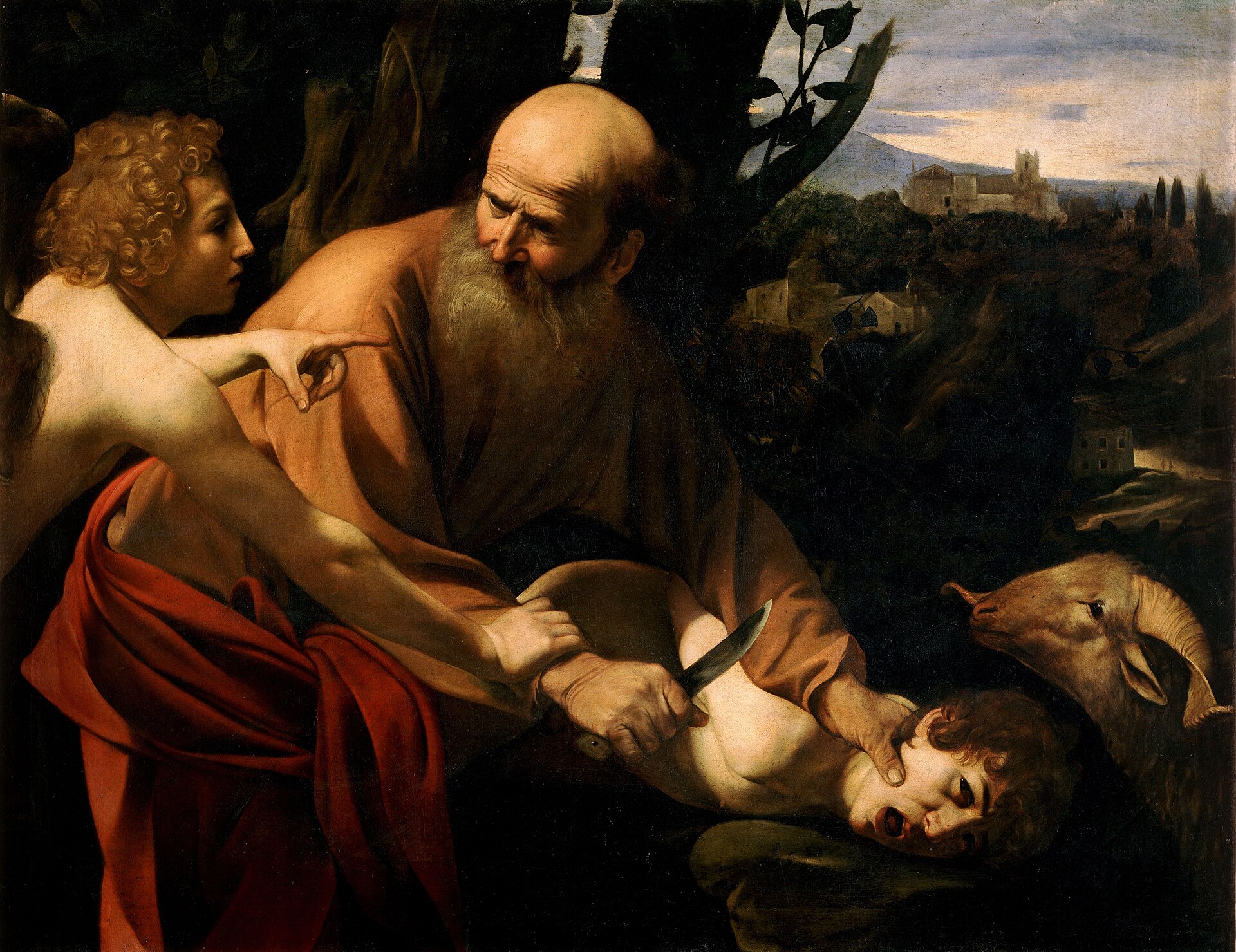
Caravaggio compresses the whole theology of the chapter into one canvas: the angel's hand grips Abraham's arm while the other hand points: at the ram, whose head is painted directly beside Isaac's own. Substitute and son, side by side at the same height: the exchange of Genesis 22:13, visible.
Michelangelo Merisi da Caravaggio, Sacrifice of Isaac (c. 1603), Uffizi Gallery, Florence. Public domain, via Wikimedia Commons.
Abraham was ready to give up his son for a sacrifice to the honour of God, and, on that occasion, God promised to give his Son a sacrifice for the salvation of man.
Matthew Henry· Commentary on the Whole Bible (1710), on Gen 22:18
How Two Faiths Read One Mountain
the church's reading, Israel's reading: each given honestly
The Aqedah in Jewish life
In Jewish tradition this chapter is not a Christ-type but the supreme test of Abraham — and of Isaac, whom the rabbis read as a willing adult participant. Genesis 22 is read in the synagogue on Rosh Hashanah, the ram's horn (shofar) itself recalling the ram caught in the thicket, and the liturgy pleads the zekhut— the merit — of the binding on behalf of Isaac's descendants. The standard modern study of this tradition is Jon D. Levenson's The Death and Resurrection of the Beloved Son(1993), which traces how deeply the offered-and-restored son shaped both Judaism and Christianity: two readings of one mountain, each claiming the pattern. This page reads the chapter toward Christ, and says so plainly; the Jewish reading is presented here as Israel's own, at its real weight, not as a foil.
What the text claims, and what tradition added
The load-bearing claims are the text's own: Isaac is the yachid, the beloved only son (the Greek translators rendered it with the very words the Father speaks over Jesus); the ram dies tachat, in the place of, the son; the mountain is the temple region; and Hebrews calls Isaac's return a parabolē— an enacted parable of resurrection. From Melito of Sardis in the second century onward, the church lovingly embroidered further parallels — the wood on the son's back, the three days, the silence. Those are treasured devotional tradition. This page keeps the two layers distinct on purpose: the type stands on what the text says, and stands stronger for not overclaiming.
Read the Great Books
the works that have carried this teaching: go further than this page
Commentary on Genesis
John Calvin · 1554
Calvin's pages on Genesis 22 are among the most searching ever written on the chapter, the quotation above, on the whole salvation of the world lying on the altar, is from them.
READ IT FREE AT CCEL →Commentary on the Whole Bible
Matthew Henry · 1710
Henry walks the chapter verse by verse with an eye on both the father's anguish and the gospel underneath it: “God promised to give his Son a sacrifice for the salvation of man.”
READ IT FREE AT CCEL →Fear and Trembling
Søren Kierkegaard · 1843
The most famous book ever written on this chapter: four retellings of the three days, circling the question of what Abraham's faith actually cost. Its English translations remain in print.
In print: find it wherever books are sold.
The Death and Resurrection of the Beloved Son
Jon D. Levenson · 1993
The standard scholarly study of how the offered son shaped Judaism and Christianity alike, the strongest account of the Jewish reading this page summarizes.
In print: find it wherever books are sold.
YHWH-Jireh: the Name the Mountain Kept
And Abraham called that place The LORD Will Provide. So to this day it is said, “On the mountain of the LORD it will be provided.”Abraham names the place not for the test, nor the knife, nor even the ram, but for the providing.
The chapter ends with a name, and the name is a promise tense: the LORD will provide— will see, and will see to it. On the mountain of the LORD it was provided: a ram for Isaac that morning, a temple's worth of substitutes on the same ridge for a thousand years, and at last the Lamb that Abraham's sentence had been waiting for. The story God stopped on Moriah is the story God finished at Calvary — the Father did not withhold His only Son.
Notable art
— click a piece to enlargeKeep studying
Read it1
By subject
Faith6 pages
The patriarchs7 pages
On this page
Symbols6