
Genesis 2 · Matthew 19 · 1 Corinthians 6 · Subject · Featured Study
The Body and Sexual Ethics in Scripture
What Scripture teaches about the body and sexual conduct, from the creation of man and woman in Genesis to the letters of Paul.
Paul told the Corinthians, “You are not your own; you were bought at a price.”
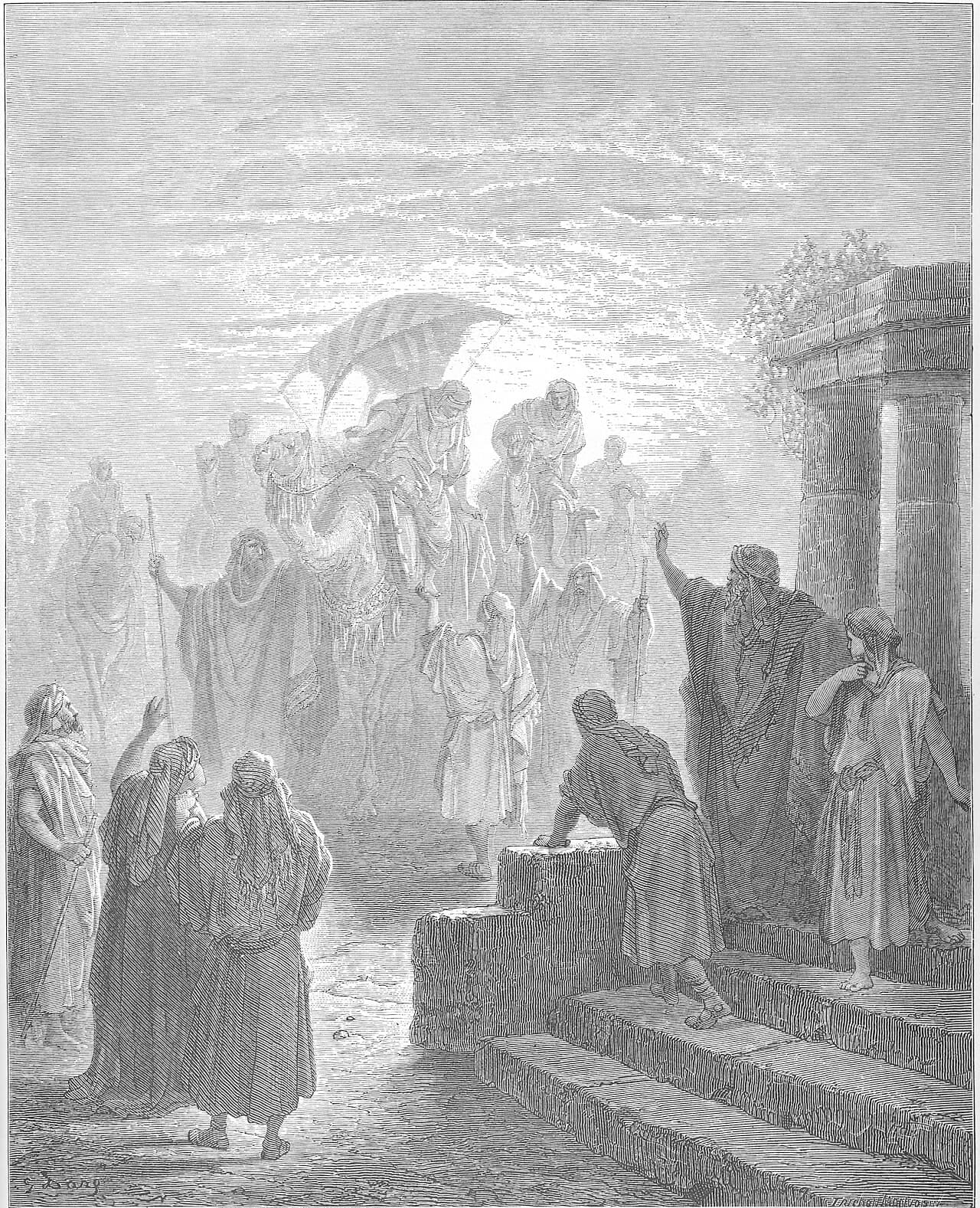
Gustave Doré, The Meeting of Isaac and Rebekah, 1866. Public domain (published before 1930), via Wikimedia Commons.
THE ARTWORKDoré engraved Rebekah's arrival at the end of Genesis 24, where Isaac takes her as his wife and loves her. The plate shows a marriage begun in public and before witnesses.
Summary
Scripture calls the body good, joins a husband and wife as one flesh, and calls the believer's body a temple of the Holy Spirit.
- The law of Moses forbids adultery and incest, and Proverbs commends faithful love within marriage.
- Jesus counts the lustful look as adultery in the heart and holds marriage to its design from the beginning.
- Paul tells believers to flee sexual immorality, and he calls the union of husband and wife a picture of Christ and the church.
Seven Passages on the Body
Seven passages from Genesis, Exodus, Matthew, 1 Corinthians and Hebrews
Genesis records the making of the body two chapters before it records any sin.
So God created man in His own image; in the image of God He created him; male and female He created them.This verse places male and female inside the image of God in the first chapter of Scripture.
And God looked upon all that He had made, and indeed, it was very good. And there was evening, and there was morning—the sixth day.God's verdict of very good covers the bodies of the man and the woman.
For this reason a man will leave his father and mother and be united to his wife, and they will become one flesh. And the man and his wife were both naked, and they were not ashamed.Jesus and Paul both quote the words one flesh from this verse when they teach on marriage.
You shall not commit adultery.Among the Ten Commandments one command guards the marriage bond.
Jesus answered, “Have you not read that from the beginning the Creator ‘made them male and female,’ and said, ‘For this reason a man will leave his father and mother and be united to his wife, and the two will become one flesh’? So they are no longer two, but one flesh. Therefore what God has joined together, let man not separate.”Jesus reads the first two chapters of Genesis as one teaching and ends with a command against separating what God has joined.
Do you not know that your body is a temple of the Holy Spirit who is in you, whom you have received from God? You are not your own; you were bought at a price. Therefore glorify God with your body.Paul gives the reason a believer may not use the body as he pleases.
Marriage should be honored by all and the marriage bed kept undefiled, for God will judge the sexually immoral and adulterers.The letter honours marriage and names God as the judge of sexual sin in one sentence.
Eleven Words of the Body and of Sexual Sin
Four words for the body and seven for sexual sin, from the Hebrew and Greek lexicon
| Word | The lexicon's gloss | Verse |
|---|---|---|
| basar (H1320) | Flesh, and by extension body or person; 270 uses | Genesis 2:24 |
| soma (G4983) | The body as a sound whole | 1 Corinthians 6:13 |
| naos (G3485) | A shrine or temple | 1 Corinthians 6:19 |
| hagiasmos (G38) | Purification, and the state of purity | 1 Thessalonians 4:4 |
| porneia (G4202) | Harlotry, including adultery and incest | 1 Corinthians 6:18 |
| moicheia (G3430) | Adultery | Matthew 15:19 |
| pornos (G4205) | A male prostitute, and by analogy a debauchee | 1 Corinthians 6:9 |
| moichos (G3432) | A male paramour | Hebrews 13:4 |
| akatharsia (G167) | Impurity, physically or morally | 1 Thessalonians 4:7 |
| aselgeia (G766) | Licentiousness | Galatians 5:19 |
| epithymia (G1939) | A longing, especially for what is forbidden | 1 Thessalonians 4:5 |
From Eden to Corinth
Six stages of the teaching, from Genesis 2 to 1 Thessalonians 4
The law of Moses and Proverbs speak to Israel, and Jesus and Paul apply the same teaching to His disciples and to the churches.
The man of dust and the shame after the fallGenesis 2 and 3, 2 passages, 1 quotation
Then the LORD God formed man from the dust of the ground and breathed the breath of life into his nostrils, and the man became a living being.Genesis 2 returns to the making of the man in closer view, and in this account the body comes first.
And the eyes of both of them were opened, and they knew that they were naked; so they sewed together fig leaves and made coverings for themselves.Genesis records shame at nakedness for the first time here, after the first sin.
Matthew Henry explains why the first two felt no shame before the fall.
“They knew not what shame was, so the Chaldee reads it. Blushing is now the colour of virtue, but it was not then the colour of innocency. Those that had no sin in their conscience might well have no shame in their faces, though they had no clothes to their backs.”
Matthew Henry · Commentary on the Whole Bible · on Genesis 2:25Puritan
Joseph in the house of PotipharGenesis 39, 2 passages, 1 quotation
But he refused. “Look,” he said to his master’s wife, “with me here, my master does not concern himself with anything in his house, and he has entrusted everything he owns to my care. No one in this house is greater than I am. He has withheld nothing from me except you, because you are his wife. So how could I do such a great evil and sin against God?”Joseph names his master's trust first and the sin against God last, and the last carries the weight of his answer.
She grabbed Joseph by his cloak and said, “Sleep with me!” But leaving his cloak in her hand, he escaped and ran outside.Potiphar's wife keeps the cloak and uses it to accuse him, and Joseph is sent to prison.
Ambrose of Milan explains how Joseph's refusal began in his heart.
“Further, she said to him, ‘Lie with me.’ The first weapons of the adulteress are those of the eyes, the second those of words, but one who is not seduced by the eyes can resist the word. A defense is at hand when the passions are still free. And so it is written that ‘he refused.’ Therefore Joseph first overcame her attack through a struggle in his heart and drove her back with the shield of his soul, so to speak; then he launched his word like a spear to force her retreat.”
Ambrose of Milan · On Joseph the Patriarch · on Genesis 39:12Patristic
Laws that set Israel apartLeviticus 18, 2 passages
You must not follow the practices of the land of Egypt, where you used to live, and you must not follow the practices of the land of Canaan, into which I am bringing you. You must not walk in their customs.Before the laws of the chapter, the LORD sets Israel apart from the customs of Egypt and Canaan.
Leviticus 18:6 to 23 names the relatives a man may not marry and forbids adultery, relations between two men and relations with an animal.
Do not defile yourselves by any of these practices, for by all these things the nations I am driving out before you have defiled themselves.After the laws, the LORD says the nations of Canaan defiled themselves by these practices.
A father's counsel to his sonProverbs 5, 1 passage
May your fountain be blessed, and may you rejoice in the wife of your youth: A loving doe, a graceful fawn—may her breasts satisfy you always; may you be captivated by her love forever.The father answers the pull of the forbidden woman of Proverbs 5:3 with the joy of marriage.
Jesus on the heartMatthew 5, 1 passage
You have heard that it was said, ‘Do not commit adultery.’ But I tell you that anyone who looks at a woman to lust after her has already committed adultery with her in his heart.Jesus treats the command against adultery as He treated the command against murder in Matthew 5:21 to 22.
The body for the Lord1 Corinthians 6 and 7, 1 Thessalonians 4, 3 passages
“Food for the stomach and the stomach for food,” but God will destroy them both. The body is not intended for sexual immorality, but for the Lord, and the Lord for the body.Paul answers a saying about food with the purpose of the body, which is for the Lord.
The husband should fulfill his marital duty to his wife, and likewise the wife to her husband. The wife does not have authority over her own body, but the husband. Likewise the husband does not have authority over his own body, but the wife. Do not deprive each other, except by mutual consent and for a time, so you may devote yourselves to prayer. Then come together again, so that Satan will not tempt you through your lack of self-control.Paul lays the same obligation on both spouses in these verses, with no difference between them.
For it is God’s will that you should be holy: You must abstain from sexual immorality; each of you must know how to control his own body in holiness and honor, not in lustful passion like the Gentiles who do not know God;Paul gives these converts a standard that marks them off from the peoples around them.
What the Text Says of the Body
Three things often said, each with the verse that tests it
THE BODY AS THE ENEMY OF THE SOUL
Paul calls the forbidding of marriage a teaching of later times and says every creation of God is good.
SEXUAL SIN AS A PRIVATE MATTER
Paul sets sexual sin apart from every other sin, because the one who commits it sins against his own body.
THE UNMARRIED LIFE AS SECOND BEST
Paul wishes others could live as he does and calls each state a gift, and in Matthew 19:12 Jesus speaks of some who live unmarried for the kingdom of heaven.
The teachers Irenaeus answeredAgainst Heresies, Books 1 and 5, 1 passage, 1 quotation
Irenaeus reports that Saturninus, a teacher of the second century, said that marriage and generation are from Satan.
They will prohibit marriage and require abstinence from certain foods that God has created to be received with thanksgiving by those who believe and know the truth.Paul foretold teachers who would prohibit marriage, as Saturninus later did.
In Book 5 Irenaeus answers such teachers from the risen body of Christ.
“In the same manner, therefore, as Christ did rise in the substance of flesh, and pointed out to His disciples the mark of the nails and the opening in His side (now these are the tokens of that flesh which rose from the dead), so ‘shall He also,’ it is said, ‘raise us up by His own power.’ And again to the Romans he says, ‘But if the Spirit of Him that raised up Jesus from the dead dwell in you, He that raised up Christ from the dead shall also quicken your mortal bodies.’ What, then, are mortal bodies?”
Irenaeus · Against Heresies Book V · on 1 Corinthians 6:14Patristic
Augustine against the ManichaeansTwo Books on Genesis against the Manichaeans, 1 quotation
Augustine rests his answer on the difference between good and very good.
“Certainly we should not carelessly pass over the words of Scripture that say, ‘And God saw that all the things that he had made were very good.’ For when dealing with individual things, it only says, ‘God saw that it is good,’ but in speaking of all things, it was not enough to say ‘good’ without adding ‘very’ as well.”
Augustine of Hippo · Two Books on Genesis Against the Manichaeans 1.21.32 · on Genesis 1:31Patristic
What the Text Leaves Open
Two questions the verses leave open
Genesis gives the blessing to be fruitful before the fall. In his Two Books on Genesis against the Manichaeans, Augustine asked how the blessing was meant before sin, and he allowed a spiritual reading of it.
And Adam had relations with his wife Eve, and she conceived and gave birth to Cain. “With the help of the LORD I have brought forth a man,” she said.The first birth in Scripture comes after the man and the woman have left the garden.
No verse says whether the raised body remains male or female.
In the resurrection, people will neither marry nor be given in marriage. Instead, they will be like the angels in heaven.The one saying of Jesus on marriage in the resurrection leaves that question unanswered.
One Flesh, Christ and the Church
Ephesians 5 and 1 Corinthians 6, on marriage and on the body that will be raised
In the same way, husbands ought to love their wives as their own bodies. He who loves his wife loves himself. Indeed, no one ever hated his own body, but he nourishes and cherishes it, just as Christ does the church.Paul measures a husband's love by the care every person gives his own body.
“For this reason a man will leave his father and mother and be united to his wife, and the two will become one flesh.” This mystery is profound, but I am speaking about Christ and the church.Paul reads the first marriage in Eden as a picture of the Lord and His people.
By His power God raised the Lord from the dead, and He will raise us also.The God who raised the Lord will raise the bodies of believers, so what is done with them matters.
Henry draws the duty of purity from that promise.
“It is an honour done to the body that Jesus Christ was raised from the dead: and it will be an honour to our bodies that they will be raised. Let us not abuse those bodies by sin, and make them vile, which, if they be kept pure, shall, notwithstanding their present vileness, be made like to Christ's glorious body.”
Matthew Henry · Commentary on the Whole Bible · on 1 Corinthians 6:14Puritan
Teachers on Marriage and the Single Life
Notes of 1755, 1856 and 1871 on Matthew 19 and 1 Corinthians 7
Wesley names three ways a person comes to live unmarried, and only the third is chosen for God.
“Now this is given to three sorts of persons to some by natural constitution, without their choice: to others by violence, against their choice; and to others by grace with their choice: who steadily withstand their natural inclinations, that they may wait upon God without distraction.”
John Wesley · Explanatory Notes upon the New Testament · on Matthew 19:11Evangelical
Ryle reads Matthew 19 as teaching on which the life of whole peoples depends.
“In these verses we have the mind of Christ declared on two subjects of great moment. One is the relation of husband and wife; the other is the light in which we should regard little children in the matter of their souls. It is difficult to overrate the importance of these two subjects: the well-being of nations and the happiness of society are closely connected with right views upon them. Nations are nothing but a collection of families.”
J.C. Ryle · Expository Thoughts on the Gospels: Matthew · on Matthew 19:1 to 15Reformed Evangelical
Jamieson, Fausset & Brown explain how each spouse's body belongs to the other in 1 Corinthians 7:4.
“She hath not power over her body, and yet it is her own. The oneness of body in which marriage places husband and wife explains this. The one complements the other.”
Jamieson, Fausset & Brown · Commentary Critical and Explanatory on the Whole Bible · on 1 Corinthians 7:4Reformed
Where Christians Differ
Divorce and remarriage, contraception in marriage and the sin of Onan, with two readings of each
Divorce for adultery or desertion, with remarriageWestminster Confession of Faith, 1647, chapter 24
The Westminster Confession allows the innocent party to divorce for adultery and to marry another, and it adds desertion that cannot be remedied.
But if the unbeliever leaves, let him go. The believing brother or sister is not bound in such cases. God has called you to live in peace.Holders take the words not bound in this verse to release the abandoned believer from the bond.
The objection: the parallel sayings in the other Gospels carry no exception clause, and Romans 7:2 binds a married woman for her husband's lifetime.
So He told them, “Whoever divorces his wife and marries another woman commits adultery against her. And if a woman divorces her husband and marries another man, she commits adultery.”This is the form of the teaching that applies to husband and wife alike.
Separation without remarriage while both liveAugustine, On the Good of Marriage, sections 7 and 27
Augustine allows a spouse to separate from an adulterous partner, and he holds that neither may marry another while the other lives.
The objection: in Matthew 19:9 the exception stands in the same sentence as the words and marries another woman, so it reads as covering the second marriage as well.
Now I tell you that whoever divorces his wife, except for sexual immorality, and marries another woman, commits adultery.”Both readings turn on how far the exception in this verse reaches.
Contraception refused within marriageAugustine, On Marriage and Concupiscence, Book 1, chapter 17
Augustine allows the union of husband and wife only where no attempt is made to prevent offspring, and he says that those who use such means keep no trace of true marriage.
God blessed them and said to them, “Be fruitful and multiply, and fill the earth and subdue it; rule over the fish of the sea and the birds of the air and every creature that crawls upon the earth.”Holders of this reading start from the first blessing given to the man and the woman.
The objection: Paul gives the union its own purpose in 1 Corinthians 7:3 to 5, the mutual duty of husband and wife, and he names no child in those verses.
Contraception permitted for a moral reasonThe Lambeth Conference, 1930, Resolution 15
The bishops at Lambeth put abstinence first where a couple feels a clear moral obligation to limit or avoid parenthood, and they allowed other methods where there was a morally sound reason. They condemned the use of such methods from selfishness, luxury or mere convenience.
The objection: the reading parts the union from the blessing of children that Genesis 1:28 joins to it.
Onan judged for the act itselfJohn Calvin, Commentary on Genesis, on Genesis 38:10
Genesis 38:9 records a means of preventing conception, and Calvin reads the act itself as what the LORD judged. He calls it a horrible thing because it quenched the hope of a son before he was born.
But Onan knew that the offspring would not belong to him; so whenever he would sleep with his brother’s wife, he would spill his seed on the ground so that he would not produce offspring for his brother. What he did was wicked in the sight of the LORD, so He put Onan to death as well.Those who refuse contraception within marriage often cite these verses.
The objection: Judah's charge in Genesis 38:8 and Onan's motive in 38:9 both name the offspring owed to his brother, so the text gives the refusal of that duty as the sin.
Onan judged for refusing his brother's lineAdam Clarke, Commentary on the Bible, 1832, on Genesis 38:10
Clarke reads Onan's crime as his refusal to raise up offspring for his brother, a duty the law of Moses later set down for Israel.
When brothers dwell together and one of them dies without a son, the widow must not marry outside the family. Her husband’s brother is to take her as his wife and fulfill the duty of a brother-in-law for her. The first son she bears will carry on the name of the dead brother, so that his name will not be blotted out from Israel.This law states the duty Onan refused, the son who carries on a dead brother's name.
The objection: Deuteronomy 25:7 to 10 punishes refusal of that duty with public shame, while Genesis 38:10 says the LORD put Onan to death.
Books on the Body and Marriage
Four works on the body and marriage, two of them free to read online
Against Heresies
Irenaeus of Lyons · Ante-Nicene Fathers, 1885
Irenaeus defends the goodness of the flesh and its resurrection against the teachers of his day.
Read it free at New AdventOn the Good of Marriage
Augustine of Hippo · Nicene and Post-Nicene Fathers, 1887
Augustine sets out the goods of marriage and his reading of divorce.
Read it free at New AdventCommentary on the Whole Bible
Matthew Henry · 1710
Henry comments verse by verse on Genesis 2, Genesis 39 and 1 Corinthians 6.
Explanatory Notes upon the New Testament
John Wesley · 1755
Wesley gives brief notes verse by verse on Matthew 19 and on 1 Corinthians 6 and 7.
Glorify God with Your Body
God formed the body from the dust, Christ bought it with His own blood, and God will raise it. Paul asks the believer to offer that body to God now, in marriage or in the single life.
Therefore I urge you, brothers, on account of God’s mercy, to offer your bodies as living sacrifices, holy and pleasing to God, which is your spiritual service of worship.This appeal opens the last part of the letter, where Paul turns from doctrine to daily life.
Keep studying
Studies9
Symbols2