
Debate
Covenant Theology and Dispensationalism
One Bible, one set of covenants, two readings of what God promised whom
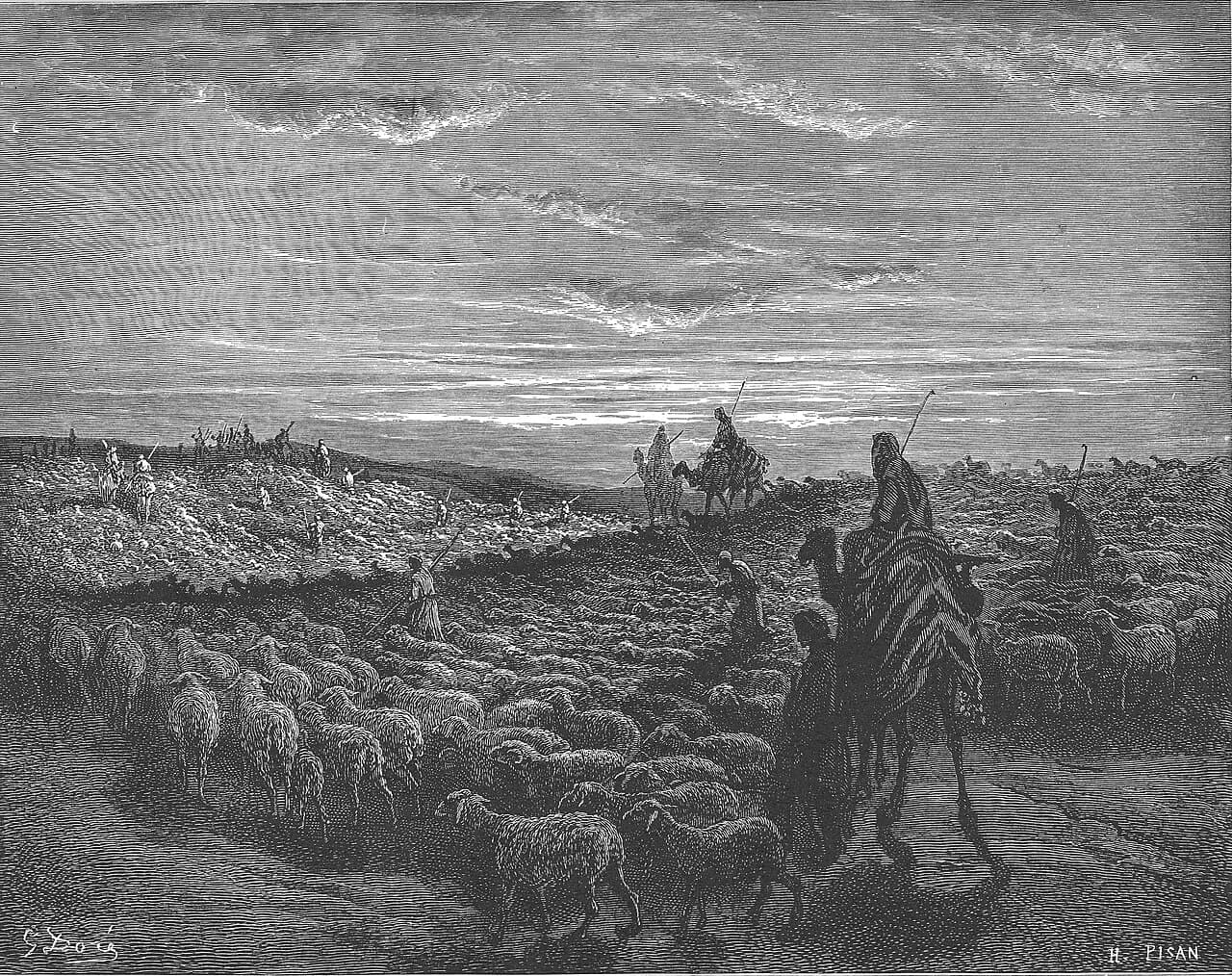
Gustave Doré, Doré's English Bible (1866). Public domain. The land promised to Abram is the text this argument keeps returning to.
Summary
Both readings hold the same Bible and the same six covenants. They split on one question: may a later promise change what an earlier one meant?
- The covenantal reading holds that the later word shows what a promise always meant. So there is one people of God, and Gentiles are joined to Israel's own root.Galatians 6:16even to the Israel of God
- The dispensational reading holds that fulfilment adds and leaves the stated terms in force. So Israel keeps what was sworn to Israel, and the church is a new thing.Romans 11:29For God’s gifts and His call are irrevocable
- Six questions divide them: Israel and the church, the covenants, the land, the law, the thousand years, and the timing of the gathering.
- Careful readers of Scripture hold each one, and each pays a cost the other names. This page shows both costs and gives no verdict.
- This site's own tradition is the second reading. It condemns replacement theology, and most covenant theologians reject it too.
each reading defined in the terms its own holders use, with the work that states it classically
The two terms, before anything else
Covenant theology
Covenant theology reads the whole Bible as one saving arrangement, the covenant of grace, which God administers in stages from the first promise after the fall to the church of the New Testament. Because that arrangement is one, the people of God are one, and Israel and the church are two administrations of a single covenant community rather than two communities. A believing Gentile is grafted into Israel's own root, and the promises are kept in Christ and in those who belong to Him.
Its classic statement is the Westminster Confession of Faith (1646). Chapter 7 defines the covenant of works made with Adam and the covenant of grace made in Christ. It holds that the covenant of grace is one covenant administered under different dispensations, and never two covenants differing in substance.
Dispensationalism
Dispensationalism reads the Bible as the record of God governing through a succession of distinct arrangements, and it holds each arrangement to the terms God stated when He made it. Prophecy is read at its plain sense, so a promise of a land, a throne and a city made to Israel is expected to be kept to Israel in those terms. Israel and the church are therefore two distinct programmes of the one God, and the church is a body revealed in the New Testament rather than a later stage of Israel.
John Nelson Darby taught the distinction from the 1830s and the Scofield Reference Bible (1909) carried it into common use. Charles Ryrie's Dispensationalism (Moody, 1966) states the three tests the tradition applies to itself. They are Israel and the church held distinct, a consistent plain reading of prophecy, and the glory of God as the purpose the whole story serves.
Both names are labels for ways of reading, and neither names a denomination. A Presbyterian, a Baptist and a Pentecostal congregation can each hold either one, which is why this page names people and dates rather than churches.
How this site asks you to read a debate
A question earns a debate page here because Scripture leaves its details open, and careful readers who submit to the same text still reach different conclusions. This page does not ask you to leave with a winner. It asks you to learn both readings well enough to recognize either one when you meet it in a sermon. It asks you to see which verses each reading carries easily and which verses cost it something. And it asks you to seek the Holy Spirit for the understanding He gives to those who ask Him.
eleven verses, and every line below is an answer to one of them
The texts both readings start from
Read these first. Both readings hold every one of them, and the argument is about what they mean together.
Scripture is the Berean Standard Bible, this site's modern floor. Every reference on this page is a door to the verse in its chapter.
The land, sworn to Abram
Genesis 15:18On that day the LORD made a covenant with Abram, saying, “To your descendants I have given this land—from the river of Egypt to the great River Euphrates—
Hebrews 11:16Instead, they were longing for a better country, a heavenly one. Therefore God is not ashamed to be called their God, for He has prepared a city for them.
The law, and the guardian
Galatians 3:24So the law became our guardian to lead us to Christ, that we might be justified by faith.
Israel, after the cross
Jeremiah 31:31Behold, the days are coming, declares the LORD, when I will make a new covenant with the house of Israel and with the house of Judah.
Romans 11:28Regarding the gospel, they are enemies on your account; but regarding election, they are loved on account of the patriarchs.
Romans 11:29For God’s gifts and His call are irrevocable.
The church, made one
Ephesians 2:14For He Himself is our peace, who has made the two one and has torn down the dividing wall of hostility
Galatians 6:16Peace and mercy to all who walk by this rule, even to the Israel of God.
Acts 15:16‘After this I will return and rebuild the fallen tent of David. Its ruins I will rebuild, and I will restore it,
The thousand years, and the timing
Revelation 20:6Blessed and holy are those who share in the first resurrection! The second death has no power over them, but they will be priests of God and of Christ, and will reign with Him for a thousand years.
Acts 1:6So when they came together, they asked Him, “Lord, will You at this time restore the kingdom to Israel?”
1 Thessalonians 4:17After that, we who are alive and remain will be caught up together with them in the clouds to meet the Lord in the air. And so we will always be with the Lord.
read down a column for one reading whole, across a row for one question answered twice
The two readings, side by side
Six questions, answered twice
A table of six questions. The left column carries the covenantal answer, the right column the dispensational answer. Each row opens to the verses that question turns on.
| The question | The covenantal readingheld in the Reformed and Presbyterian confessions, and by many Baptists through 1689 federalismthe Westminster Confession of Faith (1646) · Geerhardus Vos (1948) · O. Palmer Robertson (1980) · Michael Horton (2006) | The dispensational readingtaught across much of evangelical teaching since the nineteenth century, and this site's traditionSir Robert Anderson (1894) · C. I. Scofield (1909) · Charles Ryrie (1966) · Michael Vlach (2008) |
|---|---|---|
| Israel and the church | The covenantal readingOne people of God in both Testaments. The church is the covenant community grown up, and believing Gentiles are grafted into Israel's own root. | The dispensational readingTwo distinct programmes. The church is a new thing revealed in the New Testament, and Israel as a nation still has a future in which its own covenants are kept to it. |
The verse each reading leans on hardestThe one place Paul lays the name Israel over a body that plainly includes Gentiles. Galatians 6:16even to the Israel of God Paul writes this after the resurrection, in the present tense, about Israel. Romans 11:28they are loved on account of the patriarchs John Wesley, in his Explanatory Notes upon the New Testament, reads the Israel of God at Galatians 6:16 as the church of every nation. Peace and mercy be upon them, and upon the Israel, that is, the Church, of God - Which consists of all those, and those only, of every nation and kindred, who walk by this rule. John Wesley· Explanatory Notes upon the New Testament, 1755 Read more at Israel and the Olive Tree, read Romans 11 whole, root, branches and grafting. Read more at Why God is not finished with Israel, read more on the promises still standing to Israel. | ||
| The covenants | The covenantal readingOne covenant of grace, worked out in stages. Each covenant in the story is a stage of that single saving arrangement. | The dispensational readingDistinct instruments, each kept on its own stated terms. God governs by different arrangements in different eras, and the covenants are the arrangements themselves. |
The new covenant, and the house it is made withBoth readings agree the new covenant is announced here. They divide over who finally receives it. Jeremiah 31:31when I will make a new covenant with the house of Israel and with the house… Read more at The Covenants, read the six themselves, with parties, sign, promise and text. Read more at The New Covenant, read more on Jeremiah 31 and the house it is announced to. | ||
| The land | The covenantal readingA real grant that grows. Paul makes Abraham heir of the world, and Hebrews says he was looking for a heavenly country. | The dispensational readingA real territory held by oath. God alone passed between the pieces, and the grant still waits for the day it is kept in full. |
The grant, and the country the patriarch looked forRivers are named and borders are drawn, and the verb is already done. Genesis 15:18“To your descendants I have given this land—from the river of Egypt to the great River… The same writer says Abraham was after a city God had prepared. Hebrews 11:16a heavenly one Paul, summing up the same promise, says world rather than Canaan. Romans 4:13For the promise to Abraham and his offspring that he would be heir of the world… Both readings hold that the promise is God's own oath and rests on nothing Abram did. They divide over what the oath finally grants. Read more at The Abrahamic Covenant, read more on the oath at Genesis 15 and the grant it carries. | ||
| The law | The covenantal readingThe ceremonial and civil parts are fulfilled and expire in Christ. The moral substance stands as the shape of love. | The dispensational readingThe Mosaic economy worked as one whole and ended as one whole at the cross. The believer now stands under the law of Christ. |
The guardian, and what happened when faith cameBoth readings start here. They divide over how much of Sinai the guardian's discharge takes with it. Galatians 3:24So the law became our guardian to lead us to Christ Read more at The Mosaic Covenant, read more on Sinai, its terms and what the cross did with them. | ||
| The thousand years | The covenantal readingCommonly read as a figure for the age between the two comings, with Christ reigning now among His saints. Historic premillennial readers sit inside this stream too. | The dispensational readingPremillennial without exception. Christ returns, and then reigns a thousand years on earth, and Israel's promises are kept where people can see them. |
The verse the thousand years is counted fromThe number stands six times in the chapter. Both readings account for it. Revelation 20:6and will reign with Him for a thousand years Read more at The Millennium, read the amillennial and postmillennial readings on their own page. | ||
| The timing of the gathering | The covenantal readingThe church meets the Lord at His one appearing at the close of the age, and rises to meet Him as He comes. | The dispensational readingThe church is caught up before the tribulation, and the years that follow belong to Israel. This is where this site's tradition stands. |
The gathering, and the question the disciples askedPaul describes the meeting. He does not date it here, which is why the timing is argued. 1 Thessalonians 4:17we who are alive and remain will be caught up together with them in the clouds… The disciples ask about Israel's kingdom after the resurrection, and the answer corrects their clock. Acts 1:6will You at this time restore the kingdom to Israel?” Read more at The Rapture, read more on the gathering and the four readings of its timing. | ||
Neither cost is fatal and both are real. A reader who has not felt both has not yet met the argument.
What each reading has to account for
The covenantal reading
It has to say why so many promises were made in territorial terms, with rivers and borders named, if territory was never the point.
Genesis 15:18“To your descendants I have given this land—from the river of Egypt to the great River…
The dispensational reading
It has to say why an apostle settles the Gentile question by applying a promise about David's fallen tent to Gentiles coming to faith now.
Acts 15:17and all the Gentiles who are called by My name
two commentators on the verses that decide it, then the voices this site reads and where each one lands
Each reading in its holders' own words
The labels are modern. The readings are older, and two public domain commentators show that plainly by reading the same chapters and seeing different things. Under them stand the voices this site reads, each with the position he holds.
Every quotation on this page comes from this site's own confirmed ledger, by row, in the speaker's own words. Authors still in copyright are named with the work and the year and are never quoted here.
One people
Read this way, the new covenant announced to Israel and Judah reaches its stated recipients in the gospel church. The promise is not shrunk. It is disclosed.
Matthew Henry, in his Commentary on the Whole Bible, reads Jeremiah 31:31 as the covenant of grace, and names the gospel church as the house it is made with.
where this whole passage is quoted as a summary of the covenant of grace made with believers in Jesus Christ. Who the persons are with whom this covenant is made-- with the house of Israel and Judah, with the gospel church, the Israel of God…
Matthew Henry· Commentary on the Whole Bible, 1710
Israel still chosen
Read this way, the choice of Israel is still in force while the gospel goes to the nations. What was sworn to the fathers is still owed to their children.
Adam Clarke, in his Commentary on the Bible, reads Romans 11:28 as election still standing, and says God has favour in store for Israel on account of the patriarchs.
with regard to the original purpose of election, whereby they were chosen and separated from all the people of the earth to be the peculiar people of God, they are beloved for the fathers’ sake; he has still favor in store for them on account of their forefathers the patriarchs.
Where the voices this site reads land
A reader in one stream often holds a conviction the other stream is named for, so this page names men and dates rather than camps. Each voice below is one this site reads, his position is taken from his own works, and his own words stand under it wherever this site's quote store holds words of his on these texts.
A name here without a quotation holds his position in a work that is still in copyright or that this site's quote store has not yet mined. The work and its date stand beside the name, and no words are put in his mouth.
John Wesley
Explanatory Notes upon the New Testament (1755) and upon the Old Testament (1765)
Wesley reads one covenant of grace running through both Testaments, which sets him with the first column on the covenants themselves. On Israel he expects a real future: his note at Romans 11:25 calls the hardness partial and the rejection neither total nor final, and his note at Romans 11:26 looks for a full ingathering. On the thousand years his note at Revelation 20:3 says the church has never yet seen such a time, so that time is still to come.
John Wesley, in his Explanatory Notes upon the New Testament, reads the hardening of Romans 11:25 as partial and temporary, and says Israel is neither totally nor finally rejected.
Hardness in part is happened to Israel, till - Israel therefore is neither totally nor finally rejected.
John Wesley· Explanatory Notes upon the New Testament, 1755
John Calvin
Commentaries on the Epistle to the Romans (1554)
Calvin stands near the head of the covenantal reading, and he guards it at the point where later readers have most often misused it. On Romans 11:1 he says Paul answers the objection so that no one will conclude that the covenant made with Abraham is abrogated or that God has forgotten it.
John Calvin, in his Commentaries on Romans, reads Romans 11:1 as Paul guarding the covenant made with Abraham against the charge that God has now abrogated it.
he so modifies what he had previously said respecting the repudiation of the Jews, that no one might think that the covenant formerly made with Abraham is now abrogated, or that God had so forgotten it that the Jews were now so entirely alienated from his kingdom, as the Gentiles were before the coming of Christ.
John Calvin· Commentaries, 1554
Charles Spurgeon
The Metropolitan Tabernacle Pulpit, Sermon No. 3561, “The Drawings of Love”
Spurgeon preached inside the Reformed stream all his life and still looked for Israel's future. Preaching on Jeremiah 31:3 he takes the promise as spoken first to Israel by blood, and he expected their restoration and conversion. He held that Christ returns before the thousand years without holding the system the right column is named for.
Charles Spurgeon, preaching on Jeremiah 31:3, reads the promise as spoken first to God's ancient people, the natural descendants of Abraham.
From the context it is clear that this passage primarily refers to God's ancient people, the natural descendants of Abraham. He chose them from of old and separated them from the nations of the world.
Charles Spurgeon· The Metropolitan Tabernacle Pulpit, Sermon No. 3561: “The Drawings of Love” (lightly modernized text, CCEL edition), 1917
J.C. Ryle
Coming Events and Present Duties (1867)
Ryle expected Christ to return visibly before a literal reign on earth, and he taught a future restoration of Israel to its land and to its Messiah. He did not hold the pre-tribulation scheme, so he stands with the right column on Israel's future and with neither column's timetable.
R.C. Sproul
What Is Reformed Theology? (1997)
Sproul read the covenants as one unfolding covenant of grace with one people of God in both Testaments, and he expected one return of Christ at the close of the age.
J.I. Packer
Concise Theology (1993)
Packer held one people of God across both Testaments and one return of Christ, and he read the gathering of the church as part of that single appearing rather than as a separate earlier event.
Derek Prince
Prophetic Guide to the End Times (compiled 2008 from his sermon series)
Prince taught that Christ returns before a literal reign on earth and that what God swore to Israel is still owed to Israel. He put the weight of his teaching on the church's preparation rather than on a timetable.
Chuck Missler
The Book of Daniel and The Book of Revelation commentary series; Learn the Bible in 24 Hours (2002)
Missler taught the classic dispensational reading and argued it from the text at length: Israel and the church held distinct, the seventieth week of Daniel 9 still future, and the church gathered before that week begins.
Harold R. Eberle
Victorious Eschatology, with Martin Trench (2006; third edition 2017)
Eberle reads the Olivet Discourse as fulfilled in the fall of Jerusalem in AD 70 and expects the kingdom to advance until Christ returns to raise the dead and judge. On this page's question that sets him near the first column on how prophecy is fulfilled and outside both columns on the timetable. He makes his case in his own book, and this page sends a reader there rather than summarizing it further.
the dated marks a reader can check
How the question came down to us
The systems are modern. Some of the pieces they are built from are very old, and the record shows which is which.
A date here is the year the work was published. A date given with c. is the century a work is placed in, because the year cannot be fixed closer than that.
- c. 204Hippolytus of Rome, writing on Daniel, places the seventieth week at the end of the age.
- 1646The Westminster Confession of Faith, chapter 7, defines the covenant of works and the covenant of grace.
- 1830sJohn Nelson Darby teaches the church and Israel as two distinct programmes of God.
- 1894Sir Robert Anderson, The Coming Prince, counts out the seventy weeks of Daniel 9.
- 1909The Scofield Reference Bible carries the scheme into common use in English-speaking churches.
- 1966Charles Ryrie, Dispensationalism, sets out the tradition's own tests for itself.
- 1993Craig Blaising and Darrell Bock open a middle position between the two.
- 2022Brent Parker and Richard Lucas put four positions in one room, not two.
named plainly, with the guardrails on both sides of it
This site's tradition
Where this site stands
This site's tradition is Wesleyan-Pentecostal. On this question it stands pre-tribulational, premillennial and dispensational: Israel and the church are held distinct, and the covenants sworn to Israel are kept to Israel.
The three verses it rests on
Israel's standing as a nation is staked to the fixed order of sun, moon and sea.
Jeremiah 31:36would Israel’s descendants ever cease to be a nation before Me
The risen Christ corrects the disciples' clock and leaves their question standing.
Acts 1:7“It is not for you to know times or seasons that the Father has fixed by…
Paul writes of Israel in the present tense, years after the resurrection.
Romans 9:4theirs the divine glory and the covenants
The guardrail on this side
Where the New Testament says the dividing wall is down and the Gentiles are fellow heirs, it means it, and no chart may soften it. A distinction that ever became a difference in dignity, access or the way of salvation would have stopped being this doctrine.
Ephesians 2:14who has made the two one and has torn down the dividing wall of hostility
What this site owes the other reading
Covenant theology is the work of some of the most careful exegetes the church has produced, and it takes the apostles' own handling of the Old Testament with full seriousness. Replacement theology, the claim that God is finished with Israel and its promises have passed to somebody else, is condemned here, and most covenant theologians reject it as well. The two are separate claims and this page keeps them separate.
What to do with both readings
You have now read both positions in the words of the people who hold them. Take the verses back to the text itself, weigh what each reading gains and what each reading pays, and ask the Holy Spirit for understanding. A reader who can state both readings fairly has gained more than a reader who picked a side quickly.
the constructs, the corrections, the middle positions and the dispute alongside
Beneath the argument
The three covenants Scripture does not enact
works, grace, redemption
Covenant theology's architecture rests on three covenants that no biblical narrative enacts. They are theological constructs, arrangements the system argues Scripture presupposes rather than reports, and covenant theologians say so themselves. The Westminster Confession of Faith defines them in chapter 7.
The covenant of redemption is an eternal agreement between the Father and the Son, before creation, in which the Son undertakes to redeem a people given to him. It answers a real question, because the cross was planned rather than improvised, and the New Testament speaks of the Son being sent and of a people given to him.
The covenant of works reads Genesis 2 as a probation with Adam as federal head: a command, a prohibition and a stated penalty. That is what makes the two Adams of Romans 5 legible as a covenantal argument. The Hebrew word berith does not appear in Genesis 2 or 3, so the covenant is inferred from the structure. The usual proof text, Hosea 6:7, can be rendered like Adam, like men, or at Adam as a place name, and the Hebrew alone will not settle it.
The covenant of grace is the beam the whole system carries. It is one saving arrangement established after the fall and administered through each historical covenant in turn, which is how covenant theology can say Abraham and a reader today are saved under the same arrangement. The dispensational objection is that the construct then does the work Scripture gives to the covenants themselves, and the land promise is the first casualty.
This site affirms federal headship and original sin transmitted through Adam's representation, while declining the works-covenant construct built on top of it. The two claims come apart.
Three corrections
the caricatures that make this argument worse than it is
Dispensationalism is said to teach two ways of salvation. It teaches one. The tradition's own standard statements say so directly, in Charles Ryrie's Dispensationalism (Moody, 1966) and in Michael Vlach's Dispensationalism: Essential Beliefs and Common Myths (2008). Abraham, David and the reader of this sentence are saved by grace through faith on the ground of Christ's blood. Different arrangements of God's dealings are still one gospel.
Covenant theology is said to be replacement theology. Covenant theologians characteristically say the church is the continuation of the covenant people, and Romans 11's own picture is grafting into a standing root rather than felling the tree. The claim that God is finished with Israel is a separate claim, held by some and rejected by most, and this site condemns it.
Second Timothy 2:15 is said to command the reader to divide the dispensations. The slogan comes from the King James rendering, rightly dividing the word of truth. The Berean Standard Bible renders the same clause correctly handling the word of truth, which is a call to careful workmanship with Scripture. The reading has better arguments and does not need this one.
The middle of the room
two mediating positions
Progressive dispensationalism, set out by Craig Blaising and Darrell Bock in Progressive Dispensationalism (BridgePoint, 1993), keeps Israel's national future and the literal expectation, and softens the hard partition by reading the Davidic covenant as begun now in the reigning Christ and completed later. The church becomes the kingdom's present phase. Its cost, from the traditional side, is that allowing an inaugurated fulfilment concedes the hermeneutical principle.
Progressive covenantalism, set out by Peter Gentry and Stephen Wellum in Kingdom through Covenant (Crossway, 2012), walks the biblical covenants in their own order and argues they climax in Christ, without the covenant of grace overlay and without the Israel and church partition. Its cost, from the dispensational side, is that it still resolves the land and national promises typologically, so on this page's own question it lands nearer covenant theology.
The standard classroom volume is Covenantal and Dispensational Theologies: Four Views on the Continuity of Scripture, edited by Brent Parker and Richard Lucas (IVP Academic, 2022). These authors are living and their work is in copyright, so this site names and dates them and sends the reader to the book itself.
Ezekiel's measured temple, read twice
Ezekiel 40 to 48
Ezekiel measures a temple in exhaustive detail, with a Zadokite priesthood and a bullock for a sin offering at 43:19. Read covenantally, this is an idealized vision whose substance is Christ and his people, and John finally sees no temple in the city because the Lord God the Almighty and the Lamb are its temple. Restored animal sacrifice would cut against the argument of Hebrews.
Read dispensationally, it is a sanctuary for the coming age, its offerings memorial rather than expiatory, looking back at a finished cross as the Passover looked forward to it. The measurements are given because they are meant to be built. Both readings account for the same chapters, and this page gives no verdict between them.
Read more at Ezekiel's Temple, read the vision itself, chapter by chapter, with both readings of it.
◈Does the treaty evidence date the covenant texts early?contested · a separate argument, often confused with this one
Israel's covenants are cast in the legal molds of ancient Near Eastern diplomacy: the conditional suzerain and vassal treaty, and the unconditional royal land grant. Moshe Weinfeld drew the distinction in the Journal of the American Oriental Society (1970), and it explains at a stroke why Sinai reads as obligation while Genesis 15 and 2 Samuel 7 read as gift. Deuteronomy runs the full six-part treaty sequence, a case Meredith Kline made in Treaty of the Great King (Eerdmans, 1963).
Conservative scholars argue that the full form with a historical prologue is distinctively second-millennium Hittite, and that Deuteronomy's shape therefore fits a Mosaic-era date. Many critical scholars answer that the closest parallels are first-millennium Neo-Assyrian treaties, and date the material to the seventh century. This site presents both and settles neither here. The dating question is independent of the one this page is about, and readers on both sides of this page often agree entirely about Hittite treaty forms.
one Greek noun and three Hebrew words, read from the lexicon floor
The words both readings are reading
berith: covenant
Hebrew · H1285Strong's entry: a compact (because made by passing between pieces of flesh)
The spine word of the canon, and the one datum both readings share.
284 times in the Old Testament · berith, in full →
karath: to cut: cut
Hebrew · H3772Strong's entry: to cut (off, down or asunder); by implication, to destroy or consume; specifically, to covenant (i.e. make an alliance or bargain, originally by cutting flesh and passing between the pieces)
To cut. The ordinary Hebrew idiom is to cut a covenant, done physically at Genesis 15.
288 times in the Old Testament · karath, in full →
zera: seed
Hebrew · H2233Strong's entry: seed; figuratively, fruit, plant, sowing-time, posterity
Seed, offspring. The Hebrew noun carries a whole line of descendants in the singular, and Paul presses that singular at Galatians 3:16 to one person, Christ.
229 times in the Old Testament · zera, in full →
diatheke: covenant
Greek · G1242Strong's entry: properly, a disposition, i.e. (specially) a contract (especially a devisory will)
The Greek that carries berith into the New Testament, and the word behind new covenant.
33 times in the New Testament · diatheke, in full →
Where it leads
On this page
The covenants themselves3
Where the argument lands3
Sources
Public domain commentary is quoted from this site's own confirmed ledger, by row, never retyped. Modern authors are named and dated and never quoted, because their work is in copyright and the reader is sent to the book.
Every work this page stands on, with its date
- The Westminster Confession of Faith (1646), chapter 7. Public domain, summarized here rather than quoted.
- Matthew Henry, Commentary on the Whole Bible (1710), on Jeremiah 31:31. Public domain.
- John Wesley, Explanatory Notes upon the New Testament (1755), on Galatians 6:16 and Romans 11:25; Explanatory Notes upon the Old Testament (1765). Public domain.
- John Calvin, Commentaries on the Epistle to the Romans (1554), on Romans 11:1. Public domain.
- Adam Clarke, Commentary on the Bible (1832), on Romans 11:28. Public domain.
- Charles Spurgeon, The Metropolitan Tabernacle Pulpit, Sermon No. 3561, “The Drawings of Love” (published 1917, preached earlier), on Jeremiah 31:3. Public domain.
- J.C. Ryle, Coming Events and Present Duties (1867). Public domain, named here rather than quoted.
- Hippolytus, Commentary on Daniel (c. AD 204). Public domain, described here rather than quoted.
- Sir Robert Anderson, The Coming Prince (1894); The Scofield Reference Bible (1909).
- Geerhardus Vos, Biblical Theology (1948); O. Palmer Robertson, The Christ of the Covenants (P&R, 1980); Michael Horton, God of Promise (Baker, 2006).
- Charles Ryrie, Dispensationalism (Moody, 1966); Michael Vlach, Dispensationalism: Essential Beliefs and Common Myths (2008).
- R.C. Sproul, What Is Reformed Theology? (1997); J.I. Packer, Concise Theology (1993). Named and dated; in copyright and not quoted here.
- Derek Prince, Prophetic Guide to the End Times (compiled 2008); Chuck Missler, Learn the Bible in 24 Hours (2002) and the Daniel and Revelation commentary series. Named and dated; in copyright and not quoted here.
- Harold R. Eberle and Martin Trench, Victorious Eschatology (2006; third edition 2017). Named and dated; in copyright and not quoted here.
- Craig Blaising and Darrell Bock, Progressive Dispensationalism (BridgePoint, 1993); Peter Gentry and Stephen Wellum, Kingdom through Covenant (Crossway, 2012).
- Brent Parker and Richard Lucas, eds., Covenantal and Dispensational Theologies: Four Views on the Continuity of Scripture (IVP Academic, 2022).
- Meredith Kline, Treaty of the Great King (Eerdmans, 1963); Moshe Weinfeld, The Covenant of Grant in the Old Testament and in the Ancient Near East, JAOS 90 (1970).