
Genesis 50:10 to 11 · Place · Featured Study
The Threshing Floor
Thirty-nine verses of the Berean text name a threshing floor, from Jacob's funeral to the preaching of John the Baptist.
Joseph mourned his father for seven days at a threshing floor across the Jordan.
- Region
- Canaan and Israel, from across the Jordan to Jerusalem
- First named
- Genesis 50:10
- Last named
- Luke 3:17
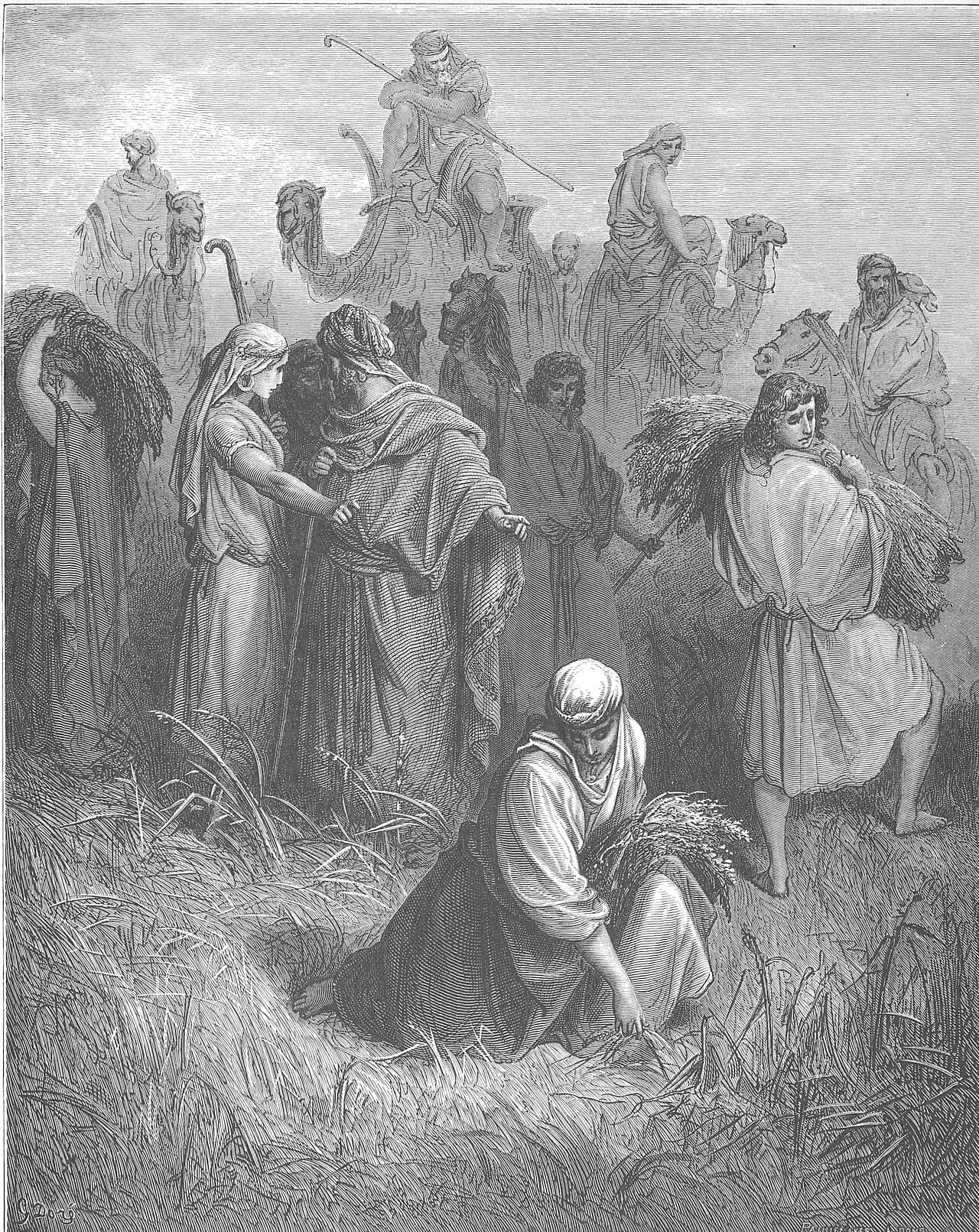
Gustave Doré, Ruth and Boaz, 1866, from Doré's English Bible. Public domain.
THE ARTWORKDoré drew Ruth gleaning in the field of Boaz, the harvest of Ruth 2 that ends at his threshing floor in Ruth 3.
Summary
A threshing floor was a levelled open place where grain was beaten out and winnowed, and Scripture sets some of its weightiest scenes on one.
- Ruth asked Boaz to spread his garment over her on his threshing floor at the barley harvest.
- David bought the threshing floor of Araunah and built an altar there, and the plague on Israel stopped.
- Solomon built the temple on that same site, on Mount Moriah.
- Gideon laid his fleece on a threshing floor, and Uzzah died beside the ark at another.
The Threshing Floor of Atad
Genesis 50 gives the floor of Atad a second name, Abel-mizraim.
Joseph went up from Egypt to bury his father in Canaan, and the elders of Egypt, with chariots and horsemen, went with him.
When they reached the threshing floor of Atad, which is across the Jordan, they lamented and wailed loudly, and Joseph mourned for his father seven days.The procession halted at a threshing floor before it reached the burial ground in Canaan.
The Hebrew word is goren, H1637, which the lexicon defines as a threshing floor, as made even, and by analogy any open area. It occurs 36 times in the Old Testament.
When the Canaanites of the land saw the mourning at the threshing floor of Atad, they said, “This is a solemn ceremony of mourning by the Egyptians.” Thus the place across the Jordan is called Abel-mizraim.The place kept the memory of Jacob's funeral in its name.
The lexicon lists Abel-mizraim, H67, as a place, and gives atad, H329, as a common noun for a thorn tree, especially the buckthorn.
Rashi on the name AtadRashi on Genesis 50:10, eleventh century
Rashi, the eleventh-century Jewish commentator of France, says the threshing floor was called Atad because a hedge of thorns surrounded it.
He then gives the account of the rabbis in the Talmud, tractate Sotah 13a. In it the kings of Canaan and the princes of Ishmael hung their crowns on Jacob's coffin when they saw Joseph's crown there. The coffin was ringed with crowns as a floor is ringed with thorns.
Where Atad layGenesis 50:10
Genesis places Atad across the Jordan and names no town or landmark near it. Adam Clarke records that Jerome placed it about two leagues from Jericho, and adds that there is no certain information on the point.
The Work of Threshing
Five verses from the Law, the histories and the prophets show how a harvest was threshed.
| Stage | What the text says of it | Verse |
|---|---|---|
| Treading | Oxen trod out the grain, and the law forbade muzzling them while they worked | Deuteronomy 25:4 |
| Sledges | Araunah offered his threshing sledges and ox yokes as wood for the fire | 2 Samuel 24:22 |
| Beating | Caraway and cumin were beaten out with a stick and a rod, and not threshed with a sledge | Isaiah 28:27 |
| Winnowing | Fodder for the oxen and donkeys was winnowed with a shovel and a pitchfork | Isaiah 30:24 |
| The chaff | The wind blows the chaff away from the threshing floor | Hosea 13:3 |
- Stage
- Treading
- What the text says of it
- Oxen trod out the grain, and the law forbade muzzling them while they worked
- Verse
- Deuteronomy 25:4
- Stage
- Sledges
- What the text says of it
- Araunah offered his threshing sledges and ox yokes as wood for the fire
- Verse
- 2 Samuel 24:22
- Stage
- Beating
- What the text says of it
- Caraway and cumin were beaten out with a stick and a rod, and not threshed with a sledge
- Verse
- Isaiah 28:27
- Stage
- Winnowing
- What the text says of it
- Fodder for the oxen and donkeys was winnowed with a shovel and a pitchfork
- Verse
- Isaiah 30:24
- Stage
- The chaff
- What the text says of it
- The wind blows the chaff away from the threshing floor
- Verse
- Hosea 13:3
Four Floors in Israel's Story
Four threshing floors stand in the story of Israel from the judges to David.
Ruth the Moabitess had come to Bethlehem with Naomi, her mother-in-law, at the beginning of the barley harvest.
Now is not Boaz, with whose servant girls you have been working, a relative of ours? In fact, tonight he is winnowing barley on the threshing floor.Naomi sent Ruth on an evening when Boaz would be found at work.
So she lay down at his feet until morning, but she got up before anyone else could recognize her. Then Boaz said, “Do not let it be known that a woman came to the threshing floor.”Boaz's words name the threshing floor as the place of the meeting and ask that the visit stay unknown.
Later David ordered a census, and the LORD sent a plague on Israel in which seventy thousand of the people died.
But when the angel stretched out his hand to destroy Jerusalem, the LORD relented from the calamity and said to the angel who was destroying the people, “Enough! Withdraw your hand now!” At that time the angel of the LORD was by the threshing floor of Araunah the Jebusite.The angel stopped at the threshing floor that David would buy for the altar.
“No,” replied the king, “I insist on paying a price, for I will not offer to the LORD my God burnt offerings that cost me nothing.” So David bought the threshing floor and the oxen for fifty shekels of silver.David refused Araunah's gift so that his offering would cost him something.
And there he built an altar to the LORD and offered burnt offerings and peace offerings. He called upon the LORD, who answered him with fire from heaven on the altar of burnt offering.God accepted the offering on the new altar with fire from heaven.
Gideon's fleeceJudges 6:37 to 40
then behold, I will place a fleece of wool on the threshing floor. If there is dew only on the fleece and all the ground is dry, then I will know that You are going to save Israel by my hand, as You have said.”Gideon chose a threshing floor as the ground for his test of the fleece.
And that night God did so. Only the fleece was dry, and dew covered the ground.Gideon asked for the sign a second time, reversed, and God gave it.
Uzzah at Nacon2 Samuel 6:6 to 8
When David brought the ark of God up from the house of Abinadab on a new cart, the procession came to another threshing floor.
When they came to the threshing floor of Nacon, Uzzah reached out and took hold of the ark of God, because the oxen had stumbled.David later named this place Perez-uzzah, for the LORD's outburst against Uzzah.
Three Details the Text Gives Plainly
The text says where Gideon threshed, why Uzzah died and who prepared the temple site.
GIDEON THRESHED IN A WINEPRESS
The Midianites were destroying the produce of the land, so Gideon threshed his wheat out of their sight. John Wesley adds that he beat it out with a staff, without the oxen that usually trod the grain.
UZZAH DIED FOR HIS IRREVERENCE
Adam Clarke ties his death to the law of Numbers 4:15, which warned the Kohathites that they must not touch the holy objects, or they would die.
DAVID PREPARED THE TEMPLE SITE
Solomon built the temple on the threshing floor of Ornan, on Mount Moriah. The lexicon counts Moriah twice, here and in Genesis 22:2, where God sent Abraham to offer Isaac.
Where Threshing Floors Stood
Commentators describe a hard, open circle near the field, watched until the grain was in.
Albert Barnes notes that threshing floors stood in the open air and were usually circular.
“The threshing-floor, which was commonly on the harvest-field, was carefully leveled with a large cylindric roller and consolidated with chalk, that weeds might not spring up, and that it might not chop with drought.”
Jamieson, Fausset & Brown · Commentary Critical and Explanatory on the Whole Bible · on Ruth 3:2Reformed
Clarke also notes that the owner or a trusted servant stayed by the threshing floor until the grain was secured, as Boaz did.
Dressed in royal attire, the king of Israel and Jehoshaphat king of Judah were sitting on their thrones at the threshing floor by the entrance of the gate of Samaria, with all the prophets prophesying before them.A threshing floor by a city gate could serve as a place of royal audience.
The King James renderings of goren in the lexicon include void place, and Barnes reads this floor as the open space at the entrance of the gate, where Ahab heard complaints and decided causes.
Samuel Beside Chronicles
Chronicles gives Uzzah's floor another name and David's purchase another price, and commentators explain both.
Fifty shekels of silver and six hundred of gold2 Samuel 24:24 and 1 Chronicles 21:25
So David paid Ornan six hundred shekels of gold for the site.This verse has to be read beside 2 Samuel 24:24, which gives the price of the threshing floor and the oxen.
The Jamieson, Fausset and Brown commentary reads two payments. The fifty shekels of silver bought the threshing floor, the oxen and the wood, and the six hundred shekels of gold were paid afterward for the whole hill where David prepared to build the temple.
Rashi, in his commentary on Chronicles, reads one payment, in which David took fifty shekels from each tribe, six hundred in all, so that all Israel would have a share in the altar.
Nacon and Chidon2 Samuel 6:6 and 1 Chronicles 13:9
When they came to the threshing floor of Chidon, Uzzah reached out and took hold of the ark, because the oxen had stumbled.Chronicles tells the same event and gives the threshing floor another name.
John Gill, in his Exposition of the Old Testament, takes Nacon and Chidon as two names for one man or for one place.
What the Text Leaves Unsaid
Scripture does not say whether Araunah the Jebusite had been a king.
O king, Araunah gives all these to the king.” He also said to the king, “May the LORD your God accept you.”The verse uses the word king twice in one sentence.
Albert Barnes sets out two readings and prefers the first, in which Araunah speaks to David as king. The Jamieson, Fausset and Brown commentary takes the second, that Araunah had once been a king or chief.
The Floor of Judgment
Hosea, Micah and John the Baptist each spoke of judgment as the work of the threshing floor.
Do not rejoice, O Israel, with exultation like the nations, for you have played the harlot against your God; you have made love for hire on every threshing floor.Hosea names the threshing floor as the place of Israel's unfaithfulness to God.
The threshing floor and winepress will not feed them, and the new wine will fail them.The threshing floors Israel misused would no longer feed the people.
But they do not know the thoughts of the LORD or understand His plan, for He has gathered them like sheaves to the threshing floor.Micah turns the picture on the nations that gathered against Zion.
Rise and thresh, O Daughter of Zion, for I will give you horns of iron and hooves of bronze to break to pieces many peoples. Then you will devote their gain to the LORD, their wealth to the Lord of all the earth.The verse makes Zion the thresher and the nations the grain.
John the Baptist spoke of the One coming after him, who would baptize with the Holy Spirit and with fire.
His winnowing fork is in His hand to clear His threshing floor and to gather His wheat into the barn; but He will burn up the chaff with unquenchable fire.”John names the coming One as the owner of the threshing floor, who keeps the wheat and burns the chaff.
Luke gives the same words. The lexicon counts halon, the Greek word for a threshing floor, and ptuon, the winnowing fork, twice each in the New Testament.
Five Voices on These Floors
Five teachers read these floors, from Ambrose in the fourth century to Matthew Henry in the eighteenth.
Matthew Henry reads the fire on David's altar as a picture of Christ bearing the judgment in the sinner's place.
“To signify that God's anger was turned away from him, the fire that might justly have fastened upon the sinner fastened upon the sacrifice and consumed that; and, upon this, the destroying sword was returned into its sheath. Thus Christ was made sin and a curse for us, and it pleased the Lord to bruise him, that through him God might be to us, not a consuming fire, but a reconciled Father.”
Matthew Henry · Commentary on the Whole Bible · on 1 Chronicles 21:26Puritan
Ambrose reads John's winnowing fork as the Lord's right to judge between full grain and empty.
“Through the sign of the fan, the Lord is said to have the right to distinguish merits. When the grain is winnowed on the threshing floor, the full grain is separated from the empty, the fruitful is separated from the worthless, as if by a weighing of a blowing breeze. So through this comparison, the Lord is manifest, because on the day of judgment, he separates the merits and fruits of solid virtue from the unfruitful shallowness of worthless ostentation and inadequate deeds, before he establishes the people of perfect merit in a heavenly home.”
Ambrose of Milan · Exposition of the Gospel of Luke 2.82 · on Luke 3:17Patristic
Jerome on the floor of OrnanLetter 46
Jerome reads the angel's drawn sword over the city as the moment the place of the temple was marked out.
“When of old the Philistines had been overcome, when their devilish audacity had been destroyed, when their champion had fallen on his face to the earth, it was from this city that there went forth a procession of jubilant souls, a harmonious choir to sing our David's victory over tens of thousands. Here, too, it was that the angel grasped his sword, and while he laid waste the whole of the ungodly city, he marked out the temple of the Lord in the threshing floor of Ornan, king of the Jebusites.”
Jerome · LETTER 46.2 · on 1 Chronicles 21:18Patristic
Caesarius of Arles on the price David paidSermon 122, sixth century
Caesarius reads David's refusal of a free gift as a pattern fulfilled at the coming of Christ.
“Therefore, the king himself offered blessed David the threshing floor and oxen for a burnt offering, but King David refused to accept them without first paying a price. This, too, was fulfilled at the coming of our Lord and Savior, for he refused to take …”
Caesarius of Arles · SERMON 122.2 · on 2 Samuel 24:22 to 25Patristic
John Calvin on Hosea 9:1Commentaries, on Hosea 9:1
Calvin draws from Hosea's warning to a feasting people that faith fears God's anger before the punishment arrives.
“Though he may not openly put forth his hand, though he may not pursue us, we ought yet to anticipate his wrath; for it is the proper office of faith, not only to find out from present punishment that God is angry, but also to fear, on account of any prevailing vices, the punishment that is far distant.”
John Calvin · Commentaries · on Hosea 9:1Reformed
What Ruth Asked of Boaz
Two readings of Ruth's night at the feet of Boaz, each with its holders.
“Who are you?” he asked. “I am your servant Ruth,” she replied. “Spread the corner of your garment over me, for you are a kinsman-redeemer.”Ruth's own words state what she asked of Boaz and on what ground.
A request for marriage in a known formAdam Clarke, Jamieson, Fausset and Brown, and Rashi, on Ruth 3:9
Adam Clarke reads Ruth's words as a request that Boaz take her as his wife, and notes that the Targum renders them that way.
“To spread a skirt over one is, in the East, a symbolical action denoting protection. To this day in many parts of the East, to say of anyone that he put his skirt over a woman, is synonymous with saying that he married her; and at all the marriages of the modern Jews and Hindus, one part of the ceremony is for the bridegroom to put a silken or cotton cloak around his bride.”
Jamieson, Fausset & Brown · Commentary Critical and Explanatory on the Whole Bible · on Ruth 3:9Reformed
Rashi, in the Metsudah translation, calls the spreading of the garment an expression of marriage.
The objection: Clarke himself, in his note on Ruth 3:4, says the plan might have ruined Ruth had Boaz been a man of less piety and restraint. He adds that Naomi probably knew more than she told her.
An act hard to justifyMatthew Henry on Ruth 3:3
Matthew Henry weighs Naomi's plan to send Ruth to Boaz by night.
“And upon this occasion she would have an easier access to him in private than she could have at his own house. And thus far was well enough. Her coming to lie down at his feet, when he was asleep in his bed, had such an appearance of evil, was such an approach towards it, and might have been such an occasion of it, that we know not well how to justify it.”
Matthew Henry · Commentary on the Whole Bible · on Ruth 3:3Puritan
The objection: Boaz blessed Ruth for the deed and called her a woman of noble character.
“He praised Ruth's deed and, moreover, he did not betray temperance, but he kept to the law of nuptial congress. ‘You show by your deed,’ he said, ‘that this was not done out of voluptuousness. In fact, you might have gone to those who are …”
Theodoret of Cyrus · Questions on Ruth · on Ruth 3:10Patristic
The One Who Came to the Jordan
John the Baptist called the people who came to him at the Jordan to repent.
Produce fruit, then, in keeping with repentance.John's demand of those who came to him is what the winnowing asks of every reader.
Then Jesus came from Galilee to the Jordan to be baptized by John. In John 1:30 John points to Jesus as the man he had said would come after him.
Keep studying
Symbols1