
Joshua 3 to 4 · Psalm 114:3 · Story · Featured Study
The Crossing of the Jordan
Under Joshua, Israel crossed the Jordan into Canaan at harvest, when the river overflowed its banks.
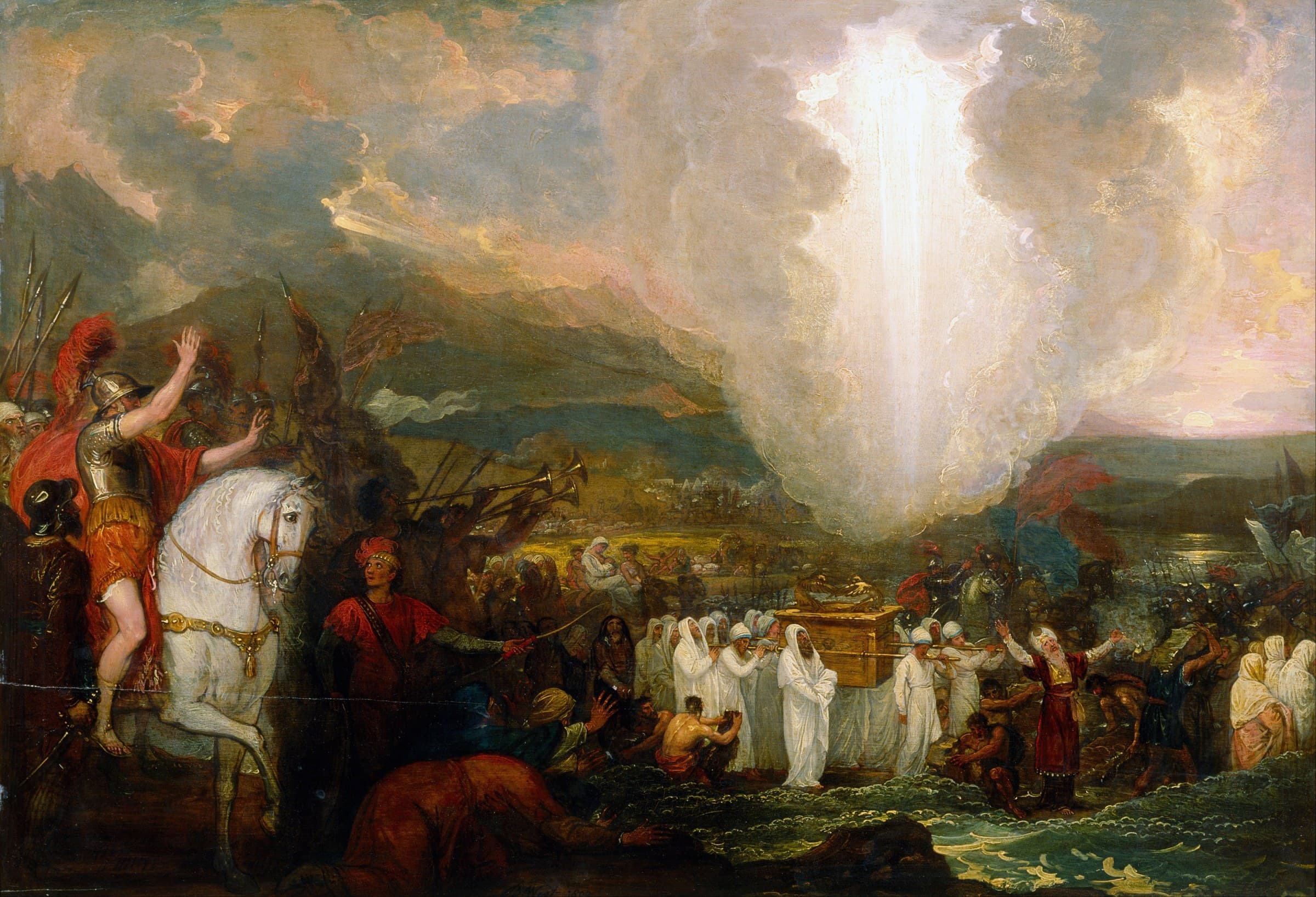
Benjamin West, Joshua Passing the River Jordan with the Ark of the Covenant, 1800. Public domain.
THE ARTWORKWest set the gold ark on the shoulders of priests in white at the water's edge, with Joshua on a white horse and men lifting stones in the foreground.
The LORD stopped the Jordan at the feet of the priests, so that the children of the wilderness crossed as their fathers had crossed the Red Sea.
Summary
Israel walked through the riverbed on dry ground behind the ark of the covenant and carried twelve stones out of it.
- The priests carried the ark into the river and stood in its bed until the whole nation had crossed.
- The flowing water stood still and backed up as far upstream as Adam, a city in the area of Zarethan.
- Joshua 4:9 tells of twelve stones set up in the riverbed, which readers take as a second pile or as the stones that went to Gilgal.
- Joshua 4:23 sets the crossing beside the Red Sea, and Exodus 15:8 uses the same Hebrew word for the standing water.
- Israel came up from the river on the tenth day of the first month and kept the Passover at Gilgal four days later.
The Crossing in the Book's Words
Six verses from Joshua 3 and 4, in the order the book gives them
and commanded the people: “When you see the ark of the covenant of the LORD your God being carried by the Levitical priests, you are to set out from your positions and follow it.The ark goes first, and the people move only when they see it carried.
But keep a distance of about two thousand cubits between yourselves and the ark. Do not go near it, so that you can see the way to go, since you have never traveled this way before.”The one measure the account gives is this distance, kept so that every eye could follow the ark.
When the feet of the priests who carry the ark of the LORD—the Lord of all the earth—touch down in the waters of the Jordan, its flowing waters will be cut off and will stand up in a heap.”Joshua tells the people beforehand what the water will do and when it will do it.
Now the Jordan overflows its banks throughout the harvest season. But as soon as the priests carrying the ark reached the Jordan and their feet touched the water’s edge,The river was at its fullest when the priests stepped into it.
The priests in the riverbedJoshua 3:17 and 4:18
The priests carrying the ark of the covenant of the LORD stood firm on dry ground in the middle of the Jordan, while all Israel crossed over the dry ground, until the entire nation had crossed the Jordan.The priests hold the ark in the riverbed for as long as the crossing takes.
When the priests carrying the ark of the covenant of the LORD came up out of the Jordan and their feet touched the dry land, the waters of the Jordan returned to their course and overflowed all the banks as before.The water returns at the moment the priests step out, which ties the whole event to the ark.
Where, when in the book, and who is in itJoshua 1 to 5
The people in it are Joshua, the officers who went through the camp, the Levitical priests who carried the ark and twelve men chosen one from each tribe. The armed men of Reuben, Gad and the half-tribe of Manasseh crossed ahead of the rest.
The Days, the Riverbed and the Road
The days, the riverbed in cubits and the road on George Adam Smith's map of 1915
The text marks the days from the order to prepare provisions to the day the manna ceased.
- The order to prepare foodWithin three days, The camp prepares provisions.Joshua 1:11
- The spies hide in the hillsThree days, The spies wait out their pursuers.Joshua 2:22
- Shittim to the riverEarly morning, All Israel camps at the river.Joshua 3:1
- The officers' commandAfter three days, The people are told to follow the ark.Joshua 3:2
- Consecrate yourselvesThe day before, Wonders are promised for tomorrow.Joshua 3:5
- Up from the JordanMonth 1, day 10, The first night west of the river.Joshua 4:19
- The PassoverMonth 1, day 14, evening, Israel keeps the Passover.Joshua 5:10
- The produce of the landMonth 1, day 15, Unleavened bread and roasted grain.Joshua 5:11
- The manna ceasesMonth 1, day 16, Israel eats the crops of Canaan.Joshua 5:12
A timeline of nine stops from Joshua 1:11 to Joshua 5:12, each with the day the text gives and its verse.
Drawn to scale, the distance of Joshua 3:4 comes to about 900 metres between the ark and the first of the people.
500 cubits, about 230 m (750 feet)
- The priests with the arkJoshua 3:17
- The stones in the riverbedJoshua 4:9
- The dry riverbedJoshua 3:16
- Two thousand cubitsJoshua 3:4
- The peopleJoshua 3:14
- Toward GilgalJoshua 4:19
500 cubits, about 230 m (750 feet)
The text gives the distance of Joshua 3:4. The river's width, the size of the priests' company and of the pile are not given, and the drawing supplies them. A cubit is about 18 inches.
A plan of the crossing drawn to one scale in cubits, with the people to the east and the way to Gilgal to the west.
Israel left Shittim, crossed the Jordan opposite Jericho and camped at Gilgal.
- Located: the site is known
- Identified: the point stands for an area, or is rounded
- The route, in the order the text gives
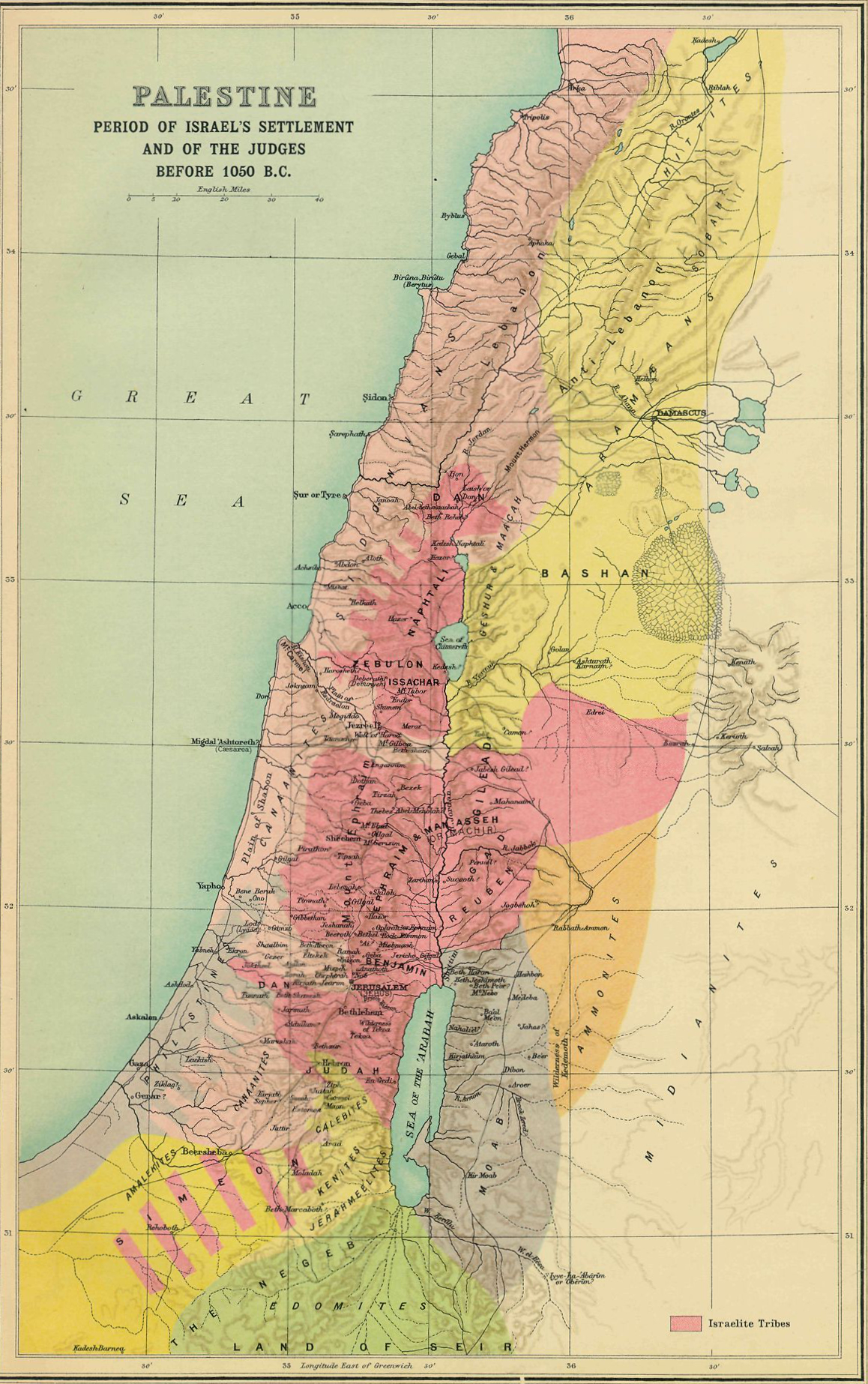
- 1Shittim, The last camp east of the river. Joshua 3:1
- 2The Jordan, The people crossed on dry ground. Joshua 3:17
- 3Gilgal, The camp and the twelve stones. Joshua 4:20
- 4Jericho, The people crossed opposite it. Joshua 3:16
- 5Adam, The water backed up as far as here. Joshua 3:16
- 6Zarethan, Adam lay in its area. Joshua 3:16
Not placed: Shittim (1), Adam (5), Zarethan (6).
Base map: Israel's settlement and the period of the Judges, George Adam Smith, Atlas of the Historical Geography of the Holy Land (1915), public domain. Each place stands at its place page's coordinates, set on the plate by Jerusalem and Damascus, as the plate prints them.
The places in the order Joshua 3 and 4 reach them; the Jordan, Gilgal and Jericho are drawn, and Shittim, Adam and Zarethan are listed in the key.
The two thousand cubitsJoshua 3:4
Adam Clarke gives two reasons for the distance in his Commentary. The ark was the sign of God's presence and called for respect, and a crowd pressing on it would have hidden it from view. John Wesley turns the cubits into yards.
“Two thousand cubits - A thousand yards, at which distance from it the Israelites seem to have been encamped in the wilderness. And because they generally went from their tents to the ark to worship God, especially on the sabbath-days; hence it hath been conceived, that a sabbath-day's journey reached only to two thousand cubits.”
John Wesley · Explanatory Notes upon the Old Testament · on Joshua 3:4Evangelical
The three days of Joshua 1 to 3Joshua 1:11 and 3:2
Joshua 1:11 promises a crossing within three days, the spies hide three days in Joshua 2:22, and Joshua 3:2 counts three days at the river. Clarke reads the three days of Joshua 3:2 as the days the spies were away. John Gill reports David Kimchi's reckoning, which puts the move from Shittim on the ninth day of the first month and the crossing on the tenth.
From Shittim to Gilgal
Joshua 3:1 to 5:1 in the order the events happened
Joshua led the people from Shittim to the bank of the Jordan, and they camped there for three days. On the day of the crossing the priests went ahead with the ark, and as soon as their feet touched the water's edge the river stopped flowing. The people hurried across while the priests stood in the riverbed.
On that day the LORD exalted Joshua in the sight of all Israel, and they revered him all the days of his life, just as they had revered Moses.The river was the place where Israel's respect for its new leader was settled, as Joshua 3:7 had promised.
When the last of the people were over, the LORD told Joshua to bring the priests up. The waters came back over the banks as before, and the people camped at Gilgal.
The stones set up at GilgalJoshua 4:20
And there at Gilgal Joshua set up the twelve stones they had taken from the Jordan.The stones from the riverbed became the camp's first monument in the land.
The news among the kings of CanaanJoshua 5:1
Now when all the Amorite kings west of the Jordan and all the Canaanite kings along the coast heard how the LORD had dried up the waters of the Jordan before the Israelites until they had crossed over, their hearts melted and their spirits failed for fear of the Israelites.The kings west of the Jordan lost heart at the news before Israel struck a single city.
The Red Sea in the Wording of the Jordan
Joshua 4:23 names the Red Sea, and Joshua 3 and 4 share its words
| The matter | At the Red Sea | At the Jordan |
|---|---|---|
| The means | A strong east wind all night (Exodus 14:21) | The priests carrying the ark step into the river (Joshua 3:15 to 16) |
| The water | A wall on the right and on the left (Exodus 14:22) | Backed up as far upstream as Adam (Joshua 3:16) |
| The Hebrew word ned | Rendered "like a wall" (Exodus 15:8) | Rendered "stand up in a heap" (Joshua 3:13) and "backed up" (Joshua 3:16) |
| The ground | Charabah, dry land (Exodus 14:21) | Charabah, dry ground (Joshua 3:17) |
| The leader | The people believed in His servant Moses (Exodus 14:31) | The LORD exalted Joshua (Joshua 4:14) |
| The children's question | "What does this service mean to you?" (Exodus 12:26) | "What do these stones mean to you?" (Joshua 4:6) |
For the LORD your God dried up the waters of the Jordan before you until you had crossed over, just as He did to the Red Sea, which He dried up before us until we had crossed over.Joshua makes the comparison himself, and he counts the generation at the Jordan among those who crossed the sea.
Matthew Henry marks the difference in his Commentary on Joshua 3: at the Red Sea the waters were a wall on either hand, and at the Jordan only on the right hand.
Psalm 114 and the two watersPsalm 114:3 and 5
Psalm 114 sets the two waters in one line, and Charles Spurgeon asks the river what drove it back.
The sea observed and fled; the Jordan turned back;The second half of the line names the Jordan, the only river the psalm mentions.
“What ailed thee, O thou sea? Wert thou terribly afraid? Did thy strength fail thee? Did thy very heart dry up? What ailed thee, O thou sea, that thou fleddest? Thou wert neighbour to the power of Pharaoh, but thou didst never fear his hosts; stormy wind could never prevail against thee so as to divide thee in twain; but when the way of the Lord was in thy great waters thou was seized with affright, and thou becamest a fugitive from before him. Thou Jordan, that thou wast driven back? What ailed thee, O quick descending river?”
Charles Spurgeon · The Treasury of David, Vol. 5 · on Psalm 114:5
The word for the standing waterExodus 15:8 and Psalm 78:13
At the blast of Your nostrils the waters piled up; like a wall the currents stood firm; the depths congealed in the heart of the sea.The song of the sea uses ned for the currents that stood firm, the word Joshua 3:13 and 16 use of the Jordan.
He split the sea and brought them through; He set the waters upright like a wall.The psalm uses ned once more of the sea, and the Berean text renders it a wall.
Where the Water Stood
Adam and Zarethan, the two towns Joshua 3:16 names upstream of the crossing
Keil and Delitzsch note that Adam is named nowhere else in Scripture and that in their day Zarethan had vanished.
the flowing water stood still. It backed up as far upstream as Adam, a city in the area of Zarethan, while the water flowing toward the Sea of the Arabah (the Salt Sea) was completely cut off. So the people crossed over opposite Jericho.The verse names the place where the water stood and the sea below it that was cut off, so the riverbed lay dry between them.
The river at harvestJoshua 3:15
John Wesley takes the harvest of Joshua 3:15 for the barley harvest, since the Passover followed within days. Albert Barnes reads the Hebrew as a river full to its banks.
“Jordan overfloweth all his banks - Rather ‘is full up to all his banks,’ i. e. ‘brim-full.’ This remark strikingly illustrates the suddenness and completeness, not less than the greatness, of the marvel. The Jordan River flows at the bottom of a deep valley, which descends to the water’s edge on either side in two, occasionally in three, terraces. Within the lowest of these the stream, ordinarily less than 100 feet wide in this lower part of its course, is confined.”
Albert Barnes · Notes, Explanatory and Practical, on the Old and New Testaments (1832-1869) · on Joshua 3:15Evangelical
Adam in the ancient versionsthe Vulgate and the Septuagint
Henry Beveridge, translating Calvin's Commentary on Joshua in 1854, notes that the Vulgate puts Edom for Adam and that the Septuagint names the district of Kiriath-jearim. Keil and Delitzsch, after Van de Velde and August Knobel, looked for Zarethan at Kurn Sartabeh, where the valley narrows, a little more than fifteen miles from Jericho.
The Season of the Crossing
The date the book gives and the command of Exodus 12 that shares it
Joshua 4:19 dates the crossing to the tenth day of the first month, the day Exodus 12:3 set for each household to choose its Passover lamb. John Gill counts from the night Israel left Egypt to this day and finds forty years less five days.
Tell the whole congregation of Israel that on the tenth day of this month each man must select a lamb for his family, one per household.Moses gave this command in Egypt before the first Passover, and its date returns at the Jordan.
Origen on the two tenth daysHomilies on Joshua 4.4
Origen of Alexandria saw the two tenth days and drew the line between them.
“And when do they come to the crossing of the Jordan? For I have noted that this also has been indicated, so that even the time might be distinguished, and with good reason. ‘On the tenth,’ it says, ‘of the first month.’ That is also the day on which the mystery of the lamb was prefigured in Egypt. On the tenth of the first month, these things were celebrated in Egypt; on the tenth of the first month, they go into the land of promise.”
Origen of Alexandria · Homilies on Joshua 4.4 · on Joshua 4:19Patristic
The Passover and the end of the mannaJoshua 5:10 to 12
And the day after they had eaten from the produce of the land, the manna ceased. There was no more manna for the Israelites, so that year they began to eat the crops of the land of Canaan.The food of the wilderness stopped on the day after Israel first ate the produce of the land.
What the Text Leaves Unsaid
The width of the river, the hours, the ford and the later history of the stones
How wide was the river?Joshua 3:15
The text says the Jordan overflows its banks at harvest and gives no width or depth.
How long did the water stand?Joshua 3:17 and 4:18
The text measures the time by the people, until the whole nation had crossed, and gives no count of hours.
Where exactly did they cross?Joshua 3:16
The text says the people crossed opposite Jericho and names no ford.
What became of the stones in the river?Joshua 4:9
The text says the stones are there to this day, the day of its writing, and records nothing of them afterward.
The Crossing in the Rest of Scripture
How the Psalms, the Gospels and Paul take up the water crossed on foot
Psalm 66:6 praises God who turned the sea into dry land, and its next line has the people pass through the waters on foot. Albert Barnes holds that the passage through the Jordan carries the same meaning as the passage through the sea.
They were all baptized into Moses in the cloud and in the sea.Paul's word for the sea crossing is the reason Christian readers look for baptism at the Jordan as well.
Albert Barnes on the two passagesNotes on Joshua 3:17
“The miraculous passage to the holy land through Jordan is not less pregnant with typical meaning than that through the Red Sea (compare 1Co 10:1-2).”
Albert Barnes · Notes, Explanatory and Practical, on the Old and New Testaments (1832-1869) · on Joshua 3:17Evangelical
The Jordan at the baptism of JesusMatthew 3:13
At the same river Jesus came to John to be baptized (Matthew 3:13). Matthew Henry joins the two beginnings, Joshua magnified at the Jordan and Jesus declared the beloved Son there.
“Some have observed that it was at the banks of Jordan that God began to magnify Joshua, and at the same place he began to magnify our Lord Jesus as Mediator; for John was baptizing at Bethabara, the house of passage, and there it was that when our Saviour was baptized it was proclaimed concerning him, This is my beloved Son.”
Matthew Henry · Commentary on the Whole Bible · on Joshua 3:7 to 8Puritan
How the Crossing Has Been Taught
Four teachers from the third century to the nineteenth
Origen of AlexandriaHomilies on Joshua, third century
“Everyone who is under the law reveres Moses. But when one crosses over to the gospel from the law, by the changed observance the reverence is also changed. It is just as the apostle says, ‘For I through the law have died to the law so that I may live for God; I was crucified with Christ, but now I live; not I, but Christ lives in me.’”
Origen of Alexandria · Homilies on Joshua 5.4 · on Joshua 4:14Patristic
Gregory of NyssaOn the Baptism of Christ, fourth century
“The people of the Hebrews, as we learn, after many sufferings, and after accomplishing their weary course in the desert, did not enter the land of promise until it had first been brought, with Joshua for its guide and the pilot of its life, to the passage of the Jordan. But it is clear that Joshua also, who set up the twelve stones in the stream, was anticipating the coming of the twelve disciples, the ministers of Baptism.”
Gregory of Nyssa · On the Baptism of Christ · on Joshua 4:3 to 4Patristic
John DamasceneOn the Divine Images, eighth century
“Images are of two kinds: either they are words written in a book … or else they are material images such as the twelve stones which he commanded to be taken from the Jordan for a second memorial (such a mystery, truly the greatest ever to befall the faithful people!) of the carrying of the ark and the parting of the waters. Therefore we now set up images in remembrance of valiant men, that we may zealously desire to follow their example.”
John Damascene · On Divine Images 3.23 · on Joshua 4:5 to 6Patristic
Jamieson, Fausset and BrownCommentary Critical and Explanatory, 1871
“The unfaltering confidence of the priests contrasts strikingly with the conduct of the people, who ‘hasted and passed over.’ Their faith, like that of many of God's people, was, through the weakness of nature, blended with fears.”
Jamieson, Fausset & Brown · Commentary Critical and Explanatory on the Whole Bible · on Joshua 4:10Reformed
Where Readers Differ
Two questions the account raises, with the readers who hold each answer
How the water at Adam was stoppedWatson and Clermont-Ganneau; Calvin and Henry
One reading holds that God used a fall of the river's bank upstream, and that the wonder lies in the timing. C. M. Watson set it out in the Quarterly Statement of the Palestine Exploration Fund in 1895, from Charles Clermont-Ganneau's notes on the Arab chronicler Nowairi. Nowairi records that on the night before 8 December 1267 a high bank of marl fell into the Jordan above Damieh. The riverbed below stood empty from midnight until the fourth hour of the day. Watson takes Damieh for Adam.
The other side answers that the text ties the stopping to the moment the priests' feet touched the water and the return to the moment they stepped out (Joshua 4:18).
The other reading holds that the text gives no means and that the heap is God's act, as at the Red Sea. John Calvin, in his Commentary on Joshua, allows that the flow might be held back for a short time by other causes. He holds that water standing in a heap was neither natural nor a chance event. Matthew Henry writes that the stream stopped as if a sluice had been let down.
The first side answers that the text itself names a city far upstream as the place the water stood, where such a dam would form.
The stones of Joshua 4:9Rashi, Calvin, Henry, Barnes, Keil and Delitzsch; Josephus
Joshua also set up twelve stones in the middle of the Jordan, in the place where the priests who carried the ark of the covenant stood. And the stones are there to this day.This verse is the whole of the evidence for a second pile, so each reading turns on how it is read.
One reading takes these for a second set of twelve, left in the riverbed beside the set carried to Gilgal. Rashi holds it on this verse, and so do Calvin, Matthew Henry, Albert Barnes, and Keil and Delitzsch in their Biblical Commentary on the Old Testament.
“Another set of stones is intended than that before mentioned. The one set was erected by the command of God at the spot where they passed the night Jos 4:3; the other by Joshua on the spot where the priests’ feet rested while they bore up the ark during the passage of the people. This spot was near, or perhaps on, the eastern brink (compare Jos 3:8).”
Albert Barnes · Notes, Explanatory and Practical, on the Old and New Testaments (1832-1869) · on Joshua 4:9Evangelical
The other reading finds one memorial only. Josephus, in his Antiquities of the Jews, tells of one altar built at the camp from the stones taken out of the deep, and names no pile in the river.
The first side answers from the verse itself, which names the place where the priests stood.
Books on the Crossing
Biblical Commentary on the Old Testament: Joshua, Judges, Ruth
C. F. Keil and F. Delitzsch · 1875
The commentary takes Joshua 3 and 4 clause by clause, with the Hebrew and the sites.
Read it free at archive.orgCommentary on Joshua
John Calvin, translated by Henry Beveridge · 1854
Calvin writes on the heap of water and the stones in the stream, and Beveridge's notes add the ancient versions.
Read it free at CCELThe Antiquities of the Jews
Flavius Josephus, translated by William Whiston · 1737
Josephus retells the crossing and the camp at Gilgal in book 5.
Read it free at Project GutenbergPalestine Exploration Fund Quarterly Statement for 1895
C. M. Watson and others · 1895
Watson prints Nowairi's account of the stoppage of 1267 in English, with a map of the river.
Read it free at archive.orgAcross on Dry Ground
The priests stood in the riverbed until the last of the people had crossed, and the stones at Gilgal kept the day for the children who would ask about them. Joshua 4:24 gives the reason: that all the peoples of the earth may know the hand of the LORD is mighty, and that Israel may always fear the LORD. The text asks the reader to fear Him and to tell the next generation what He has done. Hebrews 4:8 to 9 says that a Sabbath rest still remains beyond the rest Joshua gave, and Hebrews 4:14 sets Jesus, the great high priest, before the reader.
Keep studying
Studies7
People3
Symbols2