
Joshua 15 to Judges 3 · Person · Featured Study
Othniel, the first judge
He captured Debir for Caleb, and after eight years under Cushan-rishathaim he became the first deliverer the book of Judges names.
Judges 3:10 is the first verse of the Bible that says the Spirit of the LORD came upon a man, and the man was Othniel.
- The name means
- lion of God, as Smith's Dictionary of the Bible gives it in 1863
- Family
- father, or the clan's forefather: Kenaz; uncle, or elder brother: Caleb; wife: Acsah; brother: Seraiah; son: Hathath; son: Meonothai
- Places
- Hebron
- First named
- Joshua 15:17
- Last named
- 1 Chronicles 27:15
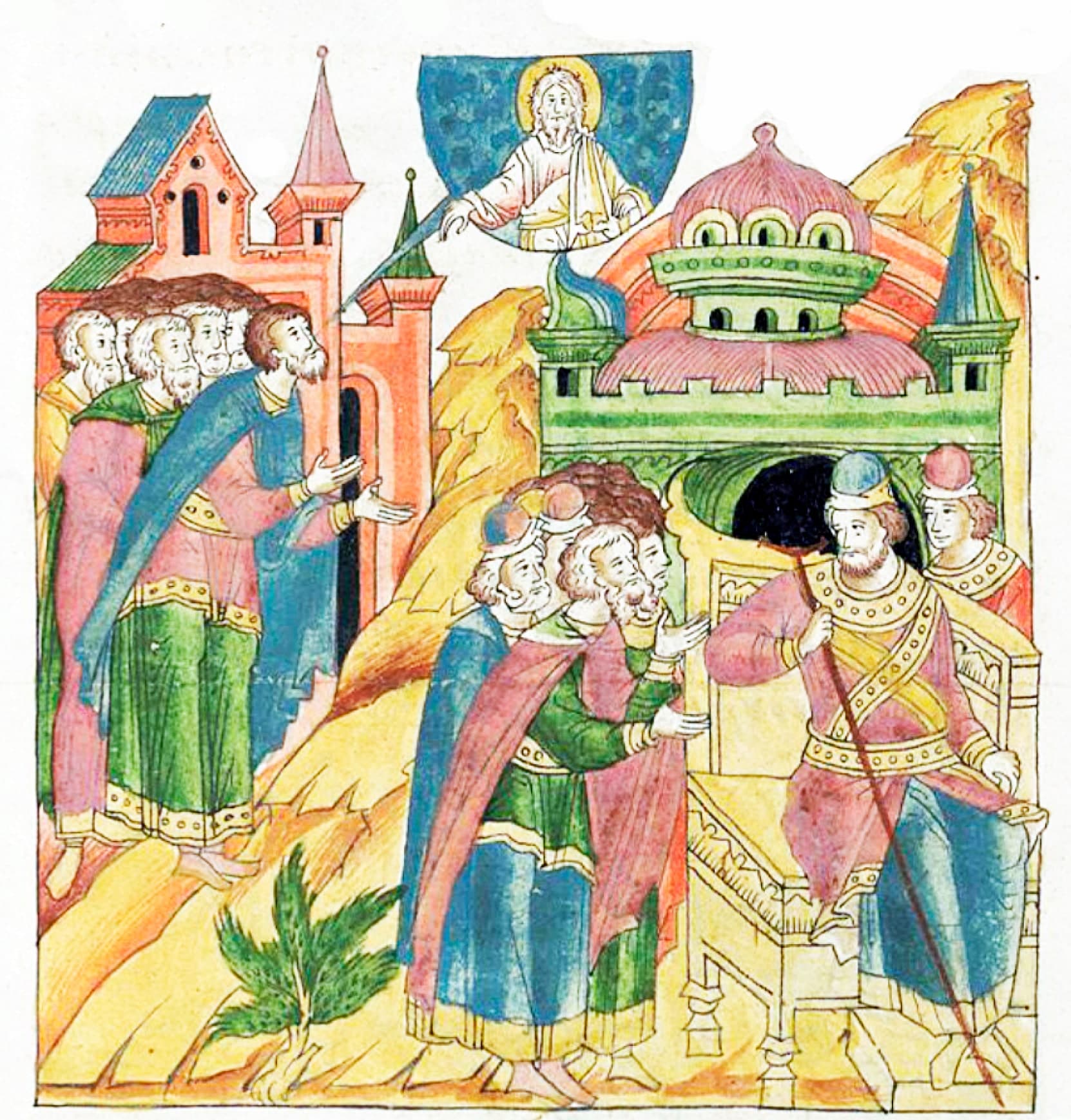
Anonymous Russian illuminators, Othniel, Judge in Israel, a miniature of the Illustrated Chronicle of Ivan the Terrible, 1560s, Museum Collection volume. Public domain, Wikimedia Commons File:Facial Chronicle - b.02, p.485 - Othniel.jpg.
THE ARTWORKThe Moscow illuminators painted Othniel seated as judge, with the men of Israel coming before him and God above them in a blue arc of sky.
Summary
Othniel son of Kenaz was a Kenizzite of Caleb's family who took the city of Debir and married Caleb's daughter Acsah.
- When Israel served the Baals and the Asherahs, the LORD sold them to Cushan-rishathaim king of Aram-naharaim for eight years.
- The Israelites cried out, and the LORD raised up Othniel as a deliverer to save them.
- The Spirit of the LORD came upon him, he became Israel's judge, and he prevailed against the king.
- The land had rest for forty years, until Othniel died.
Where Othniel Stands in Scripture
His first mention at Debir in Joshua 15 and the deliverance of Judges 3
So Othniel son of Caleb’s brother Kenaz captured the city, and Caleb gave his daughter Acsah to him in marriage.Scripture first names Othniel as the man who answered Caleb's offer and took the city.
So the land had rest for forty years, until Othniel son of Kenaz died.The same span returns for Deborah in Judges 5:31 and for Gideon in Judges 8:28.
His Life in Order
The turns of his life in Joshua 15 and Judges 1 and 3, in the order the text tells them
The text gives Othniel no age and no year, only the eight years of servitude and the forty years of rest.
- Caleb offers his daughter to the man who takes Kiriath-sephernone givenJoshua 15:16
- Othniel captures the city and marries Acsahnone givenJoshua 15:17
- Acsah urges him to ask her father for a fieldnone givenJoshua 15:18
- Caleb gives her the upper and lower springsnone givenJoshua 15:19
- Israel is sold to Cushan-rishathaim and serves himeight yearsJudges 3:8
- The LORD raises Othniel up as a delivererat the cry of IsraelJudges 3:9
- The Spirit of the LORD comes upon him and he goes out to warnone givenJudges 3:10
- The land has restforty yearsJudges 3:11
- Othniel son of Kenaz diesat the close of the restJudges 3:11
The first four turns stand in Joshua 15 and again in Judges 1; the last five stand in Judges 3.
The rest under Othniel lasted five times as long as the servitude before it.
The 2 spans in years as a table
| Span | Spans in years | Verse |
|---|---|---|
| Israel serves Cushan-rishathaim | 8 | Judges 3:8 |
| The land has rest | 40 | Judges 3:11 |
Both bars are numbers the text gives, read from zero.
From Debir to the Deliverance
Joshua 15:15 to 19 and Judges 3:7 to 11
After Caleb drove the three sons of Anak from Hebron, he marched against Debir and promised his daughter to its conqueror.
And Caleb said, “To the man who strikes down Kiriath-sepher and captures it, I will give my daughter Acsah in marriage.”Caleb's offer sets the prize that brings Othniel into the story.
Judges 3:7 to 11 tells the whole deliverance in five verses.
But when the Israelites cried out to the LORD, He raised up Othniel son of Caleb’s younger brother Kenaz as a deliverer to save them.The LORD answers the cry of a people who had forgotten Him, as Judges 2:18 says He was moved to pity by their groaning.
The Spirit of the LORD came upon him, and he became Israel’s judge and went out to war. And the LORD delivered Cushan-rishathaim king of Aram into the hand of Othniel, who prevailed against him.This is the only verse that tells Othniel's war, from the Spirit's coming to the victory.
The springs Acsah asked forJoshua 15:18 and 19
“Give me a blessing,” she answered. “Since you have given me land in the Negev, give me springs of water as well.” So Caleb gave her both the upper and lower springs.Her request shows that a gift of land in the Negev needed water to be of use.
On page 158 Keil reads the upper and lower springs as the name of a tract with springs on the higher and the lower ground near Debir. He notes that the text states only what Acsah did to gain her request.
“She thought her husband had the best interest in her father, who, no doubt, was extremely pleased with his late glorious achievement, but he thought it was more proper for her to ask, and she would be more likely to prevail; accordingly she did, submitting to her husband's judgment, though contrary to her own; and she managed the undertaking with great address.”
Matthew Henry · Commentary on the Whole Bible · on Joshua 15:19Puritan
The pattern of Judges 2 on Othniel's accountJudges 2:16 and 2:18
Whenever the LORD raised up a judge for the Israelites, He was with that judge and saved them from the hands of their enemies while the judge was still alive; for the LORD was moved to pity by their groaning under those who oppressed them and afflicted them.The book's preface says the LORD was with each judge and saved Israel while the judge lived, and Judges 3:11 keeps that rule for Othniel.
George Foot Moore wrote on Judges 3:7 to 11 in his commentary of 1895, page 84. He notes that the opening and closing formulas of the stories of the judges stand there in their complete form, where they are used for the first time.
What the Text Says
Three details of Judges 3, each with its verse
ISRAEL FORGOT THE LORD
Keil notes that Judges 3:7 says Israel forgot the LORD their God, a word he traces to Deuteronomy 32:18.
TWO NAMES FOR ONE KINGDOM
Judges 3:8 calls the oppressor king of Aram-naharaim, and Judges 3:10 calls him king of Aram.
ISRAEL TURNED BACK AFTER HIS DEATH
Judges 2:19 says Israel grew more corrupt whenever a judge died, and Judges 3:12 shows it once Othniel had died.
Cushan-rishathaim and Aram-naharaim
The king Israel served for eight years, and the land he ruled
Then the anger of the LORD burned against Israel, and He sold them into the hand of Cushan-rishathaim king of Aram-naharaim, and the Israelites served him eight years.The verse sets the servitude as the LORD's judgment on Israel's worship of the Baals.
Adam Clarke, in his Commentary on Judges 3:8, takes Aram-naharaim to mean Syria of the two rivers, the district between the Tigris and the Euphrates that the Septuagint and the Vulgate call Mesopotamia.
Keil, on Judges 3:8 in 1865, writes that all we know about this king is what the verse records. He takes Rishathaim, double wickedness, to be a title the Israelites gave him.
How Josephus tells the warAntiquities 5.3.2 to 3
Josephus, in the Antiquities of the Jews as Whiston translated it, calls the oppressor Chushan, king of the Assyrians, and says Israel paid him tribute for eight years. In his telling Othniel of the tribe of Judah first destroyed the garrison Chushan had set over them, then drove the enemy back over the Euphrates and ruled forty years.
Moore, in a note on page 84 of his commentary, says Josephus felt the lack of detail in the story and filled in incidents that seem suggested by the Maccabean wars.
Three readings of the oppressorKeil; Moore; Moore on Sayce
Keil, on pages 292 to 293 of his commentary, reads Cushan-rishathaim as a Mesopotamian or Babylonian king and compares his campaign with that of the kings of Shinar in Genesis 14.
Moore, on page 88, conjectures that Cushan was a desert tribe linked with Midian, as in Habakkuk 3:7. The story, he suggests, may come from such a tribe's raid and its defeat by the Kenizzites of Debir. On page 85 he reports that Wellhausen, Budde and Stade doubted the account had any basis in tradition.
Moore also reports, on page 85, that A. H. Sayce in The Higher Criticism and the Verdict of the Monuments took Aram-naharaim to be the land of Mitanni and tied the eight years to the wars of Ramses III. Moore answers that Sayce gives no references for it.
The objection to Moore's raid is that Judges 3:8 names a king and his kingdom. The objection to a king from the Euphrates is the distance, since Moore judges a conquest of Canaan from so remote a quarter highly improbable.
The Family of Othniel
Seven people, each with the verse that names the tie
| Person | Tie to Othniel | Verse |
|---|---|---|
| Kenaz | His father, or the forefather of the Kenizzite clan. | 1 Chronicles 4:13 |
| Caleb son of Jephunneh | His uncle, or his elder brother: the reading is contested. | Judges 3:9 |
| Jephunneh | Caleb's father. | Numbers 13:6 |
| Acsah | His wife, Caleb's daughter. | Joshua 15:17 |
| Seraiah | His brother. | 1 Chronicles 4:13 |
| Hathath | His son. | 1 Chronicles 4:13 |
| Meonothai | His son, the father of Ophrah. | 1 Chronicles 4:14 |
The Places of His Life
Hebron, Debir and the springs in the hill country of Judah, and a king from beyond the Euphrates
Smith's plate prints Kirjath Sepher southwest of Hebron, toward the Negev that Acsah named.
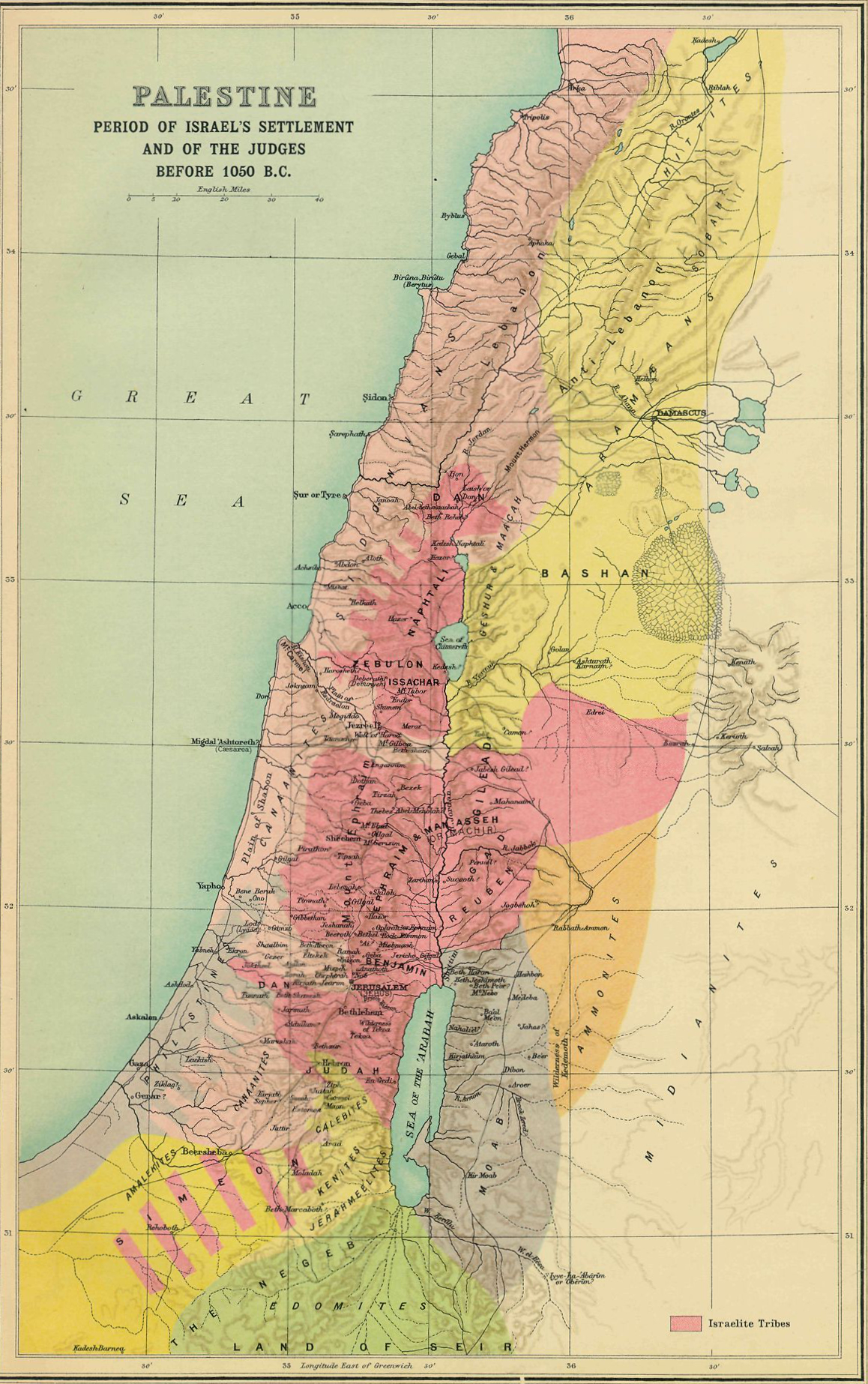
- HebronCaleb's portion, from which he marched against Debir.Joshua 15:13
- Kirjath SepherThe plate prints the city near ed-Dhahiriya, the site Knobel proposed in 1861.Joshua 15:15
- Tell Beit MirsimThe mound Melvin Grove Kyle took to be Kirjath-sepher in his lectures of 1932.Judges 1:11
- Seil ed-DilbehMoore's site for Acsah's springs in 1895, two fifths of the way from Hebron to ed-Dhahiriya.Joshua 15:19
George Adam Smith, Atlas of the Historical Geography of the Holy Land (1915), plate Palestine, Period of Israel's Settlement and of the Judges. Public domain.
Four points on the 1915 plate: Hebron and Kirjath Sepher where the plate prints them, and Tell Beit Mirsim and the springs placed from their coordinates. Aram-naharaim lies beyond the plate's northeast corner.
| Site | Proposer and year | Read in |
|---|---|---|
| Idbirwan, west of Hebron | Rosen, 1857 | Moore, Judges (1895), page 26 |
| ed-Dhahiriya | Knobel, 1861, then Conder, 1879 | Moore, Judges (1895), page 25 |
| Not yet found | Keil, 1865 | Keil, Joshua (1865), on Joshua 15:15 |
| Tell Beit Mirsim | Kyle, 1932 | Kyle, Excavating Kirjath-Sepher's Ten Cities |
| Khirbet Rabud | Kochavi, 1974 | Kochavi, Khirbet Rabud = Debir, Tel Aviv 1 |
Questions His Life Raises
Three questions answered from their verses and their commentators
Did Othniel live through all forty years?Judges 3:11
Keil, on page 294, says the words do not require that Othniel outlived the whole span, only that he died once peace had returned. John Gill, in his Exposition on Judges 3:11, counts the forty from the deliverance and reports that Gersonides and Abarbanel include the eight years of servitude in them.
Metzudat David, on the same verse, counts the forty years from the beginning of the servitude, following Seder Olam. Albert Barnes, in his Notes on Judges 3:11, takes forty years as a round number, perhaps a generation.
What power came upon Othniel?Judges 3:10
Keil, on pages 293 to 294, reports that the Targum reads a spirit of prophecy here and that Kimchi reads a spirit of bravery. He holds that the gift cannot be limited to courage, since the judges also judged the nation and put down idolatry.
“The Chaldee says, The spirit of prophecy remained on him. He first judged Israel, reproved them, called them to account for their sins, and reformed them, and then went out to war. This was the right method.”
Matthew Henry · Commentary on the Whole Bible · on Judges 3:10Puritan
How old was Othniel at his death?Joshua 14:10 and Judges 3:11
The article Othniel in Smith's Dictionary of the Bible of 1863 adds up the spans if Othniel was Caleb's brother and at least forty at his marriage. The sum gives him 143 years at his death, which the article judges impossible, and it treats the difficulty as part of the wider chronology of the judges.
The article notes that the difficulty eases if Othniel was Caleb's nephew, who might have been about twenty-five at his marriage.
What the Text Leaves Unsaid
The battle, his age and his years as judge
Judges 3 names no battlefield, no army and no ally, and Moore, on page 84, notes that no single detail of the struggle is recorded. Nor does the chapter say how Othniel judged Israel during the forty years.
No verse gives his age or the place of his burial, and after Judges 1:14 the text does not name Acsah with him again.
The Spirit of the LORD in Judges
Where the words of Judges 3:10 return in the book
| Judge | What followed | Verse |
|---|---|---|
| Othniel | He became Israel's judge and went out to war. | Judges 3:10 |
| Gideon | He blew the ram's horn and rallied the Abiezrites. | Judges 6:34 |
| Jephthah | He passed through Gilead and Manasseh and advanced against the Ammonites. | Judges 11:29 |
| Samson | The Spirit began to stir him at Mahaneh-dan. | Judges 13:25 |
| Samson | He tore the lion apart with his bare hands. | Judges 14:6 |
| Samson | He went down to Ashkelon and killed thirty men. | Judges 14:19 |
| Samson | The ropes on his arms became like burnt flax at Lehi. | Judges 15:14 |
The judges as saviorsAlbert Barnes; Origen
Albert Barnes, in his Notes on Judges 3:10, says the phrase marks the special office of the judges, saviors called and directed by the Holy Spirit. He calls them in this respect types of Christ, on whom the Spirit rested without measure.
“It calls the savior ‘Othniel,’ which means ‘the time of God for me.’ Through this first Othniel, then, the people were delivered from their humiliating servility and were restored to peace rather than having their longstanding pride and various deeds removed.”
Origen of Alexandria · Homilies on Judges 3.3 · on Judges 3:9Patristic
Voices on Othniel
Three quotations, from Origen to Matthew Henry
The servitudeOrigen; Matthew Henry
“Now Chusarsaton's name is translated as ‘humiliation.’ They were delivered, then, to the hands of one who would humiliate them. And it was because they acted wickedly on the heights of the mountains against the Most High that he sent them to their humiliation. But I don't want you to think that it is only in relation to the ancients that divine providence delivers those who were exalted in wickedness for the purpose of humiliating them and that they may be healed by such a wholesome remedy.”
Origen of Alexandria · Homilies on Judges 3.1 · on Judges 3:8Patristic
“Affliction makes those cry to God with importunity who before would scarcely speak to him. God's return in mercy to them for their deliverance. Though need drove them to him, he did not therefore reject their prayers, but graciously raised up a deliverer, or saviour, as the word is.”
Matthew Henry · Commentary on the Whole Bible · on Judges 3:9Puritan
The young man at DebirMatthew Henry
“It is good for those who are setting out in the world to begin betimes with that which is great and good, that, excelling in service when they are young, they may excel in honour when they grow old.”
Matthew Henry · Commentary on the Whole Bible · on Joshua 15:17Puritan
Caleb's Nephew or Caleb's Brother
Three readings of Judges 1:13 and 3:9, each with its holders and the objection to it
So Othniel son of Caleb’s younger brother Kenaz captured the city, and Caleb gave his daughter Acsah to him in marriage.Judges 1:13 carries the words younger than he, which the account of Joshua 15:17 lacks, and the dispute turns on them.
Moore, on page 27, says the words younger brother may refer either to Kenaz or to Othniel, and that interpreters have always been divided on it.
Othniel as the younger brotherKeil; Smith's Dictionary
Keil, on page 157, notes that the Masoretes set a disjunctive accent between son of Kenaz and brother of Caleb, and that son of Kenaz means the same as the Kenizzite of Joshua 14:6. He adds that the law did not forbid marriage with a brother's daughter.
A. C. H., writing for the Dictionary, cites Jerome's Latin and judges that the evidence, candidly weighed, favours the brother.
The objection is that 1 Chronicles 4:13 lists Othniel among the sons of Kenaz, and Caleb's father was Jephunneh.
A brother through their motherRashi
Rashi, in his commentary on Joshua 15:17 and Judges 1:13, makes Othniel Caleb's brother on his mother's side: after Jephunneh died, she married Kenaz and bore Othniel. He cites the Talmud, Sotah 11b to 12a.
The objection is that no verse names Caleb's mother or a second marriage.
A nephew, the son of KenazAdam Clarke; the Septuagint
Adam Clarke, in his Commentary on Judges 3:9, calls Othniel the nephew and son-in-law of Caleb. Moore, on page 27, reports the same reading in manuscripts of the Septuagint and in Calvin and Ewald.
The objection, as Moore puts it, is that the words who was younger than he favour making Othniel the brother.
Books to Read Next
Four books, from Matthew Henry to George Foot Moore
Biblical Commentary on the Old Testament: Joshua, Judges, Ruth
C. F. Keil and F. Delitzsch · 1865
Keil weighs the Hebrew of Othniel's tie to Caleb and the gift of the Spirit in his notes on Joshua 15:17 and Judges 3:7 to 11.
READ IT FREE AT ARCHIVE.ORG →A Critical and Exegetical Commentary on Judges
George Foot Moore · 1895
Moore sets out the proposed sites of Debir and the critical readings of Cushan-rishathaim, with their holders.
READ IT FREE AT ARCHIVE.ORG →A Dictionary of the Bible, volume 2
William Smith, editor · 1863
Its article Othniel reckons his age under both readings of his tie to Caleb.
READ IT FREE AT ARCHIVE.ORG →Commentary on the Whole Bible
Matthew Henry · 1710
Henry's second volume runs from Joshua to Esther, so it covers both the taking of Debir and the deliverance.
READ IT FREE AT CCEL →The First Deliverer
Othniel's short account shows the LORD answering His people's cry with a deliverer filled by His Spirit, and the rest lasting while that deliverer lived.
Then the LORD raised up judges, who saved them from the hands of those who plundered them.Othniel is the first judge after this summary, so his account is the first test of it.
The reader who cries to the LORD in trouble may trust Him to save, as He saved Israel in Othniel's day and saves fully in Christ.
Keep studying
Doctrines1
Peoples and groups2