
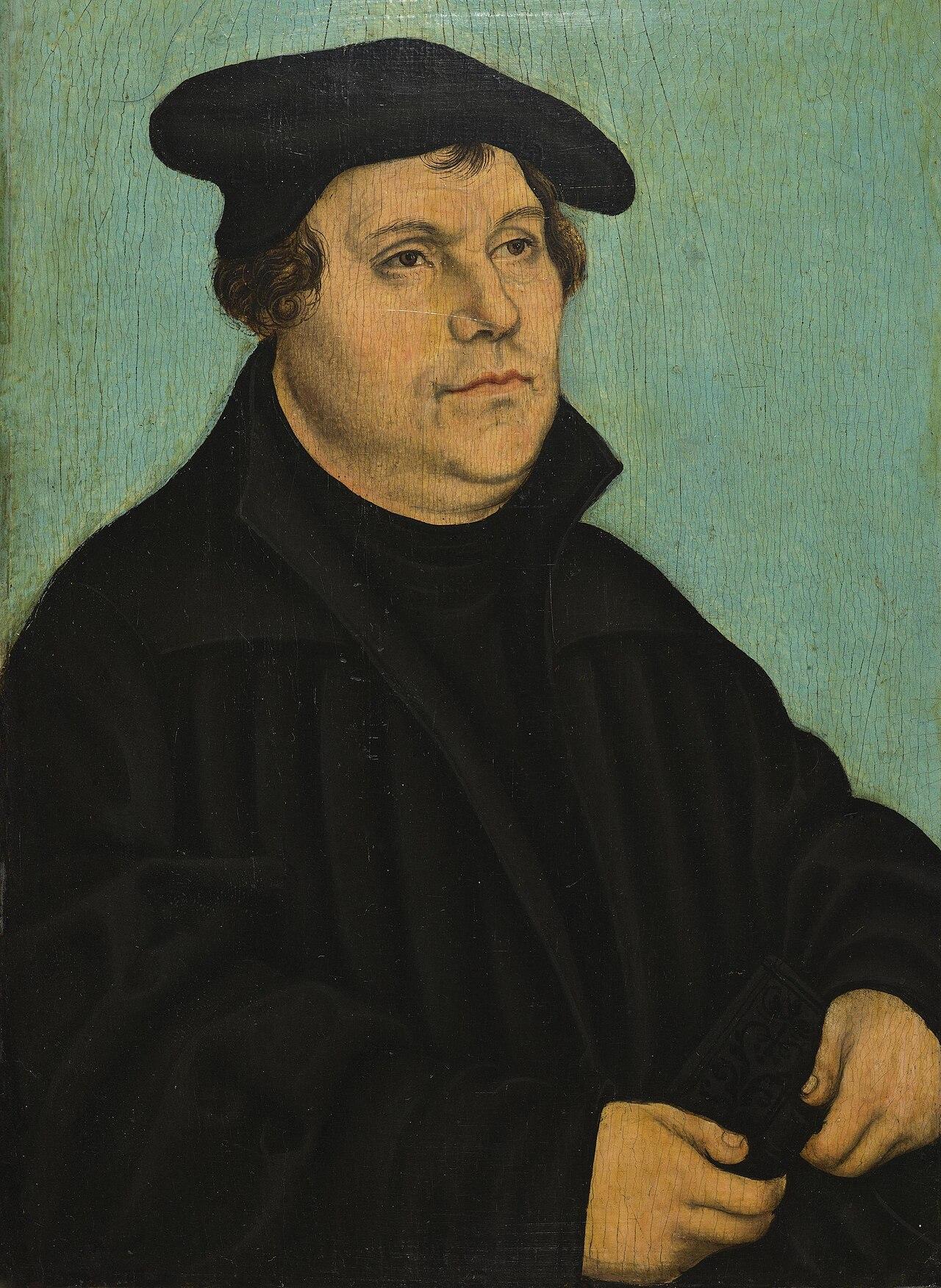
Lucas Cranach the Elder, Martin Luther, 1532. Public domain.
Saxony and the Empire, 1483 to 1546 · Person · Featured Study
Martin Luther
He was an Augustinian friar and professor at Wittenberg who broke with Rome over indulgences and justification by faith.
A friar who could not find peace in his cell read that God gives His righteousness as a gift, and he would not take it back before the Emperor.
For the gospel reveals the righteousness of God that comes by faith from start to finish, just as it is written: “The righteous will live by faith.”
For the gospel reveals the righteousness of God that comes by faith from start to finish, just as it is written: “The righteous will live by faith.”
- Born
- 10 November 1483 at Eisleben in Saxony
- Died
- 18 February 1546 at Eisleben
- Family
- father: Hans Luder; mother: Margaret; wife: Katharina von Bora
- Places
- Eisleben, Erfurt, Wittenberg, Worms, the Wartburg
Summary
Martin Luther was born at Eisleben in 1483 and became an Augustinian friar at Erfurt in 1505. As professor of the Bible at Wittenberg he came to read one verse of Paul as God's gift of righteousness by faith. His protest against indulgences led to his excommunication and to the Diet of Worms. He translated the Bible into German, married a former nun and died at Eisleben in 1546.
- He told late in life how that verse opened the gospel to him.
- His German translation of the Bible shaped the language of his people.
- His words against the rebel peasants and his books against the Jews stand against him.
The Verse That Opened
One verse turned his reading of the gospel, and another carried his word alone.
In the preface to his Latin works of 1545 Luther said that one phrase of Romans 1:17, the righteousness of God, had stood in his way. He took it at first to mean the justice by which God punishes, and he says he meditated on it day and night until he saw it as the righteousness God gives to faith.
In his German New Testament Luther added the word allein, alone, after faith in Romans 3:28, and he defended the word in print in 1530.
For we maintain that a man is justified by faith apart from works of the law.In the Smalcald Articles Luther called faith alone the article no believer may yield.
The Life in Order
Köstlin and Schaff give the dates, and Luther's letters fix the turning points.
Four years ran from his letter on indulgences to his hearing before the Emperor.
- November 1483He was born at Eisleben, the first child of Hans and Margaret LuderKöstlin, page 1
- 2 July 1505A storm caught him at Stotternheim, and he vowed to become a monkKöstlin, page 38
- 17 July 1505He entered the Augustinian convent at ErfurtKöstlin, page 39
- 2 May 1507He was ordained priest, and his father came to the service still angryKöstlin, pages 54 to 55
- 1513He began his lectures on the Psalms at WittenbergSchaff, volume 7
- October 1517He sent his theses on indulgences to Archbishop AlbrechtThe church history standard; Leppin and Wengert
- 10 December 1520He burned the papal bull outside the Elster gateSmith, 1911
- April 1521He refused to recant before Charles V at WormsSmith, 1911; Schaff, volume 7, section 53
- 4 May 1521Hidden at the WartburgKöstlin, page 244
- 21 September 1522His German New Testament appeared without his nameSchaff, volume 7
- 13 June 1525Marriage to Katharina von BoraSmith, 1911
- 1534The whole German Bible was completedSchaff, volume 7
Each step of the life stands with its witness.
10 December 1520, April 1521, 4 May 1521, 21 September 1522, 13 June 1525, 1534
From the Convent to the Castle Church
Luther told much of his life himself, and the records of Worms and Wittenberg tell the rest.
Martin Luther was born on November 10, 1483, at Eisleben in Saxony, the son of a copper miner who worked his way up to leasing smelters. His father wanted a lawyer, and Luther enrolled in law at Erfurt in 1505.
He was caught in a thunderstorm that July on the road near Stotternheim. A flash of lightning threw him to the ground, and he cried out, in Köstlin's English, "Help, Anna, beloved Saint! I will be a monk." Two weeks later he entered the Augustinian friary at Erfurt. His father did not forgive him for years.
He was a ferocious monk who fasted, confessed for hours at a stretch and punished his body, and it did not help. He said afterward that, blameless as he was in the cloister, he was secretly offended at the righteous God, because he knew God only as the judge who punishes sinners. His superior Johann von Staupitz pushed him into study and then into the chair of biblical theology at the new University of Wittenberg, where he lectured on the Psalms, Romans, and Galatians.
In his own account Romans 1:17 broke open for him: "The righteous will live by faith." He came to see that God's righteousness in that verse is the gift by which God saves. It is received by faith, and it is no longer the standard by which God condemns. He wrote that he felt himself born again and to have gone through open doors into paradise.
On October 31, 1517, he sent ninety-five theses against the sale of indulgences to his archbishop. By long tradition he posted them on the door of the Castle Church at Wittenberg, which served the university as a notice board. The letter of that day is the fixed point. The posting rests on a note by his secretary Georg Rörer, and it has been disputed since Erwin Iserloh in 1961. They were an invitation to academic debate. Within fourteen days, Luther said, they ran through the whole of Germany.
Rome moved slowly and then hard. He met Cardinal Cajetan at Augsburg in October 1518. At Leipzig in 1519 he debated Johann Eck and said that a general council, like a pope, may err. In 1520 he published three books on the reform of the church, the sacraments and Christian liberty, and a papal bull threatened him with excommunication. He burned the bull in public, and the excommunication came the next January.
That April he stood before Emperor Charles V at the Diet of Worms and was shown a table of his books. Asked to recant, he requested a day to think. Then he answered that unless he were convicted by Scripture and plain reason, his conscience was captive to the Word of God. He could not and would not recant, because to act against conscience is neither safe nor right.
On the road home his prince's men seized him for his own safety and hid him in the Wartburg castle. The Edict of Worms then declared him an outlaw. There, between the end of 1521 and the following March, he translated the New Testament into German from the second edition of Erasmus's Greek text. The complete Bible followed in 1534. It did for German what the King James Version later did for English.
In 1525 he married Katharina von Bora, a runaway nun, and made the parsonage a Protestant institution. They had six children. He wrote catechisms for the people and the young, a German order of service, and hymns, "A Mighty Fortress Is Our God" among them.
He was also capable of terrible things. He urged the princes to crush the peasants' revolt without mercy. Late in life he wrote savagely against the Jews, and later regimes seized on those writings. Lutheran churches have since publicly repudiated them.
He died at Eisleben, the town where he was born, on February 18, 1546, having travelled there to settle a quarrel among the Counts of Mansfeld.
Against the Peasants and the Jews
Schaff, a Protestant historian, sets out what Luther urged against the rebels and against the Jews.
Schaff writes that Luther at first called most of the peasants' Twelve Articles just and rebuked the princes for oppressing the poor. When the revolt spread in 1525, he called on the rulers to "stab, kill, and strangle" the rebels like mad dogs. The princes crushed the revolt, and Schaff puts the dead at far more than a hundred thousand.
In 1523 Luther protested against the cruel treatment of the Jews and counselled kindness. In 1543 he wrote two violent books against them. Schaff reports that he advised their expulsion, the banning of their books and the burning of their synagogues and even their houses. The kindness he had urged in 1523 was the standard he broke in 1543.
The Church Council of the Evangelical Lutheran Church in America adopted a declaration to the Jewish community on 18 April 1994. In it the church rejects this violent invective and deplores the use of Luther's words by modern anti-Semites. The site holds that God has not cast off Israel, and it prints these books as a failure of the man.
In Their Own Words
Five sayings from his letters and books, from the theses to the Wartburg.
Martin Luther (1483 to 1546)
The Life of Luther Gathered from His Own Writings
The righteousness of God
“I perceived that the righteousness of God is that by which the just man, through God's goodness, lives, that is to say, faith; and that the meaning of the passage is—the Gospel reveals the righteousness of God, a passive righteousness, through which the God of mercy justifies us by faith.”
Lutheran
About this saying1 paragraph
He wrote this account of Romans 1:17 in 1545, the year before he died.
Martin Luther
Letter to Christoph Scheurl (5 March 1518), in Preserved Smith, The Life and Letters of Martin Luther (Boston, 1911), chapter on the theses, page 44
Why he wrote the theses
“my purpose was not to publish them, but first to consult a few of my neighbors about them, that thus I might either destroy them if condemned or edit them with the approbation of others.”
Lutheran
About this saying1 paragraph
He wrote to Christoph Scheurl on 5 March 1518, when the theses had spread far beyond Wittenberg.
Martin Luther
Concerning Christian Liberty, the opening propositions
Free lord and dutiful servant
“A Christian man is the most free lord of all, and subject to none; a Christian man is the most dutiful servant of all, and subject to every one.”
Lutheran
About this saying1 paragraph
These two propositions open his Concerning Christian Liberty of 1520.
Martin Luther
Letter to George Spalatin, Frankfort on the Main, (April 14), 1521, in Preserved Smith, The Life and Letters of Martin Luther, page 111
On the road to Worms
“Truly Christ lives and I shall enter Worms in the face of the gates of hell and the princes of the air.”
Lutheran
About this saying1 paragraph
He wrote to George Spalatin from Frankfurt on 14 April 1521, two days before he reached Worms.
Martin Luther
Letter to John Lang at Erfurt, The Wilderness, December 18, 1521, in Preserved Smith, The Life and Letters of Martin Luther, the letter to Lang
The Bible in every town
“Would that every town had its interpreter, and that this book alone might be on the tongues and in the hands, the eyes, the ears, and the hearts of all men.”
Lutheran
About this saying1 paragraph
He wrote to John Lang from the Wartburg on 18 December 1521, when he had resolved to translate the New Testament.
The People Around Him
The witnesses name his parents, his teacher, his wife, his friends and the men who opposed him.
A prince kept him alive, and a friend in Wittenberg kept his work going.
| Person | Tie to Luther | The witness |
|---|---|---|
| Hans Luder | His father, a miner who leased two smelting furnaces and wanted his son to be a lawyer. | Köstlin, pages 7 to 8 and 35 |
| Johann von Staupitz | The vicar-general of his order, who led him into study and the doctorate. | Köstlin, pages 51 to 58 |
| Frederick of Saxony | His prince, who would not summon him himself and had him hidden after Worms. | Wace and Buchheim, 1883; Köstlin |
| George Spalatin | The prince's secretary, to whom he wrote from Frankfurt and the Wartburg. | Smith, 1911 |
| Philip Melanchthon | His colleague in Greek, who helped revise the New Testament. | Schaff, volume 7 |
| Katharina von Bora | A nun who left her convent in 1523 and married him in 1525. | Smith, 1911 |
| Johann Eck | His opponent at Leipzig in 1519. | Schaff, volume 7, section 37 |
| Ulrich Zwingli | The Zurich reformer whose hand of brotherhood, Schaff writes, he declined at Marburg in 1529. | Schaff, volume 7 |
Johann Eck, Ulrich Zwingli
The Places of His Life
His life ran between Saxon towns, and he went once to Rome and once to Worms.
He died in the town where he was born.
| Place | What the witnesses say | The witness |
|---|---|---|
| Eisleben | He was born there in 1483 and died there in 1546. | Köstlin; Schaff, volume 7 |
| Erfurt | He studied at the university and entered the Augustinian convent there. | Köstlin, pages 38 to 39 |
| Stotternheim | The storm of 2 July 1505 caught him near this village. | Köstlin, page 38 |
| Rome | He spent four weeks there on the business of his order. | Schaff, volume 7 |
| Wittenberg | He lectured on the Bible at the university there from 1513 to 1545. | Schaff, volume 7 |
| Leipzig | Duke George of Saxony heard him take the part of Hus there. | Schaff, section 37 |
| Worms | He gave his answer to the Diet there on 18 April 1521. | Smith, 1911 |
| The Wartburg | He wore a knight's dress there and went by the name Junker Georg. | Schaff, section 61 |
Worms, The Wartburg
Faith and the Word
Justification by faith was the article by which he measured every other doctrine.
Schaff writes that justification by faith alone was for Luther the sum and substance of the gospel to the end of his life. By it he measured every other doctrine and the worth of every book of the Bible. For that reason he loved Paul and disliked the Epistle of James.
For Luther, faith was more than assent to the church's teaching. Schaff calls it a hearty trust and full surrender of the whole man to Christ, which shows its life in good works as a good tree bears good fruit.
He put the Bible into the hands of the people in their own tongue. Schaff writes that Lufft's press alone sold about a hundred thousand copies of the German Bible between 1534 and 1574.
How the Key Verse Was Taught
Chrysostom, John Calvin and John Wesley read the righteousness of God that the gospel reveals.
John Chrysostom (died 407)
Homilies on the Epistle to the Romans, Homily 2
Chrysostom said the righteousness is God's own and comes as a gift.
“he adds also righteousness; and righteousness, not thine own, but that of God; hinting also the abundance of it and the facility. For you do not achieve it by toilings and labors, but you receive it by a gift from above, contributing one thing only from your own store, ‘believing.’”
Patristic
John Calvin (1509 to 1564)
Commentaries on the Epistle of Paul the Apostle to the Romans
John Calvin said the gospel offers it and faith receives it.
“But instead of the expression he used before, ‘to every one who believeth,’ he says now, from faith; for righteousness is offered by the gospel, and is received by faith.”
Reformed
John Wesley (1703 to 1791)
Explanatory Notes upon the New Testament
In his notes of 1755 John Wesley read it also as the righteousness God gives to the believer.
“Sometimes it means that righteousness by which a man, through the gift of God, is made and is righteous; and that, both by receiving Christ through faith, and by a conformity to the essential righteousness of God.”
on Romans 1:17Evangelical
What the Witnesses Leave Open
Readers differ on when Paul's words on righteousness opened to him, on the theses, on his words at Worms and on one word of Romans 3:28.
The year the verse opened to himLuther's preface of 1545; Julius Köstlin; Philip Schaff; Preserved Smith
Köstlin reads the preface of 1545 as placing the change in 1518 or 1519, when Luther took up the Psalms a second time. Schaff puts it toward the close of his years in the convent at Erfurt, and Smith in 1911 put it in 1508 or 1509.
The posting of the thesesErwin Iserloh; Martin Treu; Volker Leppin and Timothy Wengert
Iserloh argued in 1961 that the posting is a legend, since the first account is Melanchthon's of 1546. In 2006 Martin Treu found Georg Rörer's note that the theses were posted on the doors of the Wittenberg churches.
Leppin and Wengert weighed the sources for and against in 2015 and concluded that the theses were not posted.
His last words at Wormsthe record of the Diet; Preserved Smith; Philip Schaff
The official record and Luther's own notes end his answer with "God help me. Amen." The words "Here I stand" stand in two Wittenberg prints of 1521. Smith dates the present order of the words to the Wittenberg edition of 1545, and Schaff dates it to the Latin works of 1546.
The word aloneMartin Luther; Philip Schaff
In 1530 Luther wrote that the word shall remain in his New Testament. Schaff, a Protestant historian, says the word made Luther's quarrel with the Epistle of James stronger than it had to be.
Books to Read Next
Life of Luther
Julius Köstlin · 1883
Köstlin told the life from Luther's own letters and table talk.
Read Köstlin free at the Internet ArchiveHistory of the Christian Church, volume 7
Philip Schaff · 1888
Schaff gives the German Reformation year by year with the sources in his notes.
Read Schaff free at the CCELFirst Principles of the Reformation
Henry Wace and C. A. Buchheim · 1883
This prints the theses and his three chief books of 1520 in English.
Read Wace and Buchheim free at the Internet ArchiveWhat Luther Left
He left a German Bible, two catechisms and churches that still bear his name.
Sources
Scripture is the Berean Standard Bible.
- The Holy Bible, Berean Standard Bible (read 2026)
- Julius Köstlin, Life of Luther, translated from the German (New York: Charles Scribner's Sons, 1883)
- Julius Köstlin, The Theology of Luther, translated by Charles E. Hay, volume 1 (Philadelphia: Lutheran Publication Society, 1897)
- Philip Schaff, History of the Christian Church, volume 7, The German Reformation.
- Henry Wace and C. A. Buchheim, First Principles of the Reformation (London, 1883)
- Preserved Smith, The Life and Letters of Martin Luther (Boston, 1911)
- The church history standard, section 5, the standing errata, with Leppin and Wengert, Lutheran Quarterly 29 (2015)
- Declaration of the Evangelical Lutheran Church in America to the Jewish Community, adopted by the Church Council on 18 April 1994.
- Jules Michelet, The Life of Luther Gathered from His Own Writings, translated by G. H. Smith (London, about 1846)
- John Chrysostom, Homilies on the Epistle to the Romans, Homily 2, on Romans 1:17.
- John Calvin, Commentaries on the Epistle of Paul the Apostle to the Romans, on Romans 1:17.
- John Wesley, Explanatory Notes upon the New Testament (1755), on Romans 1:17.
Keep Studying
Studies6
People and groups8
Subjects1
Go further1