
Matthew 28, Mark 16, Luke 24, John 20 · Story · Featured Study
The Empty Tomb
All four Gospels report that women found the tomb of Jesus open and his body gone.
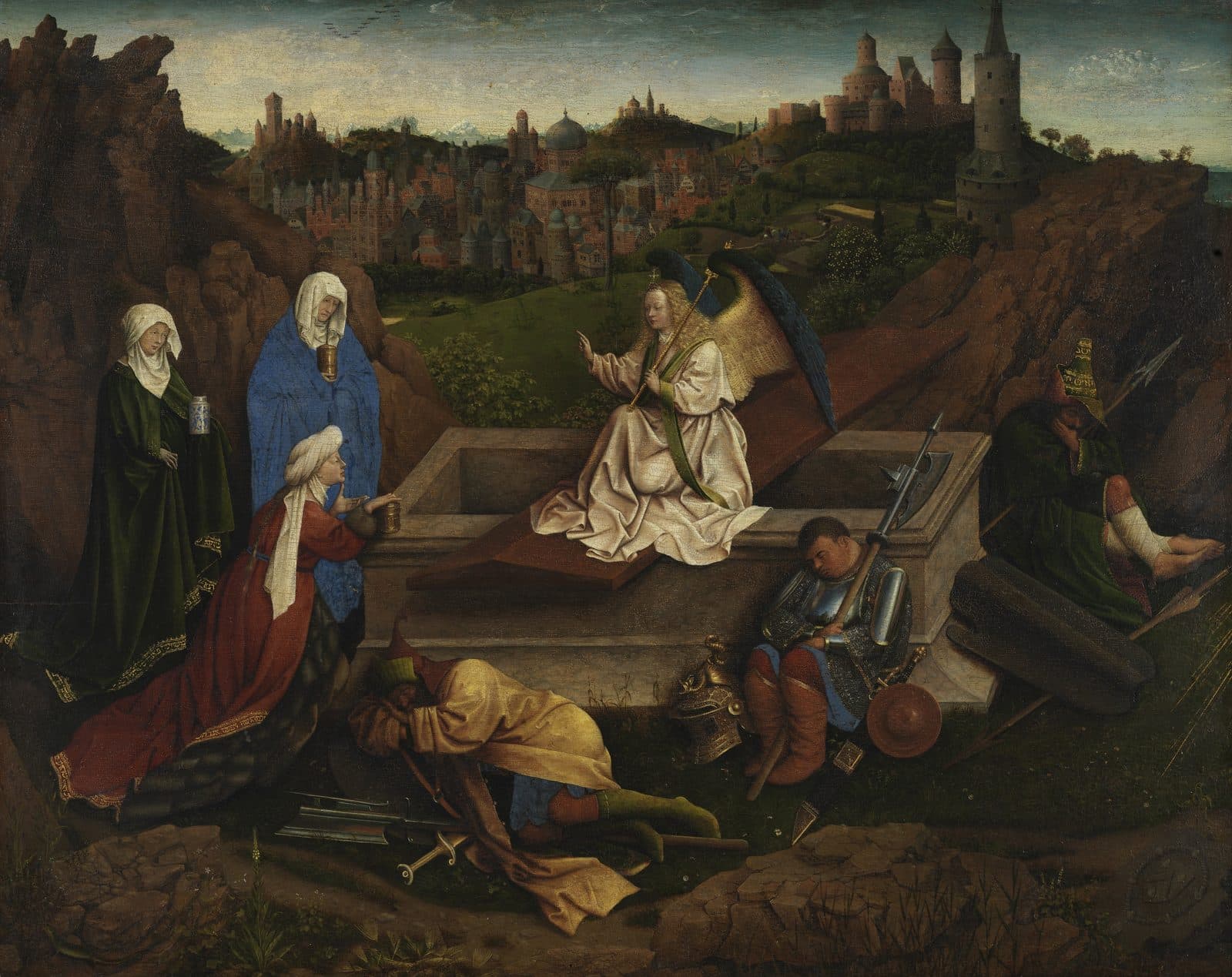
Hubert or Jan van Eyck, The Three Marys at the Tomb, about 1425 to 1435. Public domain, via Wikimedia Commons.
THE ARTWORKThe van Eyck panel joins the Gospels in one scene: the women arrive with their spices as in Mark, the angel sits on the stone as in Matthew, and the guards lie on the ground.
Matthew records that the story of a stolen body was still told among the Jews in his own day.
Summary
The women who had watched the burial came back at dawn once the Sabbath was over, and in Mark and Luke they brought spices to anoint the body.
- Joseph of Arimathea laid the body in a tomb cut into the rock, and the women saw where it was placed.
- Matthew alone tells of a guard set at the tomb and paid afterwards to say the disciples stole the body.
- Peter went into the tomb and saw the linen cloths lying and the head cloth rolled up apart.
- Paul hands on to the Corinthians that Christ was buried and raised on the third day.
The Morning of the First Day
Mark 16:1 to 8 and John 20:1 to 8
When the Sabbath was over, the women bought spices to anoint the body. On the way, just after sunrise, they asked one another who would move the stone from the entrance for them. Within the tomb they found someone sitting on the right side, who spoke to them.
But he said to them, “Do not be alarmed. You are looking for Jesus the Nazarene, who was crucified. He has risen! He is not here! See the place where they put Him.In John, Mary Magdalene came while it was still dark and brought back word that the Lord had been taken from the tomb. The two men she told hurried out, and the faster of them stooped at the entrance and looked in.
Simon Peter arrived just after him. He entered the tomb and saw the linen cloths lying there. The cloth that had been around Jesus’ head was rolled up, lying separate from the linen cloths. Then the other disciple, who had reached the tomb first, also went in. And he saw and believed.John adds that they did not yet understand from the Scripture that Jesus had to rise from the dead.
The Four Accounts Side by Side
Matthew 28:1 to 7, Mark 16:1 to 7, Luke 24:1 to 10 and John 20:1 to 16
| Gospel | Who came with Mary Magdalene | What they found | Who spoke |
|---|---|---|---|
| Matthew | The other Mary | An earthquake and the stone rolled away | An angel sitting on the stone |
| Mark | Mary the mother of James, and Salome | The stone rolled away, though it was very large | A young man in a white robe inside |
| Luke | Joanna, Mary the mother of James, and other women | The stone rolled away and no body inside | Two men in radiant apparel |
| John | No one named | The stone removed, the linen cloths, the head cloth apart | Two angels, then Jesus himself |
- Gospel
- Matthew
- Who came with Mary Magdalene
- The other Mary
- What they found
- An earthquake and the stone rolled away
- Who spoke
- An angel sitting on the stone
- Gospel
- Mark
- Who came with Mary Magdalene
- Mary the mother of James, and Salome
- What they found
- The stone rolled away, though it was very large
- Who spoke
- A young man in a white robe inside
- Gospel
- Luke
- Who came with Mary Magdalene
- Joanna, Mary the mother of James, and other women
- What they found
- The stone rolled away and no body inside
- Who spoke
- Two men in radiant apparel
- Gospel
- John
- Who came with Mary Magdalene
- No one named
- What they found
- The stone removed, the linen cloths, the head cloth apart
- Who spoke
- Two angels, then Jesus himself
The Burial and the Guard
From the cross to the sealed stone
On the Preparation Day, the day before the Sabbath, Joseph of Arimathea asked Pilate for the body.
So Joseph bought a linen cloth, took down the body of Jesus, wrapped it in the cloth, and placed it in a tomb that had been cut out of the rock. Then he rolled a stone against the entrance to the tomb.Pilate gave up the body only after the centurion told him that Jesus was dead.
The next day the chief priests and Pharisees reminded Pilate that Jesus had said he would rise after three days. They asked that the tomb be made secure until the third day, so that the disciples could not take the body.
So they went and secured the tomb by sealing the stone and posting the guard.The verse shows the tomb sealed and under guard before the women came back to it.
What the Text Says and What Is Often Said
Two common claims about the tomb, each with the reference that answers it
THE GUARDS
It is often said that the guards saw Jesus rise. Matthew says they trembled in fear of him and became like dead men.
THE FOUR ACCOUNTS
It is often said that the accounts cannot agree. They differ in the hour, the women named and the angels, and each Gospel gives the name of Mary Magdalene first or alone.
Witnesses and the Site
Josephus on who could testify, Eusebius on the site, and Luke on how the women's report was received
Josephus, in his Antiquities of the Jews, sets down a rule that the testimony of women is not to be admitted. How widely courts followed it in Judea is not known.
Eusebius reports that the tomb had been buried under earth and a shrine to Venus, and that Constantine had the place cleared and the cave uncovered.
But their words seemed like nonsense to them, and they did not believe the women.The Charge of a Stolen Body
Matthew 28:11 to 15, with Justin Martyr and Tertullian
Some of the guards went into the city and reported to the chief priests all that had happened. The chief priests met with the elders and paid the soldiers a large sum to tell a story.
The same charge was still made in the second century. Justin Martyr tells Trypho that teachers were sent out to say the disciples stole the body by night from the tomb. Tertullian reports a second version, that a gardener moved the body so the crowds would not trample his lettuces.
and instructed them: “You are to say, ‘His disciples came by night and stole Him away while we were asleep.’ If this report reaches the governor, we will satisfy him and keep you out of trouble.”What the Text Leaves Unsaid
Six things the four accounts leave open
No Gospel says at what hour of the night Jesus rose, and none says that anyone saw him leave the tomb. None says why the stone had to be moved.
The text names none of the soldiers and gives no sum for the money they were paid. It does not tie Joseph's tomb to any site known today.
Raised on the Third Day
The tomb in the gospel Paul handed on
Some in the church at Corinth were saying that there is no resurrection of the dead, and 1 Corinthians 15 is Paul's answer to them.
For what I received I passed on to you as of first importance: that Christ died for our sins according to the Scriptures, that He was buried, that He was raised on the third day according to the Scriptures,Paul goes on to name those who saw the risen Christ, Cephas first.
Luke gives the same truth from the morning itself, in the words of the two men at the tomb.
As the women bowed their faces to the ground in terror, the two men asked them, “Why do you look for the living among the dead? He is not here; He has risen! Remember how He told you while He was still in Galilee: ‘The Son of Man must be delivered into the hands of sinful men, and be crucified, and on the third day rise again.’”The saying they recall is the one Luke sets after Peter's confession, in his ninth chapter.
Teachers on the Tomb
From John Chrysostom to G. K. Chesterton
John Chrysostom read the folded grave cloths as a sign that no thief had taken the body.
“When then she came and said these things, they hearing them, draw near with great eagerness to the sepulcher, and see the linen clothes lying, which was a sign of the Resurrection. For neither, if any persons had removed the body, would they before doing so have stripped it; nor if any had stolen it, would they have taken the trouble to remove the napkin, and roll it up, and lay it in a place by itself; but how? they would have taken the body as it was. On this account John tells us by anticipation that it was buried with much myrrh, which glues linen to the body not less firmly than lead; in order that when thou hearest that the napkins lay apart, thou mayest not endure those who say that He was stolen. For a thief would not have been so foolish as to spend so much trouble on a superfluous matter. For why should he undo the clothes? and how could he have escaped detection if he had done so? since he would probably have spent much time in so doing, and be found out by delaying and loitering. But why do the clothes lie apart, while the napkin was wrapped together by itself? That thou mayest learn that it was not the action of men in confusion or haste, the placing some in one place, some in another, and the wrapping them together. From this they believed in the Resurrection. On this account Christ afterwards appeared to them, when they were convinced by what they had seen. Observe too here again the absence of boastfulness in the Evangelist, how he witnesses to the exactness of Peter's search. For he himself having gotten before Peter, and having seen the linen clothes, enquired not farther, but withdrew; but that fervent one passing farther in, looked at everything carefully, and saw somewhat more, and then the other too was summoned to the sight. For he entering after Peter, saw the grave-clothes lying, and separate. […]”
John Chrysostom · Homily on the Gospel of John 85 · on John 20:3 to 8Patristic
John Wesley answered the soldiers' report with a question.
“Say, his disciples came by night, and stole him while we slept - Is it possible, that any man of sense should digest this poor, shallow inconsistency?”
John Wesley · Explanatory Notes upon the New Testament · on Matthew 28:13Evangelical
G. K. Chesterton goes on from these words to call that morning the first day of a new creation.
“On the third day the friends of Christ coming at daybreak to the place found the grave empty and the stone rolled away.”
G.K. Chesterton · The Everlasting Man, Part II Ch. 3 "The Strangest Story in the World" · on Matthew 28:1 to 6Anglican
Augustine on the angelsThe Harmony of the Gospels, Book III, chapter 24, about AD 400
Augustine set the angel on the stone in Matthew beside the young man inside in Mark. His first answer is that the women saw two angels, one on the stone outside and one inside the tomb. His second is that Mark's entering the tomb means entering a walled space in front of the rock, where the one angel sat on the stone.
Charles Spurgeon on the women's errandPreached at the Metropolitan Tabernacle, 1872
Charles Spurgeon, in his sermon A Visit to the Tomb, taught that the women's wish to embalm the body was good and was still not granted, because it ran against what Christ had foretold.
What Happened to the Body
Four accounts of the body, each with its holders and the strongest answer to it, and where Mark's Gospel ends
He was raised from the deadThe church in every age
The Gospel writers and Paul give this account as their own. Chrysostom holds it in his homilies on John, and Calvin in his Harmony of the Evangelists.
The strongest objection comes from Kirsopp Lake, who noted that Paul grounds faith in the Lord being seen and does not name the open tomb.
The disciples stole the bodyThe chief priests and elders, as Matthew reports them
This account grants the empty tomb and gives the disciples as its cause. Calvin called it a childish subterfuge, since men asleep could not know who took the body.
The women went to the wrong tombKirsopp Lake, The Historical Evidence for the Resurrection of Jesus Christ, 1907
Lake proposed that grieving women, watching from a distance, could not tell one rock tomb from another. A young man at an open tomb, he suggested, was pointing them to the right one.
The women who had come with Jesus from Galilee followed, and they saw the tomb and how His body was placed.Mark 15:47 names two of these women, Mary Magdalene and Mary the mother of Joseph. The same women come back to this tomb on the first day of the week.
He revived in the tombRationalist critics of the nineteenth century
This account held that Jesus revived in the cool of the tomb and left it. Strauss sets it out in A New Life of Jesus and names Friedrich Schleiermacher as one who held it. Strauss, who did not believe in the resurrection, answered it himself.
He judged that a half-dead man creeping from a tomb, in need of bandaging, could never have made the disciples see him as a conqueror over death.
Where Mark's Gospel endsWestcott and Hort, Notes on Select Readings, 1882
Mark 16:8 closes with the women fleeing the tomb in fear. Westcott and Hort judged that verses 9 to 20 were not first written as one piece with verses 1 to 8.
They also judged that verse 8 was not meant to end the Gospel, and allowed that a last leaf may have been lost.
Books to Read Next
Five works on the empty tomb, each free to read
The Harmony of the Gospels
Augustine of Hippo · about 400
Augustine wrote it to show that the four evangelists do not stand against one another.
Read Book III, chapter 24 at New AdventHomilies on the Gospel of John
John Chrysostom · fourth century
Chrysostom preached these eighty-eight sermons through John's Gospel in order.
Read Homily 85 at New AdventCommentary on a Harmony of the Evangelists
John Calvin · 1555
It sets Matthew, Mark and Luke side by side and comments on them as one account.
Read the notes at CCELThe Historical Evidence for the Resurrection of Jesus Christ
Kirsopp Lake · 1907
Lake weighs the Gospel accounts of the resurrection one by one.
Read it at the Internet ArchiveThe New Testament in the Original Greek: Introduction and Appendix
B. F. Westcott and F. J. A. Hort · 1882
Its notes on select readings weigh the last twelve verses of Mark, which follow the women's flight from the tomb.
Read it at the Internet ArchiveCome and See the Place
Matthew 28:6 to 7
He is not here; He has risen, just as He said! Come, see the place where He lay. Then go quickly and tell His disciples, ‘He has risen from the dead and is going ahead of you into Galilee. There you will see Him.’ See, I have told you.”The errand the angel gave the women passes to every reader who has looked into the empty place.