
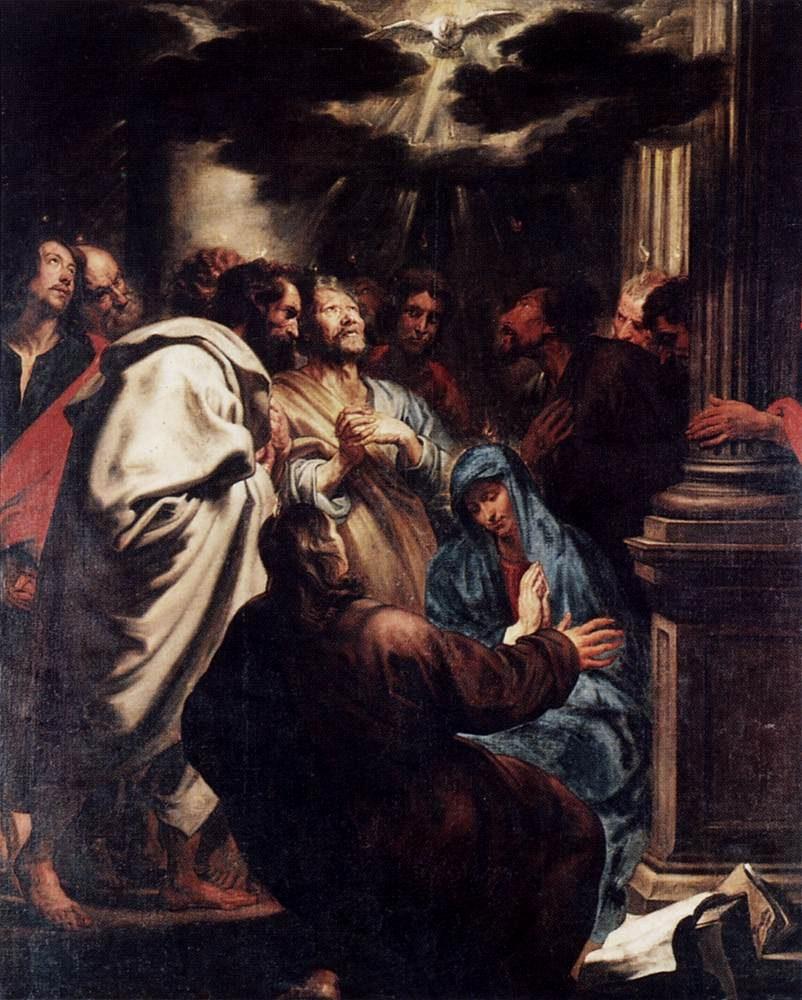
Anthony van Dyck, Pentecost, 1618 to 1620. Public domain.
Pentecost to the East African and Chinese revivals · Subject · Featured Study
The Fire Through the Generations
Each revival and witness on the line is dated by a record written in its own time.
Joel promised the Spirit on all flesh, and Peter said on the day of Pentecost that the promise was for all who are far off.
‘In the last days, God says, I will pour out My Spirit on all people. Your sons and daughters will prophesy, your young men will see visions, your old men will dream dreams.
Summary
The Spirit came at Pentecost, and the church has seen His work in every age since. Ten of those ages are set out here, from Jerusalem to China. Each has its own page.
- Acts is the only account of the day of Pentecost.
- A verse of Matthew sent Antony into the desert, and Matthew 10 became the rule of Francis.
- Wales, Azusa Street and Korea fell within four years, from 1904 to 1907.
- The East African and Shandong revivals both began in September 1929.
The Promise and the Day
The four verses run from the prophet's promise to the apostle's sermon.
The promise
And afterward, I will pour out My Spirit on all people. Your sons and daughters will prophesy, your old men will dream dreams, your young men will see visions.
Joel promises the Spirit poured out on all flesh, sons and daughters, old and young.
Joel 2:28BSB
The day and its reach
And they were all filled with the Holy Spirit and began to speak in other tongues as the Spirit enabled them.
Luke sets the day in Jerusalem at the feast of Pentecost, as the first verse of the chapter gives it.
Acts 2:4BSB
This promise belongs to you and your children and to all who are far off—to all whom the Lord our God will call to Himself.”
Peter gives the promise to his hearers, their children and all who are far off.
Acts 2:39BSB
Acts 2:4, Acts 2:39
Ten Generations
Each row is one generation's witness, with its date and the record that fixes it.
The witness runs from Pentecost in Jerusalem to Shandong in 1929, and each date rests on a record of its own time.
- Pentecost in JerusalemAD 30 or 33Acts 2, and Bond's dating of the cross (2013)
- Antony and the desertThe Life written 356 to 362Athanasius, Life of Antony
- Francis of Assisi1209Schaff, History of the Christian Church, volume 5 (1907)
- Herrnhut13 August 1727Hutton, A History of the Moravian Church (1909)
- The Wesleys24 May 1738John Wesley, Journal, Curnock's edition
- Wales31 October 1904Phillips, Evan Roberts (1906)
- Azusa Street9 April 1906The Apostolic Faith (1906 to 1908)
- Korea14 and 15 January 1907The Korea Mission Field, March 1907
- East AfricaSeptember 1929Stanley, Churchman (1978)
- Shandong, ChinaSeptember 1929The Southern Baptist Convention's Annuals (1931 to 1935)
A timeline of ten generations of the Spirit's work. Each row is a door to its page.
Azusa Street, Korea, East Africa, Shandong, China
Each Generation in Its Record
What each generation's own record says happened, with its door.
PentecostAD 30 or 33
The feast of Weeks became the day the Holy Spirit came on the disciples in Jerusalem. Three thousand were baptized that day, as Acts records.
Read Pentecost 16 sections, 24 verses set out
Antony and the desertFourth century
As Athanasius's Life tells it, Antony gave away what he had and spent most of a long life alone in the Egyptian desert. Others followed him there, and the Life was read as far as Trier.
Read Antony and the Desert Fathers 11 sections, 5 verses set out
Francis of Assisi1209
Francis gave up his father's goods in 1208 and took the words of Matthew 10 as the rule of his life the next year. In his Testament he tells how the Lord led him among lepers.
Read Francis of Assisi 12 sections, 2 verses set out
Herrnhut1727
Exiles from Moravia had quarrelled for five years on Zinzendorf's land when the quarrels ended in the summer of 1727. Two weeks after the communion they began to pray by turns, hour by hour, and in 1732 they sent their first missionaries.
Read The Moravian Revival at Herrnhut 14 sections, 12 verses set out
The Wesleys1738
John Wesley's Journal names the evening of 24 May in Aldersgate Street as the hour he first trusted Christ alone. His brother Charles had written a hymn on his own new faith the day before.
Read Aldersgate, 1738 11 sections, 4 verses set out
Wales1904
Evan Roberts held his first meeting at Moriah, Loughor, on 31 October 1904. A Cardiff paper's lists counted 83,936 converts in Wales by 28 February 1905.
Read The Welsh Revival 14 sections, 10 verses set out
Azusa Street1906
A cottage prayer meeting on Bonnie Brae moved within the month to a mission led by William J. Seymour, a Black preacher from Houston. Its missionaries sailed for Africa and India within its first year.
Read The Azusa Street Revival 14 sections, 11 verses set out
Korea1907
In January the men's winter Bible class at the Central Church in Pyongyang turned into nights of open confession. Men named their sins out loud and paid back what they had stolen.
Read The Korean Pentecost 14 sections, 13 verses set out
East Africa1929
Joe Church, an English doctor, and Nsibambi, a Ugandan layman, read the Bible together in Kampala, and the revival spread from their meeting. Its people, the balokole, told their sins to one another in the open.
Open the page 14 sections, 10 verses set out
Shandong1929
The Protestant churches of Shandong had a revival from the late 1920s to the middle 1930s. Southern Baptists date their stream from Marie Monsen's meetings at Hwanghsien.
Read The Shandong Revival 11 sections, 4 verses set out
Antony and the desert (Fourth century), Francis of Assisi (1209), Herrnhut (1727), The Wesleys (1738), Wales (1904), Azusa Street (1906), Korea (1907), East Africa (1929) and 1 more
In Their Own Words
Gregory the Dialogist (died 604)
Forty Gospel Homilies, Homily 30
Gregory the Great asked what the day made of the apostles.
“Let us consider what kind of men our holy preachers were when this day found them, and what kind it made them. Certainly those who were sitting in one room out of fear of the Jews knew each one the language of their birth, and yet they did not presume to speak openly of Christ even in that language which they knew. The Spirit came, and in their mouths taught them through the diversity of tongues, while in their minds he strengthened them with authority.”
on Acts 2:4Patristic
About this saying1 paragraph
Gregory preached on Pentecost at Rome at the end of the sixth century.
John Calvin (1509 to 1564)
Commentary upon the Acts of the Apostles, volume 1, on Acts 2:4
Calvin held that the disciples spoke real tongues.
“But we must first note that the disciples spoke indeed with strange tongues; otherwise the miracle had not been wrought in them, but in the hearers. So that the similitude should have been false whereof he made mention before; neither should the Spirit have been given so much to them as to others.”
Reformed
About this saying1 paragraph
Calvin wrote on Acts 2:4 in his commentary on Acts in the sixteenth century.
John Wesley (1703 to 1791)
Explanatory Notes upon the New Testament
Wesley read the tongues as a pledge for the whole world.
“And this family praising God together, with the tongues of all the world, was an earnest that the whole world should in due time praise God in their various tongues. As the Spirit gave them utterance - Moses, the type of the law, was of a slow tongue; but the Gospel speaks with a fiery and flaming one.”
on Acts 2:4Evangelical
About this saying1 paragraph
Wesley wrote his notes on the New Testament in the eighteenth century.
Spoken or Heard
Readers since the fourth century have weighed how the tongues of Pentecost worked.
Gregory of Nazianzus, John Chrysostom, John Calvin and John Wesley held that the disciples spoke languages they had not learned. Calvin argued that otherwise the wonder would have been worked in the hearers and not in the disciples.
Gregory of Nazianzus also weighed a second reading, which Adam Clarke reported in 1832, that the wonder lay in the hearing. Both readings stand on the Pentecost page with their holders and their works.
In 1906 William J. Seymour wrote in The Apostolic Faith that the holiness preachers did not have the evidence of the second chapter of Acts. The site's tradition, Wesleyan-Pentecostal, receives the baptism in the Spirit and the gifts as given today.
Books to Read Next
The Journal of the Rev. John Wesley, Standard Edition
John Wesley, edited by Nehemiah Curnock · 1909 to 1916
Wesley's own record of 1738 and of the revival that followed.
Free scan of volume 1How Pentecost Came to Los Angeles
Frank Bartleman · 1925
An eyewitness of Azusa Street prints his letters to Wales and his account of the mission.
Free at CCELThe Korea Pentecost and Other Experiences on the Mission Field
William Newton Blair · About 1910
A missionary at Pyongyang tells the story of the winter Bible class.
Free at the Internet ArchiveThe Promise Still Given
Peter gave the promise to his hearers' children and to those far off. The ten generations dated here stand among those who have received it since.
Sources
Scripture is the Berean Standard Bible.
- The Holy Bible, Berean Standard Bible (read 2026)
- Acts 2 in the Berean Standard Bible and Helen K. Bond, "Dating the Death of Jesus", New Testament Studies (2013)
- Athanasius, Life of Antony, translated by H. Ellershaw, NPNF second series volume 4 (1892)
- Philip Schaff, History of the Christian Church, volume 5 (1907), section 70.
- The congregation's diary and J. E. Hutton, A History of the Moravian Church (1909)
- John Wesley, Journal, ed. Curnock (1909), and Charles Wesley, Journal, ed. Jackson (1849)
- D. M. Phillips, Evan Roberts (1906), with the Western Mail's lists.
- The Apostolic Faith (Los Angeles, 1906 to 1908)
- The Korea Mission Field 3:3 (March 1907) and W. N. Blair, The Korea Pentecost (about 1910)
- Brian Stanley, "The East African Revival", Churchman 92 (1978)
- The Annuals of the Southern Baptist Convention, 1931 to 1935.
- Gregory the Great, Forty Gospel Homilies, Homily 30; John Calvin, Commentary upon the Acts of the Apostles, volume 1, on Acts 2:4; John Wesley, Explanatory Notes upon the New Testament, on Acts 2.
Keep Studying
People and groups1
Go further1