
Skip to content
mannafest.faith
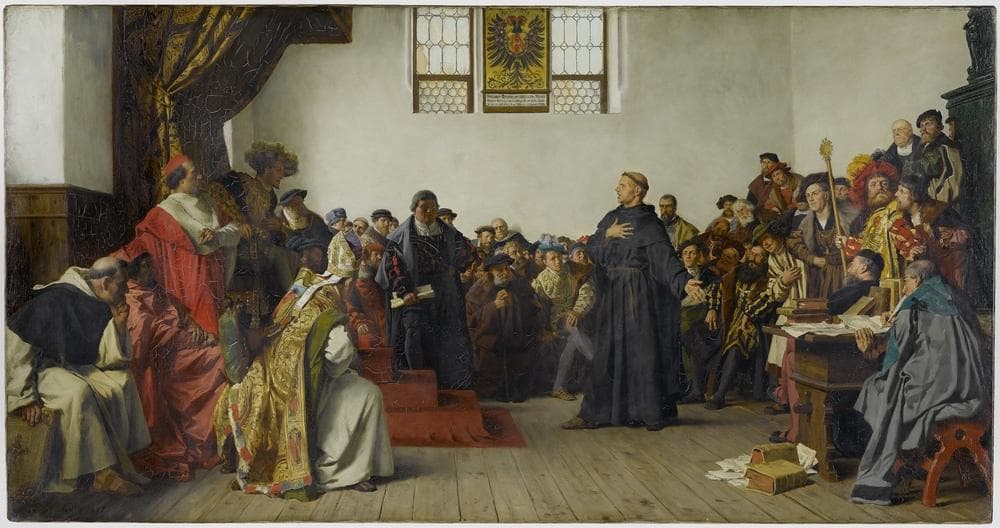
Luther at the Diet of Worms

Luther at the Diet of Worms, Anton von Werner, 1877. Public domain.

The Great Cloud of Witnesses, era 5 of 10 · Church history · Featured Study

The Reformation

One monk's conscience, one printing press, and one open Bible. In a single century Scripture went from a chained Latin book to something a farmhand could read in his own language.

Span
1500–1600
Boundary
The span closes at 1600 for tidiness, not for an event.

The west broke into churches over two questions.

Summary

How is a sinner put right with God? And who settles such a thing? In one lifetime Europe had rival creeds, printed Bibles, and wars.

  • Luther posted his ninety-five theses on 31 October 1517.
  • He would not take them back at Worms in April 1521.
  • His German New Testament came out in 1522, the whole Bible in 1534.
  • Tyndale was killed for the English Bible in 1536.
  • The Council of Trent sat from 1545 to 1563 and set the Catholic answer.

The era's own voice

Why he wrote it: Luther was summoned to Worms under imperial safe conduct and asked one question, whether he would take back what he had written. The speech is his answer to that question in front of the emperor, the papal nuncio and the German princes, and he knew it could cost him his life.

What else says so: The imperial diet's own records and the printed reports of 1521 carry the speech. The line most often quoted with it, here I stand, I can do no other, is not in the earliest printed text and first appears in a later printing, so this page does not put it in his mouth.

“Unless I am convinced by the testimony of the Scriptures or by clear reason — for I do not trust either in the pope or in councils alone, since it is well known that they have often erred and contradicted themselves — I am bound by the Scriptures I have quoted and my conscience is captive to the Word of God. I cannot and I will not recant anything, since it is neither safe nor right to go against conscience. God help me. Amen.”

Martin Luther · The record of the Diet, printed the same year and given in Luther's Works, Vol. 32. A note on the famous line: "Here I stand, I can do no other" is not in the earliest eyewitness accounts, it appears in early printed versions, and Roland Bainton (Here I Stand) judges that Luther may well have said it. The sentence above is the one the transcript actually carries.Modern scholar

The turning points

The era hangs on these moments, each with a document a reader can open.

  1. 1516Erasmus prints the Greek New TestamentIt put the Greek text in front of scholars who had only known the Latin, and every reformer's argument started from something he found there.Erasmus, Novum Instrumentum omne, Basel, 1516
  2. October 31, 1517Luther's Ninety-Five ThesesThe theses were an academic protest about one practice, and the printers turned them into a movement inside a month.Martin Luther, Disputation on the Power and Efficacy of Indulgences, 1517
  3. April 18, 1521The Diet of WormsIt put the question in public and unanswerable form: whether a man's conscience bound by Scripture stands above a council.The imperial Edict of Worms, 1521, with the contemporary reports of the hearing
  4. 1526Tyndale's English New TestamentIt is the first English New Testament from the Greek, and most of its wording is still in the English Bible four centuries later.Tyndale's New Testament, Worms, 1526
  5. 1536Calvin's Institutes, first editionIt gave the movement a complete and orderly theology, which is what turned a protest into churches that could last.John Calvin, Institutes of the Christian Religion, 1536, final edition 1559

The 5 turning points of The Reformation, 1500–1600, in order, each with the document that records it and why it earned its place.

The story

A German in 1517 could buy a printed certificate that promised to shorten a dead relative's time in purgatory, and the money went toward building a church in Rome he would never see. Most people thought this was ordinary religion.

To understand 1517 you have to picture a world where the church was not one part of life but the frame around all of it. It baptized you, married you, buried you, ran the schools and most of the charity, and read you a Bible in Latin, a language almost nobody in the pews spoke. Then in 1516 a scholar named Erasmus printed the New Testament in the original Greek. For the first time an educated man could set the church's practice beside the apostles' actual words and see the gap.

For the gospel reveals the righteousness of God that comes by faith from start to finish, just as it is written: “The righteous will live by faith.”
Romans 1:17BSB

The verse Luther was stuck on and then saw through, that "the righteousness of God" is not the standard he was failing but the gift God hands over, received by faith; he said it opened the gates of paradise to him.

The immediate spark was indulgences, and it helps to say plainly what they were. Officially an indulgence did not forgive sin; it released a person from some of the punishment still owed for sins already confessed, drawing on what the church called a treasury of merit. That is the fine print. What was preached in the German towns in 1517 was much simpler and much worse: a Dominican friar named Johann Tetzel sold certificates that promised to release dead loved ones from purgatory, and Luther quoted the jingle back at him, as soon as the coin in the box rings, the soul out of purgatory springs.

Follow the money and the protest makes sense. Half the take was going to build St. Peter's in Rome; the other half quietly repaid the bankers who had lent Albrecht of Brandenburg the money to buy a second archbishopric he was too young to hold. Poor families were handing over coins they needed for bread. Luther's ninety-five points were written in Latin for a university debate. He expected an argument among professors, instead, all of Europe joined in.

For we maintain that a man is justified by faith apart from works of the law.
Romans 3:28BSB

The Reformation's plainest sentence, a person is put right with God by faith, apart from the works of the law; Luther's German rendered it "by faith alone," a word not in the Greek, and he defended the addition as the honest sense of Paul's argument.

But the real quarrel underneath was not about money, it was about how a guilty person gets right with God. Luther had tried the whole system: fasting, sleeping in the cold, confessing until his confessor grew tired of him. Then, working through Romans and the Psalms as a young professor, he saw that "the righteousness of God" in Romans 1:17 is not the standard God measures you against but the standing God gives you as a gift. Put plainly: God declares the guilty sinner right with him because of what Jesus did, and that verdict is received by trusting him, not earned by climbing toward him. Luther said it felt like walking through open gates into paradise.

None of it would have traveled without the press. Gutenberg's invention was about seventy years old, and by 1500 presses were running in some 250 European towns, the infrastructure was already built and waiting. Luther wrote short, cheap pamphlets in punchy German, and printers who had never met him ran off editions for the profit. Historians estimate that in the years around 1520 a large share of everything printed in Germany came from his pen. It is hard not to see God's timing in the fact that the century of the open Bible was also the first century in which a book could outrun a soldier.

For it is by grace you have been saved through faith, and this not from yourselves; it is the gift of God,
Ephesians 2:8BSB

Saved by grace, through faith, and not out of yourselves, the answer the reformers gave to a system in which peace with God could be paid for.

The translation war that followed is where men died over words. William Tyndale, refused permission in England, printed his English New Testament abroad in 1525–26 and had it smuggled home. His enemies were not only angry that the Bible was in English; they were angry at his specific choices. He wrote "congregation" where the old Latin gave "church," "elder" where it gave "priest," "repentance" where it gave "penance," and "love" where it gave "charity." Every one of those words moved authority a little away from the institution and toward the gathered believers, which is exactly why Thomas More attacked him in print and why the stake was waiting. Tyndale was strangled and burned in 1536; roughly four-fifths of the King James New Testament is still his English.

The movement was never just one thing. Lutherans held to justification by faith and to Christ's real bodily presence in the Supper. The Reformed, Zwingli in Zurich, then Calvin in Geneva, pressed further in worship, stripping images and preaching straight through books of the Bible, and understood the Supper differently. In October 1529 Philip of Hesse got Luther and Zwingli in one room at Marburg to unite them. They agreed on fourteen articles out of fifteen and could not close the last one; Luther chalked "This is my body" on the table, and by most accounts refused Zwingli's offered hand. The split held for centuries.

But you are a chosen people, a royal priesthood, a holy nation, a people for God’s own possession, to proclaim the virtues of Him who called you out of darkness into His marvelous light.
1 Peter 2:9BSB

"A royal priesthood" said of ordinary believers, the ground for putting Scripture into the plow-boy's hands and letting him read it without a priest between.

England's break began for reasons that had nothing to do with the gospel, Henry VIII wanted a marriage annulled and made himself head of the church to get it. What made the English Reformation more than a royal divorce was Cranmer's prayer book and Tyndale's Bible, quietly shaping how ordinary believers actually prayed and read. Meanwhile the Anabaptists, who began in Zurich in 1525 by baptizing one another as adults, were hunted by Protestants and Catholics alike. Felix Manz was drowned by a Protestant council in 1527; Michael Sattler was tortured and burned and his wife Margaretha drowned; thousands more followed. A violent fringe seized the city of Münster in 1534 and was crushed, and the whole movement was blamed for it, though Menno Simons, a Dutch priest who joined them in 1536, spent the rest of his life leading the peaceable majority. In 1569 the Dutch Anabaptist Dirk Willems, fleeing across thin ice, turned back to pull his drowning pursuer out of the water, and was burned for his faith anyway.

The women of that century get left out of the telling, and should not be. Katharina von Bora escaped her convent in 1523 hidden in a wagon among herring barrels, married Luther in 1525, ran a household, farm, brewery, and boarding house, and helped create what became the Protestant parsonage, a pastor's home with a wife and children in it. Luther called her "my lord Katie" and left her his whole estate, a will that pushed right up against what the law let a woman inherit. Argula von Grumbach, a Bavarian noblewoman, published an open letter defending a student in 1523 and became one of the best-selling pamphleteers in Germany. Jeanne d'Albret, Queen of Navarre, made her small kingdom a refuge for French Protestants and died two months before the Paris massacre that came for her son's wedding guests. Anne Askew was racked in the Tower of London in 1546, the only woman known to have been tortured there, and had to be carried to the fire in a chair because her joints were destroyed; her own written account of her interrogation survives.

The era's writings, 1 to 3 of 9: each with its date and one line on what it holds.

WritingDateWhat it holds
The Ninety-Five Theses1517Ninety-five short debate points arguing that forgiveness belongs to God and that selling relief from punishment cheats ordinary people; written in Latin for scholars, translated and printed for everyone within weeks.
Tyndale's New Testament1526The first printed English New Testament translated from the Greek rather than from Latin, the source of an estimated eight-tenths of the King James New Testament's wording.
The Schleitheim Confession1527Seven plain articles by hunted Anabaptists on baptism of believers, church discipline, the Lord's Supper, separation from the world, and refusing the sword. Michael Sattler, who led the meeting and sent the articles out, was executed on 21 May 1527.

Then there is the ledger, and a Protestant ought to read his own side of it. Roughly 280 Protestants were burned under Mary I in England, including Latimer, Ridley, and Cranmer. But Catholics died too: Thomas More and John Fisher under Henry VIII, and about 180 more under Elizabeth, among them Edmund Campion and Margaret Clitherow. And in Geneva in 1553, Michael Servetus was burned with Calvin's approval. Calvin wanted him beheaded instead of burned, a smaller cruelty, not an excuse. Perhaps 100,000 German peasants died in the 1525 rising, after Luther wrote a pamphlet urging the princes to strike them down, words he never adequately took back. Late in life Luther wrote things about Jewish people that are indefensible, words the Nazis later quoted to justify the Holocaust. Recovering the gospel did not make these men holy, and the century's fires burned in every direction.

Rome's answer came at the Council of Trent, meeting on and off from 1545 to 1563. Half of what it did was reform that the reformers themselves had been demanding for years: it abolished the sale of indulgences, required bishops to actually live in their dioceses, and ordered a seminary in every one so priests would be trained. The other half drew lines: it said Scripture and church tradition carry equal authority, it declared the Latin Vulgate the official Bible text, and it defined justification as a righteousness worked into the believer through the sacraments, not credited to him by faith alone. Those decrees settled Catholic teaching for four hundred years, until the Second Vatican Council reopened parts of the conversation in the 1960s.

The era's writings, 4 to 6 of 9: each with its date and one line on what it holds.

WritingDateWhat it holds
The Augsburg Confession1530Melanchthon's calm summary of Lutheran belief, read aloud to Emperor Charles V, the founding doctrinal statement of Lutheran churches to this day.
Calvin's Institutes of the Christian Religion1536, final edition 1559A complete, orderly walk through the Christian faith, God, Christ, salvation, the church, that became the most influential Protestant book of the century after the Bible itself.
The Book of Common Prayer1549, revised 1552Cranmer's English liturgy, which put daily prayer, Scripture reading, and the sacraments into the language of the people and gave English worship much of its cadence.

By 1600 the map of Christendom had been redrawn, and Europe would pay for the redrawing in the Thirty Years' War. But the change that mattered most was quieter than any of the wars. Scripture was loose, in German, English, French, Dutch, Czech, Spanish, priced so a working family could own one, printed with numbered verses so two people could find the same line. Once ordinary believers can read the Bible for themselves, the next question arrives on its own: not just what does the church teach, but has my own heart been changed? That question is what the next century was for.

The era's writings, 7 to 9 of 9: each with its date and one line on what it holds.

WritingDateWhat it holds
The Geneva Bible1560The first mass-market English study Bible: numbered verses, readable type, maps, and marginal notes that taught a generation how to read Scripture for itself.
The Heidelberg Catechism1563A warm question-and-answer teaching book from the Rhineland whose famous first question, what is your only comfort in life and in death?, answers, "That I am not my own, but belong to my faithful Savior Jesus Christ."
Foxe's Acts and Monuments1563John Foxe's massive account of the martyrs, with documents and interview records, passionately one-sided, but preserving primary evidence that would otherwise be lost.

Ephesians 2:8, 1 Peter 2:9

Why these years

The span closes at 1600 for tidiness, not for an event. The better closing date is 1648, when the Peace of Westphalia ended the wars of religion, and many historians use it. This site keeps 1500 to 1600 because that century holds the generation that did the work. The era after it picks up the men who inherited the argument.

What did not change

The Latin Mass did not stop. Through the whole century most of Europe went on worshipping exactly as it had, and in 1600 the larger part of the continent was still Catholic.

The hard part

The reformers used the state's sword. The peasants rose in 1525, partly on the strength of his own language about freedom. Luther wrote Against the Robbing and Murdering Hordes of Peasants and urged the princes to cut them down. Tens of thousands died. In 1543 he wrote On the Jews and Their Lies. It called for burning synagogues and driving Jews out, and German antisemites quoted it four centuries later. Geneva burned Michael Servetus in 1553 with Calvin's approval of the sentence. Catholic and Protestant states both executed Anabaptists for rebaptising.

The posting of the theses on the church door is not certain. Luther's own account says he sent them to his archbishop on 31 October 1517. The nailing is first reported by Melanchthon in 1546, after Luther's death, and Melanchthon was not in Wittenberg in 1517. Posting theses on the church door was the ordinary way to announce a university debate, so the story is likely enough. It is still a report at second hand, and this page says so.

What this page leaves out

This page follows the Lutheran, Reformed, Anabaptist and English strands. It leaves out the Catholic Reformation beyond Trent, the wars of religion, and the Reformation in Scandinavia and eastern Europe.

What it handed the church

You can read the Bible in your own language because of this century, and because men were killed for making that possible.

The Protestant confession of salvation by God's grace, received through faith in Christ alone, was hammered out here in words the church has used ever since.

Preaching moved to the center of worship, and with it the assumption that ordinary believers can and should handle Scripture themselves.

The parsonage family, a married pastor with children in the house, begins with Martin and Katharina Luther and shaped Protestant ministry for five hundred years.

The Catholic Church was genuinely reformed too, at Trent: no more selling indulgences, and a trained priest in every parish.

The hard inheritance came with it: a divided church, and the memory that Christians who had just learned the gospel still burned each other over it.

The dated line14 dated moments of the era in order, the turning points included

Every dated moment of The Reformation in order, 14 in all, the turning points included.

YearMomentWhat happened
1516Erasmus prints the Greek New TestamentThe Dutch scholar Erasmus published the New Testament in its original Greek, with his own fresh Latin beside it, at Basel. For the first time a parish priest could check the church's Latin Bible against the words the apostles wrote. Luther and Tyndale both worked from it.
Oct 31, 1517Luther's Ninety-Five ThesesMartin Luther, a monk and professor at Wittenberg, wrote out ninety-five points for debate against the selling of indulgences and mailed them to his archbishop that day. Tradition holds he also nailed them to the door of the Castle Church, which served as the university's notice board; that detail comes from Melanchthon after Luther's death and is debated.
April 18, 1521The Diet of WormsSummoned before the emperor and the empire's princes, Luther was shown a table of his books and told to take them back. He asked for a night to think, then refused. Weeks later the Edict of Worms declared him an outlaw whom anyone could kill without penalty.
1521–1522The Wartburg: a New Testament in GermanFriends staged a kidnapping and hid Luther in the Wartburg castle, where he grew a beard, called himself Knight George, and translated the New Testament from Erasmus's Greek in about eleven weeks. It was printed in September 1522 and sold out almost at once. He wrote that he wanted the mother in the house and the common man in the market to hear it in their own speech.
January 1525The first Anabaptist baptism, ZurichIn a private house a few of Zwingli's own students baptized one another as confessing adults, believing infant baptism had no warrant in Scripture. In March 1526 Zurich's Protestant council made rebaptism punishable by drowning. On 5 January 1527 it sentenced Felix Manz to be bound and drowned.
1525–1526Tyndale's English New TestamentRefused permission to translate in England, William Tyndale printed abroad. The Cologne run was raided mid-printing in 1525; he escaped upriver with the sheets and finished the job at Worms, and copies reached England in 1526 hidden in bales of cloth and sacks of flour. By the account Edward Hall's chronicle and then Foxe preserved, bishops bought up the stock to burn it, and the money the bishops paid financed the next edition.
Oct 1529Marburg: the reformers fail to agreePhilip of Hesse brought Luther and Zwingli together to unite the movement. They agreed on fourteen of fifteen articles and broke on the fifteenth, what happens in the Lord's Supper. Luther chalked "This is my body" on the table and would not be moved; Zwingli reportedly offered his hand in fellowship and Luther declined it. The Protestant world stayed divided.
1534Luther's complete German BibleWith a team of Hebrew and Greek scholars, Luther finished the whole Bible in German, printed at Wittenberg by Hans Lufft. He hunted words in butcher shops and marketplaces to get the sound right. His Bible carried the Saxon chancery German he wrote in into every corner of the language, one of the strongest single forces in the making of standard written German, though not its sole origin.
March 1536Calvin's Institutes, first editionA twenty-six-year-old French exile published a small six-chapter handbook at Basel explaining the faith to a hostile king. He kept enlarging it for the next twenty-three years; the 1559 edition runs to four books and eighty chapters. That same year he was pressed into staying in Geneva against his own wishes.
Oct 6, 1536Tyndale strangled at VilvoordeBetrayed by a man he had befriended, Tyndale was held sixteen months in a castle near Brussels, then tied to a stake, strangled, and burned. Foxe reports his last cry: "Lord, open the King of England's eyes." Within three years an English Bible resting largely on his work stood chained in every parish church in England by royal order.
Dec 13, 1545The Council of Trent opensRome's answer began in a small Alpine city and met in three long stretches until 1563. It cleaned up real abuses, it banned the sale of indulgences outright and ordered a seminary in every diocese, and it drew hard doctrinal lines against the Protestant reading of Scripture and salvation.
1555–1556The Oxford firesUnder Queen Mary I, roughly 280 Protestants were burned in under four years. Hugh Latimer and Nicholas Ridley died together at Oxford on October 16, 1555; Foxe records Latimer telling Ridley they would that day light such a candle in England as would never be put out. Thomas Cranmer, who had signed recantations under pressure, took them back at the stake on March 21, 1556, and held his right hand in the fire first.
1560The Geneva BibleEnglish exiles who had fled Mary produced a pocket-sized Bible in readable Roman type, with every verse numbered and study notes in the margins. It was the Bible of Shakespeare, of the Puritans, and of the Mayflower passengers, and it outsold the King James Version for decades after 1611.
Aug 24, 1572St. Bartholomew's DayA wedding in Paris meant to reconcile Catholics and French Protestants ended in an assassination and then a massacre that spread to the provinces over several weeks. Estimates of the dead range from about 5,000 to 30,000; the honest answer is that nobody counted. It is the single darkest day of the century's religious violence.

Oct 1529, 1534, March 1536, Oct 6, 1536, Dec 13, 1545, 1555–1556, 1560, Aug 24, 1572

Books to Read Next

Here I Stand: A Life of Martin Luther
Roland H. Bainton

Seventy years on, still the best single-volume Luther for a normal reader, warm, honest about his faults, and careful about which famous sayings he actually said.

William Tyndale: A Biography
David Daniell

The definitive life of the man who gave English its Bible, and the book that shows exactly how much of the wording you already know came from him.

Acts and Monuments, 1583 edition
John Foxe · 1583

Free, public domain, in the variorum text at dhi.ac.uk/foxe. Read it as a passionate eyewitness collection rather than a neutral history: the documents and interview records are priceless, the numbers and speeches want checking against modern scholarship.

Institutes of the Christian Religion
John Calvin

Free, public domain. The century's great orderly walk through the faith; start with Book I on the knowledge of God rather than reading straight through all four books.

History of the Christian Church, Vols. 7–8
Philip Schaff

Free, public domain. The German and Swiss Reformations at full length, with primary documents quoted, by a historian who tries hard to be fair to everyone.

The Reformation: A History
Diarmaid MacCulloch

The standard modern one-volume account of the whole continent, including the parts a Protestant telling usually skips, long, but the clearest map of the century in print.

Sources

Scripture is the Berean Standard Bible.

  1. Luther's Works, Vol. 32, the record of the Diet of Worms, 1521 (primary)
  2. Martin Luther, The Freedom of a Christian (1520) and Preface to the Epistle to the Romans.
  3. John Calvin, Institutes of the Christian Religion (1536; final edition 1559)
  4. The Book of Concord (1580), carrying the Augsburg Confession of 1530 and the Lutheran confessional texts, primary.
  5. John Foxe, Acts and Monuments, 1583 edition, a primary witness to the English martyrs, and openly partisan; his documents are gold, his numbers and speeches want checking.
  6. Roland Bainton, Here I Stand: A Life of Martin Luther (1950) (cited)
  7. David Daniell, William Tyndale: A Biography (1994) (cited)
  8. Diarmaid MacCulloch, The Reformation: A History (2003) (cited)
  9. Philip Schaff, History of the Christian Church, vols. 7–8: The German and Swiss Reformations (1888)
  10. J. H. Merle d'Aubigné, History of the Reformation of the Sixteenth Century (1835–1853)
  11. Thieleman van Braght, Martyrs Mirror (1660), the Anabaptist record of their own dead.

Every cited work: the sources registry →