
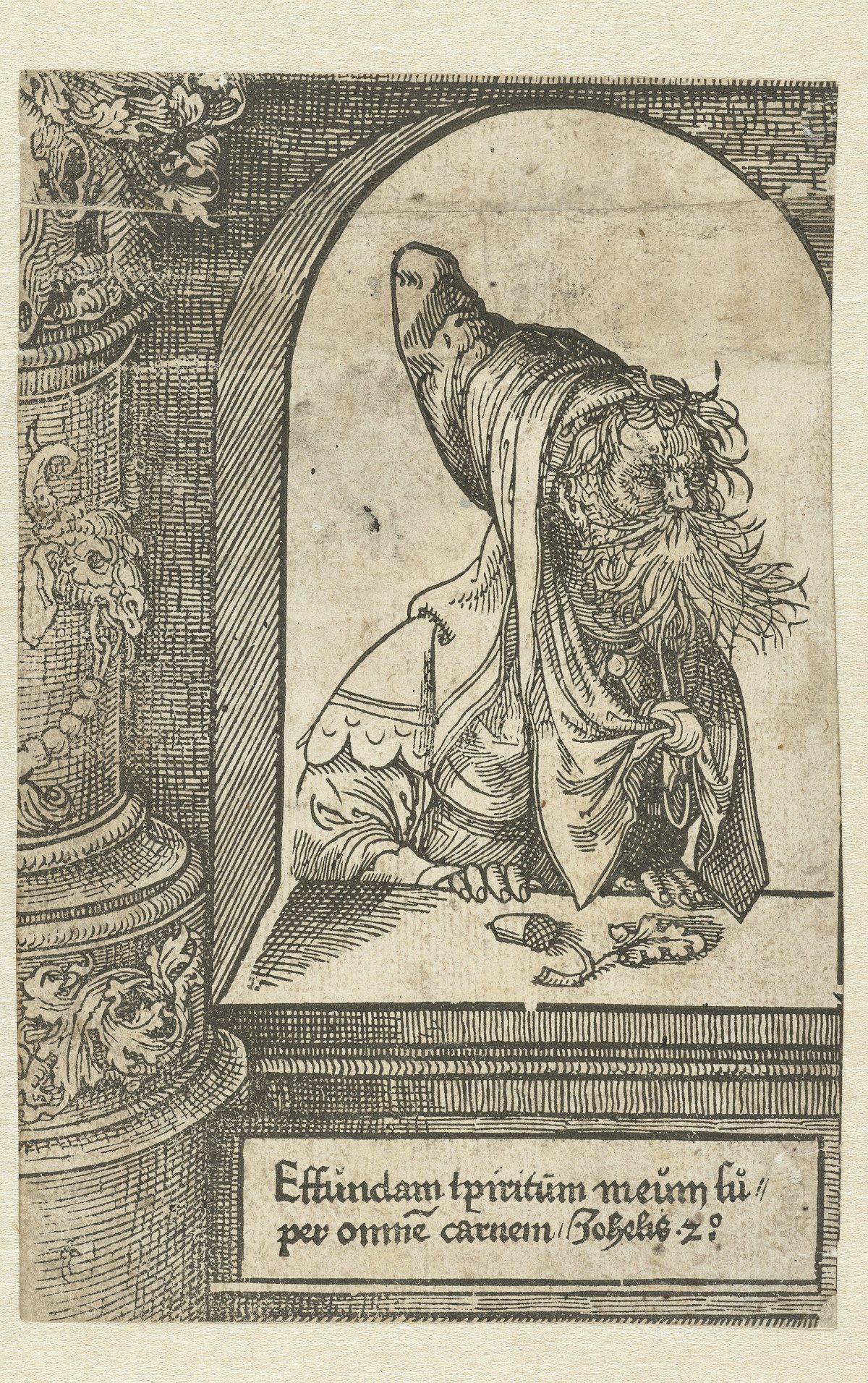
Jacob Cornelisz van Oostsanen, The Prophet Joel, 1521 to 1525. Public domain.
Joel 1 to 3 · Debate · Featured Study
The Date of Joel
Readers date the book from the leaders it calls, the peoples it names and the line it shares with Amos.
Amos dates his words by two kings, and Joel dates his by none.
This is the word of the LORD that came to Joel son of Pethuel:
This is the word of the LORD that came to Joel son of Pethuel:
Summary
Readers have placed Joel in five settings, from the reign of Jehoram son of Ahab to the years after Ezra and Nehemiah. Rashi and Seder Olam Rabbah give a reign, while Keil, Pusey and Driver argue from the verses of the book.
- C. F. Keil dates Joel to the years when the high priest Jehoiada advised the young Joash.
- Seder Olam Rabbah places Joel in the days of Manasseh.
- S. R. Driver dates the book about 500 BC, and George Adam Smith after 444 BC.
A Father and No King
The headings of Joel and Amos stand side by side.
These are the words of Amos, who was among the sheepherders of Tekoa—what he saw concerning Israel two years before the earthquake, in the days when Uzziah was king of Judah and Jeroboam son of Jehoash was king of Israel.The neighbouring book shows what a dated heading looks like.
Albert Barnes, in his Notes on the heading, observed that Joel names only his father and leaves even the time when he lived to be guessed at.
The Evidence Read Both Ways
The same verse serves both the early and the late datings.
Pusey, Newcome and Driver on three verses of Joel.
| Verse | Read for an early date | Read for a date after the exile |
|---|---|---|
| Joel 1:14, the elders called | Pusey: the arguments built on the fast have been overstated. | Driver: naming the elders alone would be remarkable for a prophet before the exile. |
| Joel 3:1 to 2 names the captivity and the scattering | Newcome: the captivity of Joel 3:1 is still to come. | Driver: the words are too strong for any calamity less than the exile to Babylon. |
| Joel 3:6, sold to the Greeks | Pusey: Amos condemns the same sale by Tyre and the Philistines, so the two prophets stand near in time. | Driver: the Greeks suit a later time, when slaves from Syria were sought in Greece. |
Five Datings
Rashi, Keil, Pusey, Seder Olam Rabbah, Driver and Smith each hold one of the datings.
In the reign of JehoramRashi, on Joel 1:1
Rashi, the medieval Jewish commentator, makes Joel a son of the prophet Samuel. He reports a reading that sets the locusts in the days of Jehoram son of Ahab, during the seven years of famine Elisha announced.
Under Joash, while Jehoiada advised himC. F. Keil, Biblical Commentary on the Old Testament: The Twelve Minor Prophets (1878); K. A. Credner (1831)
Keil places Joel's ministry in the first thirty years of Joash's reign, when the high priest Jehoiada was the king's adviser. The enemies Joel names are Egypt, Edom, Tyre, Sidon and Philistia, and Keil notes that the Syrians, who later marched against Jerusalem, are missing. S. R. Driver reports that Credner set out this case in 1831.
Before Amos gathered his propheciesE. B. Pusey, The Minor Prophets with a Commentary
Pusey dates Joel by its link with Amos, and writes that beyond it the book gives no clue to its own date.
In the days of ManassehSeder Olam Rabbah 20; Archbishop Newcome after Drusius, as Adam Clarke reports
Seder Olam Rabbah, an early Jewish chronicle, places Joel, Nahum and Habakkuk in the days of Manasseh. Adam Clarke, on Joel 1:1, reports that Newcome followed Drusius in placing Joel under Manasseh, some time from 697 to about 660 BC, because Joel 3:1 seems to see the captivity drawing near.
After the return from exileS. R. Driver, The Books of Joel and Amos (1897); George Adam Smith, The Book of the Twelve Prophets; Hans Walter Wolff, Joel and Amos (1977)
Driver dates the book most safely to about 500 BC, shortly after Haggai and Zechariah, and allows that it may come from the century after Malachi. He rests the date on the elders and priests who lead without a king, the scattering of Joel 3:2, and the Greeks of Joel 3:6.
George Adam Smith places Joel after Ezra and Nehemiah established the law in 444 BC, and before the cruelties of Artaxerxes about 360 BC. Hans Walter Wolff's commentary of 1977 dates the book to the first half of the fourth century BC; William H. Shea, reviewing it in 1979, judged that date too late.
The Place in the Twelve
Two old orders of the Twelve give Joel two places.
The Hebrew Bible orders the first six books as Hosea, Joel, Amos, Obadiah, Jonah and Micah. The Septuagint, the old Greek translation, orders them as Hosea, Amos, Micah, Joel, Obadiah and Jonah.
Keil, who holds the early date, writes that the Twelve are arranged without strict regard to chronology. George Adam Smith adds that the same group holds Obadiah and Jonah, whom he dates later, so the place of a book in the group settles nothing about its age.
Left Undecided
John Calvin judged the date uncertain.
In the preface to his commentary on Joel, he chose to leave the time undecided.
What Peter Names
At Pentecost Peter quotes Joel by name.
No, this is what was spoken by the prophet Joel:The verse shows the book read as prophecy at Pentecost.
The Datings Weighed
Each dating meets an objection from another reader of the book.
The datings set side by side.
| Dating | Held by | Representative work | The objection |
|---|---|---|---|
| Jehoram, son of Ahab | Rashi | Rashi on Joel 1:1 | Calvin lists the Jewish view among three and adopts none. |
| Joash, under Jehoiada | C. F. Keil; K. A. Credner | Keil, The Twelve Minor Prophets | Driver: a book with no king fits the years after the exile equally. |
| Before Amos | E. B. Pusey | Pusey, The Minor Prophets | Driver: northern Israel does not appear, and the promises are for Judah and Jerusalem alone. |
| Manasseh | Seder Olam Rabbah; Newcome after Drusius | Seder Olam Rabbah 20 | Calvin calls it a conjecture. |
| After the exile | S. R. Driver; George Adam Smith; Hans Walter Wolff | Driver, The Books of Joel and Amos (1897) | Pusey: Joel finished before Amos collected his prophecies. |
Books to Read Next
Three older commentaries on Joel are free to read.
The Books of Joel and Amos
S. R. Driver · 1897
Driver sets out both cases and argues for a date after the exile.
Read it free at the Internet ArchiveBiblical Commentary on the Old Testament: The Twelve Minor Prophets, volume 1
C. F. Keil · 1878
Keil's introduction weighs the enemies Joel names and the line he shares with Amos.
Read it free at the Internet ArchiveThe Minor Prophets with a Commentary
E. B. Pusey · 1860
Pusey sets out the arguments for an early date and finds two of them overstated.
Read it free at the Internet ArchiveThe Locusts and the Day
Joel's book turns from a plague in the fields to the Day of the LORD.
Sources
Scripture is the Berean Standard Bible.
- C. F. Keil, Biblical Commentary on the Old Testament: The Twelve Minor Prophets, volume 1 (T. and T. Clark translation, 1878), Introduction to Joel, pp. 169 to 170; public domain.
- E. B. Pusey, The Minor Prophets with a Commentary (1860; the 1883 printing read), Introduction to Joel, pp. 94 to 95; public domain.
- S. R. Driver, The Books of Joel and Amos, Cambridge Bible for Schools and Colleges (1897), Introduction, pp. 13 to 19; public domain.
- George Adam Smith, The Book of the Twelve Prophets, volume 2, The Expositor's Bible, chapter The Book of Joel; public domain.
- Hans Walter Wolff, Joel and Amos (Hermeneia, 1977), as reported in William H. Shea's review, Andrews University Seminary Studies 17 (1979), p. 230; cite-only.
- Rashi on Joel 1:1, Judaica Press translation; cite-only.
- Seder Olam Rabbah 20.
- John Calvin, Commentaries on Joel, Amos and Obadiah, the preface to Joel; public domain.
- Albert Barnes, Notes on the Old Testament, on Joel 1:1.
- Adam Clarke, Commentary on the Bible (1832), on Joel 1:1.
- Wikipedia, Twelve Minor Prophets, the table Sequence of books (the Hebrew and the Septuagint orders)
Keep Studying
Studies5
Places1
Subjects1
Doctrines1
Go further3