

Genesis 14 · Psalm 110 · Hebrews 5–7 · Featured Study
Melchizedek
He holds the stage for three verses and then vanishes for a thousand years. No father is named, no mother, no lineage, no death: a king of Salem who is also priest of God Most High, who feeds Abram, blesses him, and takes his tithe. Scripture returns to him exactly twice: once in a sworn oath, once in a sustained argument. And on that slender thread the letter to the Hebrews hangs its whole case that a man from Judah (a tribe with no priestly claim whatsoever) is our great High Priest.
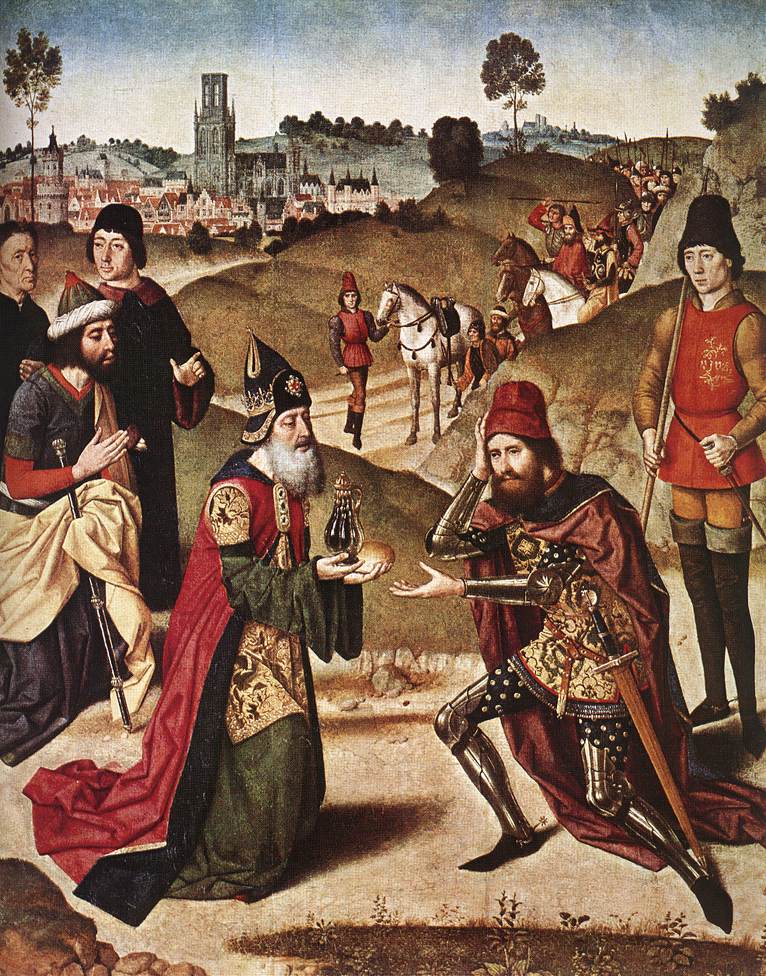
Peter Paul Rubens, The Meeting of Abraham and Melchizedek (c. 1626) — Public domain, via Wikimedia Commons
Summary
Melchizedek appears in only three texts a thousand years apart: Genesis 14's encounter, Psalm 110's sworn oath, and Hebrews 5-7's argument built on both. The page walks the three-move Hebrews case, the identity debate, and how Jewish writers read him before Hebrews did.
- Hebrews 7 argues in three moves: a priesthood without recorded genealogy, greater than Abraham because Abraham paid him tithes, and one that cannot die because no successor ever takes it.
- Four identity readings are set out, from a real historical king-priest (the mainstream view) to the largely-set-aside claim that he was a pre-incarnate appearance of Christ.
- The tithe is Hebrews' own argument; the bread and wine as a picture of the Lord's Supper is a later typological reading, kept distinct from it.
- Josephus, Philo, and the Qumran sect each read Melchizedek differently before Hebrews was written, none of them making the argument Hebrews makes.
The Three Texts
two thousand years, three passages: and nothing else in all of Scripture
Almost everything a reader wants to know about Melchizedek is not in the Bible. What is there fits on one page: and that scarcity is not an accident of the record. It is the material Hebrews works with. Walk the three stations in order and the argument assembles itself.
Abram comes back from rescuing Lot, and a king of Salem walks out to meet him with bread and wine. He is priest of God Most High. He blesses Abram; Abram gives him a tenth of everything. Then he is gone: three verses, no genealogy, no death notice, and the narrative moves on as if nothing unusual has happened.
- ▪He is the first explicit royal priest in Genesis: king and priest in one man, centuries before Israel had either office.
- ▪Abram, who has just refused the king of Sodom’s goods, accepts this king’s blessing and pays him tribute.
- ▪His God: El Elyon, God Most High: is the God Abram immediately swears by in the next breath (14:22). The narrative itself identifies them.
A thousand years of silence, and then David’s psalm reaches back and picks the name up: the LORD has sworn and will not change His mind: you are a priest forever in the order of Melchizedek. One verse, sworn under oath, addressed to a coming figure who is neither David nor a Levite.
- ▪God does not merely appoint here: he swears, and adds that he will not change his mind. The oath is the whole weight of the argument Hebrews will build.
- ▪The Hebrew le’olam (for ever) is used elsewhere of the Aaronic priesthood too (Exodus 40:15; Numbers 25:13): but of an office perpetuated by succession. Here it is sworn to a single, undying individual.
- ▪The idiom rendered “in the order of” is al-divrati, which the Septuagint carries over as kata tēn taxin: the verbal bridge from the Hebrew oracle straight into the Greek argument of Hebrews.
Another thousand years, and a letter to Jewish believers turns the two earlier texts into a case. Jesus is a real high priest: even though he came from the tribe of Judah, of which Moses said nothing concerning priests: because Psalm 110 swore an order of priesthood that never ran through Levi in the first place.
- ▪The name is invoked five times (5:6, 10; 6:20; 7:11, 17), always by way of Psalm 110:4: Hebrews argues from the oracle, not from Genesis alone.
- ▪The silences of Genesis 14 become the argument: no father, no mother, no genealogy, no recorded beginning or end: a man made to resemble the Son of God, abiding a priest continually (7:3).
- ▪The payoff is pastoral, not academic: a priest who never dies never leaves office, so he is able to save to the uttermost, seeing he ever liveth to make intercession (7:25).
The Hebrews 7 Argument
three moves, in order: this is why the man matters
A priesthood the record does not trace, and does not end.
Hebrews reads Genesis the way a lawyer reads a register: not only what it says, but what it conspicuously omits. Levitical priests lived and died by their pedigree: no genealogy, no altar (compare Ezra 2:62). Melchizedek walks into the text with no father named, no mother named, no lineage, no birth, no death, and walks out again still a priest. The writer is careful about what he is claiming: Melchizedek was made to resemble the Son of God: a pattern conformed to a model, not the model himself.
apatōr · amētōr · agenealogētos: “without father, without mother, without genealogy”
Proved from the tithe, and from a blessing that only runs downhill.
Consider how great this man was, the writer says, to whom even the patriarch gave a tenth of the choicest spoils. Two arguments run in parallel. First: the Levites collect tithes by commandment from their brethren: but this man, with no claim on Abraham at all, collected from Abraham. Second, and beyond dispute: the lesser is blessed by the greater. Then the daring step: Levi, still in the loins of his ancestor, paid tithes through Abraham. The tribe that would one day receive Israel’s tithes had already paid them.
kreittōn (7:7): “the less is blessed of the better”
So the law that established the old order was itself provisional.
If perfection had come through the Levitical priesthood, why would God swear in a psalm to raise up a priest of a different order? And a change of priesthood requires a change of law: which is how a man from Judah can hold the office legitimately. The ground of this priesthood is not a carnal commandment but the power of an endless life: the old priests were many in number because death kept stopping them; this one abides for ever, holding a priesthood that passes to no successor.
aparabatos (7:24): permanent, intransmissible · akatalytos (7:16): indestructible
It is yet more abundantly evident, the writer says, that another priest arises after the likeness of Melchizedek: and if the priesthood changes, the law that regulated it must change with it. That is the sentence a Jewish reader in the sixties would have felt in his chest. Hebrews does not get there by asserting it; it gets there through a Canaanite king, a psalm, and a tithe.
Why It Matters
a priest for us, outside Levi’s limits
A priest for a people outside Levi’s limits
The Aaronic priesthood was national, hereditary, and closed. Melchizedek is the proof, printed in Genesis long before Sinai, that God had a category of priesthood that never depended on descent from anyone. Which is why the letter can say: of a Galilean carpenter from the tribe of Judah: that he is a high priest at all.
A priest whose office death cannot interrupt
Israel’s high-priestly line ran through inheritance, exile, purchase, and Roman appointment; the office kept surviving the men who held it, and the men kept dying out of it. Hebrews answers the whole sorry succession with one word: unchangeable. Nobody is next.
A priest who is presently working
The argument does not stop at qualification. Because he lives, he intercedes: continuously, for those who draw near to God through him. The Melchizedek chapters are the doctrinal ground of the most practical sentence in the letter: draw near with boldness.
A king who is also the priest
Israel kept the two offices deliberately apart: Uzziah was struck for crossing the line. Salem’s king held both without offence, and Psalm 110 sets both on the coming one: seated at God’s right hand (v. 1) and sworn a priest for ever (v. 4). The offices that Israel could not combine are combined in Christ.
Two Threads, Kept Apart
the tithe and the bread-and-wine are not the same claim
The tithe
Hebrews’ own argumentAbram’s tenth is the hinge of Hebrews 7:4–10. This is not a later Christian reading laid over Genesis: it is the letter’s explicit reasoning for Melchizedek’s superiority to Levi, made from the text itself.
The bread and wine
A later typological readingMelchizedek’s provisioning of Abram’s exhausted company is the only place in the Old Testament where a priest brings out bread and wine like this, and Christian interpreters from the patristic era onward have read it as anticipating the Lord’s Supper (a line surveyed by Kenneth Vandergriff in Theology Today, 2020). Worth holding: and worth keeping distinct, because Hebrews itself makes no eucharistic argument at all.
They are easy to blur together, and blurring them makes Hebrews say something it never says. Kept apart, both survive: one is the letter’s reasoning, the other is the church’s reading of a scene the letter passes over.
Who Was He?
four readings, each held by a real tradition
Scripture’s silence about Melchizedek’s parentage is the engine of Hebrews’ argument: which means a study that over-explains who he “really was” quietly dismantles the very point the text is making. So: the best-supported reading first, then the historic alternatives at their own full strength, each attributed to the tradition that holds it.
A real king-priest of Salem
Keil & Delitzsch; Matthew Henry; the mainstream historical-grammatical stream, and Matthew Emadi for The Gospel Coalition
An actual Bronze Age ruler of the city later called Jerusalem who: like other kings of the ancient Near East: held royal and priestly office together, and who worshipped the true God independently of the Abrahamic covenant. That last point is not incidental: it shows that knowledge of God was not confined to Abram’s line before Sinai.
Melchizedek was Shem
A rabbinic tradition; Jerome records it circulating among Hebrew interpreters of his day
Reasoning from the chronology of Genesis 11, Shem’s lifespan overlapped Abram’s: so a priest of God Most High living near Salem in that era could plausibly be the patriarch through whom pre-Flood worship had passed. A minority view even within Judaism, with few current defenders, but a genuine part of the identity debate’s history.
An exalted heavenly figure
The Qumran fragment 11Q13 (11QMelchizedek, c. 100 BC)
A Second-Temple sectarian text portrays “Melchizedek” as a heavenly deliverer, at points addressed with divine titles, leading an eschatological judgment in an apocalyptic reading of the Jubilee law of Leviticus 25. No mainstream Jewish or Christian tradition has followed it as a claim about the Genesis figure: but it shows how loaded the name already was when Hebrews took it up.
A pre-incarnate appearance of Christ
A patristic-era strand, pressing Hebrews 7:3 into identity
If the missing genealogy and missing death are literal rather than literary, the argument runs, the simplest explanation is that Melchizedek is the Son himself. The reading founders on the very verse it leans on: 7:3 says he was made to resemble the Son of God, and 7:15 speaks of a different priest arising in Melchizedek’s likeness. The grammar requires two figures being compared, not one.
The mainstream historical-grammatical position: a real historical king-priest, and a type of Christ’s eternal priesthood, not a Christophany. The identity question is genuinely debated among faithful, Scripture-affirming interpreters, and Genesis gives no parentage to settle it. On the Christophany question the text itself supplies a check: Hebrews 7:3 and 7:15 compare two figures, and a comparison needs two.
A note to prevent a confusion: later Latter-day Saint theology uses “the Melchizedek Priesthood” as the name of an order distinct in content and authority-claim from anything in Genesis 14, Psalm 110, or Hebrews 5–7. That belongs to a different theological system and is not part of the debate above.
How Jewish Writers Read Him Before Hebrews
three readings survive from the centuries between Genesis and the letter: and they do not agree
Hebrews was not the first Jewish writing to make something of these three verses. By the first century the name had already been pulled in three different directions: a heavenly judge at Qumran, a moral allegory in Alexandria, a Bronze Age king in a Roman-era history. Reading them together shows how loaded the name was when the letter picked it up, and how little the letter’s own argument depends on any of them.
Josephus
c. AD 93A man, and the first priest of the city that became Jerusalem.
Writing for a Roman readership, the Jewish historian treats Melchizedek as a plain fact of the past and stops to translate the name for people who have no Hebrew: “That name signifies the righteous king; and such he was without dispute, insomuch that on this account he was made the priest of God: however they afterward called Salem, Jerusalem.” He then retells Genesis 14 in ordinary terms: the king supplied Abram’s exhausted army with provisions in abundance, praised him at the meal, blessed God for the victory, and accepted the tenth.
In the Jewish War he goes further and makes the same figure the city’s founding priest: the first to officiate there, the first to build a sanctuary on the site, and the one who renamed Salem as Jerusalem.
Antiquities 1.179–181; Jewish War 6.438
Philo of Alexandria
c. AD 40Not a man to be placed in history: a picture of right reason.
A generation before the letter to the Hebrews, a Greek-speaking Jew read the same three verses as moral allegory. In Philo’s handling the name and the city become a programme for the soul: the righteous king set against the tyrant, ruling a mind at peace, and the priesthood identified with logos: reason itself: which pours out wine rather than water because what it gives the soul is stronger than drink. Elsewhere he simply calls him the great priest of God Most High.
Worth naming carefully. That a Jewish writer was already using logos of Melchizedek before Hebrews was written shows the vocabulary was in the air; it does not show that Hebrews borrowed from him. Philo is doing moral allegory. Hebrews is arguing from a sworn oath about a real priesthood.
Allegorical Interpretation 3.79–82; On Abraham 235
The Qumran sect
c. 100 BCA heavenly deliverer who executes God’s judgment.
The most extreme reading of the three, and the oldest. A sectarian scroll from the caves near the Dead Sea casts “Melchizedek” as an exalted heavenly figure who proclaims liberty and carries out judgment in the last days. It is set out in full among the four identity readings above.
11Q13 (11QMelchizedek) · see the four readings →
Notice what none of them does. Qumran makes him a heavenly deliverer, Philo makes him an idea, Josephus makes him a man: and not one of them argues what Hebrews argues. The letter takes a fourth road: the man of Genesis 14, read through the oath of Psalm 110, and applied to Jesus. It is Josephus, the least theological of the three, who happens to supply the page’s outside witness that Salem was the city later called Jerusalem.
Salem, El Elyon, and the Ancient Near East
what the world around Genesis 14 looked like
Salem is Jerusalem
Psalm 76:2 pairs Salem with Zion as poetic synonyms: the Old Testament making the identification itself. Josephus then says it outright, twice: Salem was “afterward” called Jerusalem (Antiquities 1.180), and the city’s first priest was this same righteous king (Jewish War 6.438). The name element Shalem also echoes a West Semitic deity attested in Ugaritic and Amarna-period material, evidence that the city was a functioning Canaanite cult centre with royal-priestly leadership long before Israel’s conquest.
Priest-kings were normal
Kings serving as chief priest of the city’s patron deity are attested across the ancient Near East. Genesis 14:18 is not inventing a category: it is reporting one, which is part of why conservative commentators read Melchizedek as a real contemporary rather than a literary cipher.
El Elyon
“God Most High” is a recognized ancient Semitic divine epithet, used elsewhere in the Hebrew Bible for Israel’s God. Melchizedek is priest of El Elyon; two verses later Abram raises his hand to the LORD God Most High, Creator of heaven and earth. The narrative merges them deliberately.
What the ground has not said
No inscription naming Melchizedek has been recovered. The case for his historicity rests on the narrative claim of Genesis 14 read against a well-attested pattern of royal priest-kingship: not on an epigraphic find, and this page will not pretend otherwise.
The Words
Hebrew oracle, Greek argument: and the bridge between them
The single strongest textual peg in the whole study is one Hebrew word in Psalm 110:4: le’olam, for ever. Not because it is the only priesthood Scripture calls everlasting (the Aaronic order is called that too), but because it is the only one sworn for ever to a single, undying person rather than to an office kept alive by succession. Hebrews 7 is an extended unpacking of exactly that distinction, and it answers the Hebrew word with a Greek one: aparabatos: a priesthood that passes to no one, because the priest never leaves.
Keep studying
Read it1
By subject
The patriarchs7 pages
On this page
People3
Doctrines10
Go further1