
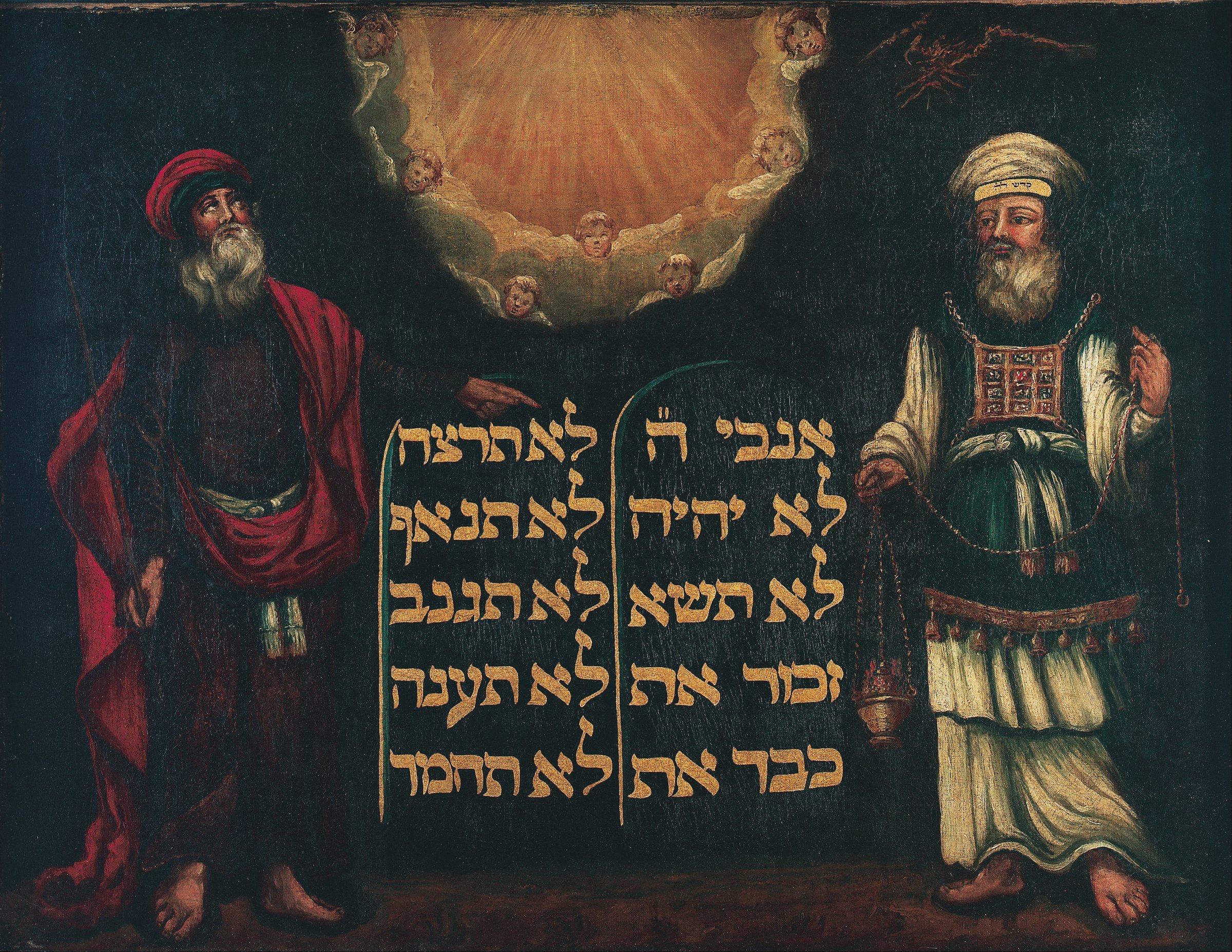
Unknown painter, Moses and Aaron with the Tablets of the Law, 1692. Public domain.
Exodus 28 and 39 · Symbol · Featured Study
The Garments of the High Priest
Bezalel and the craftsmen of Israel made the high priest's dress at Sinai to the pattern God gave Moses.
These are the garments that they shall make: a breastpiece, an ephod, a robe, a woven tunic, a turban, and a sash. They are to make these holy garments for your brother Aaron and his sons, so that they may serve Me as priests.
- The word
- אֵפוֹד (ephod), H646
- First appears
- Exodus 25:7 “and onyx stones and gemstones to be mounted…”
When Aaron died on Mount Hor, his garments were already on his son.
Summary
The high priest of Israel wore holy clothes when he served God, and no other priest wore the whole set. The law says when he put them on, when he took them off, and what he must never do to them. Exodus gives the use of some of the pieces. Two old readers, the Jewish historian Josephus and the Reformer John Calvin, each saw the whole dress as a picture of something more.
- Exodus 28 names eight pieces of the dress: the six of verse 4, a gold plate and linen undergarments.
- Of all the priests, only the high priest wore the ephod of gold and yarn, the blue robe, the breastpiece and the gold plate.
- On the Day of Atonement he bathed before he put on the linen garments of that day (Leviticus 16:4).
- The robe had a woven collar at its opening so that it would not tear (Exodus 28:32).
- The robe of the Son of Man in Revelation 1:13 has the name the Greek Exodus gives the high priest's robe, poderes.
Made for Glory and Splendor
God named the purpose of the garments before Exodus describes a single piece.
The high priest of Israel stood before God for the whole people, in clothes made for that work alone. Exodus 28 gives their pattern and Exodus 39 records their making. The garments were holy, and they were made to give Aaron glory and splendor (Exodus 28:2). Craftsmen whom God had filled with a spirit of wisdom made them (Exodus 28:3), from gold, fine linen and yarn of blue, purple and scarlet (Exodus 28:5).
Aaron's sons received tunics, sashes and headbands (Exodus 28:40), and the linen undergarments of Exodus 28:42 were made for the high priest and his sons alike.
The Pieces on One Figure
The print shows the high priest barefoot, holding a censer on its chains.
Six of the eight pieces and three of their parts can be seen on one standing figure.
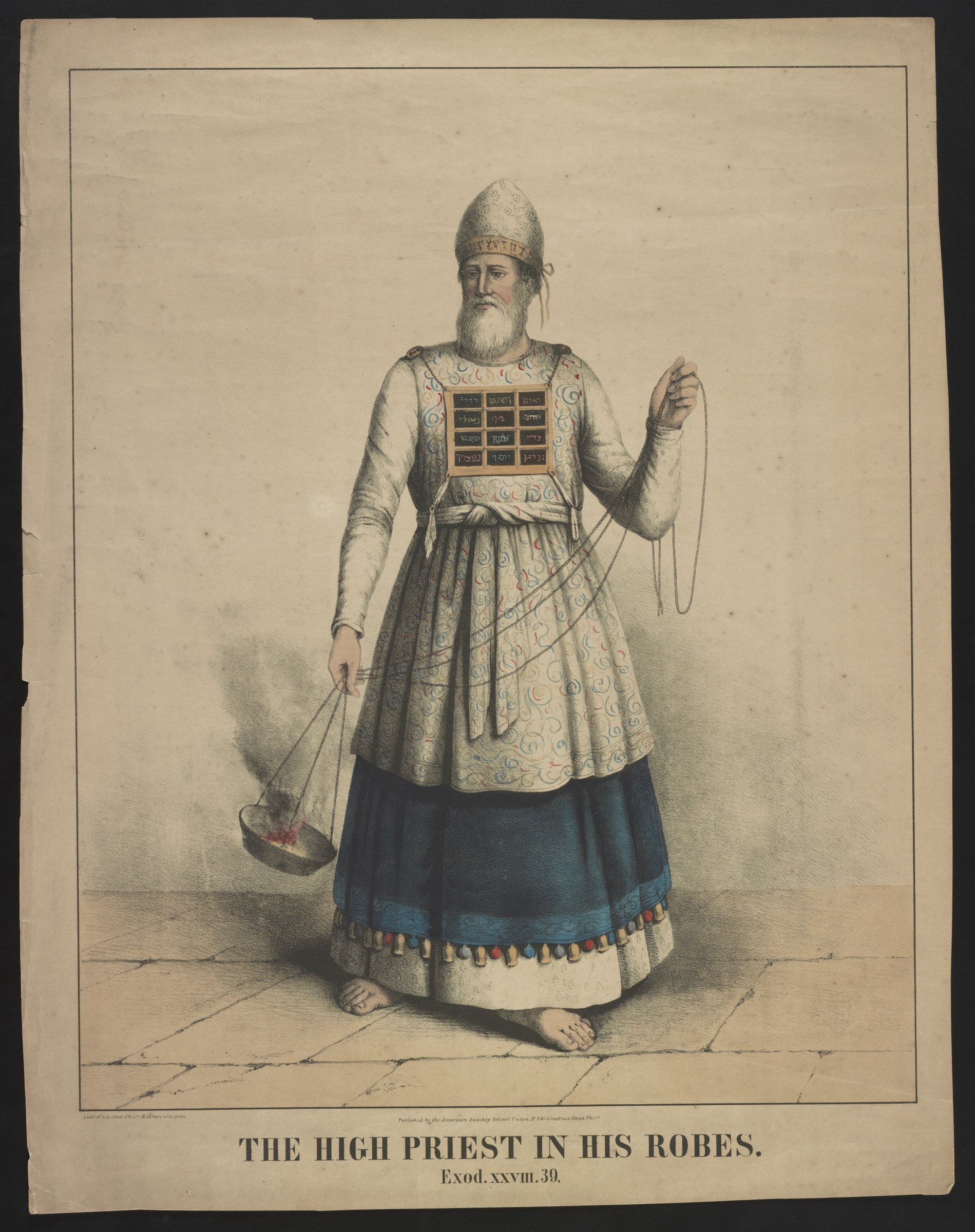
- 1. The turban, mitsnephethMade of fine linen, with the ornate headbands of the other priestsExodus 39:28
- 2. The plate, tsitsCalled the plate of the holy crown, of pure gold, engraved like an inscription on a sealExodus 39:30
- 3. The shoulder piecesAttached at two of the ephod's corners, so that it could be fastenedExodus 39:4
- 4. The breastpiece, choshenTied by its rings to the rings of the ephod with a cord of blue, so that it would not swing outExodus 39:21
- 5. The waistband of the ephodWoven in one piece with the ephod, of the same workmanshipExodus 39:5
- 6. The tunic, kethonethWoven of fine linen by a weaver, for Aaron and his sons alikeExodus 39:27
- 7. The ephodMade by Bezalel, with gold hammered into thin sheets and cut into threadsExodus 39:2 to 3
- 8. The robe of the ephod, meilThe work of a weaver, with an opening at its center like that of a garmentExodus 39:22 to 23
- 9. The bells and pomegranatesBells of pure gold set between pomegranates of yarn and fine linen around the lower hemExodus 39:24 to 26
Augustus Kollner, lithographer, The High Priest in His Robes, Exodus 28:39, printed by John Henry Camp for the American Sunday-School Union, Philadelphia, between 1849 and 1853, Library of Congress. Public domain, via Wikimedia Commons (File:The high priest in his robes. Exod. xxviii. 39 - lith'y. of A. Kollner Phila ; H. Camp's lith'c. press. LCCN2013650017.jpg).
The numbers run from the head down. The sash and the linen undergarments are worn beneath the robe and the ephod, so the picture does not show them.
Exodus 28:29 to 30 says Aaron carried the breastpiece over his heart whenever he went into the Holy Place. Precious Stones teaches its twelve stones and the names cut into them, and The Breastplate teaches the breastpiece as a made thing.
Seven of the verses of Exodus 39 on the garments end with the words as the LORD had commanded Moses.
Worn, Laid Aside and Passed On
Exodus, Leviticus and Numbers follow the garments from the ordination to the death of Aaron.
When the garments went on and came offLeviticus 8:7 to 9; Exodus 28:35; Leviticus 16:4 to 23; Exodus 29:29 to 30
Four passages tell when the high priest put on his garments, wore them, laid them aside and passed them on.
| Occasion | What the passage says of the garments | Verse |
|---|---|---|
| His ordination | Moses dresses him piece by piece, from the linen tunic to the gold plate on the turban | Leviticus 8:7 to 9 |
| Every ministry in the sanctuary | He wears the robe, so the bells are heard as he goes in and comes out | Exodus 28:35 |
| The Day of Atonement | He wears a linen tunic, undergarments, sash and turban, and leaves them in the tent afterward | Leviticus 16:4 to 23 |
| His son's succession | The garments belong to the son who follows him, who wears them for seven days | Exodus 29:29 to 30 |
Aaron's garments on Mount HorNumbers 20:26 to 28
Remove Aaron’s priestly garments and put them on his son Eleazar. Aaron will be gathered to his people and will die there.” So Moses did as the LORD had commanded, and they climbed Mount Hor in the sight of the whole congregation. After Moses had removed Aaron’s garments and put them on his son Eleazar, Aaron died there on top of the mountain. Then Moses and Eleazar came down from the mountain.Exodus 29:29 to 30 commanded this handing on, and here it is carried out.
The Garment That Must Not Tear
Leviticus sets a law on the high priest's clothes, and Matthew records what one high priest did with his.
The priest who is highest among his brothers, who has had the anointing oil poured on his head and has been ordained to wear the priestly garments, must not let his hair hang loose or tear his garments.Leviticus 21:1 speaks to Aaron's sons, the priests, and verse 10 turns to the one highest among them.
At this, the high priest tore his clothes and declared, “He has blasphemed! Why do we need any more witnesses? Look, now you have heard the blasphemy.Matthew 26:57 names this high priest as Caiaphas.
Matthew does not say which garment Caiaphas tore. In his Explanatory Notes upon the New Testament, John Wesley says the law forbade the high priest to tear his clothes in some cases where others might. Wesley adds that for blasphemy or a public calamity it was thought allowable.
The Hebrew Names of the Pieces
Beged, the word of Exodus 28:2 for the holy garments, is the common Hebrew word for clothing.
The words, their glosses and their countsStrong's concordance
Nine Hebrew words and one Greek word belong to the high priest's dress.
| Word | What it names | Number in Strong's concordance | Uses |
|---|---|---|---|
| beged | a covering, i.e. clothing; also treachery or pillage | H899 | 217 |
| ephod | a girdle; specifically the ephod or highpriest's shoulder-piece; also generally, an image | H646 | 49 |
| kethoneth | The tunic | H3801 | 29 |
| meil | The robe, which was an upper and outer garment | H4598 | 28 |
| choshen | The breastpiece, used only of the high priest's | H2833 | 25 |
| tsits | A glistening thing: the gold plate here, elsewhere a flower or a wing | H6731 | 15 |
| mitsnepheth | The turban, which kings and high priests wore | H4701 | 12 |
| abnet | The sash | H73 | 9 |
| miknasayim | The linen undergarments | H4370 | 5 |
| poderes | A garment reaching the ankles; the Greek Exodus uses it for the high priest's robe at Exodus 28:4 and Exodus 28:31 | G4158 | 1 |
mitsnepheth, abnet, miknasayim, poderes
What the Text Leaves Unsaid
The bells have a stated purpose in Exodus 28:35, and the pomegranates beside them have none.
A meaning given for the pomegranates is a reader's meaning, and so is a shape given for the turban, since Exodus names its linen and not its form.
The turban as Jamieson, Fausset and Brown describe itExodus 28:37
“The Scripture has not described its form, but from JOSEPHUS we may gather that it was conical in shape, as he distinguishes the mitres of the common priests by saying that they were not conical--that it was encircled with swathes of blue embroidered, and that it was covered by one piece of fine linen to hide the seams.”
Jamieson, Fausset & Brown · Commentary Critical and Explanatory on the Whole Bible · on Exodus 28:37Reformed
The length of the priests' sash, as it was reportedExodus 28:39
“It is said to have been very long, and being many times wound round the body, it was fastened in front and the ends hung down, which, being an impediment to a priest in active duty, were usually thrown across the shoulders. This was the outer garment of the common priests.”
Jamieson, Fausset & Brown · Commentary Critical and Explanatory on the Whole Bible · on Exodus 28:39Reformed
Where It Points
John saw the vision of Revelation 1 on the island of Patmos, on the Lord's day.
and among the lampstands was One like the Son of Man, dressed in a long robe, with a golden sash around His chest.The robe and the sash are the first details John gives of the figure among the lampstands.
Jamieson, Fausset and Brown compare the golden sash with the high priest's girdle, which in their words "was only interwoven with gold". Exodus puts gold in the woven waistband of the ephod (Exodus 28:8) and makes the sash of linen and coloured yarn (Exodus 39:29).
Zechariah and the clean turbanZechariah 3:5
Then I said, “Let them put a clean turban on his head.” So a clean turban was placed on his head, and they clothed him, as the angel of the LORD stood by.Besides garments and robes, the turban is the one piece of dress the vision names.
The Garment and the Robe follows the vision of Joshua the high priest from his filthy garments to his splendid robes.
Two Readings of the Garments
Calvin's commentary on Exodus was among the labours of 1563, the year before his death.
The garments picture the universeFlavius Josephus, Antiquities of the Jews 3.7.7
Josephus holds that the tabernacle and the high priest's dress were each made to represent the universe. In his reading the linen stands for the earth, the blue for the sky, the bells for thunder, the girdle for the ocean and the turban for heaven. Exodus states its own purposes for the pieces and names no sky and no sea.
The garments picture Christ the MediatorJohn Calvin; John Wesley
“But we must chiefly recollect what I have said, viz., that in these garments the supreme purity and wondrous glory of Christ were represented; as if God should promise that the Mediator would be far more august than the condition of man could produce.”
John Calvin · Commentaries · on Exodus 28:2Reformed
John Wesley, in his Explanatory Notes upon the Old Testament on Exodus 28:38, reads the plate's bearing of iniquity as the work of Christ, and The Ordination of the Priests quotes him.
Hebrews draws Christ's priesthood from Melchizedek (Hebrews 7:1 to 17) and from the earthly sanctuary and its yearly entry (Hebrews 9:1 to 12), and names none of the high priest's garments.
Books to Read Next
Two older works give the garments in detail.
Antiquities of the Jews
Flavius Josephus, translated by William Whiston · 1737
Book 3, chapter 7 describes each garment of the priests and the high priest and gives his reading of them.
READ AT GUTENBERG →Explanatory Notes upon the Old Testament
John Wesley · 1765
His notes on Exodus 28 and Leviticus 16 and 21 take the garments verse by verse.
Holy to the LORD
The garments were holy because God set them apart for His service.
Hebrews 4:14 names Jesus the Son of God as the great high priest who has passed through the heavens, and on that ground it says: "let us hold firmly to what we profess."
Sources
Scripture is the Berean Standard Bible.
- James Strong, Exhaustive Concordance of the Bible, 1890, with the STEP Bible glosses of Tyndale House, H899, H646, H2833, H3801, H4598, H6731, H4701, H73, H4370 and G4158.
- The Septuagint, Exodus 28:4 and 28:31, in the Greek text of Lancelot Brenton's edition.
- Flavius Josephus, Antiquities of the Jews, Book 3, chapter 7, translated by William Whiston, 1737.
- John Calvin, Commentaries on the Four Last Books of Moses Arranged in the Form of a Harmony (Latin, 1563), translated by Charles William Bingham, on Exodus 28:2.
- John Wesley, Explanatory Notes upon the Old Testament, 1765, on Exodus 28:38.
- Jamieson, Fausset and Brown, Commentary Critical and Explanatory on the Whole Bible, 1871, on Exodus 28:37, 28:39 and Revelation 1:13.
- John Wesley, Explanatory Notes upon the New Testament, 1755, on Matthew 26:65.
Keep Studying
People and groups6
Places1