
Matthew, Mark, Luke, John and Acts · Person · Featured Study
Jesus
The life of Jesus of Nazareth in the four Gospels, with His names, His family, the places where He lived and taught, and every room of the study of Him.
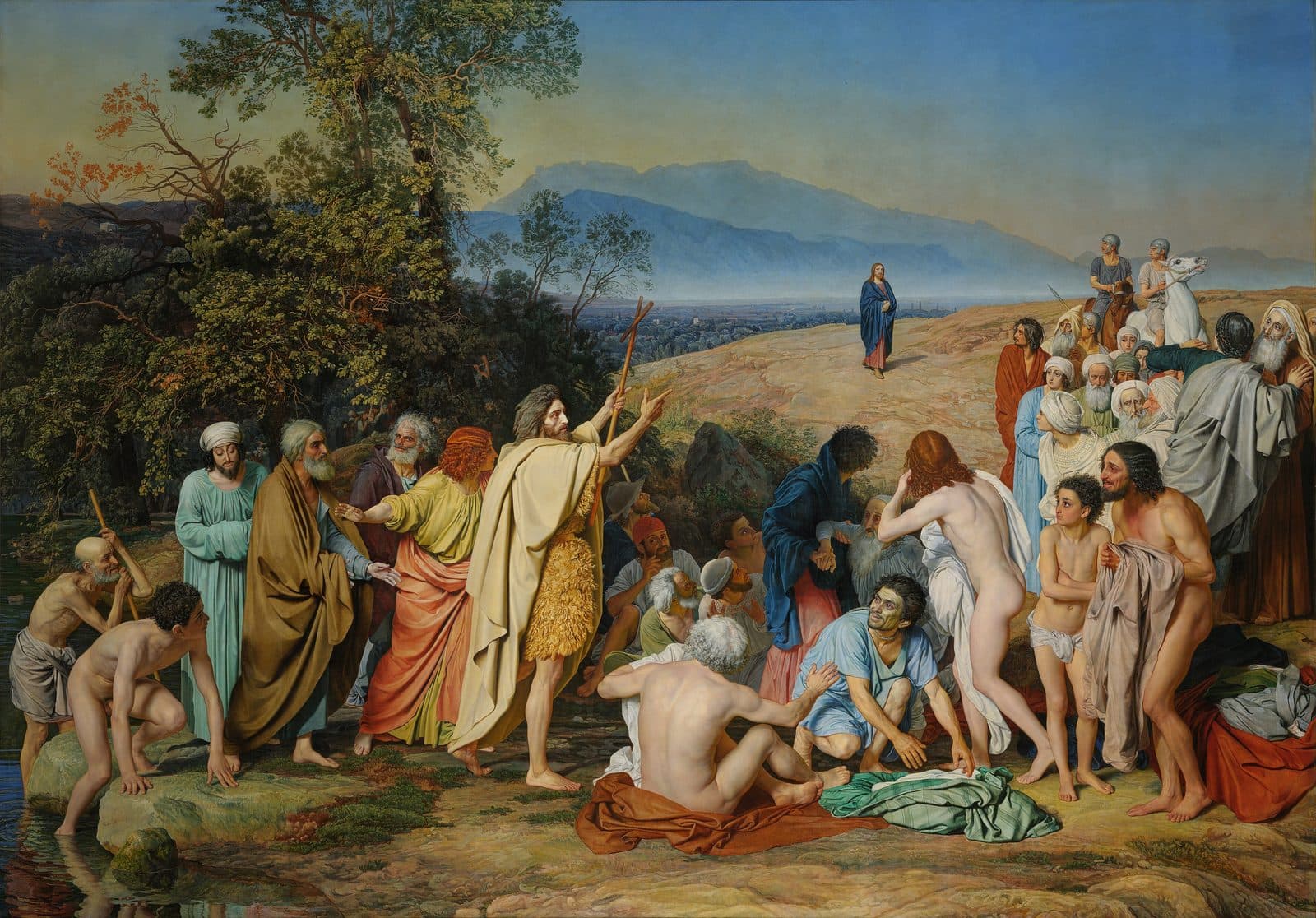
Alexander Ivanov, The Appearance of Christ Before the People, 1837 to 1857, State Tretyakov Gallery. Public domain, via Wikimedia Commons.
THE ARTWORKIvanov painted the day John pointed out Jesus at the Jordan, and he set Jesus small and far off on the road, with John's raised arm drawing the eye to Him.
Before He was born, the angel told Joseph to give Him the name Jesus, because He will save His people from their sins.
Summary
Jesus of Nazareth, the son of Mary, was born at Bethlehem in Judea, was crucified at Jerusalem under Pontius Pilate, and on the third day rose from the dead.
- Joseph and Mary raised Him in Nazareth, and at about thirty He was baptized by John in the Jordan.
- He made Capernaum His home and went through Galilee healing every disease and sickness.
- On the night of the Passover meal He was arrested, and the next day He died on a cross at Golgotha.
- After forty days He was taken up into heaven from the Mount of Olives.
Where Jesus Stands in Scripture
Matthew's first verse, the aim John gives his Gospel, and three witnesses to who He is
This is the record of the genealogy of Jesus Christ, the son of David, the son of Abraham:Matthew begins with God's promises to David and Abraham.
But these are written so that you may believe that Jesus is the Christ, the Son of God, and that by believing you may have life in His name.John closes his account of the signs here, so every sign he tells is meant to bring the reader to faith.
The Life, Turn by Turn
From Bethlehem to the Mount of Olives, each turn with its time and how sure it is
Five turns of the life carry a year, and each year is reckoned from a ruler the Gospels name.
To scale: 5 of 21 stops dated; a bar is a span; two dots joined are the two years held; a mark that would lie on another stands in a lane under the axis.
- Born in the days of King HerodBethlehem6 to 2 BCproposedMatthew 2:1
- Herod dies, so the birth falls before himJudea4 BC or 1 BCproposedMatthew 2:19
- Taken by night out of Herod's reachEgyptUntil Herod diedknownMatthew 2:14
- Brought home to GalileeNazarethUnder ArchelausknownMatthew 2:23
- Found among the teachersThe temple courtsAt age 12knownLuke 2:46
- John preaches in the wildernessThe Jordan26 to 29 ADprobableLuke 3:2
- Baptized by JohnThe Jordan27 to 29 ADprobableMatthew 3:16
- Tempted by the devilThe wildernessStraight after the baptismknownMatthew 4:1
- The first of His signsCanaSoon after the first disciples cameknownJohn 2:11
- Goes up for the first Passover John namesJerusalemA Passover of the ministryknownJohn 2:13
- Makes His home by the seaCapernaumAfter John's arrestknownMatthew 4:13
- Feeds the five thousand near the second PassoverGalileeA Passover of the ministryknownJohn 6:4
- Asks the Twelve who people say He isCaesarea PhilippiBefore the journey southprobableMark 8:27
- TransfiguredA high mountainSix days laterknownMatthew 17:2
- Sets out for JerusalemThrough SamariaAs His ascension approachedknownLuke 9:51
- Rides into the city on a donkeyJerusalemThe third Passover John namesknownMatthew 21:7
- Eats the Passover with the TwelveAn upper roomThe night of the arrestknownLuke 22:15
- CrucifiedGolgotha30 or 33 ADprobableJohn 19:30
- Raised from the deadA garden tombThe third dayknownMatthew 28:6
- Appears to His disciplesJerusalem and GalileeForty daysknownActs 1:3
- Taken up into heavenThe Mount of OlivesWhen the forty days endedknownActs 1:9
Luke gives two ages, twelve at the temple and about thirty when His ministry began.
From Bethlehem to the Mount of Olives
The birth, the ministry in Galilee, the last week in Jerusalem and the forty days after it
Matthew and Luke tell of His birth and childhood, Mark begins at His baptism, and John begins before creation with the Word who was with God.
After His baptism He came into Galilee and preached that the kingdom of heaven is near.
For even the Son of Man did not come to be served, but to serve, and to give His life as a ransom for many.”Jesus gives the purpose of His coming in His own words, and the purpose is to serve and to give His life.
For what I received I passed on to you as of first importance: that Christ died for our sins according to the Scriptures, that He was buried, that He was raised on the third day according to the Scriptures,Paul hands on these facts as the gospel he received, and he sets the death, the burial and the rising in one sentence.
The early yearsMatthew 1 and 2; Luke 2
At twelve He stayed behind in Jerusalem after the feast, and His parents searched three days before they found Him.
“Why were you looking for Me?” He asked. “Did you not know that I had to be in My Father’s house?”His first recorded words call God His Father and the temple His Father's house.
The baptism and the temptationMatthew 3 and 4
As He came up out of the water the heavens were opened and the Spirit of God descended on Him like a dove. Afterward He answered each temptation of the devil with the words It is written.
And a voice from heaven said, “This is My beloved Son, in whom I am well pleased!”The Father names the Son at the start of the ministry, and the same words come again on the mountain of the transfiguration.
The teaching and the signsMatthew 5 to 13; John 2 to 12
He taught on the mountain, in the synagogues and from a boat, and much of His teaching on the kingdom came in parables.
When Jesus had finished saying these things, the crowds were astonished at His teaching, because He taught as one who had authority, and not as their scribes.Matthew closes the Sermon on the Mount with the crowd's astonishment at the authority of His teaching.
The road to JerusalemLuke 9:51
Luke marks the turn south with one verse, and from there his Gospel follows Jesus on the way to the city where He would die.
As the day of His ascension approached, Jesus resolutely set out for Jerusalem.Luke names the ascension as the end in view when Jesus set out for Jerusalem.
“The days are fulfilled that he should be received up - That is, the time of his passion was now at hand. St. Luke looks through this, to the glory which was to follow.”
John Wesley · Explanatory Notes upon the New Testament · on Luke 9:51Evangelical
The last weekMatthew 21 to 27; Luke 22
The crowds spread their cloaks and branches on the road and shouted Hosanna to the Son of David. At the supper He gave the bread as His body and the cup as the new covenant in His blood. After the arrest the high priest charged Him under oath to say whether He was the Christ, the Son of God.
“You have said it yourself,” Jesus answered. “But I say to all of you, from now on you will see the Son of Man sitting at the right hand of Power and coming on the clouds of heaven.”Jesus answers with the figure Daniel saw, the Son of Man coming on the clouds of heaven.
Pilate had Him flogged and handed Him over to be crucified. About the ninth hour He cried out the opening words of Psalm 22, My God, My God, why have You forsaken Me?
The forty days and the ascension1 Corinthians 15; Acts 1
Paul lists His appearances to Cephas, to the Twelve, to more than five hundred brothers at once, to James and to all the apostles.
“Men of Galilee,” they said, “why do you stand here looking into the sky? This same Jesus, who has been taken from you into heaven, will come back in the same way you have seen Him go into heaven.”The two men in white promise that the same Jesus will come back in the way He went.
Six Details of His Human Life
The Gospels show Him hungry, weary, asleep, weeping and thirsty, and eating after He rose
HUNGRY IN THE WILDERNESS
After fasting forty days and forty nights in the wilderness, He was hungry.
WEARY AT THE WELL
At Sychar, tired from the road, He sat down by Jacob's well at about the sixth hour.
ASLEEP IN THE STORM
He slept on the cushion in the stern through the storm until the disciples woke Him.
WEEPING AT A GRAVE
Jesus wept at Bethany before He called Lazarus out of the tomb.
THIRSTY ON THE CROSS
Knowing that all was accomplished, He said I am thirsty, to fulfill the Scripture.
EATING AFTER HE ROSE
The disciples gave Him a piece of broiled fish, and He ate it in front of them.
The Rulers of His Day
Nine rulers the Gospels name, from Caesar Augustus to the high priest Caiaphas
Bede, writing on Luke 3:1, says that Pilate was sent in the twelfth year of Tiberius and governed the Jewish nation for ten years.
The nine rulers, office by officeLuke 2 and 3; Matthew 2, 26 and 27; John 18
| Ruler | Office | Verse |
|---|---|---|
| Caesar Augustus | Roman emperor, whose decree of a census brought Joseph to Bethlehem | Luke 2:1 |
| Herod the Great | King in Judea when Jesus was born | Matthew 2:1 |
| Archelaus | Herod's son, reigning in Judea in his father's place | Matthew 2:22 |
| Tiberius Caesar | Roman emperor when the word of God came to John | Luke 3:1 |
| Pontius Pilate | Governor of Judea, before whom Jesus was tried | Matthew 27:2 |
| Herod Antipas | Tetrarch of Galilee, a son of Herod the Great | Luke 3:1 |
| Philip | Tetrarch of Ituraea and Trachonitis, brother of Antipas | Luke 3:1 |
| Annas | High priest, father-in-law of Caiaphas, before whom Jesus was brought first | John 18:13 |
| Caiaphas | High priest, in whose house the council met on the night of the arrest | Matthew 26:57 |
The Family of Jesus
Matthew's line through Solomon and Luke's through Nathan, meeting at David, with His mother, His brothers and His sisters
David
- DavidThe king at whom the two lines meet, Matthew 1:1
- Joseph's side, by Matthew's lineMary's side, by Luke's line as Robertson reads it
Two sons of David
Many generations on
Joseph and Mary
- JosephHusband of Mary, Matthew 1:16
- MaryHis mother, Matthew 1:18
- Mary's sisterAt the cross with His mother, John 19:25
Jesus and His brothers and sisters
His brothers did not believe in Him during the ministry, and after the ascension they prayed in Jerusalem with the apostles and His mother.
Elizabeth, the mother of John the Baptist, was Mary's relative and a daughter of Aaron.
The church has read the brothers of Mark 6:3 as sons of Joseph and Mary, as sons of Joseph by an earlier wife, or as cousins. James the Brother of the Lord sets out each reading with its holders and their works.
Joseph's father in Matthew and in LukeAugustine, The Harmony of the Gospels 2.3.5; Eusebius, Church History 1.7; Robertson, 1922
Matthew calls Joseph the son of Jacob, and Luke calls him the son of Heli. Augustine, in The Harmony of the Gospels, reads Heli as the father who adopted Joseph. Eusebius, in his Church History, makes Jacob and Heli brothers by one mother, so that Jacob raised up a son for Heli under the law.
A. T. Robertson, in his Harmony of the Gospels of 1922, reads Matthew's list as Joseph's line and Luke's as Mary's. Jamieson, Fausset and Brown hold that Matthew's list at least is Joseph's.
“And Jacob begat Joseph, the husband of Mary, of whom was born Jesus--From this it is clear that the genealogy here given is not that of Mary, but of Joseph; nor has this ever been questioned.”
Jamieson, Fausset & Brown · Commentary Critical and Explanatory on the Whole Bible · on Matthew 1:16Reformed
The Places of His Life
Nineteen places, from Nazareth to the Mount of Olives, each with the verse that sets Him there
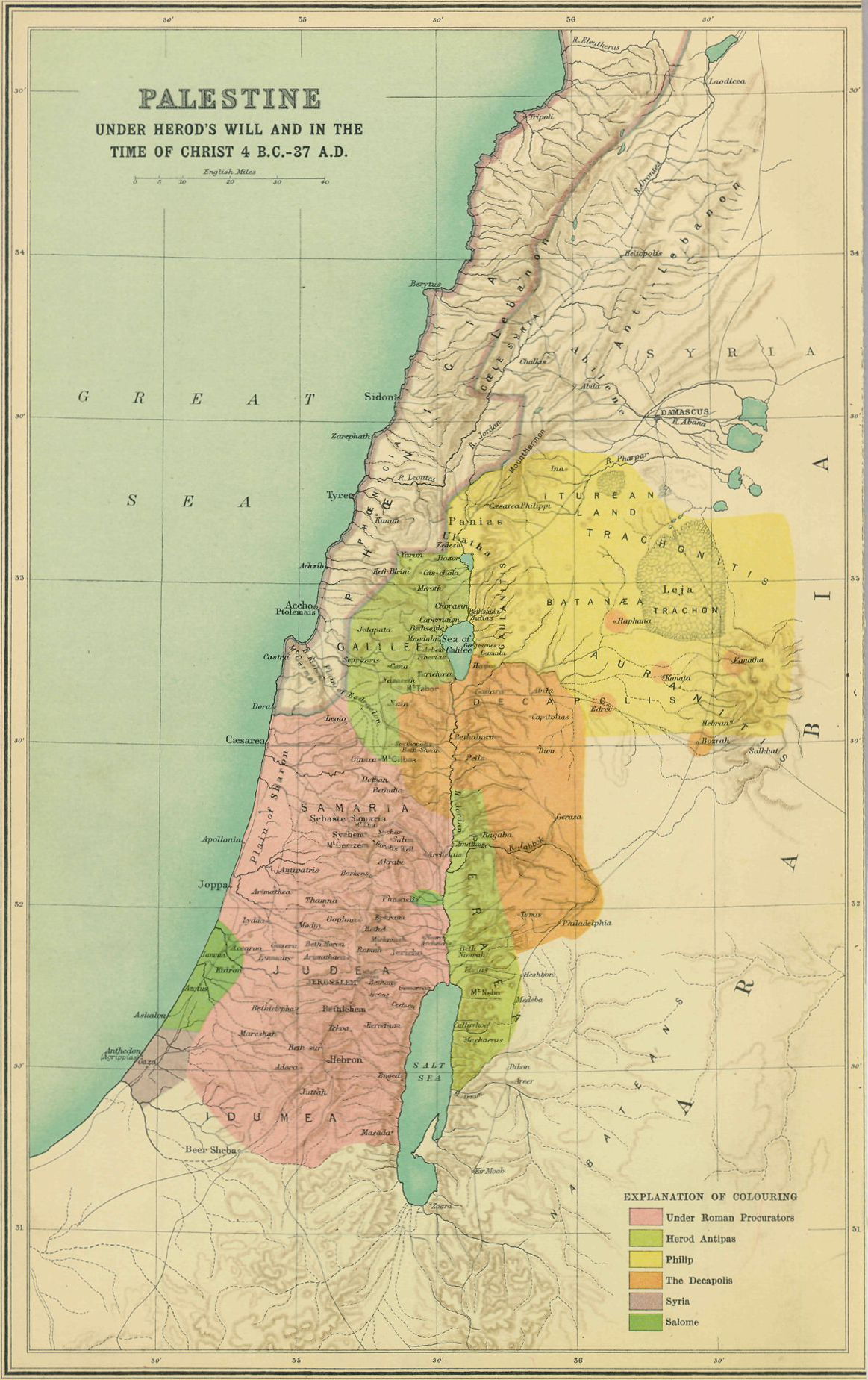
Sixteen of the nineteen places stand on the map, each ringed by how sure its site is.
- Known: a score of 800 or more
- Probable: a score of 500 to 799
- Proposed: a score under 500, or a rival site above half the leader's
- 1Nazareth, Where He was brought up, Luke 2:39
- 2Bethlehem, Born in the city of David, Matthew 2:1
- 3Egypt, The family's refuge until the king died, Matthew 2:14
- 4Jerusalem, In the temple courts at twelve, Luke 2:46
- 5?Bethany beyond the Jordan, Baptized by John in the Jordan, John 1:28
- 6Cana, The water made wine, the first sign, John 2:11
- 7Capernaum, His home by the sea, Matthew 4:13
- 8Sychar in Samaria, A woman of the town met Him at Jacob's well, John 4:5
- 9?Bethsaida, A blind man brought to Him there, Mark 8:22
- 10Tyre and Sidon, He withdrew to their district, Matthew 15:21
- 11Caesarea Philippi, He asked who people said He was, Mark 8:27
- 12A high mountain, Transfigured before Peter, James and John, Matthew 17:1
- 13Perea, beyond the Jordan, He taught the crowds there, Mark 10:1
- 14?Ephraim, He withdrew there near the wilderness, John 11:54
- 15Jericho, He passed through on the way up, Luke 19:1
- 16Bethany, The home of Lazarus, Mary and Martha, John 11:1
- 17?Golgotha, Crucified, and laid in a new tomb in a garden there, John 19:41
- 18?Emmaus, He went in to stay with two disciples, Luke 24:29
- 19Mount of Olives, Taken up into heaven, Acts 1:12
Not placed: Egypt (3), A high mountain (12), Perea, beyond the Jordan (13).
Base map: Palestine in the time of Christ, George Adam Smith, Atlas of the Historical Geography of the Holy Land (1915), public domain. Places with a place page stand at its coordinates and the others at the point cited for each, set on the plate by Jerusalem and Tyre, as the plate prints them.
Each ring follows the OpenBible.info identification score out of 1,000, as the key gives it. Egypt and Perea are whole lands with no town named, and the mountain of the transfiguration is unnamed, so the three stand in the key without a mark.
Matthew ties the home at Nazareth to the words of the prophets, that He would be called a Nazarene.
“He came and dwelt in Nazareth - (where he had dwelt before he went to Bethlehem) a place contemptible to a proverb. So that hereby was fulfilled what has been spoken in effect by several of the prophets, (though by none of them in express words, ) He shall be called a Nazarene - that is, he shall be despised and rejected, shall be a mark of public contempt and reproach.”
John Wesley · Explanatory Notes upon the New Testament · on Matthew 2:23Evangelical
Meet Him
Four first doors: the gospel in plain words, the faith from its first lesson, His titles and every verse tagged to Him
Mark opens his Gospel by calling his whole account the gospel of the Son of God. A reader new to Him can begin with these four and go on to the rooms that follow.
This is the beginning of the gospel of Jesus Christ, the Son of God.Mark names his subject and his title for Jesus in his first sentence.
The four pagesFour pages
| Page | What it holds |
|---|---|
| What Is the Gospel? | The good news of Jesus Christ in plain words: what sin broke, what He did on the cross, and how to be saved. |
| Christianity 101 | The faith in ten plain steps, from God and Jesus to the church, baptism, communion and His return. |
| The Titles of Christ | The names Scripture gives to Jesus, each title a door to its own page. |
| Every Verse Tagged to Him | The verses and pages tagged to Jesus the Messiah, gathered in one list. |
His Words and His Works
Five rooms that gather what He said at length and what He did, set out by Gospel and by day
The Gospels set His words beside His works, and each explains the other. These five rooms take that pair apart. The discourses and the parables hold His words, the miracles hold His works, and the last week and the four Gospels side by side give the order of both.
In my first book, O Theophilus, I wrote about all that Jesus began to do and to teach,Luke joins doing and teaching in one phrase as the content of his Gospel.
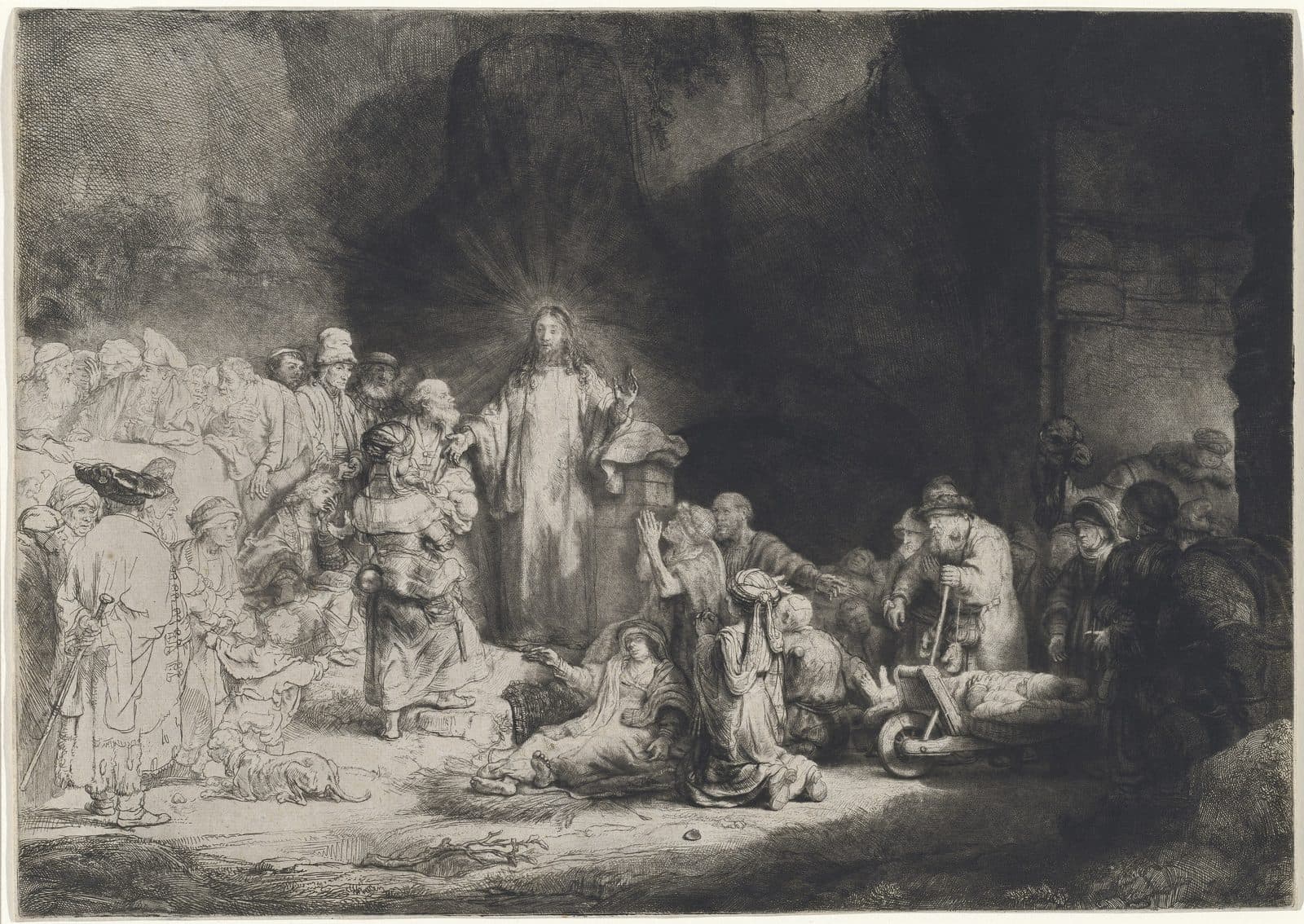
Rembrandt van Rijn, Christ Preaching (The Hundred Guilder Print), about 1643 to 1649, etching, drypoint and burin, National Gallery of Art, Washington, 1949.1.48. CC0, via Wikimedia Commons.
Rembrandt set Jesus at the centre of one crowd, with listeners standing on the left and the sick brought to Him on the right.
The five hub pagesFive hub pages
| Page | What it holds |
|---|---|
| The Great Discourses | The fifteen long teaching blocks, from the Sermon on the Mount to the upper room. |
| The Parables | Every parable, grouped by what it teaches, with why the counts of the parables differ. |
| The Miracles | Thirty-five recorded miracles grouped four ways, with why the number is disputed. |
| Passion Week, Day by Day | The last week in nine days, with the disputes over the calendar named. |
| The Gospels Side by Side | All four Gospels in 185 episodes from the genealogies to the ascension. |
Who Jesus Is
Eighteen pages on His person: God and man, the Word made flesh, and the names the prophets gave Him
This room gathers the answers to the question Jesus put to the Twelve at Caesarea Philippi. The eighteen pages take the answer part by part: the deity and the humanity of Christ, the incarnation, the Word of John's prologue, and the titles from Immanuel to the Son of Man.
Simon Peter answered, “You are the Christ, the Son of the living God.”Peter's answer names Jesus as the Messiah and as the Son of God in one sentence.
The eighteen pagesEighteen pages
| Page | What it holds |
|---|---|
| Christ Our Wisdom, Proverbs 8 | Wisdom's portrait in Proverbs 8 and the New Testament's use of its words for Christ. |
| Immanuel | A Hebrew name meaning God with us, first given by Isaiah to the royal house of Judah. |
| Jesus on Himself | The seven I AM sayings, the claim before Abraham was, and the testimony that convicted Him. |
| Jesus: Titles and Roles | Christ, Son of Man, Lamb of God, Logos, High Priest and King of Kings, each a door. |
| Tell No One | Mark shows Jesus silencing those who name Him while the crowds go on asking who He is. |
| The Branch and the King | The Branch through its four Old Testament plantings and the crowning of Joshua the priest. |
| The Deity of Christ | Six witnesses in nine texts call Jesus God, and five of the texts are read closely. |
| The Humanity of Christ | Jesus was fully God and fully man, and the Gospels show His human life. |
| The Incarnation | The Word who was God became a man and is still one person, fully God and fully man. |
| The Lamb, from Moriah to the Throne | The lamb God would provide, read as given at the cross and shown on the throne. |
| The Mind of Christ, Philippians 2:5 to 11 | The hymn as six steps down to the cross and two steps up, turning on the word wherefore. |
| The Mystery of Godliness, 1 Timothy 3:16 | The six-line creed from the incarnation to the ascension, with its manuscript question laid out. |
| The Prologue, John 1:1 to 18 | Seven stations from eternity to the Word made flesh, with the grammar of the Word was God. |
| The Prophet like Moses | Moses promises a prophet like him from among Israel's own people in Deuteronomy 18. |
| The Seven I AM Sayings of John | All seven sayings with the Old Testament picture behind each, and the three bare I am statements. |
| The Son of Man, Daniel 7:13 to 14 | Daniel's night vision frame by frame, and the title through six New Testament stops. |
| The Supremacy of Christ, Colossians 1:15 to 20 | The hymn in two strophes, Paul's eightfold all, and the firstborn of all creation. |
| The Virgin Birth | Matthew through Joseph and Luke through Mary tell the same birth by two separate routes. |
What Jesus Did
His miracles and signs, His birth and ministry, His death and rising
The category of His acts holds three rooms of thirty-nine pages: eleven of its own, twenty single scenes of His life, and eight scenes of His passion and resurrection.
how God anointed Jesus of Nazareth with the Holy Spirit and with power, and how Jesus went around doing good and healing all who were oppressed by the devil, because God was with Him.Peter gives the whole ministry in one sentence of anointing, doing good and healing.
What He Did, Page by Page
His works of power and signs, the songs of His birth, Malachi's two promises, the upper room, the cross, the resurrection and the commission
John says he chose the signs he wrote from many more that Jesus performed before His disciples. A sign points past itself to who He is.
Jesus performed many other signs in the presence of His disciples, which are not written in this book.John tells his readers that his book holds a chosen few of the signs.
The eleven pagesEleven pages
| Page | What it holds |
|---|---|
| Miracles of Jesus | Thirty-five works of power across the four Gospels, each anchored to its passage. |
| The Canticles, the Four Songs of Luke 1 and 2 | The Magnificat, the Benedictus, the Gloria and the Nunc Dimittis beside their Old Testament roots. |
| The Forerunner and the Refiner, Malachi 3 and 4 | Malachi's two promises set beside their fulfilment in the New Testament. |
| The Great Commission, Matthew 28:18 to 20 | The four uses of all in the commission, and the one command inside the word go. |
| The Hour of John | John marks the whole story of Jesus with one recurring word, the hour. |
| The Messianic Miracles | A leper cleansed, a mute demoniac freed and a man born blind given sight, with the verdicts on them. |
| The Passion and Resurrection, John 18 to 21 | The trial's irony, the fulfilled prophecies of the cross and three scenes of the risen Lord. |
| The Resurrection Chapter, 1 Corinthians 15 | From the earliest resurrection testimony in the New Testament to the last word on death. |
| The Seven Signs of John | John's seven chosen signs in order from Cana to Lazarus, each paired with its discourse. |
| The Sign of Jonah | Matthew 12:39 to 41, with two readings of three days and three nights. |
| The Upper Room and the Farewell, John 13 to 17 | The foot-washing, the promise of the Spirit and the High-Priestly Prayer. |
His Life, Scene by Scene
Twenty single scenes of the life before the cross, from the annunciation to the last week
The twenty pagesTwenty pages
| Page | What it holds |
|---|---|
| Be It unto Me, the Annunciation | Gabriel's visit to Mary in Luke 1, with her question set beside Zechariah's. |
| Calming the Storm, Mark 4:35 to 41 | The storm on the Sea of Galilee beside three psalms that give the stilling of the sea to the LORD. |
| Feeding the Five Thousand, John 6:1 to 15 | The only miracle all four Gospels record, with the four accounts set side by side. |
| Jesus at Twelve, Luke 2 | Luke 2:41 to 52, the pilgrimage customs behind it and the silent years after it. |
| Jesus Wept | Three times Jesus wept: at the tomb of Lazarus, over Jerusalem and in Gethsemane. |
| Mary and Martha, Luke 10:38 to 42 | The two sisters across three scenes in two Gospels, and what the moment shows of Jesus. |
| Men Who Read the Sky, the Wise Men and the Star | Matthew 2 against the carol, with three readings of the star and their holders. |
| Nicodemus at Night, John 3 | A ruler of the council comes after dark and is answered with the new birth and John 3:16. |
| Peter's Confession | Peter's answer that Jesus is the Christ turns Mark's Gospel toward the cross. |
| The Baptism of Jesus, Matthew 3 | Matthew 3:13 to 17, five readings of why He was baptized, and what the Gospels leave open. |
| The Cleansing of the Temple, John 2 and Matthew 21 | Both cleansings, the temple courts behind them and what the scene shows of Him. |
| The Entry into Jerusalem | Jesus came down the Mount of Olives on a colt while a festival crowd cried hosanna. |
| The First People Told, the Shepherds of Bethlehem | Luke 2:8 to 20, the shepherds' setting and the titles the angel names. |
| The Flight to Egypt, Matthew 2 | The flight into Egypt beat by beat, read in the New Testament as a new exodus. |
| The Raising of Lazarus, John 11 | John 11 with a timeline of the delay and what the sign reveals of Jesus. |
| The Silent Years | Between Egypt and the Jordan, Scripture narrates one story of Jesus, the temple at twelve. |
| The Temptation in the Wilderness, Matthew 4 | Matthew 4 and Luke 4 in the desert and at the temple, with the second Adam beside them. |
| The Transfiguration, Matthew 17, Mark 9 and Luke 9 | The three accounts, the unnamed mountain and the Father's two declarations. |
| The Woman at the Well, John 4 | The whole conversation in ten turns, His lines and hers side by side. |
| Walking on Water, Matthew 14:22 to 33 | Matthew's account with its Mark and John parallels, the distance and the hours. |
The Passion and the Risen Lord
Eight scenes from the garden of Gethsemane to the ascension
The angel at the tomb told the women that Jesus had risen, just as He said.
He is not here; He has risen, just as He said! Come, see the place where He lay.The angel points the women to the empty place and to the words Jesus had spoken beforehand.
The eight pagesEight pages
| Page | What it holds |
|---|---|
| Gethsemane, the Garden Called the Oil Press | The three prayers in the garden, with the disciples asleep each time He returns. |
| Peter's Denial | All four accounts of the denial side by side, where they agree and where they differ. |
| The Ascension, Acts 1:1 to 11 and Luke 24:50 to 53 | The ascension, its place and the priestly blessing, and how the early church read it. |
| The Crucifixion | Roman soldiers crucified Jesus at Golgotha on Pilate's order, between two condemned men. |
| The Empty Tomb | The women who watched the burial came back at dawn after the Sabbath. |
| The Man Who Asked to Touch, John 20:24 to 29 | Thomas's three conditions beside what the text records of the risen Lord. |
| The Road to Emmaus, Luke 24:13 to 35 | The walk to Emmaus, its seven miles checked against Josephus. |
| The Trial of Jesus | Six hearings in about twelve hours: Annas, Caiaphas, the Sanhedrin, Pilate, Herod and Pilate again. |
What Jesus Taught
The largest of the door's four categories, with the Sermon on the Mount, the parables and the last things
Jesus said His teaching was not His own and came from the One who sent Him. The category of His teaching holds eight rooms of ninety-nine pages: His great subjects, the Sermon teaching by teaching, His single sayings, His claims, money, His reading of the Scriptures, life together and the end.
“My teaching is not My own,” Jesus replied. “It comes from Him who sent Me.Jesus names the Father as the source of what He taught.
His Great Subjects
Seventeen pages of His teaching, among them the parables, the great reversal of Luke and the questions He asked
Each page gathers what He said on one subject across the four Gospels. Seven name the subject in the title: Jesus on the Father, on the Holy Spirit, on the kingdom, on prayer, on money, on discipleship and on the Scriptures.
After the arrest of John, Jesus went into Galilee and proclaimed the gospel of God. “The time is fulfilled,” He said, “and the kingdom of God is near. Repent and believe in the gospel!”Mark gives the first words of His preaching in Galilee.
The seventeen pagesSeventeen pages
| Page | What it holds |
|---|---|
| Jesus on Discipleship | His sayings on following Him, from the call through the cross, the vine and the foot-washing. |
| Jesus on Money and Possessions | The rich man who could not let go set against Zacchaeus, who gave half away. |
| Jesus on Prayer | The prayer of agreement, asking in His name, Gethsemane and His prayer before dawn. |
| Jesus on the Father | The Father across the Gospels: the prayer's address, the prodigal's father and the word Abba. |
| Jesus on the Holy Spirit | His teaching on the Spirit from Nicodemus to the promise of the Father in Acts 1. |
| Jesus on the Kingdom | Mark 1:14 to 15, the kingdom within or among, and the already and not yet. |
| Jesus on the Scriptures | Nine places where Jesus quotes, argues from or corrects a reading of Scripture. |
| Parables of Jesus | Some forty parables of the kingdom gathered into seven clusters. |
| Prayer in Luke, Jesus at Every Hinge | Every place Luke shows Jesus praying, on a timeline of all 24 chapters. |
| The Beatitudes | Eight blessings from the mountain, each rooted in the Psalms and Isaiah. |
| The Great Reversal, the Ledger of Luke | Seven scenes of the lifted and the brought down, closed by the law of Luke 14:11 and 18:14. |
| The Kingdom of Heaven, Matthew's Great Subject | Matthew's kingdom already and not yet, why he says of heaven, and his eleven kingdom parables. |
| The Kingdom Parables | Matthew 13 as one day of teaching, four parables from a boat and four in a house. |
| The Lord's Prayer | One prayer that asks first for the honour of God and then for the needs of those who pray it. |
| The Questions Jesus Asked | Jesus taught as much by asking as by telling. |
| The Sermon on the Mount | His longest teaching in any Gospel, from blessing to a house built to stand. |
| Why Jesus Spoke in Parables | The disciples asked the question at Matthew 13:10, and Jesus answered from Isaiah 6. |
The Sermon, Teaching by Teaching
Matthew 5 to 7 cut into twenty-two teachings, one page each
Matthew sets the Sermon on a mountain, with Jesus seated and His disciples come to Him. Each of the twenty-two pages of this room takes one teaching of Matthew 5 to 7, from salt and light to the two builders.
When Jesus saw the crowds, He went up on the mountain and sat down. His disciples came to Him, and He began to teach them, saying:The verses set the scene before the first beatitude.
The twenty-two pagesTwenty-two pages
| Page | What it holds |
|---|---|
| Anger and Murder of the Heart | The sixth commandment traced from the hand to the heart, up to judgment, the council and Gehenna. |
| Ask, Seek, Knock | Three verbs whose Greek grammar describes a lasting posture of prayer. |
| Divorce, What Jesus Said | Design, permission and restoration, through Matthew 19 and Malachi. |
| Do Not Worry | The argument from the greater, from birds and lilies, as a command against anxiety. |
| Fasting, What Jesus Taught | Matthew 6:16 to 18, the third act of hidden righteousness after giving and prayer. |
| Giving in Secret | Matthew 6:1 to 4 assumes giving and corrects its audience. |
| Judge Not | Matthew 7:1 to 5 verse by verse, with the beam and the mote drawn to scale. |
| Known by Their Fruit | Matthew 7:15 to 20, one test for false prophets: their fruit over time. |
| Love Your Enemies | The last of the six antitheses, a command of active love toward the hostile. |
| Lust and Adultery of the Heart | Matthew 5:27 to 30, the seventh commandment traced to the deliberate look. |
| Oaths, Let Your Yes Be Yes | Matthew 5:33 to 37, the four forbidden oaths and sixteen centuries of comment. |
| Pearls Before Swine | The dogs and the pigs as a ritual category, and the same discernment through Scripture. |
| Praying in Secret | Matthew 6:5 to 8 verse by verse, with the common misreading of it answered. |
| Salt and Light | What salt and light meant in His world, and the two ways each fails. |
| The Eye as the Lamp of the Body | Matthew 6:22 to 23 between two teachings on money, read two ways. |
| The Golden Rule | Matthew 7:12 in practice, beside Hillel's earlier negative form. |
| The Law Fulfilled | Matthew 5:17 to 20, the hinge of the Sermon, clause by clause. |
| The Narrow Gate | Matthew 7:13 to 14, the word strait and two readings of the gate held together. |
| The Two Builders | Matthew 7:24 to 27, where hearing joined to doing parts the wise from the foolish. |
| Treasure in Heaven | Matthew 6:19 to 21 and where the heart follows, traced through Paul, Luke and James. |
| Turn the Other Cheek | Matthew 5:38 to 42 against the Torah's limit on retaliation. |
| Two Masters and Mammon | Why Jesus called divided loyalty impossible, and the word He left untranslated. |
His Teachings, One by One
Twenty-four single sayings and themes, each from its own passage
When many turned back, Peter said that Jesus had the words of eternal life. The twenty-four pages of this room each take one of those words, among them Abba, abide and the promise of the Father.
Simon Peter replied, “Lord, to whom would we go? You have the words of eternal life.Peter answers for the Twelve that there is no one else to go to.
The twenty-four sayingsTwenty-four pages
| Page | What it holds |
|---|---|
| Abba, Father | One Aramaic word from His cry in Gethsemane to the believer's cry in Paul's letters. |
| Abide in Me | The vine and the branches of John 15:1 to 11, and the vinedresser's pruning. |
| Asking in His Name | Five promises across John 14 to 16 with the one condition Jesus sets on them. |
| Blasphemy Against the Spirit | The healing that provoked the warning, and Mark's note on what triggered it. |
| Born of the Spirit | Nicodemus's night visit and the wordplay of wind, breath and spirit. |
| Come unto Me | The invitation of Matthew 11:28 to 30, hung on His claim that only the Son knows the Father. |
| Count the Cost | The tower and the king, and the Semitic hate of Luke 14:26. |
| Entering the Kingdom | Five entrance sayings from four Gospels, what each strips away and what each gives. |
| Eternal Life | Four places Jesus defines eternal life, each answered by a Person known. |
| Faith, What Jesus Said About It | Four sayings of Jesus on faith, His own definition setting the terms. |
| Follow Me | Every recorded call to follow, from the nets to Peter after the resurrection. |
| Knowing the Father | Matthew 11 and John 14, where Jesus claims to be the only way to know the Father. |
| Repentance | His first public word, and the three lost things of Luke 15. |
| Take Up Your Cross | The saying in Matthew, Mark and Luke, and what carrying a cross meant in that world. |
| The Father's Care | From birds and lilies to a two-penny sparrow, each rung a proof of the Father's character. |
| The Father's Will | Five sayings on the Father's will, from the Lord's Prayer to Gethsemane. |
| The Foot-Washing | John 13 verb by verb, Peter's protest and two readings of the command. |
| The Kingdom Is at Hand | His first public sentence taken clause by clause. |
| The Kingdom Within | Luke 17:20 to 21 and its contested phrase, within you or in your midst. |
| The Least Is Greatest | Twice the Twelve argue over who is greatest, and twice Jesus answers that the leader serves. |
| The Paraclete | Five things Jesus says the Paraclete will do, each with its verse. |
| The Prayer of Agreement | Matthew 18:19 to 20 read both ways the church has read it. |
| The Promise of the Father | One promise from His last words in Luke to Peter's sermon at Pentecost. |
| Whoever Believes | John 3:14 to 18 read whole, from the serpent lifted up to the warning of verse 18. |
Who He Said He Is
Nine pages on His own claims: the I AM sayings, His authority, His mission and the passion predictions
Jesus claimed to exist before Abraham was born, in the words I am. The nine pages of this room take His own claims about Himself, among them the door, the good shepherd and the three times He foretold His death.
“Truly, truly, I tell you,” Jesus declared, “before Abraham was born, I am!”Jesus answers a question about Abraham with the bare words I am.
The nine pagesNine pages
| Page | What it holds |
|---|---|
| He Told Them Three Times | The three passion predictions side by side, each with the disciples' failure to receive it. |
| His Authority | Four rising claims: to teach, to forgive sin, to judge and give life, and over everything. |
| I Am the Door | John 10:1 to 10, the one entrance to the sheepfold, with a diagram of the fold. |
| The Good Shepherd | The hireling who flees and the shepherd who lays down His life, with the Old Testament behind it. |
| The Light of the World | The claim made at the Feast of Tabernacles, its challenge and His answer. |
| The Resurrection and the Life | Martha's faith and His claim, with Augustine, Irenaeus, Gill, Henry, JFB and Barnes. |
| The Son of God | Three scenes where Jesus claims equality with the Father, and what His hearers took Him to mean. |
| The Way, the Truth, and the Life | Thomas asking the way and Philip asking to see the Father, in the upper room. |
| Why He Said He Came | Four times Jesus stated His mission in plain words, opened by the reading at Nazareth. |
What He Taught About Money
Five scenes where money shows the heart
Jesus tied a person's treasure to the place of the heart. The five scenes of this room set rich and poor side by side, among them the coin of Caesar and the widow's two small coins.
For where your treasure is, there your heart will be also.Jesus states the rule that the five scenes of this room apply.
The five pagesFive pages
| Page | What it holds |
|---|---|
| Render unto Caesar | The coin trap of Mark 12:13 to 17, and the image we bear. |
| The Rich Fool | The rich fool's plans clause by clause, and God's answer that ends them that night. |
| The Rich Young Ruler | A command to one man, read beside Zacchaeus and the women who supported Him. |
| The Widow's Mites | What the two small coins were worth, and proportion as His measure. |
| Zacchaeus | A rich man who gives away half his goods before Jesus asks. |
How He Read the Bible
Five pages on how He read and quoted the Law and the Prophets
Here He reads the Scriptures against the tempter, on the Sabbath and before the scribes.
And beginning with Moses and all the Prophets, He explained to them what was written in all the Scriptures about Himself.Luke records Jesus reading all the Scriptures as written about Himself.
The five pagesFive pages
| Page | What it holds |
|---|---|
| It Is Written | Deuteronomy quoted three times against the tempter, and the same appeal elsewhere. |
| Lord of the Sabbath | Both Sabbath disputes of Matthew 12 and the three sayings of one greater. |
| Moses Wrote of Me | Three times, each wider, Jesus claims the Old Testament speaks of Him. |
| The Greatest Commandment | The Shema joined to Leviticus 19:18, in Matthew 22 and Mark 12. |
| Tradition and Commandment | How the Corban vow routed a son's support away from his parents. |
Life Together
Eleven pages on how His people are to live with one another
Among its pages are forgiving a brother, settling a matter before witnesses and His prayer for their unity.
A new commandment I give you: Love one another. As I have loved you, so you also must love one another. By this everyone will know that you are My disciples, if you love one another.”Every page of this room works out this one rule.
The eleven pagesEleven pages
| Page | What it holds |
|---|---|
| I Saw Satan Fall | The return of the seventy-two in Luke 10:17 to 20 and three readings of what He saw. |
| Kept in the World | John 17:14 to 18 and the one request Jesus refused to make. |
| Love One Another | The new commandment of John 13:34 to 35 and its restatement in John 15. |
| Receiving Children | Two scenes of Jesus with children in His arms, and the teaching He draws from them. |
| Seventy Times Seven | His answer to Peter, from Lamech's song to the unmerciful servant. |
| The Good Samaritan | The lawyer's two questions, the road and the neighbour who acted. |
| The Prayer for Unity | John 17:20 to 26, His prayer for every future believer and its purpose. |
| The Prodigal Son | The parable in five beats, from the far country to the son outside the music. |
| The World's Hatred | The world's hatred traced to its source in John 15 and Matthew 10. |
| Two or Three Witnesses | Under the law of Moses no one was condemned on the word of a lone witness. |
| Upon This Rock | Peter's confession at Caesarea Philippi, at a cult centre against a rock cliff. |
What He Said About the End
Six pages on judgment, reward, resurrection and watchfulness
His teaching on the last things takes in Gehenna, the sheep and the goats, rewards and the days of Noah.
Therefore keep watch, because you do not know the day on which your Lord will come.Jesus grounds the command to watch in the hidden day of His return.
The six pagesSix pages
| Page | What it holds |
|---|---|
| Gehenna | The valley behind His severest word for final loss, and its history. |
| Rewards | His reward sayings down to a cup of cold water, and the line between reward and salvation. |
| The Days of Noah | His guard against date-setting, and two readings of one taken, one left. |
| The Resurrection and the Sadducees | The trick question and His answer in three moves: diagnosis, correction and proof. |
| The Sheep and the Goats | The scene from the throne, with three readings of the least of these. |
| Watchfulness | Matthew 24:42 to 25:13: the thief, the two servants and the ten virgins. |
Foretold and Foreshadowed
Twenty-one stations from Genesis to Zechariah where the Old Testament points to Him, and two rooms of forty-seven pages
The Old Testament points to Him in three ways: by prophecy, by types, and by appearances of the angel of the LORD. The strip sets twenty-one stations in canon order, each marked by its way and by whether the New Testament names it or a tradition reads it.
Jesus said to them, “These are the words I spoke to you while I was still with you: Everything must be fulfilled that is written about Me in the Law of Moses, the Prophets, and the Psalms.”Jesus names the three parts of the Hebrew Scriptures as written about Him.
- Genesis 3:15The seed of the woman, Prophecy; a tradition reading
- Genesis 14:18Melchizedek, Type; Hebrews 7 names it
- Genesis 16:13Hagar at the well, Appearance; a tradition reading
- Genesis 22:13The ram on Moriah, Type; a tradition reading
- Genesis 32:30Jacob's wrestler, Appearance; a tradition reading
- Exodus 3:2The bush, Appearance; a tradition reading
- Exodus 12:13The Passover blood, Type; 1 Corinthians 5:7 names it
- Exodus to LeviticusThe tabernacle and its law, Type; Hebrews 10:1 names it
- Numbers 21:9The bronze serpent, Type; John 3:14 names it
- Joshua 5:14The Commander, Appearance; a tradition reading
- Judges 13:18The name beyond comprehension, Appearance; a tradition reading
- Psalm 22:1The forsaken cry, Prophecy; Matthew 27:46 names it
- Psalm 110:1My Lord, Prophecy; Matthew 22:41 to 45 names it
- Isaiah 6:1The throne, Appearance; John 12:41 names it
- Isaiah 53:5The Servant, Prophecy; Acts 8:32 to 35 names it
- Daniel 3:25The fourth man, Appearance; a tradition reading, contested
- Daniel 7:13The Son of Man, Prophecy; Matthew 26:64 names it
- Jonah 1:17Three days in the fish, Type; Matthew 12:40 names it
- Micah 5:2Bethlehem, Prophecy; Matthew 2:5 to 6 names it
- Zechariah 9:9The King on a colt, Prophecy; Matthew 21:5 names it
- Zechariah 12:10The pierced one, Prophecy; John 19:37 names it
Thirteen of the twenty-one stations rest on a New Testament text that names them, and eight on a reading the church has given them, among them Daniel 3:25, which readers still contest.
The Types of Christ, One by One
Twenty-three types: the tabernacle and its furniture, the feasts and laws, and the persons that prefigure Him
Readers differ on how far to take the types. Herbert Marsh counted only those the New Testament names, while Patrick Fairbairn and Leonhard Goppelt read the New Testament as modelling a method that may be carefully extended. The twenty-three pages of this room label each type by its warrant.
These are a shadow of the things to come, but the body that casts it belongs to Christ.Paul gives the picture of shadow and body that the reading of types rests on.
The twenty-three pagesTwenty-three pages
| Page | What it holds |
|---|---|
| Circumcision of the Heart | The phrase Paul uses comes from the law and the prophets before him. |
| Cities of Refuge | The law's limit set around the avenger of blood. |
| David, a Type of Christ | What makes David a type of Christ beyond a likeness of life. |
| Firstfruits | The first sheaf waved before God, and no harvest eaten until it was. |
| Hanged on a Tree | The two verses that close Deuteronomy 21. |
| Incense and the Censers | The gold altar of incense and the blend of four spices of Exodus 30. |
| Jubilee | The fifty-year clock of Leviticus 25. |
| Lending, Pledges and the Year of Release | No interest, a pledge that leaves the poor what they need, and a seventh-year release. |
| Manna | Forty years of bread on the ground each morning after the dew lifted. |
| Noah's Ark as a Type | Gopher wood, pitch, three decks, one door, and the LORD shutting it. |
| Sabbath Rest | The sabbath told three times: at creation, at Sinai and in Hebrews. |
| The Ark of the Covenant | A chest of acacia wood overlaid with gold, two and a half cubits long. |
| The Bride and the Jewish Wedding | Hosea, John the Baptist, Paul and Revelation call the church a bride. |
| The Bronze Laver | The basin where the priests washed their hands and feet before they served. |
| The Lampstand | One lampstand of hammered gold with seven lamps, tended from evening to morning. |
| The Mercy Seat | The slab of pure gold set on the ark of the covenant. |
| The Red Heifer | The rite of Numbers 19, unlike any other in the law. |
| The Rock in the Wilderness | The type rests on Paul's own sentence, and both scenes are read from it. |
| The Rules of War | Deuteronomy 20 on who speaks before a battle and who goes home. |
| The Showbread | Twelve loaves in two rows on a gold table, with frankincense beside each row. |
| The Tassels and the Blue Cord | Numbers 15 commands tassels on the corners of garments for every generation. |
| The Veil | The curtain worked with cherubim between Israel and the room where God would meet them. |
| Types of Christ: Joseph and Joshua | Both are taught as pictures of Christ, on two different kinds of evidence. |
Questions the Life Raises
Whether He rose, weighed as evidence with each objection and its holder; whether He knew He would die; how long His ministry lasted
Jesus of Nazareth is the Messiah, risen bodily, and that confession stands apart from the grades below. The grades measure only what the historical record can show: that the claim was early, public and costly, and how well each rival account explains it.
Only after three years did I go up to Jerusalem to confer with Cephas, and I stayed with him fifteen days.Paul met Cephas in Jerusalem three years after his conversion, which dates the creed he hands on in 1 Corinthians 15 close to the cross.
| What the record shows | Grade | Where it rests |
|---|---|---|
| Jesus died by crucifixion under Pilate | high | The four Gospels; the creed of 1 Corinthians 15 |
| His followers believed they had seen Him alive | high | The creed's list of named witnesses |
| Paul turned from persecutor to apostle | high | His own letters |
| James turned from unbelief | strong | John 7:5 beside 1 Corinthians 15:7; Josephus, Antiquities 20.9.1 |
| The creed dates within a few years of the cross | strong | Galatians 1:18; Gerd Lüdemann, 1994 |
| Joseph of Arimathea buried Him | strong | Mark 15:46; R. Brown |
| The tomb was found empty | strong | The four Gospels, and the guards' story of Matthew 28:13 |
| What the witnesses saw | debated | A question history leaves to faith |
Raymond Brown, in The Death of the Messiah (1994), finds nothing in the earliest account of the burial by Joseph that could not plausibly be historical. The evidence leaves the order of the appearances open, and it leaves the site of the tomb open. A first-century text placing the body, or a manuscript lacking 1 Corinthians 15:3 to 7, would overturn the case.
So Joseph bought a linen cloth, took down the body of Jesus, wrapped it in the cloth, and placed it in a tomb that had been cut out of the rock. Then he rolled a stone against the entrance to the tomb.The grade of strong for the burial in the table above rests on this verse.
The objections, each with its holder and its answerThe Evidence Room, Did Jesus Rise from the Dead?
| Objection | Held by | The answer |
|---|---|---|
| The disciples stole the body | The guards' report, as Matthew 28:13 records it | It explains the empty tomb and leaves the appearances and Paul's turn unexplained |
| He did not die on the cross | The swoon theory of the eighteenth and nineteenth centuries | David Strauss answered it in 1865, and the spear thrust of John 19:34 stands against it |
| The women went to the wrong tomb | Kirsopp Lake, 1907 | Luke 23:55 has the women see the tomb and how His body was placed |
| The witnesses had visions | Gerd Lüdemann, 1994; Dale Allison, 2005 | It strains at Paul, at James, at the group appearances and at the bodily claim |
| He was left in a common grave | Bart Ehrman, 2014 | Deuteronomy 21:23 required burial the same day, and Mark 15:43 names the man who asked for the body |
Did Jesus know He would die?Matthew 16:21, Matthew 17:22 to 23 and Matthew 20:18 to 19
Matthew records three times that Jesus told the disciples He would be killed and raised on the third day, and the first time comes straight after Peter's confession.
“Look, we are going up to Jerusalem, and the Son of Man will be delivered over to the chief priests and scribes. They will condemn Him to death and will deliver Him over to the Gentiles to be mocked and flogged and crucified. And on the third day He will be raised to life.”The third telling adds that the Gentiles will mock, flog and crucify Him.
How long did His ministry last?John 2:13, John 6:4 and John 11:55; John 5:1; Bede on Luke 3:1
John names three Passovers during the ministry, at John 2:13, John 6:4 and John 11:55, so it ran for more than two years. Bede, on Luke 3:1, reckons the whole ministry within about four years by the high priests who served between John's preaching and the cross.
John 5:1 names a feast of the Jews without saying which, and A. T. Robertson reads it as possibly a Passover, which would make four and a ministry of a little over three years. Charles Spurgeon, preaching on John 20:30 to 31 in 1881, said few suppose it ran longer than three and a half years.
What the Text Leaves Unsaid
His years between twelve and thirty, the death of Joseph, His appearance and His birthday
After the temple at twelve, Luke says only that He grew in wisdom and stature, and the Gospels next meet Him at His baptism. No Gospel records the death of Joseph. The Gospels describe His face only at the transfiguration, where it shone like the sun in Matthew 17:2. In his vision John saw it like the sun shining at its brightest in Revelation 1:16. No writer gives the day or the month of His birth.
“These verses should always be deeply interesting to a reader of the Bible. They record the only facts which we know about our Lord Jesus Christ during the first thirty years of His life on earth, after His infancy. How many things a Christian would like to know about the events of those thirty years, and the daily history of the house at Nazareth! But we need not doubt that there is wisdom in the silence of Scripture on the subject. If it had been good for us to know more — then more would have been revealed.”
J.C. Ryle · Expository Thoughts on the Gospels: Luke (lightly modernized text, Grace Gems edition) · on Luke 2:41 to 52Reformed Evangelical
His Names and Titles
Fifteen titles in canon order, from the prophet like Moses in Deuteronomy to the King of kings in Revelation
- Verse
- Deuteronomy 18:15
- Verse
- Psalm 118:22
3Wonderful Counselor, Mighty God
- Verse
- Isaiah 9:6
- Verse
- Daniel 7:13
- Verse
- Zechariah 6:12
- Verse
- Matthew 1:1
- Verse
- Matthew 1:23
- Verse
- Luke 2:11
- Verse
- John 1:1
- Verse
- John 1:29
- Verse
- John 10:11
- Verse
- Colossians 1:15
13Mediator
- Verse
- 1 Timothy 2:5
- Verse
- Hebrews 4:14
- Verse
- Revelation 19:16
Paul writes that God gave Him the name above all names, so that every tongue confesses that Jesus Christ is Lord.
The Word became flesh and made His dwelling among us. We have seen His glory, the glory of the one and only Son from the Father, full of grace and truth.John joins the eternal Word of his first verse to a man who lived among them and whose glory they saw.
How the Church Has Read Him
Four quotations from Cyril, Athanasius and John Wesley on who He is
“Peter did not say ‘you are a Christ’ or ‘a son of God’ but ‘the Christ, the Son of God.’ For there are many christs by grace, who have attained the rank of adoption [as sons], but [there is] only one who is by nature the Son of God. Thus, using the definite article, he said, the Christ, the Son of God. And in calling him Son of the living God, Peter indicates that Christ himself is life and that death has no authority over him.”
Cyril of Alexandria · FRAGMENT 190 · on Matthew 16:16Patristic
Athanasius on why the Word took a bodyOn the Incarnation of the Word 9
“For the Word perceived that death was the only way that the corruption of people could be undone. However, it was impossible for the Word to suffer death, being immortal and Son of the Father. Therefore, he takes to himself a body capable of death, so that such a body, by partaking of the Word who is above all, might be worthy to die in the stead of all, and might, because of the Word that had come to dwell in it, remain incorruptible. In this way, the corruption of all might be checked by the grace of the resurrection.”
Athanasius of Alexandria · On the Incarnation of the Word 9.1-4 · on John 1:14Patristic
Athanasius on the confession of ThomasLetter 59, to Epictetus
“Let them therefore confess, even they who previously denied that the crucified was God, that they have erred. For the divine Scriptures bid them, and especially Thomas, who, after seeing upon him the print of the nails, cried out, ‘My Lord and my God.’”
Athanasius of Alexandria · Letter 59.10, to Epictetus · on John 20:28Patristic
Wesley on the Lamb of GodExplanatory Notes upon the New Testament, on John 1:29
“He seeth Jesus coming and saith, Behold the Lamb - Innocent; to be offered up; prophesied of by Isaiah, Isaiah liii, 7, typified by the paschal lamb, and by the daily sacrifice: The Lamb of God - Whom God gave, approves, accepts of; who taketh away - Atoneth for; the sin - That is, all the sins: of the world - Of all mankind. Sin and the world are of equal extent.”
John Wesley · Explanatory Notes upon the New Testament · on John 1:29Evangelical
The Contested Years
Two datings of Herod's death, two counts of the reign of Tiberius, two days of the month and two years of the cross, each with its holders
Dating the birth by Herod's deathAndrew Steinmann, 2009; Harold Hoehner, 1977
Matthew places the birth in the days of King Herod, and Albert Barnes, on Matthew 2:15, reports that the best chronologers put Herod's death two to four years after it. Most scholars date Herod's death to 4 BC by a partial eclipse of the moon twenty-nine days before Passover and by the reigns of his three sons. Andrew Steinmann states that case in Novum Testamentum (2009), in his article on when Herod the Great reigned, and answers it. Steinmann argues that Herod reigned until early 1 BC, after the total eclipse of January 10, 1 BC. He places the birth in late 2 BC, while granting that his argument from Luke 3:23 is a weak one. Harold Hoehner, in Chronological Aspects of the Life of Christ (1977), concludes that Christ was born in the winter of 5 or 4 BC. Against both, Barnes notes that the first year of Herod's reign is not certainly known.
Counting the fifteenth year of TiberiusLuke 3:1; Steinmann, 2009; Albert Barnes and Adam Clarke
Augustus died in AD 14, and Steinmann writes that ancient sources, as far as is known, always counted the reign of Tiberius from that death, which puts the fifteenth year in AD 28 to 29. Hoehner counts the same way and has John's preaching begin in AD 29 and the ministry of Jesus shortly after. Albert Barnes and Adam Clarke count the fifteenth year from the joint rule of Tiberius with Augustus two years earlier, which moves John's preaching back to about AD 26 or 27.
Which day of the month He diedMark 14:12; John 18:28 and 19:14; Hoehner, 1977
Mark, Luke and John put the death on the day of Preparation, the day before a Sabbath. Mark makes the last supper a Passover meal, which sets the cross on 15 Nisan. John has the accusers stay out of the Praetorium so that they could still eat the Passover, which sets it on 14 Nisan. Hoehner concludes that Jesus was crucified on Friday, Nisan 14, and he reconciles Mark by a second way of counting the day, from sunrise to sunrise. The Greek pascha can mean the meal, the day, the festival or its sacrifices, so the word alone leaves the question open.
Then they led Jesus away from Caiaphas into the Praetorium. By now it was early morning, and the Jews did not enter the Praetorium, to avoid being defiled and unable to eat the Passover.This verse sets the trial before the Passover meal was eaten.
Which year of the crossA. T. Robertson, 1922; Harold Hoehner, 1977
A. T. Robertson, in his harmony, gives AD 30 for the cross with AD 29 as the other choice, and Hoehner dates it to Friday, April 3, AD 33. AD 30 fits a birth before 4 BC and Luke's about thirty without strain, and it needs the joint-rule count of Tiberius. AD 33 fits the count from the death of Augustus and a ministry of four Passovers, and it stretches Luke's about thirty to thirty-two or more.
Books to Read Next
Works from about 390 to 2002
Homilies on the Gospel of Matthew
John Chrysostom · about 390
Chrysostom preaches through the Gospel of Matthew, and his Homily 54 takes up Peter's confession.
The Harmony of the Gospels
Augustine of Hippo · about 400
Augustine sets the four accounts side by side and answers where they seem to differ.
Catena Aurea
Thomas Aquinas · about 1263
Aquinas gathers the fathers' comments on the Gospels verse by verse.
Expository Thoughts on the Gospels
J. C. Ryle · 1856 to 1873
Ryle comments on the four Gospels passage by passage.
The Life and Times of Jesus the Messiah
Alfred Edersheim
Edersheim, a Jewish convert, sets the life of Jesus in the Jewish world of His day.
Read it free at the Christian Classics Ethereal LibraryA Harmony of the Gospels for Students of the Life of Christ
A. T. Robertson · 1922
Robertson arranges the four Gospels in fourteen parts and 184 sections, and the site's harmony of 185 episodes takes its order and its passage assignments from him.
Learn the Bible in 24 Hours
Chuck Missler · 2002
Missler gives the four Gospels one hour of the course and the final week a second.
In print: find it wherever books are sold.
Who Do You Say I Am?
Jesus first asked the disciples who people said He was, and they named John the Baptist, Elijah, Jeremiah or one of the prophets.
“But what about you?” Jesus asked. “Who do you say I am?”Jesus turns the question from the crowds to the Twelve, and every reader of the Gospels meets it in turn.
Each name the Gospels give Him is part of an answer, and the question still waits for each reader's own.
Keep studying
Read it5
Studies122
- Matthew: the book
- Mark: the book
- Luke: the book
- John: the book
- The Twelve Apostles
- James the Son of Zebedee
Show the next 6 titles
- John the Apostle
- Judas Iscariot
- The Mind of Christ, Philippians 2:5 to 11
- The Prologue, John 1:1 to 18
- Miracles of Jesus
- The Canticles, the Four Songs of Luke 1 and 2
Show the next 6 titles
- The Forerunner and the Refiner, Malachi 3 and 4
- The Great Commission, Matthew 28:18 to 20
- The Hour of John
- The Messianic Miracles
- The Passion and Resurrection, John 18 to 21
- The Resurrection Chapter, 1 Corinthians 15
Show the next 6 titles
- The Seven Signs of John
- The Sign of Jonah
- The Upper Room and the Farewell, John 13 to 17
- Be It unto Me, the Annunciation
- Calming the Storm, Mark 4:35 to 41
- Feeding the Five Thousand, John 6:1 to 15
Show the next 6 titles
- Jesus at Twelve, Luke 2
- Jesus Wept
- Mary and Martha, Luke 10:38 to 42
- Men Who Read the Sky, the Wise Men and the Star
- Nicodemus at Night, John 3
- Peter's Confession
Show the next 6 titles
- The Baptism of Jesus, Matthew 3
- The Cleansing of the Temple, John 2 and Matthew 21
- The Entry into Jerusalem
- The First People Told, the Shepherds of Bethlehem
- The Flight to Egypt, Matthew 2
- The Raising of Lazarus, John 11
Show the next 6 titles
- The Silent Years
- The Temptation in the Wilderness, Matthew 4
- The Transfiguration, Matthew 17, Mark 9 and Luke 9
- The Woman at the Well, John 4
- Walking on Water, Matthew 14:22 to 33
- Gethsemane, the Garden Called the Oil Press
Show the next 6 titles
- Peter's Denial
- The Ascension, Acts 1:1 to 11 and Luke 24:50 to 53
- The Crucifixion
- The Empty Tomb
- The Man Who Asked to Touch, John 20:24 to 29
- The Road to Emmaus, Luke 24:13 to 35
Show the next 6 titles
- The Trial of Jesus
- The Sermon on the Mount
- Anger and Murder of the Heart
- Ask, Seek, Knock
- Divorce, What Jesus Said
- Do Not Worry
Show the next 6 titles
- Fasting, What Jesus Taught
- Giving in Secret
- Judge Not
- Known by Their Fruit
- Love Your Enemies
- Lust and Adultery of the Heart
Show the next 6 titles
- Oaths, Let Your Yes Be Yes
- Pearls Before Swine
- Praying in Secret
- Salt and Light
- The Eye as the Lamp of the Body
- The Golden Rule
Show the next 6 titles
- The Law Fulfilled
- The Narrow Gate
- The Two Builders
- Treasure in Heaven
- Turn the Other Cheek
- Two Masters and Mammon
Show the next 6 titles
Show the next 6 titles
- Lord of the Sabbath
- Moses Wrote of Me
- The Greatest Commandment
- Tradition and Commandment
- I Saw Satan Fall
- Kept in the World
Show the next 6 titles
- Receiving Children
- Seventy Times Seven
- The Good Samaritan
- The Prayer for Unity
- The Prodigal Son
- The World's Hatred
Show the next 6 titles
- Upon This Rock
- Gehenna
- Rewards
- The Days of Noah
- The Resurrection and the Sadducees
- The Sheep and the Goats
Show the next 6 titles
- Watchfulness
- Gomer, Bought Back, Hosea 1 to 3
- Isaiah 53 and the Rabbis
- Jacob's Ladder
- Shiloh and the Scepter, Genesis 49:10
- The Angel Who Redeemed, Genesis 48:16
Show the next 6 titles
- The Ruler from Bethlehem
- Hanged on a Tree
- An Eye for an Eye in the Law of Moses
- The Binding of Isaac
- The Tanakh
- The Torah
Show the next 6 titles
People14
Places14
Show the next 6 titles
Show the next 2 titles
Symbols18
Doctrines127
- Christ Our Wisdom, Proverbs 8
- Immanuel
- Jesus on Himself
- Jesus: Titles and Roles
- Tell No One
- The Branch and the King
Show the next 6 titles
- The Deity of Christ
- The Humanity of Christ
- The Incarnation
- The Lamb, from Moriah to the Throne
- The Mystery of Godliness, 1 Timothy 3:16
- The Prophet like Moses
Show the next 6 titles
- The Seven I AM Sayings of John
- The Son of Man, Daniel 7:13 to 14
- The Supremacy of Christ, Colossians 1:15 to 20
- The Virgin Birth
- Jesus on Discipleship
- Jesus on Money and Possessions
Show the next 6 titles
- Jesus on Prayer
- Jesus on the Father
- Jesus on the Holy Spirit
- Jesus on the Kingdom
- Jesus on the Scriptures
- Parables of Jesus
Show the next 6 titles
- Prayer in Luke, Jesus at Every Hinge
- The Beatitudes
- The Great Reversal, the Ledger of Luke
- The Kingdom of Heaven, Matthew's Great Subject
- The Kingdom Parables
- The Lord's Prayer
Show the next 6 titles
- The Questions Jesus Asked
- Why Jesus Spoke in Parables
- Abba, Father
- Abide in Me
- Asking in His Name
- Blasphemy Against the Spirit
Show the next 6 titles
- Born of the Spirit
- Come unto Me
- Count the Cost
- Entering the Kingdom
- Eternal Life
- Faith, What Jesus Said About It
Show the next 6 titles
Show the next 6 titles
- The Foot-Washing
- The Kingdom Is at Hand
- The Kingdom Within
- The Least Is Greatest
- The Paraclete
- The Prayer of Agreement
Show the next 6 titles
- The Promise of the Father
- Whoever Believes
- He Told Them Three Times
- His Authority
- I Am the Door
- The Good Shepherd
Show the next 6 titles
- The Light of the World
- The Resurrection and the Life
- The Son of God
- The Way, the Truth, and the Life
- Why He Said He Came
- Love One Another
Show the next 6 titles
- Two or Three Witnesses
- Christophany
- Messianic Prophecy
- The Bronze Serpent
- The Exodus, Redemption's Master-Type
- The Kinsman-Redeemer, Ruth 2 to 4
Show the next 6 titles
- The Messianic Psalms
- The One They Have Pierced
- The Scarlet Thread
- The Seed Promise
- The Servant Songs, Isaiah 42, 49, 50 and 53
- The Seventy Weeks, Daniel 9:24 to 27
Show the next 6 titles
- The Suffering Servant
- The Vision That Waits
- Trees: Eden, Cross, New Jerusalem
- Types of Christ
- Unto Us a Child Is Born
- Circumcision of the Heart
Show the next 6 titles
- David, a Type of Christ
- Firstfruits
- Jubilee
- Lending, Pledges and the Year of Release
- Sabbath Rest
- The Bride and the Jewish Wedding
Show the next 6 titles
- The Rules of War
- Types of Christ: Joseph and Joshua
- Brit milah: circumcision on the eighth day
- Clean and Unclean
- The Day of Atonement
- The Fall Feasts
Show the next 6 titles
- The Hebrew Feasts
- Gleaning and the corner of the field
- God Dwelling with His People, from Eden to the New Jerusalem
- Levirate Marriage
- Marriage and the Household
- Molech and Topheth
Show the next 6 titles
- Partakers of the Divine Nature
- Passover
- Redemption
- The Names of Satan
- The Appointed Times Read as a Calendar of Prophecy
- The Body and Sexual Ethics in Scripture
Show the next 6 titles
Subjects1
Go further8
Peoples and groups1