
Genesis 44 · Subject · Featured Study
The Silver Cup and Joseph's Claim to Divine
Joseph's last test of his brothers, in which his steward charges them with stealing the cup his master uses for divination.
The brothers who had once sold Joseph for silver now stood before him over a cup of silver.
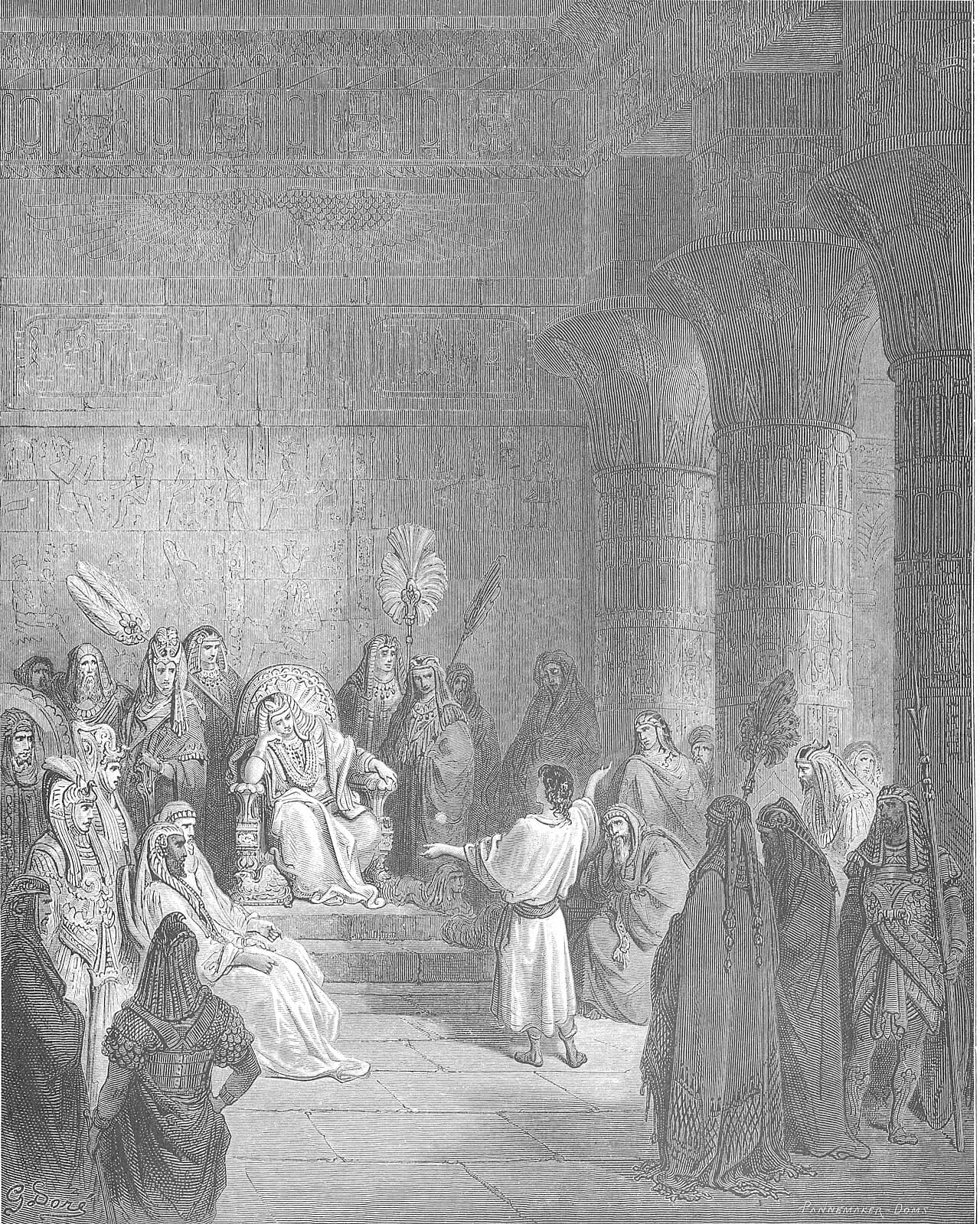
Gustave Doré, Joseph Interprets Pharaoh's Dream, 1866. Public domain, via Wikimedia Commons.
THE ARTWORKDoré drew Joseph before Pharaoh's throne in Genesis 41 as he explains the king's dreams, with the court of Egypt standing around them.
Summary
In Genesis 44 Joseph's silver cup is found in Benjamin's sack, and Joseph rules that Benjamin will stay in Egypt as his slave while the others go home.
- The verb of the charge, nachash, to divine, is a verb the law of Moses forbids Israel to practice.
- Judah had pledged his own life to Jacob for Benjamin, and he asked to stay as Joseph's slave in the boy's place.
- Readers differ on whether Joseph divined: Adam Clarke reads the verb as careful inquiry, and Jamieson, Fausset and Brown read the cup as one he divined by.
The Cup in Benjamin's Sack
Genesis 44:1 to 16, from Joseph's order to Judah's answer
The test begins in Joseph's house, with an order to his steward.
Then Joseph instructed his steward: “Fill the men’s sacks with as much food as they can carry, and put each one’s silver in the mouth of his sack. Put my cup, the silver one, in the mouth of the youngest one’s sack, along with the silver for his grain.” So the steward did as Joseph had instructed.Joseph himself chose the cup and the sack it went into.
Radak, in his commentary on Genesis, calls the whole affair a charade that Joseph arranged to frighten the brothers without harming them.
Joseph then sends the steward after the brothers with the words he is to say.
They had not gone far from the city when Joseph told his steward, “Pursue the men at once, and when you overtake them, ask, ‘Why have you repaid good with evil? Is this not the cup my master drinks from and uses for divination? What you have done is wicked!’”The charge of divination is Joseph's own script, which the steward repeats in Genesis 44:6.
The steward searched, beginning with the oldest and ending with the youngest—and the cup was found in Benjamin’s sack.Rashi, in his commentary on Genesis, reads the order of the search as Joseph's care that the brothers should not see he knew where the cup lay.
The brothers go back to the city and fall to the ground before Joseph in his house.
“What is this deed you have done?” Joseph declared. “Do you not know that a man like me can surely divine the truth?” “What can we say to my lord?” Judah replied. “How can we plead? How can we justify ourselves? God has exposed the iniquity of your servants. We are now my lord’s slaves—both we and the one who was found with the cup.”Joseph claims for himself the power his steward named, and Judah offers no defense.
The Test from the Order to the Offer
The eight steps of Genesis 44:1 to 45:3
- The orderJoseph has his cup put in the youngest brother's sack, Genesis 44:2
- The chargeThe steward overtakes the brothers and charges them with theft, Genesis 44:6
- The oathThe brothers swear death for the thief and slavery for the rest, Genesis 44:9
- The searchThe sacks are opened from the oldest to the youngest, Genesis 44:12
- The verdictJoseph will keep the one found with the cup and send the rest home, Genesis 44:17
- The pleaJudah tells of his father's grief and of his own pledge, Genesis 44:32
- The offerJudah asks to stay as a slave in place of the boy, Genesis 44:33
- The answerJoseph sends everyone out and makes himself known, Genesis 45:1
Steps one to five are Joseph's test, steps six and seven are Judah's plea and offer, and step eight is Joseph's answer.
Divining Cups in Egypt
The custom two commentators of the nineteenth century report, and Joseph's place at Pharaoh's court
Adam Clarke wrote that divination by cups had long been common across Asia. Jamieson, Fausset and Brown called it one of the common superstitions of ancient Egypt.
John Wesley, in his Explanatory Notes upon the Old Testament, says the brothers knew Joseph only by his Egyptian name.
Pharaoh gave Joseph the name Zaphenath-paneah, and he gave him Asenath daughter of Potiphera, priest of On, to be his wife. And Joseph took charge of all the land of Egypt.Pharaoh's gift of a name and a wife made Joseph a lord of Egypt.
The Hebrew of the Charge
Five Hebrew words of Genesis 41, 43 and 44
Gevia is the word for Joseph's cup in Genesis 44:2. Rashi describes it as a long goblet.
Nachash, to divine or to read omens, is the verb of both the steward's charge in Genesis 44:5 and Joseph's question in Genesis 44:15. In each verse it stands twice, an infinitive before the finite verb, and the Berean text renders the pair in Genesis 44:15 as surely divine.
Laban uses the same verb in Genesis 30:27, where he says he has learned by divination that the LORD has blessed him because of Jacob. Deuteronomy 18:10 uses it for one who interprets omens, among the practices Israel must not allow.
You must not eat anything with blood still in it. You must not practice divination or sorcery.The verb of Genesis 44:5 stands here in the law's command against divination.
Bil'aday, apart from me, is the first word of Joseph's answer to Pharaoh in Genesis 41:16.
Arav, to stand surety, is Judah's word for his pledge to his father in Genesis 43:9, and he uses it again before Joseph in Genesis 44:32. The Berean text renders it as a guarantee of the boy's safety.
Tachat, in place of, is the word on which Judah's offer turns in Genesis 44:33.
What the Text Leaves Unsaid
Three things Genesis 44 does not tell
Genesis never shows Joseph using the cup. It is put in a sack, named, searched for and found, and no verse has Joseph drink from it or divine with it.
Genesis does not say whether the steward knew why the cup was in Benjamin's sack. John Gill, in his Exposition of the Old Testament, holds that the steward was privy to Joseph's plan.
Joseph does not explain his question in Genesis 44:15, and the text does not say how it fits what he had told Pharaoh years before.
“I myself cannot do it,” Joseph replied, “but God will give Pharaoh a sound answer.”Before Pharaoh and his court Joseph gives the answer to God, and any reading of Genesis 44:15 has to be set beside these words.
Judah in the Boy's Place
Genesis 37:26 to 27, 42:21, 43:9 and 44:33 to 34
Judah first speaks in Joseph's story at the pit where the brothers held him.
Then Judah said to his brothers, “What profit will we gain if we kill our brother and cover up his blood? Come, let us sell him to the Ishmaelites and not lay a hand on him; for he is our brother, our own flesh.” And they agreed.Joseph's life is spared on Judah's word, and the sale follows in the next verse.
In Egypt, years later, the brothers tie their trouble to that day.
Then they said to one another, “Surely we are being punished because of our brother. We saw his anguish when he pleaded with us, but we would not listen. That is why this distress has come upon us.”The brothers name their guilt over Joseph before any cup is hidden.
Judah says in Genesis 44:16 that God has exposed the iniquity of the brothers. None of them had taken the cup. Ephrem the Syrian, in his Commentary on Genesis, and Rashi read Judah's words as a confession of the sale of Joseph.
Before the brothers went down to Egypt a second time, Judah answered to his father for Benjamin.
I will guarantee his safety. You may hold me personally responsible. If I do not bring him back and set him before you, then may I bear the guilt before you all my life.This pledge is the ground Judah stands on when he pleads before Joseph.
Judah's plea before Joseph runs for seventeen verses, from Genesis 44:18 to 34.
Now please let your servant stay here as my lord’s slave in place of the boy. Let him return with his brothers. For how can I go back to my father without the boy? I could not bear to see the misery that would overwhelm him.”Judah asks for himself the slavery that the verdict of Genesis 44:17 laid on Benjamin.
Four Voices on the Test
Four teachers on Genesis 43 to 45, earliest first
Ambrose of Milan sets the order of the search beside the order of the meal and turns the choice of the youngest toward the apostle Paul.
“The sacks of the brothers are first examined according to the order of age of each brother. God's Scripture is teaching you a moral lesson. Previously they sat at the banquet in Joseph's presence in order of age from the firstborn. You see that the place of honor is to be given to the eldest. On the other hand, the sacks of each are searched in order of age so that you may know that Paul has been chosen by the judgment of heaven. The rest were examined, but this man was given the preference.”
Ambrose of Milan · On Joseph the Patriarch · on Genesis 44:12Patristic
John Calvin defends the tears with which Joseph ends the test against the Stoic ideal of a mind unmoved.
“And whereas it thus bursts forth in tears, this softness or tenderness is more deserving of praise than if he had maintained an equable temper. Therefore the stoics speak foolishly when they say, that it is an heroic virtue not to be touched with compassion.”
John Calvin · Commentaries · on Genesis 45:1Reformed
Matthew Henry finds in the cleared room a picture of the way Christ makes Himself known to His people.
“The private conversations of friends are the most free. When Joseph would put on love he puts off state, and it was not fit his servants should be witnesses of this. Thus Christ graciously manifests himself and his loving-kindness to his people, out of the sight and hearing of the world.”
Matthew Henry · Commentary on the Whole Bible · on Genesis 45:1Puritan
John Wesley ties Judah's pledge for Benjamin to his repentance for the sale of Joseph.
“Judah's conscience had lately smitten him for what he had done a great while ago against Joseph; and as an evidence of the truth of his repentance, he is ready to undertake, as far as a man could do it, for Benjamin's security.”
John Wesley · Explanatory Notes upon the Old Testament · on Genesis 43:9Evangelical
Did Joseph Divine?
Two readings of the cup and of Joseph's claim in Genesis 44:15, with who holds each
Readers have asked whether Joseph practiced divination or only spoke of it before his brothers.
Joseph claimed knowledge of the theftAdam Clarke; Rashi
Adam Clarke, in his Commentary on the Bible, takes nachash in Genesis 44:5 in its general sense, to view attentively and to inquire.
Rashi, in his commentary on Genesis, has Joseph say that a man of his rank could find the thief by his own reasoning, even with the cup gone.
“We both had dreams,” they replied, “but there is no one to interpret them.” Then Joseph said to them, “Don’t interpretations belong to God? Tell me your dreams.”This reading rests on Joseph's earlier words to the cupbearer and the baker, which agree with his answer to Pharaoh.
The objection: Rashi's own gloss has Joseph speak of the goblet by which he divines, so even this reading leaves the cup a divining cup.
The cup was one Joseph divined byJamieson, Fausset and Brown
Jamieson, Fausset and Brown, in their Commentary Critical and Explanatory on the Whole Bible, read the steward's words as naming a cup kept for the governor's own use and for divining.
The objection: the steward's words and Joseph's question are the only witnesses to the cup's use, and both were spoken inside a test Joseph had set.
Books on the Cup and the Plea
Three older works that comment on Genesis 44
On Joseph the Patriarch
Ambrose of Milan · 397
Ambrose reads the whole story of Joseph, the search of the sacks included, as teaching for the church.
Commentary on Genesis, translated by M. Rosenbaum and A. M. Silbermann
Rashi · 1929 to 1934
Rashi comments on the search, Joseph's question and Judah's confession verse by verse.
In print: find it wherever books are sold.
Commentary on the Bible
Adam Clarke · 1832
Clarke's notes on Genesis 44 run from the cup to Judah's speech, which he credits to Judah's pledge for Benjamin.
One Brother for Another
Judah's offer in Genesis 44:33 puts one man under a penalty in another man's place. The chapter asks the reader to put another's safety before his own freedom, as Judah did for Benjamin.
For Christ also suffered for sins once for all, the righteous for the unrighteous, to bring you to God. He was put to death in the body but made alive in the Spirit,Hebrews 7:14 says that our Lord descended from Judah, and here Peter writes of His death for the unrighteous.
Keep studying
Read it1
Doctrines6
Peoples and groups1