
Numbers 13 to Joshua 15 · Person · Featured Study
Caleb
His life from the report at Kadesh-barnea in Numbers 13 to his inheritance at Hebron in Joshua 15.
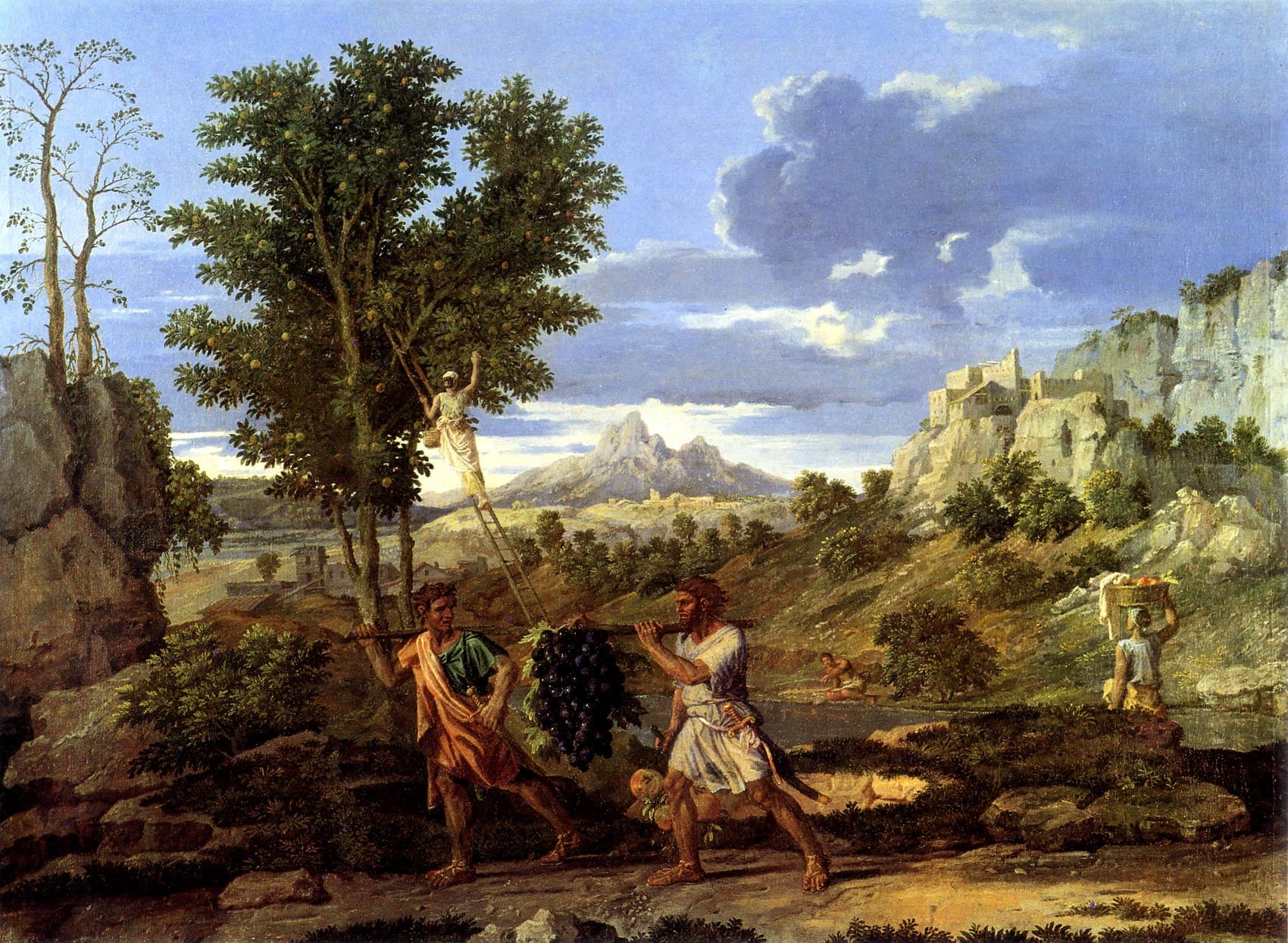
Nicolas Poussin, Autumn, or The Spies with the Grapes of the Promised Land, 1660 to 1664, Musée du Louvre, Paris. Public domain, Wikimedia Commons File:Four-seasons-autumn.jpg.
THE ARTWORKPoussin painted two of the spies carrying the cluster cut in the Valley of Eshcol on a pole between them, as the autumn canvas of his Four Seasons.
At eighty-five Caleb asked Joshua for the hill country where the Anakim lived, because Moses had sworn it to him forty-five years before.
Summary
Caleb son of Jephunneh was the man Moses sent for Judah, with eleven others, from Kadesh-barnea to spy out Canaan.
- He and Joshua alone of the twelve urged the people to go up and take the land, and the congregation threatened to stone them.
- The LORD said Caleb had a different spirit and had followed Him wholeheartedly, and promised him the land he had entered.
- Of the men counted in the wilderness, only Caleb and Joshua were left alive to enter Canaan.
- At eighty-five he was given Hebron, drove out the three sons of Anak and gave his daughter Acsah to Othniel, who captured Debir.
- Othniel, his nephew and son-in-law, is the first deliverer the book of Judges names.
Where Caleb Stands in Scripture
His first mention among the spies in Numbers 13 and the grant of Hebron in Joshua 14
from the tribe of Judah, Caleb son of Jephunneh;The list of the leaders is the first place Scripture names him.
Therefore Hebron belongs to Caleb son of Jephunneh the Kenizzite as an inheritance to this day, because he wholly followed the LORD, the God of Israel.The book of Joshua states here why Hebron became Caleb's inheritance.
His Life, Turn by Turn
The turns of his life in Numbers and Joshua, in the order the books tell them
Joshua 14 gives two ages, forty at the mission and eighty-five at the claim.
To scale: 6 of 12 stops dated.
- Sent to spy out the land for Judahage 40Joshua 14:7
- Goes up through the Negev to Hebron with the spiesage 40Numbers 13:22
- Quiets the people and says they can take the landage 40Numbers 13:30
- Tears his clothes with Joshua and is threatened with stoningage 40Numbers 14:10
- Promised the land he has enteredage 40Numbers 14:24
- Outlives every man counted in the wilderness but Joshuathe plains of MoabNumbers 26:65
- Named for Judah to divide the landthe plains of MoabNumbers 34:19
- Claims the hill country from Joshuaage 85Joshua 14:10
- Is blessed by Joshua and given HebronGilgalJoshua 14:13
- Drives out Sheshai, Ahiman and TalmaiHebronJoshua 15:14
- Gives Acsah to Othniel for taking DebirDebirJoshua 15:17
- Gives Acsah the upper and lower springsthe NegevJoshua 15:19
The last three turns follow the claim at Gilgal.
Thirty-eight of the forty-five years were spent in the wilderness, and seven in the wars of the land.
The 2 spans in years as a table
| Span | Spans in years | Verse |
|---|---|---|
| Wilderness years | 38 | Deuteronomy 2:14 |
| Years of war | 7 | Joshua 14:10 |
Deuteronomy 2:14 counts thirty-eight years from Kadesh-barnea to the Brook of Zered; the seven are the rest of the forty-five of Joshua 14:10.
From Kadesh-barnea to Hebron
Numbers 13 and 14, and Joshua 14 and 15
The twelve went through the land for forty days and came back carrying a cluster of grapes, pomegranates and figs.
Then Caleb quieted the people before Moses and said, “We must go up and take possession of the land, for we can certainly conquer it!”Caleb answers the spies' account at once and speaks for going up.
The whole congregation wept that night and spoke of choosing a leader to take them back to Egypt.
But because My servant Caleb has a different spirit and has followed Me wholeheartedly, I will bring him into the land he has entered, and his descendants will inherit it.The LORD's sentence on the generation sets Caleb apart from it by name and gives the reason.
Forty-five years later the sons of Judah came to Joshua at Gilgal for the division of the land, and Caleb spoke for himself.
Now therefore give me this hill country that the LORD promised me on that day, for you yourself heard then that the Anakim were there, with great and fortified cities. Perhaps with the LORD’s help I will drive them out, as the LORD has spoken.”He asks for the very ground the spies had feared, and he rests his hope on the LORD's help.
The report at KadeshNumbers 14:8 to 9 and 14:38
If the LORD delights in us, He will bring us into this land, a land flowing with milk and honey, and He will give it to us. Only do not rebel against the LORD, and do not be afraid of the people of the land, for they will be like bread for us. Their protection has been removed, and the LORD is with us. Do not be afraid of them!”Joshua and Caleb ground their courage on the LORD's delight in Israel, and they name the danger as rebellion against Him.
Of those men who had gone to spy out the land, only Joshua son of Nun and Caleb son of Jephunneh remained alive.The ten spies die of a plague before the LORD, while the two who spoke for the land live.
The oath of MosesDeuteronomy 1:36
except Caleb son of Jephunneh. He will see it, and I will give him and his descendants the land on which he has set foot, because he followed the LORD wholeheartedly.”Moses repeats the LORD's word forty years later and ties the gift to the ground Caleb had walked.
Hebron and DebirJoshua 15:13 to 17
And Caleb drove out from there the three sons of Anak—the descendants of Sheshai, Ahiman, and Talmai, the children of Anak.The three names the spies saw at Hebron in Numbers 13:22 are the three Caleb drives out.
And Caleb said, “To the man who strikes down Kiriath-sepher and captures it, I will give my daughter Acsah in marriage.” So Othniel son of Caleb’s brother Kenaz captured the city, and Caleb gave his daughter Acsah to him in marriage.The offer and its outcome join Caleb's family to the taking of the land.
The springs Acsah asked forJoshua 15:18 and 19
“Give me a blessing,” she answered. “Since you have given me land in the Negev, give me springs of water as well.” So Caleb gave her both the upper and lower springs.Acsah asks for water to go with land in the dry south, and her father gives her two sources of it.
Rashi, in his commentary on Joshua 15:19, reads her request for a blessing as a request for land she and her husband could live from.
What the Text Says
Three details of Numbers and Joshua that retellings often pass over
TWO MEN TORE THEIR CLOTHES
Numbers 13:30 gives Caleb's words alone, and Numbers 14:6 sets Joshua beside him when the congregation turns on them.
HIS CHILDREN WERE IN THE OATH
Moses swore that the land Caleb had walked would belong to him and to his children forever.
THE CITY ITSELF WENT TO THE PRIESTS
Hebron and its pasturelands were given to the descendants of Aaron, and the fields and villages around it stayed with Caleb.
The Anakim and the Kenizzite
The people the spies feared, and the clan name Caleb carries
We even saw the Nephilim there—the descendants of Anak that come from the Nephilim! We seemed like grasshoppers in our own sight, and we must have seemed the same to them!”The ten spies set the descendants of Anak in a line from the Nephilim, and this fear is what Caleb answered.
Joshua 14:15 says Hebron had been called Kiriath-arba after Arba, the greatest man among the Anakim.
Caleb the KenizziteNumbers 32:12, Genesis 15:19 and 36:11
not one except Caleb son of Jephunneh the Kenizzite and Joshua son of Nun—because they did follow the LORD wholeheartedly.’Moses gives Caleb the clan name Kenizzite in the same breath as the oath.
the land of the Kenites, Kenizzites, Kadmonites,The Kenizzites stand among the peoples whose land the LORD promised to Abram.
The sons of Eliphaz were Teman, Omar, Zepho, Gatam, and Kenaz.A Kenaz also stands among the grandsons of Esau, which is why readers ask where Caleb's clan came from.
Adam Clarke, in his Commentary on Numbers 32:12, takes Kenaz to be the father of Jephunneh. On Joshua 14:6 he adds that Kenaz was a family name, since Othniel is called the son of Kenaz and a grandson of Caleb bears the name in 1 Chronicles 4:15.
The Family of Caleb
Seven ties, each with its verse
| Person | Tie to Caleb | Verse |
|---|---|---|
| Jephunneh | His father. | Numbers 13:6 |
| Kenaz | His younger brother. | Judges 1:13 |
| Othniel | His nephew, who married Acsah and judged Israel. | Judges 3:9 |
| Acsah | His daughter, given to the man who took Debir. | Joshua 15:16 |
| Iru | His son. | 1 Chronicles 4:15 |
| Elah | His son. | 1 Chronicles 4:15 |
| Naam | His son. | 1 Chronicles 4:15 |
The Places of His Life
Five places, from Kadesh-barnea in the south to Gilgal by the Jordan
Caleb's life runs between Kadesh-barnea in the south and the hill country of Hebron.
- Located: the site is known
- Identified: the point stands for an area, or is rounded
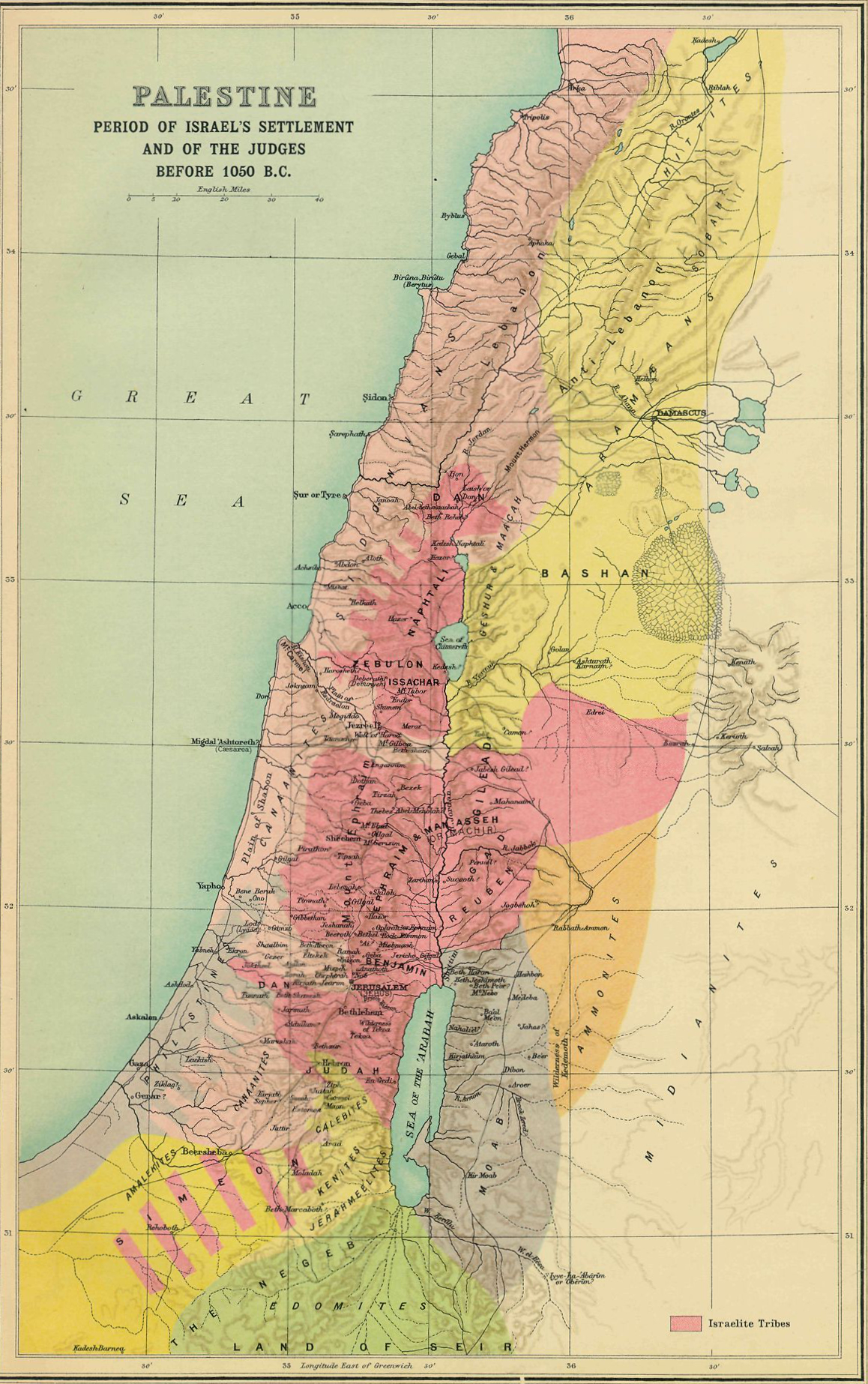
- 1Kadesh-barnea, The twelve brought their report back to the camp there. Numbers 13:26
- 2The Valley of Eshcol, Numbers says the valley took its name from what Israel gathered there. Numbers 13:24
- 3Gilgal, His claim was heard there, in the camp by the Jordan. Joshua 14:6
- 4Hebron, The town lay in the hill country he asked for. Joshua 14:13
- 5Debir, Othniel captured it, which was then called Kiriath-sepher. Joshua 15:15
Not placed: The Valley of Eshcol (2), Debir (5).
Base map: Israel's settlement and the period of the Judges, George Adam Smith, Atlas of the Historical Geography of the Holy Land (1915), public domain. Each place stands at its place page's coordinates, set on the plate by Jerusalem and Damascus, as the plate prints them.
Smith's plate shows the land in the period of Israel's settlement and of the Judges.
Questions His Life Raises
Four questions answered from their verses
What was Caleb's different spirit?Numbers 14:24
Adam Clarke, in his Commentary on Numbers 14:24, reads the Hebrew of the verse as saying Caleb filled up the line God showed him, and so followed Him fully. Rashi, in his commentary on the same verse, says Caleb kept one word in his mouth for the other spies and another in his heart. On Joshua 14:7 Rashi adds that Caleb brought back the report that was in his heart.
Did Caleb go up to Hebron alone?Numbers 13:22
They went up through the Negev and came to Hebron, where Ahiman, Sheshai, and Talmai, the descendants of Anak, dwelled. It had been built seven years before Zoan in Egypt.The verse names Hebron and the descendants of Anak, the city and the people Caleb later asked for.
Rashi, in his commentary on Numbers 13:22, reads the Hebrew verb there as singular and says Caleb alone went to Hebron to pray at the graves of the patriarchs. He supports it from Deuteronomy 1:36 and Judges 1:20 and cites the Talmud, Sotah 34b.
How are the forty-five years counted?Joshua 14:10
Albert Barnes, in his Notes on Joshua 14:10, dates the oath to the autumn of the second year after the exodus. He takes the years of war to be the long time of Joshua 11:18, and Rashi, in his commentary on the verse, draws from it the length of the conquest.
Was Othniel Caleb's nephew or his brother?Joshua 15:17 and Judges 1:13
Albert Barnes, in his Notes on Joshua 15:17, takes Othniel to be Caleb's younger brother and reads son of Kenaz as another way of saying Kenizzite. Rashi, in his commentary on Joshua 15:17, makes Othniel his brother on his mother's side, born after Jephunneh died and his mother married Kenaz.
What the Text Leaves Unsaid
His wilderness years, his wife and his death
Caleb and the Rest Hebrews Names
Hebrews 3 reads the generation of Kadesh as a warning to the church
The New Testament does not name Caleb. Hebrews 3 and 4 read the generation that fell in the wilderness, the generation he outlived, as a warning to believers.
And with whom was God angry for forty years? Was it not with those who sinned, whose bodies fell in the wilderness? And to whom did He swear that they would never enter His rest? Was it not to those who disobeyed? So we see that it was because of their unbelief that they were unable to enter.Hebrews gives unbelief as the reason the generation could not enter, which is the charge Caleb and Joshua laid before the congregation in Numbers 14:9.
| Who | Their end | Verse |
|---|---|---|
| The men counted from twenty years old and upward | Their bodies fell in the wilderness. | Numbers 14:29 |
| The ten spies who spread the bad report | They died by a plague before the LORD. | Numbers 14:37 |
| Caleb son of Jephunneh | He entered the land and his descendants inherited it. | Numbers 14:24 |
Voices on Caleb
Five quotations, from John Calvin to Albert Barnes
The ten spies and the twoJohn Calvin; Matthew Henry; Albert Barnes
“Their names are enumerated, in perpetual remembrance of their ignominy, except in the case of two, Joshua and Caleb; for it was just that their crime should be handed down to all ages, and that the infamy of their perfidiousness should never be blotted out, since they endeavored, as far as in them lay, to bring to naught the promise and the grace of God.”
John Calvin · Commentaries · on Numbers 13:2Reformed
“Difficulties that lie in the way of salvation dwindle and vanish before a lively active faith in the power and promise of God. All things are possible, if they be but promised, to him that believes.”
Matthew Henry · Commentary on the Whole Bible · on Numbers 13:30Puritan
“Already Caleb had endeavored to still the people before Moses Num 13:30; already Moses himself (Deu 1:29 ff) had endeavored to recall the people to obedience. After the failure of these efforts Moses and Aaron cast themselves down in solemn prayer before God (compare Num 16:22); and the appearance of the glory of the Lord in the ‘tabernacle of the congregation’ Num 14:10 was the immediate answer.”
Albert Barnes · Notes, Explanatory and Practical, on the Old and New Testaments (1832-1869) · on Numbers 14:5Evangelical
“It is probable that all the twelve spies stood together, for the eyes of all Israel were now upon them; and therefore it is taken notice of as very remarkable, and which could not but be affecting to the whole congregation, that when the ten evil spies fell down dead of the plague, a malignant infectious distemper, yet these two that stood among them lived, and were well.”
Matthew Henry · Commentary on the Whole Bible · on Numbers 14:38Puritan
Caleb's plea at GilgalMatthew Henry
“This promise is his chief plea, and that on which he relies. As we find it ( Num. xiv. 24 ) it is general, him will I bring into the land whereunto he went, and his seed shall possess it; but it seems it was more particular, and Joshua knew it; both sides understood this mountain for which Caleb was now a suitor to be intended.”
Matthew Henry · Commentary on the Whole Bible · on Joshua 14:9Puritan
When Caleb Took Hebron
Three readings of Joshua 15:14 beside Joshua 10:37 and Judges 1:10
They captured it and put to the sword its king, all its villages, and all the people. Joshua left no survivors, just as he had done at Eglon; he devoted to destruction Hebron and everyone in it.Joshua 10 has already given Hebron and its king to Joshua's sword before Caleb makes his claim.
Judah also marched against the Canaanites who were living in Hebron (formerly known as Kiriath-arba), and they struck down Sheshai, Ahiman, and Talmai.Judges names the same three sons of Anak, Sheshai, Ahiman and Talmai, that Joshua 15:14 names.
The hill country taken in Joshua's lifetimeAdam Clarke; John Gill
Adam Clarke, in his Commentary on Joshua 14:12, holds that Joshua had already taken Hebron and that Caleb's request took in the country around it, where the Anakim were still strong. John Gill, in his Exposition on Judges 1:20, says the gift of Hebron was made in Joshua's time and that Judges 1:10 tells the same expedition as Joshua 15:14.
The objection is that Judges 1:1 sets its events after the death of Joshua.
Hebron taken after Joshua's deathRashi
Rashi, in his commentary on Joshua 15:14, says Caleb drove out the sons of Anak after the death of Joshua, since Hebron had not yet been captured in Joshua's days. He adds that Joshua 15 records it only because it belongs to the division of the land.
The objection is that Joshua 14:13 to 15 sets Caleb's grant in Joshua's lifetime and closes with the land at rest from war.
The Anakim came backJohn Wesley
John Wesley, in his Explanatory Notes on Joshua 15:14, says the Anakim had recovered their cities or held out in the mountains. He adds that the three named may be the men of Numbers 13 or their sons called by their fathers' names.
The objection is that Joshua 11:22 says no Anakim were left in the land of the Israelites except in Gaza, Gath and Ashdod.
Books to Read Next
Four books, from Calvin's Joshua to Jamieson, Fausset and Brown
Commentaries on the Book of Joshua
John Calvin · 1564
Calvin comments on the whole book of Joshua, and Caleb's claim of chapter 14 stands among its chapters.
READ IT FREE AT CCEL →Commentary on the Whole Bible
Matthew Henry · 1710
Henry's second volume runs from Joshua to Esther, so it covers Caleb's claim and the later history of Hebron.
READ IT FREE AT CCEL →Explanatory Notes upon the Old Testament
John Wesley · 1765
Wesley wrote short notes on Numbers 13 and 14 and on Joshua 14 and 15.
READ IT FREE AT CCEL →Commentary Critical and Explanatory on the Whole Bible
Robert Jamieson, A. R. Fausset and David Brown · 1871
Their notes on Joshua 14 and 15 give the meaning of the names Kiriath-arba and Kiriath-sepher.
READ IT FREE AT CCEL →The Man Who Followed Wholly
The ground the spies had feared at forty became Caleb's inheritance, because the LORD keeps what He promises.
We have come to share in Christ if we hold firmly to the end the assurance we had at first.Hebrews asks of believers what Caleb's life shows, a confidence held firmly to the end.
His life asks the reader to keep following the LORD to the end, as Caleb still did at eighty-five, trusting the promise of God that is kept in Christ.
Keep studying
Read it4
Studies5
Peoples and groups2