
Leviticus 23 · Subject · Featured Study
The Appointed Times Read as a Calendar of Prophecy
C. H. Mackintosh, a Brethren writer, set the seven feasts of Leviticus 23 against the work of Christ in order, and later premillennial teachers took up his reading.
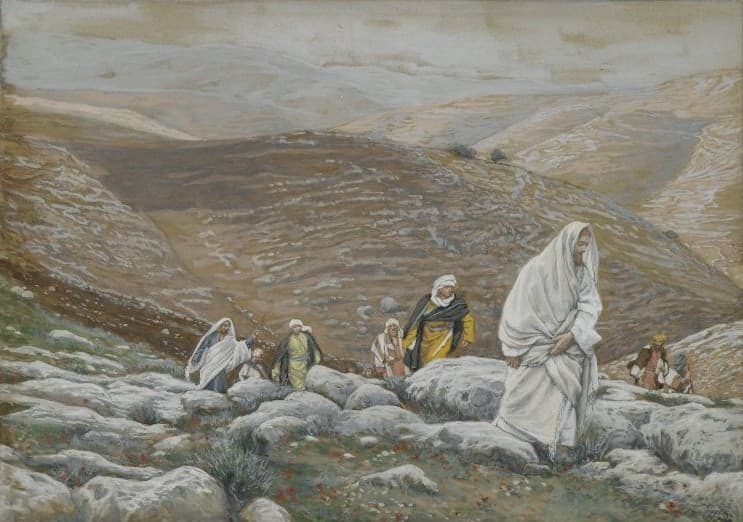
James Tissot, With Passover Approaching, Jesus Goes Up to Jerusalem, 1886 to 1894, opaque watercolor over graphite, Brooklyn Museum. Public domain (made before 1930), via the Internet Archive.
THE ARTWORKTissot painted Jesus walking ahead of His disciples on the climb to Jerusalem as a Passover drew near. He set the small band of travellers among the stony hills of Judea.
Leviticus 23 sets seven appointed feasts in the year, four from the first month to the fiftieth day and three in the seventh month.
Summary
The site's tradition, Wesleyan-Pentecostal and premillennial, reads the feasts of Leviticus 23 as a calendar of the work of Christ, the spring feasts kept at His first coming and the autumn feasts awaiting His return.
- Paul calls Christ our Passover lamb and the firstfruits of those who have fallen asleep, and Luke dates the gift of the Spirit to the day of Pentecost.
- C. H. Mackintosh, the Brethren writer, set out the whole reading in his Notes on Leviticus, the earliest holder found in print.
- Readers who hold the calendar differ on whether the Feast of Trumpets answers the rapture of the church or the waking of Israel.
- Dates set from the feasts have failed, among them Edgar Whisenant's date for the rapture at Rosh Hashanah in 1988.
- Calvin and Matthew Henry read the feasts as shadows fulfilled in Christ as a whole, and Rashi and the Mishnah read them as harvest festivals and memorials.
Seven Feasts in One Year
Leviticus 23 names the appointed feasts after the weekly Sabbath.
The chapter lists the feasts of the year in their order. Five of them fall on a fixed day of a month, and the other two are found by a count from a Sabbath.
These are the LORD’s appointed feasts, the sacred assemblies you are to proclaim at their appointed times.This verse is the heading under which every later feast of the chapter stands.
“Speak to the Israelites and say, ‘On the first day of the seventh month you are to have a day of rest, a sacred assembly announced by trumpet blasts.The seventh month opens with trumpet blasts, and the last three feasts of the list all fall in that month.
The Feasts and the Fulfilments Assigned
Each feast with its date in Leviticus 23, the event it is read as, who reads it so and who answers.
The first four feasts stand beside texts of Paul and Luke, and the last three beside the readings of later teachers.
- Passovermonth 1, day 14Read as the cross: Paul, 1 Corinthians 5:7; MackintoshLeviticus 23:5
- Unleavened Breadmonth 1, days 15 to 21Read as holiness after redemption: Paul, 1 Corinthians 5:8; MackintoshLeviticus 23:6
- Firstfruitsthe day after the SabbathRead as the resurrection: Paul, 1 Corinthians 15:20; Jamieson, Fausset and Brown, 1871Leviticus 23:10 to 11
- Weeksfifty days after the sheafRead as the Spirit given: Luke, Acts 2:1; MackintoshLeviticus 23:15 to 16
- The months betweenmonth 3 to month 7Read as the gathering of the church, the reading's inference: MackintoshRomans 11:25
- Trumpetsmonth 7, day 1Read as the waking of Israel: Mackintosh; as the rapture: Missler, 2013Answered by Thomas Ice, 1992Leviticus 23:24
- Day of Atonementmonth 7, day 10Read as Israel's mourning: Mackintosh, after Zechariah 12:10Answered by Hebrews 9:12Leviticus 23:27
- Tabernaclesmonth 7, days 15 to 21Read as the kingdom's glory: Mackintosh, after Zechariah 14:16; Missler, 2013Answered by Matthew Henry, 1710Leviticus 23:34
Eight numbered stops: the seven feasts in the order of Leviticus 23, with the months between Weeks and Trumpets at stop 5, where Leviticus names no feast and the event is the reading's inference. Mackintosh's readings are from his Notes of 1861.
The order on the stops is a reading of the chapter. Calvin, Matthew Henry, Rashi and the Mishnah read the same seven feasts in other ways.
The Texts the Reading Rests On
Paul, John and Luke tie three of the first four feasts to Christ, and Paul and Zechariah speak of a trumpet and of Israel's mourning.
Get rid of the old leaven, that you may be a new unleavened batch, as you really are. For Christ, our Passover lamb, has been sacrificed.Paul gives the Passover its fulfilment in the middle of a call to the church about its own conduct.
But Christ has indeed been raised from the dead, the firstfruits of those who have fallen asleep.Firstfruits is the name the chapter gives the first sheaf of the harvest, and Paul gives it to the risen Christ.
When the day of Pentecost came, they were all together in one place.Luke dates the gift of the Spirit to the Feast of Weeks, the fiftieth day of Leviticus 23:16.
But each in his own turn: Christ the firstfruits; then at His coming, those who belong to Him.Mackintosh cites this order of Christ first and His people at His coming when he reads the sheaf of firstfruits.
The bones of the Passover lambJohn 19:36; Exodus 12:46
The law of the Passover forbids breaking any bone of the lamb, at Exodus 12:46 and again at Numbers 9:12.
Now these things happened so that the Scripture would be fulfilled: “Not one of His bones will be broken.”John reads the soldiers leaving the legs of Jesus unbroken as the fulfilment of a Scripture.
The trumpet at the Lord's coming1 Thessalonians 4:16; 1 Corinthians 15:52
Two letters of Paul name a trumpet at the raising of the dead.
For the Lord Himself will descend from heaven with a loud command, with the voice of an archangel, and with the trumpet of God, and the dead in Christ will be the first to rise.Paul joins the trumpet of God to the Lord's descent from heaven and to the rising of the dead in Christ.
in an instant, in the twinkling of an eye, at the last trumpet. For the trumpet will sound, the dead will be raised imperishable, and we will be changed.Paul places the change of the living and the raising of the dead at the last trumpet.
Israel's mourning and the covenantZechariah 12:10; Romans 11:26 to 27
Then I will pour out on the house of David and on the people of Jerusalem a spirit of grace and prayer, and they will look on Me, the One they have pierced. They will mourn for Him as one mourns for an only child, and grieve bitterly for Him as one grieves for a firstborn son.Mackintosh quotes this verse for the affliction of soul he read in the tenth day of the seventh month.
And so all Israel will be saved, as it is written: “The Deliverer will come from Zion; He will remove godlessness from Jacob. And this is My covenant with them when I take away their sins.”Paul joins the saving of all Israel to a coming day when God takes away their sins, so the hope of Israel's turning rests on an apostle's words.
What Leviticus Says the Feasts Are
Leviticus 23 gives the feasts as offerings of the harvest and as a memorial of the Exodus.
“Speak to the Israelites and say, ‘When you enter the land that I am giving you and you reap its harvest, you are to bring to the priest a sheaf of the firstfruits of your harvest.The sheaf is the first of the harvest, brought to the priest once Israel reaps in the land.
Rashi, the French commentator of the eleventh century, in his commentary on the Torah read the booths of Leviticus 23:43 as the clouds of glory that sheltered Israel in the wilderness. On Leviticus 23:24 he read the trumpet blast as a memorial of the binding of Isaac, in whose place a ram was offered.
so that your descendants may know that I made the Israelites dwell in booths when I brought them out of the land of Egypt. I am the LORD your God.’”The booths are kept so that each generation knows that God made Israel dwell in booths after Egypt.
Jesus at the Feast of Tabernacles
John 7 sets a saying of Jesus on the last and greatest day of the Feast of Tabernacles.
However, the Jewish Feast of Tabernacles was near.John dates the chapter by the feast, so the sayings that follow were spoken at Tabernacles.
The Mishnah, set down about AD 200, holds at Rosh Hashanah 1:2 that the world is judged at four times of the year. At Passover the judgment is for grain, at Shavuot for the fruit of trees, at the new year for every creature and at Sukkot for the rain of the year to come.
On the last and greatest day of the feast, Jesus stood up and called out in a loud voice, “If anyone is thirsty, let him come to Me and drink. Whoever believes in Me, as the Scripture has said: ‘Streams of living water will flow from within him.’”John sets this call on the closing day, so the setting of Tabernacles frames what Jesus offers.
The Words of the Appointed Times
Two Hebrew words of the chapter's opening verse, from the lexicon of Brown, Driver and Briggs.
MO'ED, APPOINTED TIME (HEBREW, H4150)
Brown, Driver and Briggs give appointed time, place and meeting, and list the plural at Leviticus 23:2 and Leviticus 23:44. The same word names the Tent of Meeting.
MIQRA QODESH, SACRED ASSEMBLY (HEBREW, H4744)
Brown, Driver and Briggs give convocation for miqra and call miqra qodesh the term for a religious gathering on the Sabbath and certain sacred days. The Berean text of Leviticus 23 renders it sacred assembly eleven times, three of them in the plural.
What the Text Leaves Unsaid
Three matters on which Leviticus and Acts are silent.
Leviticus 23 gives no meaning for the order of the feasts and ties them to the months of the harvest.
The chapter states no purpose for the sound commanded on the first day of the seventh month. Adam Clarke, in his Commentary on the Bible of 1832, judged that the day probably marked the start of the civil year.
Peter's sermon on the day of Pentecost quotes Joel and the Psalms and does not quote Leviticus 23.
The Shadow and the Body
Four texts of Paul and Hebrews set the law's feasts beside Christ.
Therefore let no one judge you by what you eat or drink, or with regard to a feast, a New Moon, or a Sabbath. These are a shadow of the things to come, but the body that casts it belongs to Christ.Paul counts a feast among the shadows and gives the body that casts them to Christ.
For the law is only a shadow of the good things to come, not the realities themselves. It can never, by the same sacrifices offered year after year, make perfect those who draw near to worship.The writer reasons from the repetition of the yearly rites that they could not finish their work.
But when Christ came as high priest of the good things that have come, He went through the greater and more perfect tabernacle that is not made by hands and is not a part of this creation. He did not enter by the blood of goats and calves, but He entered the Most Holy Place once for all by His own blood, thus securing eternal redemption.Christ's one entry by His own blood stands where the high priest's yearly entry stood on the tenth day of the seventh month.
You are observing special days and months and seasons and years!Paul writes this of the Galatians' keeping of special days and seasons, and in the next verse he fears that his efforts for them may have been in vain.
Voices on the Feasts
Bede and Calvin on the feast of Pentecost.
Bede on the two loavesHomilies on the Gospels 2.17, on Leviticus 23:17
“Two loaves of bread made from the first fruits of the new harvest were rightly ordered to be offered, for the church gathers those it can consecrate to its Redeemer as a new family from both peoples, the Jews and the Gentiles.”
Bede · Homilies on the Gospels 2.17 · on Leviticus 23:17Patristic
John Calvin on Augustine's reading of PentecostCommentary upon the Acts of the Apostles, on Acts 2:1, in Fetherstone's translation of 1585
“I will not refute that high and subtle interpretation of Augustine, that like as the law was given to the old people fifty days after Easter, being written in tables of stone by the hand of God, so the Spirit, whose office it is to write the same in our hearts, did fulfill that which was figured in the giving of the law as many days after the resurrection of Christ, who is the true Passover.”
John Calvin · Commentaries · on Acts 2:1Reformed
Is the Order of the Feasts a Prophecy?
Five readings of the seven feasts, each with its holders, its case and the strongest objection.
A calendar of the work of Christ, the site's readingC. H. Mackintosh; Kevin Howard and Marvin Rosenthal; Chuck Missler · the site's tradition, Wesleyan-Pentecostal and premillennial
In his Notes on the Book of Leviticus, Mackintosh counted the Passover as "Israel's first great feast" and the Feast of Tabernacles as their seventh. He read the first as redemption and the last as "the millennial glory". Between them he set the resurrection, the gathering of the church and the turning of Israel.
He met the charge of spiritualizing Zechariah 14:16 with the words "Surely, Jerusalem means Jerusalem, nations mean nations, and the feast of tabernacles means the feast of tabernacles."
Kevin Howard and Marvin Rosenthal gave their book on the seven feasts, published by Thomas Nelson, the subtitle God's Prophetic Calendar from Calvary to the Kingdom.
“While each of these feasts has a historical commemorative role, each also has a prophetic role.”
Chuck Missler · The Fall Feasts of Israel (article) · on Leviticus 23:2Evangelical
The objection is Hebrews 9, which reads the rite of the tenth day of the seventh month as fulfilled in Christ's entry at His first coming. The holders answer from the same chapter.
so also Christ was offered once to bear the sins of many; and He will appear a second time, not to bear sin, but to bring salvation to those who eagerly await Him.The chapter that sets Christ's entry once for all also sets a second appearing, and the reading hangs the autumn feasts on it.
Which event the Feast of Trumpets answersChuck Missler; C. H. Mackintosh; Thomas Ice · premillennial teachers, a question left open
Missler, in his article The Fall Feasts of Israel of 2013, held that the rapture "is clearly associated with the sound of the trumpet". Mackintosh read the same feast as the waking of Israel.
Thomas Ice, writing for the Pre-Trib Research Center, held that the rapture is "a signless, any-moment event". In his words the Feast of Trumpets "does not in any way relate to the rapture of the church". He held that Israel's feasts "have been and will continue to be fulfilled in relation to Israel."
No one knows about that day or hour, not even the angels in heaven, nor the Son, but only the Father.Ice rests the any-moment hope on this saying, which leaves the day and the hour to the Father.
Shadows fulfilled in Christ as a wholeJohn Calvin; Matthew Henry · Reformed commentary
Calvin, in his commentary on Colossians in Pringle's translation of 1851, held on Colossians 2:17 that the substance the ceremonies foreshadowed is now presented in Christ. In his words, Christ "contains in himself everything that they marked out as future."
Matthew Henry, in his Commentary on the Whole Bible of 1710, read the trumpets of Leviticus 23:24 to 25 as a type of the preaching of the gospel. On Leviticus 23:39 he read the Feast of Tabernacles in Zechariah 14 as a prophecy of the worship of God under the New Testament.
The objection is that the apostles keep the order of Leviticus, the Passover before the firstfruits and the firstfruits before Pentecost, which a reading of the feasts as a whole leaves unexplained.
Harvest and memorialRashi; the Mishnah · Rabbinic tradition
Its holders are Rashi, in his commentary on the Torah, and the Mishnah, in tractate Rosh Hashanah. Their case is that Leviticus gives each feast an occasion and a law and assigns none of them a later fulfilment. So Rashi's notes on the chapter settle its laws: the leap year, the new moon, the sheaf of the omer and the two loaves.
The objection, from the Christian side, is Luke 22:19, where Jesus at the Passover meal gives the bread as His body and asks His disciples to do this in remembrance of Him. For Rashi and the Mishnah the feasts remain what Leviticus names them, harvests and memorials kept by law each year, and the two readings part at this verse.
Dates and signs read from the feastsEdgar Whisenant; Mark Biltz; John Hagee · popular prophecy teaching, shown for its weakness
Whisenant set the rapture at Rosh Hashanah, from sunset on 11 September to sunset on 13 September 1988. When that passed he moved it to 3 October, as Dean Halverson recorded in the Christian Research Journal the same year.
Mark Biltz read the four eclipses of the moon from April 2014 to September 2015, near Passover and Tabernacles, as the beginning of the end times. Three of the four could not be seen from Israel. John Hagee wrote on the same eclipses in Four Blood Moons of 2013 and named no event to come. He held that each run of four such eclipses in the last 500 years fell beside events in Jewish history that were first tragic and then followed by triumph.
The weakness is the saying of Jesus that no one knows the day or the hour, and Whisenant's two dates passed with no rapture.
Books on the Appointed Times
Four works on the feasts of Leviticus 23 and their meaning, all four free to read.
Notes on the Book of Leviticus
C. H. Mackintosh · 1861
Mackintosh's chapter on Leviticus 23 sets out the prophetic reading of all seven feasts in full.
Read at Project GutenbergCommentaries on the Epistles to the Philippians, Colossians, and Thessalonians
John Calvin, translated by John Pringle · 1851
Calvin explains Colossians 2:16 to 17 and gives the Reformed reading of the feasts as shadows.
Read at the Internet ArchiveRashi on Leviticus
Rashi, translated by M. Rosenbaum and A. M. Silbermann · 1929 to 1934
Rosenbaum and Silbermann translated Rashi's notes on the whole Pentateuch into English.
Read at SefariaMishnah Rosh Hashanah
The Mishnah · about 200
Here the Mishnah gives four new years of the Jewish calendar, and the first of Nisan begins the order of the festivals.
Read at SefariaTimes Appointed by God
The Christian readings agree on Christ, and Paul and John give the church its call and its hope.
Both Christian readings hold that Christ is the body the feasts foreshadow, and they differ on whether three of the feasts still wait.
So the text asks the reader to keep the feast Paul names in daily life and to wait for the day John saw.
Therefore let us keep the feast, not with the old bread, leavened with malice and wickedness, but with the unleavened bread of sincerity and of truth.Paul names what the old leaven stands for and what replaces it.
And I heard a loud voice from the throne saying: “Behold, the dwelling place of God is with man, and He will dwell with them. They will be His people, and God Himself will be with them as their God.The verse states the end both Christian readings expect, God living among His people.
Keep studying
Read it1
Places1
Symbols2
Doctrines20