
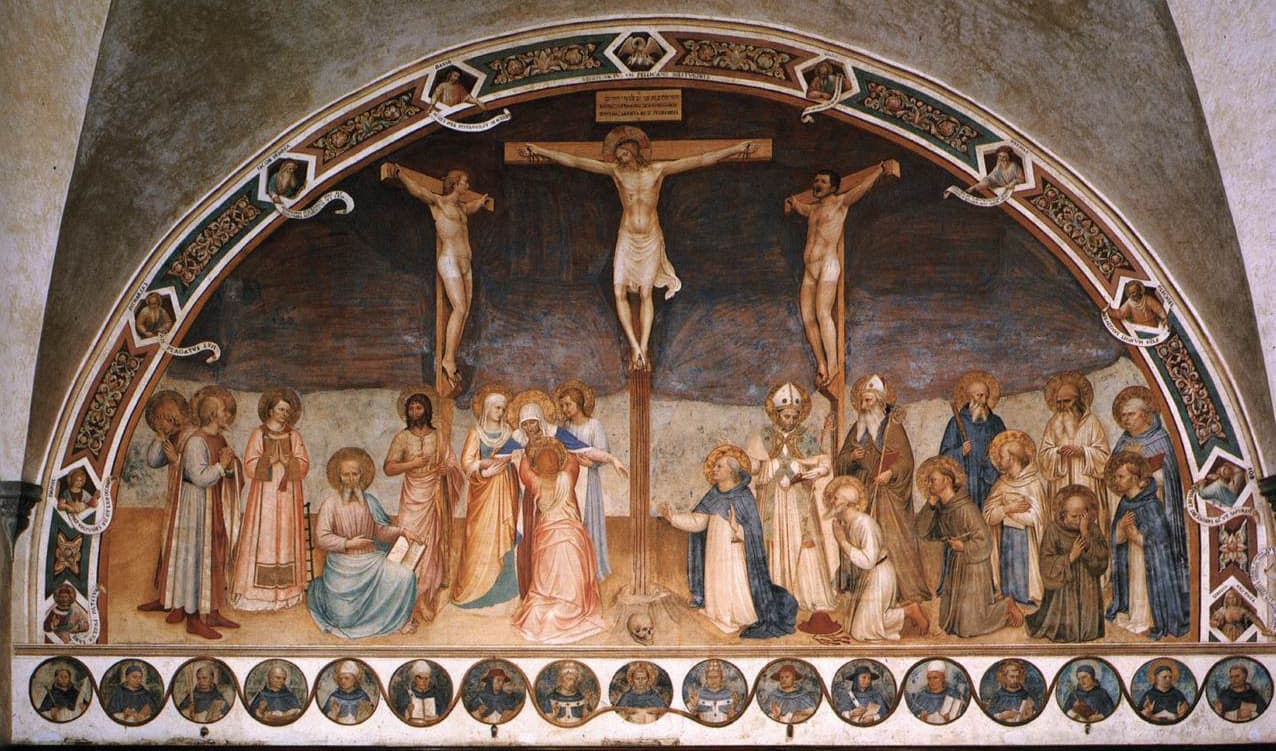
Hebrews 12:2 · Passage · Joy
The Joy Set Before Him
Hebrews 12:2 is the one verse in the Bible that speaks of a joy set before Jesus when He endured the cross.
The first readers of Hebrews had lost their property for the faith, and the writer feared they would grow weary and lose heart.
Let us fix our eyes on Jesus, the author and perfecter of our faith, who for the joy set before Him endured the cross, scorning its shame, and sat down at the right hand of the throne of God.
- The passage
- Hebrews 12:1 to 3
- Book
- Hebrews
- Hold in memory
- Hebrews 12:1 to 2
Summary
Hebrews 12:2 calls tired believers to look at Jesus, who endured the cross for the joy set before Him. He scorned its shame and sat down at the right hand of the throne of God. The verse gives Jesus as the pattern for the race of 12:1 and as the reason not to grow weary in 12:3. Its small preposition anti has been read in two ways: the joy Jesus set aside to take the cross, or the joy ahead of Him that He reached through it.
- The seat Jesus took after the cross is the seat Psalm 110:1 gives to David's Lord.
- The verse stands at the centre of a call to run with endurance, and the readers look at Jesus so that they will not grow weary and lose heart (Hebrews 12:1 to 3).
- The Greek preposition anti can mean in place of or for the sake of, so the joy is read either as a joy Jesus gave up or as a joy He looked toward.
- John Calvin preferred in place of, and his own translator, John Owen, answered that the words set before Him point to a joy that lay ahead.
- The joy lies at God's right hand, where Psalm 16:11 places eternal pleasures in His presence.
Hebrews 12:1 to 3, Verse by Verse
The verse is the middle of one sentence that begins in 12:1 and is applied in 12:3.
Hebrews 12:2 is a single sentence about the cross that names joy beside it. The writer sets it in the middle of a call to run a race, and he gives Jesus as the one runners are to watch. The verse belongs to joy, the value this family of pages teaches, because it places joy at the centre of the hardest thing Jesus did. It shows that the joy God asks of His people was first held by His Son.
The question the page answers is what that joy was and how it bears on a believer who is worn down by suffering. The page reads the verse in its chapter and its letter and sets the two readings of its preposition anti side by side in a table. It then follows the joy to God's right hand in Psalm 16 and Psalm 110 and gives the teachers who have read the verse, from John Chrysostom to B. F. Westcott.
Therefore, since we are surrounded by such a great cloud of witnesses, let us throw off every encumbrance and the sin that so easily entangles, and let us run with endurance the race set out for us.The sentence of verse 2 begins here, so the call to look at Jesus is given to runners who are already in a race.
Verses 2 and 3 move in five steps. They tell the reader where to look, what Jesus did, why He did it, where He is now and what this means for a tired runner.
In the Greek, archegos, the word the Berean text renders author, means a chief leader, and teleiotes, perfecter, stands nowhere else in the New Testament. The verb for endured, hypomeno, is the verb Hebrews 10:32 uses of the readers themselves, who endured a great conflict in the face of suffering.
Two Readings of the Word Anti
The clause turns on one Greek preposition, and each reading of it rests on a real use of the word in the New Testament.
The preposition anti makes the joy either a joy Jesus gave up or a joy He gained, and each reading has its verse and its holders.
| The question | Instead of the joy | For the sake of the joy |
|---|---|---|
| The Greek clause, ἀντὶ τῆς προκειμένης αὐτῷ χαρᾶς | read as instead of the joy set before Him | read as for the joy set before Him, the Berean rendering |
| What the joy is | a joy Jesus could have kept, set aside to take the cross | the joy ahead of Jesus, reached through the cross |
| Anti in another verse | Archelaus was reigning in Judea in place of his father Herod (Matthew 2:22) | Esau, who for a single meal sold his birthright (Hebrews 12:16) |
| The link in the context | Christ's freedom not to suffer at all, stressed by John Chrysostom | the race set out for us in 12:1, which uses the same verb, prokeimai |
| Holders | John Calvin (1549) | J. A. Bengel (1742); John Owen (1853); B. F. Westcott (1892) |
STEP Bible's short lexicon based on Abbott-Smith (1922) lists Hebrews 12:2 under the sense instead of, in place of, for. An interlinear gloss of the same word in this verse reads in view of. The word itself leaves the question open, so each reader decides it from the context.
From the Cloud of Witnesses to the Throne
Hebrews 10:32 to 12:11 moves from the readers' early suffering through Moses and the witnesses of chapter 11 to Jesus, and then back to the readers' own struggle.
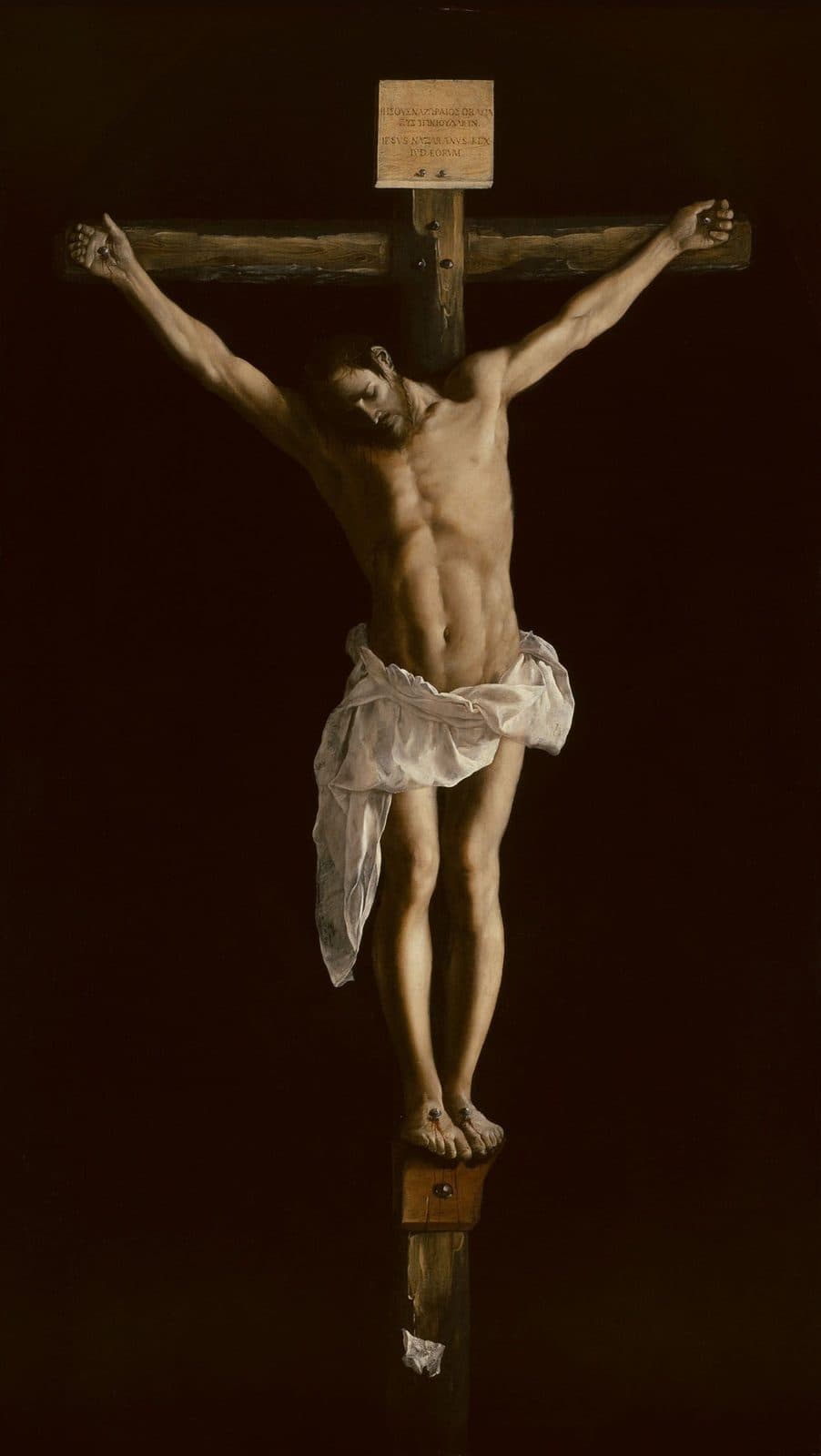
Francisco de Zurbarán, Christ on the Cross, 1627, Art Institute of Chicago; Wikimedia Commons file Francisco de Zurbarán - Christ on the Cross - WGA26051.jpg; public domain by date.
Zurbarán painted Jesus alone on the cross against a dark ground, with His head bowed and His body lit from the left.
Remember the early days that you were in the light. In those days, you endured a great conflict in the face of suffering. Sometimes you were publicly exposed to ridicule and persecution; at other times you were partners with those who were so treated. You sympathized with those in prison and joyfully accepted the confiscation of your property, knowing that you yourselves had a better and permanent possession.The readers had already endured suffering and accepted the loss of their goods with joy, and the writer calls them back to those early days.
By faith Moses, when he was grown, refused to be called the son of Pharaoh’s daughter. He chose to suffer oppression with God’s people rather than to experience the fleeting enjoyment of sin. He valued disgrace for Christ above the treasures of Egypt, for he was looking ahead to his reward.The joy set before Jesus in 12:2 offers the reader the kind of choice Moses made in Egypt, between present ease and a later good.
Chapter 11 names men and women who lived by faith, and 12:1 calls them a great cloud of witnesses around the runners. The writer then turns from the witnesses to Jesus, the one the runners are to look at.
In your struggle against sin, you have not yet resisted to the point of shedding your blood.The readers' struggle had not yet cost them their blood, and the verse measures it against the cross of verse 2.
No discipline seems enjoyable at the time, but painful. Later on, however, it yields a harvest of righteousness and peace to those who have been trained by it.This later verse of the chapter keeps the order of verse 2, in which pain endured now gives way to a good that comes after.
Hebrews uses one verb for endure of the readers in 10:32 and of Jesus in 12:2, and in 12:7 the same verb becomes a command. The endurance asked of the readers is the endurance Jesus showed.
Hebrews 12:4, Hebrews 12:11
The Joy at the Right Hand
Hebrews seats Jesus at the right hand of God from its first chapter, and Psalm 110 and Psalm 16 stand behind that seat.
The LORD said to my Lord: “Sit at My right hand until I make Your enemies a footstool for Your feet.”Hebrews quotes this verse in 1:13 as words God spoke to the Son and to none of the angels.
The Son is the radiance of God’s glory and the exact representation of His nature, upholding all things by His powerful word. After He had provided purification for sins, He sat down at the right hand of the Majesty on high.The letter's first sentence already seats the Son at the right hand once He has provided purification for sins, so 12:2 returns to the place where the letter began.
You have made known to me the path of life; You will fill me with joy in Your presence, with eternal pleasures at Your right hand.The psalm's last line names the end of the path of life, and 12:2 ends the course of Jesus at the same right hand.
At Pentecost Peter quoted Psalm 16:8 to 11 and introduced it with the words "David says about Him" (Acts 2:25). He said that David "spoke about the resurrection of the Christ" (Acts 2:31). Acts therefore reads the joy in God's presence that the psalm promises as the joy of Jesus raised from the dead.
Charles Spurgeon, in The Treasury of David, reads the path of life in this verse as shown "To Jesus first". He writes that "The thought of being made the path of life to his people, gladdened the soul of Jesus."
But we see Jesus, who was made a little lower than the angels, now crowned with glory and honor because He suffered death, so that by the grace of God He might taste death for everyone. In bringing many sons to glory, it was fitting for God, for whom and through whom all things exist, to make the author of their salvation perfect through suffering.Hebrews joined suffering to glory in chapter 2, where the author of salvation is made perfect through suffering, with the word archegos that 12:2 uses again.
So also you have sorrow now, but I will see you again and your hearts will rejoice, and no one will take away your joy.Jesus spoke these words on the night of the evening meal in John 13, before His arrest in John 18, and He promised His disciples a joy that no one would take away.
Psalm 16:11, John 16:22, Hebrews 2:9 to 10
Teachers on the Joy Set Before Him
John Chrysostom drew a lesson for runners from the verse, and Matthew Henry and John Wesley read the end of the verse as the reward of the cross.
died 407 · John Chrysostom
John Chrysostom, in his twenty-eighth homily on Hebrews, compared the reader to a learner watching a master: "if we wish to run, and to learn to run well, let us look to Christ". He went on: "If then He who was under no necessity of being crucified, was crucified for our sake, how much more is it right that we should endure all things nobly!" (on Hebrews 12:2).
1662 to 1714 · Matthew Henry
Matthew Henry, in his Commentary on the Whole Bible, calls the seat at the right hand "The reward of his suffering" (on Hebrews 12:2).
1703 to 1791 · John Wesley
John Wesley, in his Explanatory Notes upon the New Testament (1755), writes that Jesus "Patiently and willingly endured the cross, with all the pains annexed thereto". His note on the words is set down reads "Where there is fulness of joy."
Instead of the Joy or for the Sake of It
John Calvin read anti as instead of, and John Owen, J. A. Bengel and B. F. Westcott read it as for the sake of.
Instead of the joy Jesus could have hadJohn Calvin, Commentary on Hebrews (1549)
John Calvin wrote his Commentary on Hebrews in 1549, and John Owen translated it in 1853. Calvin holds that "though it was free to Christ to exempt himself from all trouble and to lead a happy life", "he yet underwent a death that was bitter". He concludes that "the expression, for joy, is the same as, instead of joy".
Calvin allows the other sense, "if any one thinks that the preposition anti denotes the final cause, I do not much object", and he adds, "I still prefer the former exposition". John Chrysostom's homily on the verse stresses the same freedom: "it was in His power not to suffer at all, if He so willed".
The objection: Owen, in his appendix to the translation, answers that "the words, 'set before him,' and the argument, evidently favor the other view".
For the sake of the joy that lay aheadJohn Owen (1853); J. A. Bengel, Gnomon (1742); B. F. Westcott, Hebrews (1892)
Owen, Calvin's own translator, wrote that "Hardly any agree with Calvin in the view he takes of this clause", and this reading is the majority reading.
J. A. Bengel, in his Gnomon of the New Testament (1742), glosses the words "For the joy, i.e. that He might obtain the joy". He links that joy to Psalm 16:11. B. F. Westcott, in The Epistle to the Hebrews (second edition, 1892), writes that "The joy that was set before Him was accepted as an equivalent (and more than an equivalent) for the sufferings which He endured". He cites the use of anti in Hebrews 12:16 beside it.
Bengel and Westcott both link the joy that lay before Jesus to the race that lies before believers in 12:1, where the same verb, prokeimai, stands.
The objection: anti commonly means in place of, and Calvin's reading keeps the weight on Christ's freedom to refuse the cross, which Chrysostom also stressed.
Theodoret of Cyrus, in his Interpretation of Hebrews, holds both senses together. He reads Christ as able to avoid the suffering, and he names the salvation of human beings as the joy for which Christ endured it.
Running with Eyes on Jesus
Consider Him who endured such hostility from sinners, so that you will not grow weary and lose heart.The writer draws the lesson of verse 2 himself, and the lesson is endurance for readers who are tempted to give up.
Whichever way anti is read, Hebrews sets the cross and the throne in one sentence, and the reader who looks at Jesus sees both. A believer who is weary in suffering is asked to consider Him and to keep running, because His joy came by way of the cross.
Sources
Scripture is the Berean Standard Bible.
- The tagged Greek text of Hebrews 12:1, 12:2 and 12:16, with Strong's numbers and morphology, and the occurrence lists of g747, g4295, g5051 and g5278.
- STEP Bible TBESG, the brief lexicon based on Abbott-Smith (1922), entries g473, g747, g4295, g5051 and g5278.
- John Calvin, Commentary on the Epistle to the Hebrews (1549), translated by John Owen (1853), on Hebrews 12:2, with Owen's appendix.
- J. A. Bengel, Gnomon of the New Testament (1742), on Hebrews 12:2, in the English translation served by biblehub.com (edition not stated there)
- B. F. Westcott, The Epistle to the Hebrews, second edition (London: Macmillan, 1892), pages 395 to 396.
- John Chrysostom, Homily 28 on Hebrews, Nicene and Post-Nicene Fathers, first series, volume 14.
- Matthew Henry, Commentary on the Whole Bible, on Hebrews 12:2.
- John Wesley, Explanatory Notes upon the New Testament (1755), on Hebrews 12:2.
- C. H. Spurgeon, The Treasury of David, volume 1, on Psalm 16:11.
- Theodoret of Cyrus, Interpretation of Hebrews, on Hebrews 12:2, in a modern English translation (cited, not quoted)
Keep Studying
Studies7
In this value7
Symbols1
Values2