
Genesis 36 and Obadiah · Place · Featured Study
Edom, the nation of Esau
Edom's people outlasted the kingdom of Judah and lived on as the Idumeans of Herod's day.
Esau asked his brother for the red stew, and the name it gave him became the name of a nation.
- Region
- The hill country of Seir (Genesis 32:3; 36:8)
- First named
- Genesis 25:30
- Last named
- Mark 3:8
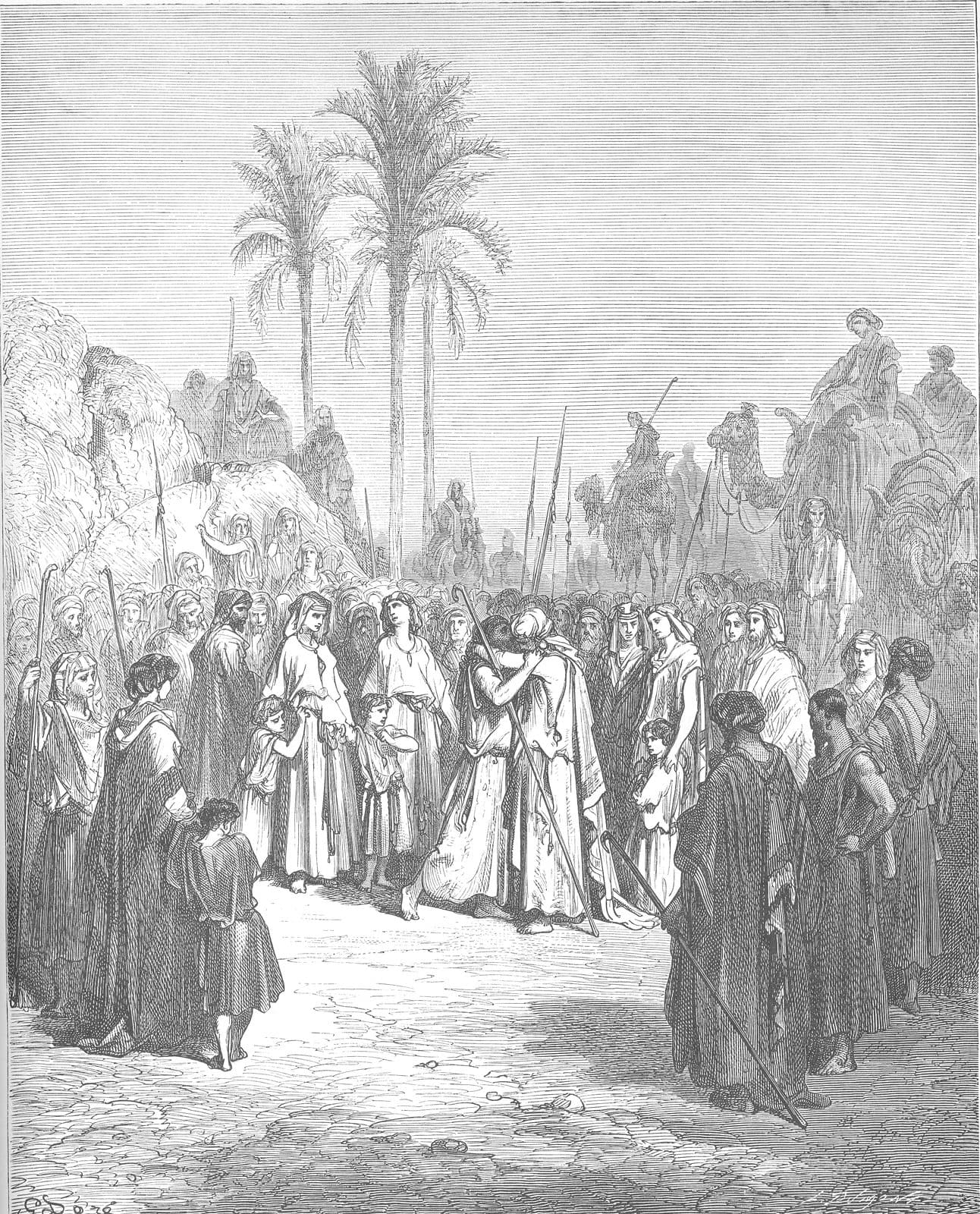
Gustave Doré, Jacob and Esau Meet, 1866, from Doré's English Bible. Public domain, via Wikimedia Commons.
THE ARTWORKDoré drew Esau, the father of the Edomites, embracing his brother Jacob on the road home, the meeting of Genesis 33.
Summary
Edom was the people of Esau, Jacob's elder twin, who settled in the hills of Seir, and their story runs from Rebekah's womb to the crowds from Idumea who came to Jesus.
- Esau was also called Edom, for the red stew.
- Edom had kings before Israel had any, and it barred Israel from the King's Highway.
- David held Edom, and Edom broke free under Jehoram of Judah.
- Obadiah gives a whole book to Edom's wrong against its brother Jacob.
Esau, Who Is Edom
Genesis 25 and 36 give the nation its name and its land.
Esau and Jacob were twins, and the LORD spoke over them before they were born.
and He declared to her: “Two nations are in your womb, and two peoples from within you will be separated; one people will be stronger than the other, and the older will serve the younger.”The word over the birth.
Esau came out first, and he came out red. Years later he came in from the field famished and asked Jacob for some of the red stew.
He said to Jacob, “Let me eat some of that red stew, for I am famished.” (That is why he was also called Edom.)The verse that gives Esau his second name.
The Hebrew word for red there is adom, and the name is Edom. The lexicon lists them as two words, H122, rosy, and H123, Edom, the elder twin brother of Jacob. The lexicon gives Seir, H8165, as a mountain of Idumea.
So Esau (that is, Edom) settled in the area of Mount Seir. This is the account of Esau, the father of the Edomites, in the area of Mount Seir.Esau settles in Seir and fathers the Edomites.
These are the kings who reigned in the land of Edom before any king reigned over the Israelites:The heading over the list of Edom's kings.
The Land of Edom
Scripture names Edom's hills, its towns, its border at Kadesh and the road that ran through it.
| Place | What the text says of it | Verse |
|---|---|---|
| Seir | The hill country where Esau settled | Genesis 36:8 |
| Teman | A town of Edom known for its wise men | Jeremiah 49:7 |
| Bozrah | A city of Edom whose citadels Amos says fire will consume | Amos 1:12 |
| Sela | The rock city Amaziah took and renamed Joktheel | 2 Kings 14:7 |
| Valley of Salt | Amaziah struck down 10,000 Edomites in this valley | 2 Kings 14:7 |
| Kadesh | Kadesh is a city on the edge of Edom's territory | Numbers 20:16 |
| King's Highway | The main road ran through Edom's territory | Numbers 20:17 |
- Place
- Seir
- What the text says of it
- The hill country where Esau settled
- Verse
- Genesis 36:8
- Place
- Teman
- What the text says of it
- A town of Edom known for its wise men
- Verse
- Jeremiah 49:7
- Place
- Bozrah
- What the text says of it
- A city of Edom whose citadels Amos says fire will consume
- Verse
- Amos 1:12
- Place
- Sela
- What the text says of it
- The rock city Amaziah took and renamed Joktheel
- Verse
- 2 Kings 14:7
- Place
- Valley of Salt
- What the text says of it
- Amaziah struck down 10,000 Edomites in this valley
- Verse
- 2 Kings 14:7
- Place
- Kadesh
- What the text says of it
- Kadesh is a city on the edge of Edom's territory
- Verse
- Numbers 20:16
- Place
- King's Highway
- What the text says of it
- The main road ran through Edom's territory
- Verse
- Numbers 20:17
Brother and Enemy
Edom and Israel meet as enemies from Kadesh to the fall of Jerusalem.
From Kadesh, Moses sent word to the king of Edom as from his brother Israel and asked to pass along the King's Highway. Edom refused and came out against Israel with a large army, and Israel turned away.
But Edom answered, “You may not travel through our land, or we will come out and confront you with the sword.”Edom's answer at Kadesh.
On the march the LORD told Israel to pass the descendants of Esau without provoking them.
Do not provoke them, for I will not give you any of their land, not even a footprint, because I have given Mount Seir to Esau as his possession.The land is Esau's by the LORD's gift.
David placed garrisons throughout Edom, and all the Edomites were subject to him.
In the days of Jehoram, Edom rebelled against the hand of Judah and appointed their own king.The revolt that ended Judah's rule over Edom.
Jerusalem fell to Babylon in 586 BC, and the psalmist asked the LORD to remember what the sons of Edom cried that day.
Remember, O LORD, the sons of Edom on the day Jerusalem fell: “Destroy it,” they said, “tear it down to its foundations!”Edom calls for Jerusalem to be razed.
Three Things Often Said of Edom
Each common saying stands beside the verse that answers it.
GOD HATED ESAU THE MAN
Malachi 1:3 speaks of Esau's mountains laid waste and his inheritance left to the jackals, and the next verse names Edom as a people. The question of election in Romans 9:13 is taken up under Jacob Have I Loved.
EDOM WAS ONLY EVER ISRAEL'S ENEMY
The law told Israel not to despise an Edomite, for he is your brother. The grandchildren of Edomites could enter the assembly of the LORD.
OBADIAH IS A BOOK OF JUDGMENT ALONE
Obadiah ends with deliverance on Mount Zion, deliverers who rule the mountains of Esau, and the kingdom belonging to the LORD.
Edom After the Prophets
In Greek the name Edom becomes Idumea.
The lexicon counts Idumea once in the New Testament.
The rock city of the Old Testament is Sela, which the lexicon calls the rock city of Idumea.
Jerusalem, Idumea, the region beyond the Jordan, and the vicinity of Tyre and Sidon. The large crowd came to Him when they heard what great things He was doing.Idumea among the lands the crowds came from.
Edom in the Record
Commentators, Assyrian prisms and Jewish readers carry Edom's name past the Old Testament.
Albert Barnes on Edom's later history
Albert Barnes, writing in the nineteenth century, traces the people from Esau to John Hyrcanus, to the Idumean Herod, and to the Nabataeans under whom Petra rose.
Edom, so named from Esau, consisted of various tribes enumerated in Gen. 36. The Edomites became a powerful nation before the Israelites came out of Egypt. David conquered them, but in the reign of Joram they rebelled and were not again subdued 2Ki 8:20. Under the name of Idumea the land was conquered by John Hyrcanus (compare Eze 25:14), when many of the people adopted the religion of the Jews. In later times the Idumean Herod became king of Palestine, reckoning himself as a Jew. Mount Seir, deserted by its original inhabitants, was occupied by a tribe of Arabians (the Nabatheans), under whelm Petra rose and continued a flourishing city under Roman dominion, until the tide of Mahometan conquest brought it to that ruin in which Edom at last found the complete fulfillment of the prophecies uttered against it Eze 35:1-15. Taking vengeance - Referring to the wrong done by Jacob to Esau Gen 27:36.
Albert Barnes · Notes, Explanatory and Practical, on the Old and New Testaments (1832-1869) · on Ezekiel 25:12Evangelical
Edom on the Assyrian prisms, under Hyrcanus and in the war with Rome
The prisms of the Assyrian kings Esarhaddon and Ashurbanipal list Qaus-gabri of Edom among their western vassals in the seventh century BC.
John Hyrcanus conquered Idumea about 112 BC, and Josephus tells of it in his Antiquities, book 13.
The Jamieson, Fausset and Brown commentary adds that Hyrcanus made the Idumeans accept circumcision, and that by Christ's time the Herods of Idumean origin ruled the two peoples as one.
In AD 70 an Idumean force of twenty thousand was admitted into Jerusalem and destroyed with it, as Josephus records in the Jewish War, book 4.
Edom read as Rome
Rashi, the eleventh-century Jewish commentator of France, in his commentary on Daniel 11:21, reads Obadiah's word to Edom, “you are very despised,” as the kingdom of Rome.
In his commentary on the Psalms he reads Psalm 60:9 the same way, so that the fortified city is Rome and the way to it runs against the fortress of Edom.
Who will bring me to the fortified city? Who will lead me to Edom?The verse Rashi reads of Rome.
What the Text Leaves Unsaid
Five questions about Edom that Scripture leaves open.
No verse of Scripture names Petra, and no verse ties Herod to Edom. No verse names Rome as Edom either, and that reading belongs to the later Jewish commentators.
Esau's final state
Hebrews says Esau sought the blessing with tears and found no ground for repentance, and it says nothing more of his final state.
For you know that afterward, when he wanted to inherit the blessing, he was rejected. He could find no ground for repentance, though he sought the blessing with tears.Esau rejected, with nothing said of his end.
Edom in the land of Uz
Lamentations places the Daughter of Edom in the land of Uz, and it leaves open whether this is the Uz of Job.
So rejoice and be glad, O Daughter of Edom, you who dwell in the land of Uz. Yet the cup will pass to you as well; you will get drunk and expose yourself.Edom in the land of Uz.
Obadiah's Charge
Obadiah charges Edom with pride and with violence against a brother.
Obadiah charges Edom first with pride. Its people lived in the clefts of the rocks and asked who could bring them down to the ground.
The pride of your heart has deceived you, O dwellers in the clefts of the rocks whose habitation is the heights, who say in your heart, ‘Who can bring me down to the ground?’ Though you soar like the eagle and make your nest among the stars, even from there I will bring you down,” declares the LORD.The pride of the high places.
The heart of the charge is the brother. Edom stood aloof while strangers carried off Jerusalem's wealth, then gloated, looted and cut off the fugitives at the crossroads.
Because of the violence against your brother Jacob, you will be covered with shame and cut off forever.Obadiah names the wrong done to a brother.
Amos brings the same charge, that Edom pursued his brother with the sword and stifled all compassion. Obadiah then widens the sentence to every nation.
For the Day of the LORD is near for all the nations. As you have done, it will be done to you; your recompense will return upon your own head.The Day of the LORD for all the nations.
Six Voices on Edom
Six readers of Edom, from Jerome in the fourth century to Spurgeon in the nineteenth.
Jerome reads Edom's pride as the pride of the heretic who scorns the Church.
Although you, o heretic, may seem great and despise the smallness of the Church, you are nonetheless small among the nations, and contemptible, and not only contemptible, but also very contemptible with arrogance. The pride of your heart has lifted you up. For who among heretics is not lifted up in pride, despising the simplicity of the Church and considering faith as ignorance? Dwelling in the clefts of the rock, and exalting his throne.
Jerome · Commentary on Obadiah · on Obadiah 1:3Patristic
John Calvin, in his Commentary on Genesis of 1554, sets the splendor of Esau's line against the lasting kingdom of God.
As, therefore, it has been before said of other profane nations, so now Esau is exalted as on a lofty theater. But since there is no permanent condition out of the kingdom of God, the splendor attributed to him is evanescent, and the whole of his pomp departs like the passing scene of the stage.
John Calvin · Commentaries · on Genesis 36:1Reformed
Charles Spurgeon turns on the word but in verse 17, where judgment on Edom gives way to blessing on Zion.
THIS is a remarkable passage. Its wording is singular. It begins with a, "but," because the previous verses have been denouncing judgments upon Edom. When God comes forth to punish His enemies He also comes forth to bless His friends. When Pharaoh is overthrown in the Red Sea, it is that Israel may pass onward to Canaan. When Amalek is overcome, it is that Israel may be at peace. There is a black cloud as well as the silvery rain. The acceptable year of the Lord is the day of vengeance of our God.
Charles Spurgeon · The Metropolitan Tabernacle Pulpit, Sermon No. 2136: “Possessing Possessions” (lightly modernized text, CCEL edition) · on Obadiah 1:17
John Wesley on verse 18
John Wesley sees Obadiah 1:18 fulfilled in part under Hyrcanus and the Maccabees.
Shall kindle - This was fulfilled in part by Hyrcanus and the Maccabees, 1Macc v, 3, but will be more fully accomplished, when the Lord shall make his church as a fire to all its enemies.
John Wesley · Explanatory Notes upon the Old Testament · on Obadiah 1:18Evangelical
Augustine on the end of Obadiah
Augustine reads Mount Esau in verse 21 as the church of the Gentiles, kept safe by the apostles who went up from Zion with the gospel.
Obadiah, so far as his writings are concerned the briefest of all the prophets, speaks against Edom, that is, the nation of Esau, that reprobate elder of the twin sons of Isaac and of the grandsons of Abraham. Now by that form of speech in which a part is understood for the whole, we understand Edom as referring to the nations. We may understand what Christ says in the same way: "But upon Mount Zion shall be safety, and there shall be a holy one." And a little further, at the end of the same prophecy, he says concerning Paul, "And the redeemed shall come up out of Mount Zion, that they may defend Mount Esau, and it shall be a kingdom to the Lord." It is quite evident that this was fulfilled when the redeemed out of Mount Zion (that is, the believers in Christ from Judea, of whom the apostles are chiefly to be acknowledged) went up to defend Mount Esau. How could they defend it except by making safe through the preaching of the gospel those who believed that they might be "delivered from the power of darkness and translated into the kingdom of God." Consequently he expressed this by adding, "And it shall be to the Lord a kingdom." For Mount Zion signifies Judea, where it is predicted there shall be safety and a holy one, that is, Jesus Christ. But Mount Esau is Edom. It signifies the church of the Gentiles, which is defended by the redeemed from Mount Zion, so that it should become a kingdom to the Lord. This was obscure before it took place, but what believer does not understand it now that it has happened?
Augustine of Hippo · City of God 18:31 · on Obadiah 1:21Patristic
Jamieson, Fausset and Brown on verses 10 and 21
The Jamieson, Fausset and Brown commentary weighs verse 10 and finds the wrong heavier because it was done to a twin brother.
against thy brother--This aggravates the sin of Esau, that it was against him who was his brother by birth and by circumcision. The posterity of Esau followed in the steps of their father's hatred to Jacob by violence against Jacob's seed (Ge 27:41). Jacob--not merely his own brother, but his twin brother; hence the name Jacob, not Israel, is here put emphatically.
Jamieson, Fausset & Brown · Commentary Critical and Explanatory on the Whole Bible · on Obadiah 1:10Reformed
On verse 21 it calls Edom the type of Israel's and God's last foes, citing Isaiah 63:1 to 4. It reads the kingdom of verse 21 as the kingdom under Messiah, citing Daniel 2:44.
Who is this coming from Edom, from Bozrah with crimson-stained garments? Who is this robed in splendor, marching in the greatness of His strength? “It is I, proclaiming vindication, mighty to save.”The one who comes from Edom, mighty to save.
When Obadiah Spoke
Two dates for the book, each with its holders.
Obadiah names no king. Readers date the book from the day it describes, when strangers carried off Jerusalem's wealth and cast lots for the city.
Under Jehoram of Judah
The Jamieson, Fausset and Brown commentary lists the raid of the Philistines and Arabs on Jehoram's palace first among the days verse 11 may describe.
Then the LORD stirred against Jehoram the spirit of the Philistines and Arabs who lived near the Cushites. So they went to war against Judah, invaded it, and carried off all the possessions found in the king’s palace, along with his sons and wives; not a son was left to him except Jehoahaz, his youngest.The raid on Jehoram's palace.
The objection: Chronicles names Philistines and Arabs in that raid and names no Edomite.
After Babylon took Jerusalem
Jerome, Adam Clarke and Albert Barnes read Edom's wrongs in verses 10 to 14 as done when the Chaldeans took Jerusalem. Obadiah's opening verses also share whole lines with Jeremiah 49.
Thou stoodest on the other side - Thou not only didst not help thy brother when thou mightest, but thou didst assist his foes against him. And cast lots - When the Chaldeans cast lots on the spoils of Jerusalem, thou didst come in for a share of the booty; “thou wast as one of them.”
Adam Clarke · Commentary on the Bible · on Obadiah 1:11Evangelical
If grape gatherers came to you, would they not leave some gleanings? Were thieves to come in the night, would they not steal only what they wanted?Jeremiah's form of Obadiah 1:5.
The objection: verses 12 to 14 are warnings that say “you should not,” which fits an event still open.
The Brothers Embraced
Esau held a grudge against Jacob and planned to kill him. Centuries later Obadiah judged Esau's descendants for violence against their brother Jacob.
Yet on the road home Esau ran to Jacob, embraced him and kissed him, and they both wept.
Hebrews holds up Esau, who sold his birthright for a single meal, as a warning against a godless life. It sets that warning before those who have come to Jesus, the mediator of a new covenant, whose blood speaks a better word than the blood of Abel.
See to it that no one falls short of the grace of God, and that no root of bitterness springs up to cause trouble and defile many.What the warning asks of the reader.
Obadiah asks the same of anyone who sees a brother's day of misfortune: do not gloat over it, and do not stand aloof.