
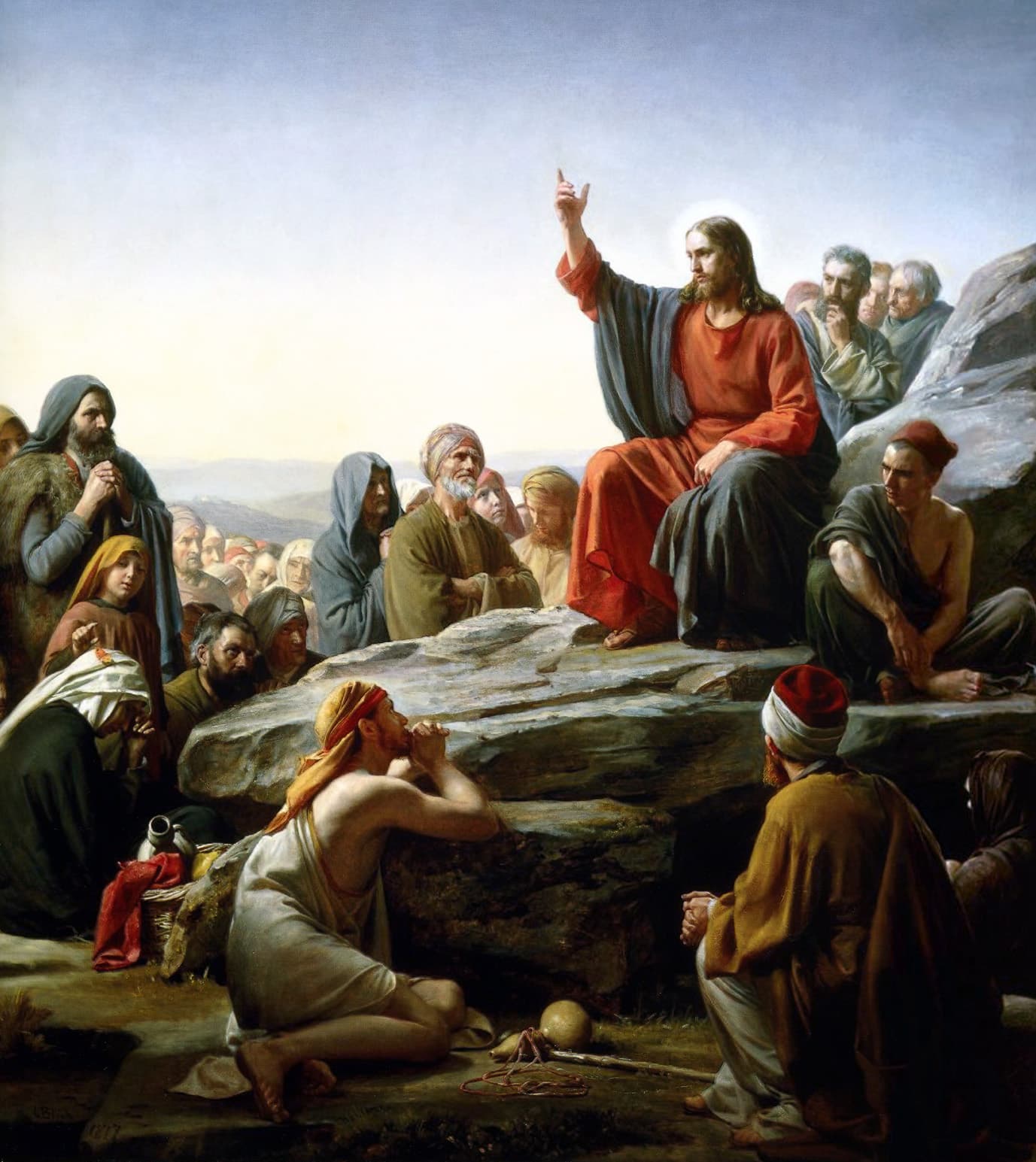
The Sermon on the Mount, Carl Bloch, 1877. Public domain.
New Testament · Book 40 of 66
Matthew
Matthew tells the life of Jesus as the promised King, the son of David and of Abraham. Five long blocks of his teaching stand in the story, and Old Testament prophecies are shown fulfilled throughout.
Matthew tells the life of Jesus as the promised King, the son of David and of Abraham. Five long blocks of his teaching stand in the story, and Old Testament prophecies are shown fulfilled throughout.
What is Matthew about?
Matthew tells the story of Jesus, the son of David and the son of Abraham, from his birth in Bethlehem to his rising from the dead. He is baptized and tested, calls disciples in Galilee and teaches them on a mountain. He heals the sick, sends out the twelve and speaks of the kingdom of heaven in parables. Peter confesses him the Christ, and he goes up to Jerusalem to be crucified. The book gathers his teaching into five long discourses, and it ends with the risen Lord sending the eleven to all nations: “I am with you always, even to the end of the age” (28:20).
All 28 chapters
Every chapter of the book, in one grid. Each cell opens that chapter.
- The king comesChapters 1 to 7
- The king's works and his messengersChapters 8 to 10
- The kingdom hidden and revealedChapters 11 to 13
- The church and the cross foretoldChapters 14 to 20
- The king in JerusalemChapters 21 to 25
- The passion and the risen LordChapters 26 to 28
The colour is the movement of the book the chapter stands in, and every cell opens that chapter's Study level.
Who wrote it, where, when, for whom, and why?
This is the one Gospel that calls the tax collector at the booth Matthew (9:9), where Mark and Luke call him Levi (Mark 2:14; Luke 5:27), and its list of the twelve names him Matthew the tax collector (10:3). The book calls itself the record of the genealogy of Jesus Christ (1:1).
As Jesus went on from there, He saw a man named Matthew sitting at the tax booth. “Follow Me,” He told him, and Matthew got up and followed Him.
Matthew 9:9, Berean Standard Bible.
The story runs from Bethlehem and Egypt to Nazareth, then in Galilee around Capernaum, north to Caesarea Philippi, south through Jericho to Jerusalem, and back to a mountain in Galilee (28:16).
The story is set in the time of King Herod (2:1) and ends under Pilate (27:2). The book counts its own time only by generations, fourteen and fourteen and fourteen (1:17), and it speaks of an account circulated among the Jews to this very day (28:15), which places the writing after the resurrection.
It is written for readers who know Israel's Scriptures: it quotes them without explaining them and calls Jerusalem the holy city (4:5). It also opens to the nations, from the magi to the command to go to all nations (28:19).
The book gives its own end in the last words of Jesus: to make disciples of all nations, to baptize them, and to teach them to obey all he commanded, with his promise to be with them (28:19 to 20).
Therefore go and make disciples of all nations, baptizing them in the name of the Father, and of the Son, and of the Holy Spirit,
Matthew 28:19, Berean Standard Bible.
Sources. Matthew 1:1, 1:17, 2:1, 4:5, 9:9, 10:3, 27:2, 28:15, 28:16 and 28:19 to 20; Mark 2:14; Luke 5:27. Every verse is read in the Berean Standard Bible.
How is Matthew arranged, and what is it for?
The six movements the book falls into, then what it teaches and what it was written to do.
- The king comesChapters 1 to 7, 201 verses
The son of David is born, baptized and tested, calls his first disciples and teaches on the mountain.
- The king's works and his messengersChapters 8 to 10, 114 verses
Ten works of power from the leper to the mute man, the call of Matthew, and the twelve sent out.
- The kingdom hidden and revealedChapters 11 to 13, 138 verses
John's question, the towns that did not repent, the Sabbath disputes, and seven parables by the sea.
- The church and the cross foretoldChapters 14 to 20, 229 verses
Two feedings, Peter's confession, the first word of the church, three passion predictions and the road up.
- The king in JerusalemChapters 21 to 25, 228 verses
The entry, the temple cleared, the questions in its courts, the woes, and the discourse on the Mount of Olives.
- The passion and the risen LordChapters 26 to 28, 161 verses
The supper, Gethsemane, the trials, the cross and the tomb, and the risen Lord's commission in Galilee.
The theme
Jesus is the son of David and the son of Abraham, the king the Scriptures promised, and the kingdom of heaven comes near in him. He fulfils the Law and the Prophets, teaches a righteousness greater than the scribes', and calls disciples to follow him. Rejected by the leaders of his own people, he gives his life as the covenant's blood, rises from the dead, and sends his church to all nations with his presence.
The purpose
Matthew was written so that its readers would know who Jesus is and obey what he taught. It shows him as the one in whom Israel's Scriptures come to their end, gathers his teaching into five discourses a church can learn, and closes with a command to make disciples of all nations, teaching them to obey all he commanded (28:19 to 20).
Five discourses stand on the story like five pillars
- 1The Sermon on the MountChapters 5 to 7
Closed by “When Jesus had finished saying these things” (7:28)
- 2The sending of the twelveChapter 10
Closed by “After Jesus had finished instructing His twelve disciples” (11:1)
- 3The parables of the kingdomChapter 13
Closed by “When Jesus had finished these parables” (13:53)
- 4The life of the communityChapter 18
Closed by “When Jesus had finished saying these things” (19:1)
- 5The discourse on the Mount of OlivesChapters 24 and 25
Closed by “When Jesus had finished saying all these things” (26:1)
The story between the pillars: birth, baptism, testing (1 to 4); ten works (8 to 9); opposition (11 to 12); feedings and confession (14 to 17); the road and the city (19 to 23); the passion (26 to 28).
The king comes, Matthew 1 to 7
What the text says in these 201 verses, and the pages they open on.
Matthew opens with the record of Jesus Christ, the son of David and the son of Abraham, in three sets of fourteen generations (1:17). Joseph learns in a dream that Mary's child is from the Holy Spirit and is to be named Jesus, because he will save his people from their sins (1:21). Magi come to worship him, Herod tries to kill him, and the family flees to Egypt and settles in Nazareth. John baptizes Jesus at the Jordan, and the voice from heaven names him the beloved Son (3:17). Jesus answers the devil from Deuteronomy, calls four fishermen, and on a mountain teaches the blessed life, the law fulfilled, prayer and the two ways.
From that time on Jesus began to preach, “Repent, for the kingdom of heaven is near.”
- Study
Matthew 1the genealogy in three fourteens, and Joseph's dreamShow the summary and 6 pagesShow summary, 6 pagesHide the summary
Genealogy of Jesus the Christ, son of David and son of Abraham, arranged in three groups of fourteen from Abraham to David to the exile to Christ. The angelic announcement to Joseph, the virgin conception, and the name 'Jesus'. He shall save his people from their sins. Matthew grounds the opening of his Gospel in fulfillment (Isa 7:14, cited 1:22–23).
On this chapter (6)
- The genealogy of Jesus
The three fourteens from Abraham.
- The virgin birth
The child conceived by the Holy Spirit.
- The fulfilment formula
The ten quotations that say the Scripture was fulfilled.
- What does Isaiah 7:14 say of the virgin in the Hebrew and the Greek, and how does Matthew 1:23 use it?
Answered under Where do readers disagree, lower on this page, with each reading and who holds it.
- Why three fourteens in the genealogy, and what of the kings left out?
Answered under Where do readers disagree, lower on this page, with each reading and who holds it.
- Matthew 1:21
The verse on its own page, with the commentators on it by era.
- The genealogy of Jesus
- Study
Matthew 2the magi, Herod, Egypt and NazarethShow the summary and 2 pagesShow summary, 2 pagesHide the summary
Magi from the east follow the star to Herod's Jerusalem, then to Bethlehem. Gifts of gold, frankincense, and myrrh. Joseph's flight to Egypt with the child, Herod's slaughter of the innocents at Bethlehem, and the return to Nazareth. Three fulfillment formulas close the chapter (Mic 5:2; Hos 11:1; Jer 31:15).
On this chapter (2)
- The wise men and the star
The magi, the star and Herod.
- Matthew 2:2
The verse on its own page, with the commentators on it by era.
- The wise men and the star
- Study
Matthew 3John at the Jordan, and the voice at the baptismShow the summary and 2 pagesShow summary, 2 pagesHide the summary
John the Baptist preaches in the Judean wilderness: 'Repent, for the kingdom of heaven is near.' Pharisees and Sadducees warned; the axe is laid to the root. Jesus comes from Galilee to be baptized; the heavens open, the Spirit descends as a dove, the Father's voice identifies the Son.
On this chapter (2)
- The baptism of Jesus
The voice from heaven at the Jordan.
- Matthew 3:17
The verse on its own page, with the commentators on it by era.
- The baptism of Jesus
- Study
Matthew 4the testing, Capernaum, and four fishermen calledShow the summary and 3 pagesShow summary, 3 pagesHide the summary
The temptation in the wilderness. Three testings, three Scripture answers. Ministry begins in Galilee as Isaiah 9 foretold. Jesus calls Peter and Andrew, then James and John: 'Come, follow Me … and I will make you fishers of men.' A summary of preaching, teaching, and healing closes the chapter.
On this chapter (3)
- The temptation in the wilderness
Three tests answered from Deuteronomy.
- The kingdom of heaven
Matthew's own name for the reign of God.
- Matthew 4:4
The verse on its own page, with the commentators on it by era.
- The temptation in the wilderness
- Study
Matthew 5the Beatitudes, salt and light, and the law fulfilledShow the summary and 3 pagesShow summary, 3 pagesHide the summary
The Sermon on the Mount opens with the Beatitudes, salt and light, and the law not destroyed but fulfilled. Six 'You have heard … But I tell you' antitheses rewrite murder, adultery, divorce, oaths, retaliation, and love of enemies. The chapter ends with the command to be perfect as the heavenly Father is perfect.
On this chapter (3)
- The law fulfilled
What Jesus said he came to do with the law.
- Is the Sermon on the Mount law for the church, an ideal beyond reach, or the life of the kingdom?
Answered under Where do readers disagree, lower on this page, with each reading and who holds it.
- Matthew 5:17
The verse on its own page, with the commentators on it by era.
- The law fulfilled
- Study
Matthew 6giving, prayer and fasting in secret, and treasure in heavenShow the summary and 3 pagesShow summary, 3 pagesHide the summary
Giving, prayer, and fasting. All done for God's eye, not man's. The Lord's Prayer. Treasures in heaven, single eye, two masters. Do not be anxious; consider the lilies of the field; seek first the kingdom of God and his righteousness, and all these things shall be added to you.
On this chapter (3)
- Jesus on prayer
The prayer he taught and how he prayed.
- Treasure in heaven
Where the heart's treasure is kept.
- Matthew 6:33
The verse on its own page, with the commentators on it by era.
- Jesus on prayer
- Study
Matthew 7judging, asking, the narrow gate and the two buildersShow the summary and 2 pagesShow summary, 2 pagesHide the summary
The Sermon on the Mount concludes. Judge not; ask, seek, knock; the narrow gate; false prophets known by their fruits; not everyone who says 'Lord, Lord'; the two houses built on rock and on sand. Matthew closes with the crowds astonished. Jesus taught as one having authority, not as the scribes.
On this chapter (2)
- Entering the kingdom
The narrow gate and the way in.
- Matthew 7:24
The verse on its own page, with the commentators on it by era.
- Entering the kingdom
Ten times Matthew says the Scripture was fulfilled
- 1 1:22 to 23quotes Isaiah 7:14
- 2 2:15quotes Hosea 11:1
- 3 2:17 to 18quotes Jeremiah 31:15
- 4 2:23the prophets, no one verse named
- 5 4:14 to 16quotes Isaiah 9:1 to 2
- 6 8:17quotes Isaiah 53:4
- 7 12:17 to 21quotes Isaiah 42:1 to 4
- 8 13:35quotes Psalm 78:2
- 9 21:4 to 5quotes Zechariah 9:9
- 10 27:9 to 10quotes Zechariah 11:12 to 13
Read the ten pairs side by side in the Berean text
All this took place to fulfill what the Lord had said through the prophet: “Behold, the virgin will be with child and will give birth to a son, and they will call Him Immanuel” (which means, “God with us”).
Matthew 1:22–23, Berean Standard Bible. Therefore the Lord Himself will give you a sign: Behold, the virgin will be with child and will give birth to a son, and will call Him Immanuel.
Isaiah 7:14, Berean Standard Bible. Explicit quotation. where he stayed until the death of Herod. This fulfilled what the Lord had spoken through the prophet: “Out of Egypt I called My Son.”
Matthew 2:15, Berean Standard Bible. When Israel was a child, I loved him, and out of Egypt I called My son.
Hosea 11:1, Berean Standard Bible. Explicit quotation. Then what was spoken through the prophet Jeremiah was fulfilled: “A voice is heard in Ramah, weeping and great mourning, Rachel weeping for her children, and refusing to be comforted, because they are no more.”
Matthew 2:17–18, Berean Standard Bible. This is what the LORD says: “A voice is heard in Ramah, mourning and great weeping, Rachel weeping for her children, and refusing to be comforted, because they are no more.”
Jeremiah 31:15, Berean Standard Bible. Explicit quotation. and he went and lived in a town called Nazareth. So was fulfilled what was spoken through the prophets: “He will be called a Nazarene.”
Matthew 2:23, Berean Standard Bible. No single Old Testament verse carries these words.
to fulfill what was spoken through the prophet Isaiah: “Land of Zebulun and land of Naphtali, the Way of the Sea, beyond the Jordan, Galilee of the Gentiles— the people living in darkness have seen a great light; on those living in the land of the shadow of death, a light has dawned.”
Matthew 4:14–16, Berean Standard Bible. Nevertheless, there will be no more gloom for those in distress. In the past He humbled the land of Zebulun and the land of Naphtali, but in the future He will honor the Way of the Sea, beyond the Jordan, Galilee of the nations: The people walking in darkness have seen a great light; on those living in the land of the shadow of death, a light has dawned.
Isaiah 9:1–2, Berean Standard Bible. Explicit quotation. This was to fulfill what was spoken through the prophet Isaiah: “He took on our infirmities and carried our diseases.”
Matthew 8:17, Berean Standard Bible. Surely He took on our infirmities and carried our sorrows; yet we considered Him stricken by God, struck down and afflicted.
Isaiah 53:4, Berean Standard Bible. Explicit quotation. This was to fulfill what was spoken through the prophet Isaiah: “Here is My Servant, whom I have chosen, My beloved, in whom My soul delights. I will put My Spirit on Him, and He will proclaim justice to the nations. He will not quarrel or cry out; no one will hear His voice in the streets. A bruised reed He will not break, and a smoldering wick He will not extinguish, till He leads justice to victory. In His name the nations will put their hope.”
Matthew 12:17–21, Berean Standard Bible. “Here is My Servant, whom I uphold, My Chosen One, in whom My soul delights. I will put My Spirit on Him, and He will bring justice to the nations. He will not cry out or raise His voice, nor make His voice heard in the streets. A bruised reed He will not break and a smoldering wick He will not extinguish; He will faithfully bring forth justice. He will not grow weak or discouraged before He has established justice on the earth. In His law the islands will put their hope.”
Isaiah 42:1–4, Berean Standard Bible. Explicit quotation. So was fulfilled what was spoken through the prophet: “I will open My mouth in parables; I will utter things hidden since the foundation of the world.”
Matthew 13:35, Berean Standard Bible. I will open my mouth in parables; I will utter things hidden from the beginning,
Psalm 78:2, Berean Standard Bible. Explicit quotation. This took place to fulfill what was spoken through the prophet: “Say to the Daughter of Zion, ‘See, your King comes to you, gentle and riding on a donkey, on a colt, the foal of a donkey.’”
Matthew 21:4–5, Berean Standard Bible. Rejoice greatly, O Daughter of Zion! Shout in triumph, O Daughter of Jerusalem! See, your King comes to you, righteous and victorious, humble and riding on a donkey, on a colt, the foal of a donkey.
Zechariah 9:9, Berean Standard Bible. Explicit quotation. Then what was spoken through Jeremiah the prophet was fulfilled: “They took the thirty pieces of silver, the price set on Him by the people of Israel, and they gave them for the potter’s field, as the Lord had commanded me.”
Matthew 27:9–10, Berean Standard Bible. Then I told them, “If it seems right to you, give me my wages; but if not, keep them.” So they weighed out my wages, thirty pieces of silver. And the LORD said to me, “Throw it to the potter”—this magnificent price at which they valued me. So I took the thirty pieces of silver and threw them to the potter in the house of the LORD.
Zechariah 11:12–13, Berean Standard Bible. Explicit quotation.
Characters (6)
Who the text names. A name with a page carries its door.
- Jesus
The son of David and of Abraham, named Immanuel, God with us (1:23).
- Mary and Joseph
Mary bears the child; Joseph, a righteous man, obeys four dreams.
- John the Baptist
Calls Israel to repent at the Jordan and baptizes Jesus.
- Herod
The king in Jerusalem who kills the boys of Bethlehem.
Show the next 2
- The magi
Wise men from the east who follow the star and worship the child.
- Peter and Andrew, James and John
Four fishermen called at the Sea of Galilee (4:18 to 22).
Places (4)
Where the chapters stand.
Themes (5)
What these chapters raise, each on its own page where one stands.
- The fulfilment of the Scriptures
The formula that runs through the book.
- The kingdom of heaven
Matthew's own name for the reign of God.
- The righteousness of the Sermon
A righteousness that surpasses the scribes'.
- The virgin birth
The child conceived by the Holy Spirit.
Show the next 1
- The genealogy
Three fourteens from Abraham to the Christ.
Where these chapters take up the Old Testament (6)each marked as a quotation or an allusion, with the evidence
- Explicit quotationMicah 5:2 at Matthew 2:5 to 6. The chief priests and scribes answer Herod that the Christ is to be born in Bethlehem. Introduced with this is what the prophet has written.
- Probable allusionIsaiah 11:1 at Matthew 2:23. He will be called a Nazarene is said to fulfil the prophets, but no prophet has those words. Read by Jerome, Commentary on Matthew, on 2:23, as the branch, netzer, of Isaiah 11:1.
- Explicit quotationIsaiah 40:3 at Matthew 3:3. John is the voice calling in the wilderness to prepare the way for the Lord. Introduced with this is he who was spoken of through the prophet Isaiah.
- Explicit quotationDeuteronomy 8:3, 6:16 and 6:13 at Matthew 4:4 to 10. Jesus answers each of the devil's three tests with a word from Deuteronomy. Each answer opens with it is written.
- Explicit quotationPsalm 91:11 to 12 at Matthew 4:6. The devil quotes the psalm's promise of angels to the Son of God. Introduced with for it is written.
- Explicit quotationExodus 20:13 and 20:14; Leviticus 19:18 at Matthew 5:21 to 43. The six sayings of the Sermon set the commandments beside Jesus' own word. Each opens with you have heard that it was said.
Parallels: Mark 1:1 to 20; Luke 1 to 6, with the sermon on the plain at Luke 6:20 to 49; John 1:19 to 34.
The king's works and his messengers, Matthew 8 to 10
What the text says in these 114 verses, and the pages they open on.
Coming down from the mountain, Jesus touches a leper and makes him clean (8:3). Ten works of power follow in two chapters, over sickness, the storm, demons, sin and death. Between them he calls Matthew from the tax booth and eats with sinners (9:9 to 13). He sees the crowds harassed and helpless and tells the disciples to ask the Lord of the harvest to send out workers (9:37 to 38). He then names the twelve and sends them to the lost sheep of Israel with his authority, warning them of floggings and trials and promising that the Spirit of their Father will speak through them (10:20).
When He saw the crowds, He was moved with compassion for them, because they were harassed and helpless, like sheep without a shepherd.
- Study
Matthew 8the leper, the centurion, the storm and the GadarenesShow the summary and 3 pagesShow summary, 3 pagesHide the summary
Leper cleansed; the centurion's servant healed: 'I have not found anyone in Israel with such great faith.' Peter's mother-in-law raised up; demoniacs of Gadara; the storm on the sea stilled. 'Foxes have dens and birds of the air have nests, but the Son of Man has no place to lay His head.' Matthew highlights Jesus' authority over disease, nature, and the demonic.
On this chapter (3)
- Healing
The works of power as signs of the kingdom.
- The Son of Man
The title Jesus used of himself.
- Matthew 8:17
The verse on its own page, with the commentators on it by era.
- Healing
- Study
Matthew 9the paralytic, Matthew called, a girl raised, eyes openedShow the summary and 2 pagesShow summary, 2 pagesHide the summary
The paralytic lowered through the roof: 'your sins are forgiven.' Matthew called at the receipt of custom. The question about fasting; new wine in new bottles. The ruler's daughter raised; the woman with the issue of blood; two blind men and a dumb demoniac. 'The harvest is plentiful, but the workers are few.'
On this chapter (2)
- Jesus on discipleship
The cost and the call of following.
- Matthew 9:13
The verse on its own page, with the commentators on it by era.
- Jesus on discipleship
- Study
Matthew 10the twelve named and sent to the lost sheep of IsraelShow the summary and 2 pagesShow summary, 2 pagesHide the summary
Discourse 2. The mission of the Twelve. Names of the apostles. Sent to the lost sheep of the house of Israel, with authority over unclean spirits. Instructions: take no provision, greet the worthy, shake dust against the unworthy. The cost of confession, the sword not peace, cross-bearing, receiving the disciple is receiving Christ.
On this chapter (2)
- The twelve disciples
The men he named and sent.
- Matthew 10:7
The verse on its own page, with the commentators on it by era.
- The twelve disciples
Ten works of power in two chapters
- 1A leper made clean8:1 to 4, over disease
- 2The centurion's servant8:5 to 13, over distance
- 3Peter's mother-in-law8:14 to 15, over disease
- 4The storm stilled8:23 to 27, over nature
- 5Two men freed of demons8:28 to 34, over demons
- 6A paralysed man forgiven9:1 to 8, over sin
- 7A ruler's daughter raised9:18 to 26, over death
- 8A bleeding woman healed9:20 to 22, over disease
- 9Two blind men see9:27 to 31, over blindness
- 10A mute man speaks9:32 to 33, over demons
Characters (3)
Who the text names. A name with a page carries its door.
- The centurion
A Gentile officer whose faith Jesus has not found in Israel (8:10).
- Matthew
The tax collector called from his booth (9:9).
- The twelve
Named at 10:2 to 4 and sent with the king's authority.
Places (2)
Where the chapters stand.
- The Sea of Galilee
Where the storm is stilled.
- The region of the Gadarenes
Where two men are freed and the pigs rush into the sea (8:28 to 34).
Themes (3)
What these chapters raise, each on its own page where one stands.
- Healing
The works of power as signs of the kingdom.
- Discipleship
The cost of following, from 8:19 to 10:39.
- The Son of Man
The title Jesus first uses at 8:20.
Where these chapters take up the Old Testament (3)each marked as a quotation or an allusion, with the evidence
- Explicit quotationHosea 6:6 at Matthew 9:13. Jesus answers those who fault him for eating with sinners: God desires mercy, not sacrifice. Introduced with go and learn what this means.
- Probable allusionNumbers 27:17 at Matthew 9:36. The crowds are like sheep without a shepherd, the words Moses uses when he asks for a leader after him. The same phrase in the Greek of Numbers 27:17 and of 1 Kings 22:17.
- Explicit quotationMicah 7:6 at Matthew 10:35 to 36. A man's enemies will be the members of his own household. Given without a formula, in words close to the Greek of Micah.
Parallels: Mark 1:40 to 2:22, 4:35 to 5:43 and 6:7 to 13; Luke 5, 7:1 to 10, 8:22 to 56 and 9:1 to 6.
The church and the cross foretold, Matthew 14 to 20
What the text says in these 229 verses, and the pages they open on.
Herod has John beheaded, and Jesus feeds five thousand, walks on the sea and brings Peter out on the water (14:29). He heals the daughter of a Canaanite woman for her faith and feeds four thousand. At Caesarea Philippi Peter confesses him the Christ, and Jesus names the rock on which he will build his church (16:18). Three times on the road he says he must suffer, die and be raised on the third day. He is transfigured before three disciples, teaches the community to seek the lost and to forgive without end, and on the way to Jerusalem answers on divorce and riches and gives sight to two blind men at Jericho.
Simon Peter answered, “You are the Christ, the Son of the living God.”
- Study
Matthew 14John beheaded, five thousand fed, a walk on the seaShow the summary and 1 pageShow summary, 1 pageHide the summary
John the Baptist beheaded at Herod's birthday feast. Jesus withdraws; five thousand fed from five loaves and two fish, twelve baskets remain. Jesus walks on the sea to the disciples in the storm; Peter walks and sinks: 'You of little faith … why did you doubt?' Gennesaret's sick touch the hem of his garment.
On this chapter (1)
- Matthew 14:33
The verse on its own page, with the commentators on it by era.
- Matthew 14:33
- Study
Matthew 15what defiles, the Canaanite woman, four thousand fedShow the summary and 1 pageShow summary, 1 pageHide the summary
Tradition of the elders. That which defiles comes from within, not from without. The Syrophoenician woman's faith: 'the crumbs which fall from their masters' table.' Healing on the mountain by the sea of Galilee; four thousand fed from seven loaves. Matthew strings acts of mercy across the clean/unclean boundary that tradition had drawn.
On this chapter (1)
- Matthew 15:28
The verse on its own page, with the commentators on it by era.
- Matthew 15:28
- Study
Matthew 16the Christ confessed, the rock, the first predictionShow the summary and 4 pagesShow summary, 4 pagesHide the summary
Pharisees and Sadducees demand a sign; leaven of the Pharisees and Sadducees warned against. At Caesarea Philippi, Peter confesses: 'You are the Christ, the Son of the living God.' 'And I tell you that you are Peter, and on this rock I will build My church, and the gates of Hades will not prevail against it.' First passion prediction. Take up the cross; lose the life to find it.
On this chapter (4)
- Upon this rock
The rock on which the church is built.
- The church
The people Christ builds.
- What is the rock of 16:18?
Answered under Where do readers disagree, lower on this page, with each reading and who holds it.
- Matthew 16:18
The verse on its own page, with the commentators on it by era.
- Upon this rock
- Study
Matthew 17the transfiguration, the boy healed, the temple taxShow the summary and 2 pagesShow summary, 2 pagesHide the summary
Transfiguration on the mount. Moses, Elijah, the bright cloud, the Father's voice. Descent and the demoniac boy whom the disciples could not heal ('this kind goeth not out but by prayer and fasting'). Second passion prediction. The temple-tax miracle. Peter and the coin in the fish's mouth.
On this chapter (2)
- The transfiguration
The glory seen on the mountain.
- Matthew 17:5
The verse on its own page, with the commentators on it by era.
- The transfiguration
- Study
Matthew 18the child, the lost sheep, correction and forgivenessShow the summary and 2 pagesShow summary, 2 pagesHide the summary
Discourse 4. Community in the kingdom. Who is the greatest. The child received. Offense and the cutting off of the hand. The lost sheep. Church discipline. Between two, before witnesses, before the church. Peter's question and the parable of the unforgiving servant: 'until seventy times seven.'
On this chapter (2)
- The church
The people Christ builds.
- Matthew 18:20
The verse on its own page, with the commentators on it by era.
- The church
- Study
Matthew 19divorce, the children, the rich young manShow the summary and 1 pageShow summary, 1 pageHide the summary
Divorce and marriage: 'Therefore what God has joined together, let man not separate.' The rich young ruler: 'go, sell your possessions … Then come, follow Me.' 'Again I tell you, it is easier for a camel to pass through the eye of a needle than for a rich man to enter the kingdom of God.' The disciples' reward.
On this chapter (1)
- Matthew 19:26
The verse on its own page, with the commentators on it by era.
- Matthew 19:26
- Study
Matthew 20the workers, the cup, and two blind men at JerichoShow the summary and 2 pagesShow summary, 2 pagesHide the summary
Laborers in the vineyard. All receive a penny; the last first. Third passion prediction. Request of the mother of James and John, and the 'It shall not be this way among you' teaching: 'the Son of Man did not come to be served, but to serve, and to give His life as a ransom for many.' Two blind men at Jericho healed.
On this chapter (2)
- The passion predictions
Three foretellings of the cross.
- Matthew 20:28
The verse on its own page, with the commentators on it by era.
- The passion predictions
Three times he foretells the cross, and three times they fail to hear it
- 1
“He must be killed and on the third day be raised to life” (16:21)
What followsPeter rebukes him.“Peter took Him aside and began to rebuke Him” (16:22)
- 2
“They will kill Him, and on the third day He will be raised to life” (17:23)
What followsThe disciples grieve.“And the disciples were deeply grieved” (17:23)
- 3
“And on the third day He will be raised to life” (20:19)
What followsTheir mother asks for the places of honour.“the mother of Zebedee’s sons came to Jesus with her sons” (20:20)
Characters (3)
Who the text names. A name with a page carries its door.
- Peter
Walks on the water, confesses the Christ and is named the rock.
- The Canaanite woman
Pleads for her daughter and is praised for her great faith (15:28).
- Herod the tetrarch
Has John beheaded at his birthday feast.
Places (3)
Where the chapters stand.
- Caesarea Philippi
Where Peter confesses the Christ (16:13).
- The region of Tyre and Sidon
Where the Canaanite woman comes to him (15:21).
- Jericho
Where two blind men receive their sight (20:29 to 34).
Themes (5)
What these chapters raise, each on its own page where one stands.
- The church
The word Matthew alone of the Gospels uses, at 16:18 and 18:17.
- The rock
The rock on which the church is built.
- The passion predictions
Three foretellings of the cross.
- The transfiguration
The glory seen on the mountain.
Show the next 1
- Take up your cross
The disciple's road after the master's.
Where these chapters take up the Old Testament (4)each marked as a quotation or an allusion, with the evidence
- Explicit quotationExodus 20:12 at Matthew 15:4. Honour your father and mother is set against the tradition of the elders. Introduced with God said.
- Explicit quotationIsaiah 29:13 at Matthew 15:8 to 9. This people honours me with their lips, but their hearts are far from me. Introduced with Isaiah prophesied correctly about you.
- Probable allusionDeuteronomy 19:15 at Matthew 18:16. Every matter is established by two or three witnesses. The words of the law given without its name.
- Explicit quotationGenesis 1:27 and 2:24 at Matthew 19:4 to 5. Jesus answers on divorce from the creation of man and woman. Introduced with have you not read.
Parallels: Mark 6:14 to 10:52; Luke 9:7 to 50 and 18:15 to 43; John 6:1 to 21.
The king in Jerusalem, Matthew 21 to 25
What the text says in these 228 verses, and the pages they open on.
Jesus rides into Jerusalem on a donkey and a colt as the crowds cry Hosanna. He clears the temple, curses a fig tree, and answers the challenge to his authority with three parables. The Pharisees, the Herodians and the Sadducees test him on taxes, the resurrection and the greatest commandment, and he silences them with a question on David's son (22:41 to 46). He pronounces seven woes on the scribes and Pharisees and laments over Jerusalem (23:37). On the Mount of Olives he answers the disciples' question with the signs, the coming of the Son of Man and six parables of readiness.
The crowds that went ahead of Him and those that followed were shouting: “Hosanna to the Son of David!” “Blessed is He who comes in the name of the Lord!” “Hosanna in the highest!”
- Study
Matthew 21the entry, the temple cleared, two sons and the tenantsShow the summary and 2 pagesShow summary, 2 pagesHide the summary
Triumphal entry on the colt (fulfilling Zech 9:9). Temple cleansed: 'my house shall be called the house of prayer.' The barren fig tree cursed. Chief priests question his authority; parable of the two sons, of the householder and the wicked husbandmen. 'The stone which the builders rejected is become the head of the corner.'
On this chapter (2)
- The cleansing of the temple
The house of prayer made a den of robbers.
- Matthew 21:5
The verse on its own page, with the commentators on it by era.
- The cleansing of the temple
- Study
Matthew 22the wedding feast, taxes, the resurrection, the great commandShow the summary and 2 pagesShow summary, 2 pagesHide the summary
Parable of the wedding feast and the king's supper. Tribute to Caesar: 'Give to Caesar what is Caesar’s, and to God what is God’s.' Sadducees on resurrection; a lawyer on the great commandment; and Jesus' own David-son question that silences them.
On this chapter (2)
- Love one another
The command to love, from Leviticus to the upper room.
- Matthew 22:37
The verse on its own page, with the commentators on it by era.
- Love one another
- Study
Matthew 23seven woes, and the lament over JerusalemShow the summary and 2 pagesShow summary, 2 pagesHide the summary
Woes to the scribes and Pharisees: 'you hypocrites! You shut the kingdom of heaven in men’s faces.' Eight woes: shutting the kingdom, proselytes, swearing, mint and cummin, cup and platter, whited sepulchres, tombs of the prophets, the blood of the righteous. Lament over Jerusalem: 'how often I have longed to gather your children together, as a hen gathers her chicks under her wings, but you were unwilling!'
On this chapter (2)
- The Pharisees
The party the woes are spoken against.
- Matthew 23:37
The verse on its own page, with the commentators on it by era.
- The Pharisees
- Study
Matthew 24the question on the Mount of Olives, and the signsShow the summary and 4 pagesShow summary, 4 pagesHide the summary
The Olivet Discourse begins. The disciples ask about the temple's fall and the end of the age. Signs: false Christs, wars, famines, persecution, the gospel to all nations, the abomination of desolation, tribulation, the coming of the Son of man in power and great glory. 'Therefore keep watch, because you do not know the day on which your Lord will come.'
On this chapter (4)
- The abomination of desolation
The sign of 24:15, from Daniel.
- The second coming
The coming of the Son of Man.
- How do Matthew 24 and the fall of Jerusalem relate?
Answered under Where do readers disagree, lower on this page, with each reading and who holds it.
- Matthew 24:30
The verse on its own page, with the commentators on it by era.
- The abomination of desolation
- Study
Matthew 25the ten virgins, the talents, the sheep and the goatsShow the summary and 2 pagesShow summary, 2 pagesHide the summary
Olivet Discourse continues. The parable of the ten virgins. The parable of the talents. Faithful in little, ruler over much. The sheep and the goats: 'whatever you did for one of the least of these brothers of Mine, you did for Me.' Final judgment framed by mercy done to the hungry, the stranger, the prisoner.
On this chapter (2)
- The sheep and the goats
The last parable of the discourse.
- Matthew 25:40
The verse on its own page, with the commentators on it by era.
- The sheep and the goats
The question on the Mount of Olives, its signs and its parables
- 1When, and what sign?24:3
- 2Birth pains: false christs, wars, famines, earthquakes24:4 to 8
- 3Persecution, and the gospel to all nations24:9 to 14
- 4The abomination of desolation24:15 to 28
- 5The Son of Man coming on the clouds24:29 to 31
- 6The fig tree24:32 to 35
- 7The thief in the night24:43 to 44
- 8The faithful and the wicked servant24:45 to 51
- 9The ten virgins25:1 to 13
- 10The talents25:14 to 30
- 11The sheep and the goats25:31 to 46
Characters (2)
Who the text names. A name with a page carries its door.
- The chief priests and elders
Challenge his authority in the temple (21:23).
- The Pharisees and Sadducees
Test him on taxes, the resurrection and the law.
Places (3)
Where the chapters stand.
- Jerusalem
The city of the great king, lamented at 23:37.
- Bethany
Where he lodges during the last week (21:17).
- The Mount of Olives
Where he answers the disciples' question.
Themes (4)
What these chapters raise, each on its own page where one stands.
- The cleansing of the temple
The house of prayer made a den of robbers.
- The second coming
The coming of the Son of Man on the clouds.
- The sheep and the goats
The last parable of the discourse.
- The abomination of desolation
The sign of 24:15, from Daniel.
Where these chapters take up the Old Testament (7)each marked as a quotation or an allusion, with the evidence
- Explicit quotationPsalm 118:26 at Matthew 21:9. The crowds greet him with the psalm's blessing on the one who comes in the name of the Lord. The psalm's own words, as the crowds sing them.
- Explicit quotationIsaiah 56:7; Jeremiah 7:11 at Matthew 21:13. A house of prayer made a den of robbers. Introduced with it is written.
- Explicit quotationPsalm 118:22 to 23 at Matthew 21:42. The stone the builders rejected has become the cornerstone. Introduced with have you never read in the Scriptures.
- Explicit quotationDeuteronomy 6:5; Leviticus 19:18 at Matthew 22:37 to 39. The two commandments on which all the Law and the Prophets hang. Given as the greatest and the second commandment.
- Explicit quotationPsalm 110:1 at Matthew 22:44. David calls his son Lord, the question that silences the Pharisees. Introduced with how then does David in the Spirit call him Lord.
- Probable allusionDaniel 9:27 at Matthew 24:15. The abomination of desolation standing in the holy place. Named as spoken of by the prophet Daniel.
- Probable allusionDaniel 7:13 at Matthew 24:30. The Son of Man coming on the clouds of heaven with power and great glory. The title and the clouds are Daniel's own.
Parallels: Mark 11 to 13; Luke 19:28 to 21:38; John 2:13 to 17 and 12:12 to 19.
The passion and the risen Lord, Matthew 26 to 28
What the text says in these 161 verses, and the pages they open on.
A woman anoints Jesus at Bethany, and Judas agrees to hand him over for thirty pieces of silver. At the supper Jesus gives the bread and the cup as his body and his blood of the covenant (26:26 to 28). In Gethsemane he yields to his Father's will. He is tried by Caiaphas and denied three times by Peter, and Pilate hands him over to be crucified. He dies at the ninth hour, the veil of the temple is torn, and the centurion calls him the Son of God (27:54). On the first day of the week an angel tells the women he has risen (28:6), and in Galilee the risen Lord sends the eleven to all nations.
Then Jesus came to them and said, “All authority in heaven and on earth has been given to Me.
- Study
Matthew 26the anointing, the supper, Gethsemane and Peter's denialShow the summary and 4 pagesShow summary, 4 pagesHide the summary
Passion narrative begins. The anointing at Bethany: 'wherever this gospel is preached … what she has done will also be told in memory of her.' Judas agrees to betray for thirty pieces of silver. The Last Supper; Gethsemane: 'not as I will, but as You will'; arrest; Peter's denial; trial before Caiaphas where the high priest tears his clothes at the Son-of-man confession.
On this chapter (4)
- The Lord's Supper
The bread and the cup of the covenant.
- Gethsemane
The prayer of the cup.
- Peter's denial
Three denials before the rooster crows.
- Matthew 26:28
The verse on its own page, with the commentators on it by era.
- The Lord's Supper
- Study
Matthew 27Judas, Pilate, the cross, and the tomb sealedShow the summary and 1 pageShow summary, 1 pageHide the summary
Judas hangs himself; the potter's field bought with his silver. Jesus before Pilate; Barabbas released; scourging; mockery; crucifixion between two thieves. Darkness over the land; the cry 'Eli, Eli, lama sabachthani'; the veil rent; graves opened; the centurion's confession: 'truly this was the Son of God.' Joseph of Arimathea seals the tomb.
On this chapter (1)
- Matthew 27:54
The verse on its own page, with the commentators on it by era.
- Matthew 27:54
- Study
Matthew 28the empty tomb, and the commission in GalileeShow the summary and 2 pagesShow summary, 2 pagesHide the summary
Resurrection morning. The women at the tomb, the angel, the risen Jesus met on the road. Guards bribed to lie. The Great Commission on the mountain in Galilee: 'All authority in heaven and on earth has been given to Me. Therefore go and make disciples of all nations … And surely I am with you always, even to the end of the age.'
On this chapter (2)
- The Great Commission
Make disciples of all nations.
- Matthew 28:6
The verse on its own page, with the commentators on it by era.
- The Great Commission
The last week, by the text's own markers
- 1 The approach
“As they approached Jerusalem” (21:1)
The entry and the temple cleared.
- 2 The next morning
“In the morning” (21:18)
The fig tree, the questions, the woes and the discourse.
- 3 Two days before
“the Passover is two days away” (26:2)
The plot, the anointing and Judas's bargain.
- 4 The first day of Unleavened Bread
“On the first day of the Feast of Unleavened Bread” (26:17)
The supper, Gethsemane, the arrest and the night trial.
- 5 The morning
“When morning came” (27:1)
Pilate, the cross at the ninth hour, and the burial.
- 6 The next day
“The next day, the one after Preparation Day” (27:62)
The tomb sealed and guarded.
- 7 The first day of the week
“at dawn on the first day of the week” (28:1)
The empty tomb and the risen Lord.
Characters (5)
Who the text names. A name with a page carries its door.
- Judas
Hands Jesus over for thirty pieces of silver.
- Caiaphas
The high priest who tries him before the council.
- Pilate
The governor who hands him over to be crucified.
- The centurion
Calls the crucified man the Son of God (27:54).
Show the next 1
- Mary Magdalene
At the cross, at the tomb and first to see the risen Lord.
Places (3)
Where the chapters stand.
- Gethsemane
Where he prays three times and is arrested.
- Golgotha
The place of the skull, where he is crucified.
- Galilee
The mountain where the eleven meet the risen Lord (28:16).
Themes (4)
What these chapters raise, each on its own page where one stands.
- The Lord's Supper
The bread and the cup of the covenant.
- Gethsemane
The prayer of the cup.
- Peter's denial
Three denials before the rooster crows.
- The commission
Make disciples of all nations.
Where these chapters take up the Old Testament (5)each marked as a quotation or an allusion, with the evidence
- Probable allusionExodus 24:8 at Matthew 26:28. The blood of the covenant, the words Moses said over the blood at Sinai. The same phrase, blood of the covenant, in both.
- Explicit quotationZechariah 13:7 at Matthew 26:31. Strike the shepherd, and the sheep of the flock will be scattered. Introduced with for it is written.
- Probable allusionDaniel 7:13; Psalm 110:1 at Matthew 26:64. Jesus answers the high priest with the Son of Man seated at the right hand and coming on the clouds. The two texts joined in one answer.
- Explicit quotationPsalm 22:1 at Matthew 27:46. The cry at the ninth hour is the psalm's first line, given in Aramaic and then translated. The words are the psalm's, and Matthew translates them.
- Probable allusionPsalm 22:18 at Matthew 27:35. The soldiers divide his garments by casting lots. The act the psalm describes, told without a formula.
Parallels: Mark 14 to 16; Luke 22 to 24; John 12:1 to 8 and 13 to 21.
- Author
- Matthew (Levi), a former tax collector called by Jesus
- Date
- c. AD 50–60
- Audience
- Jewish Christians; argued from the Hebrew Scriptures
Where do readers disagree?
One list: the readings with their holders, and what the evidence does not settle.
Who wrote Matthew, and what did Papias mean by the sayings in the Hebrew tongue?
- The apostle Matthew, first in Hebrew. Held by Irenaeus in Against Heresies, at 3.1.1, and by Jerome in Lives of Illustrious Men, chapter 3.
- The apostle Matthew, in a Hebrew manner. Held by Robert H. Gundry, Matthew: A Commentary on His Literary and Theological Art (1982).
- A Jewish Christian writing in Greek, after Mark. Held by W. D. Davies and Dale C. Allison, A Critical and Exegetical Commentary on the Gospel According to Saint Matthew (1988).
What the evidence does not settle: No Hebrew Matthew survives, and no copy of the book carries another name; what Papias meant turns on one Greek phrase.
The argument in full
The apostle Matthew, first in Hebrew. Papias, as Eusebius quotes him in the Ecclesiastical History 3.39.16, says that Matthew put the sayings together in the Hebrew language, and the church writers after him name the apostle as the writer of the first Gospel.
The apostle Matthew, in a Hebrew manner. The word Papias uses can mean a style or manner of arrangement, so he may be saying that Matthew wrote in a Jewish way and not in the Hebrew language.
A Jewish Christian writing in Greek, after Mark. The Greek of the book does not read as a translation, and it takes over most of Mark in Mark's order, which they judge an apostle would not need to do.
When was Matthew written, before or after the fall of Jerusalem, and on what evidence?
- Before AD 70. Held by John A. T. Robinson, Redating the New Testament (1976).
- After AD 70, about 80 to 90. Held by W. D. Davies and Dale C. Allison in their Critical and Exegetical Commentary on Matthew.
- In the sixties, before Luke. Held by Robert H. Gundry in his commentary Matthew: A Commentary on His Literary and Theological Art.
What the evidence does not settle: Whether 22:7 is prophecy or hindsight, and whether Matthew used Mark or Mark used Matthew.
The argument in full
Before AD 70. The book gives the fall of the temple as a thing still to come (24:2) and does not mention it as past, and Irenaeus places the writing while Peter and Paul were preaching at Rome.
After AD 70, about 80 to 90. The king who sends his army and burns the city in the parable of the wedding feast (22:7) is read as the fall of Jerusalem looked back on, and Matthew is read as using Mark.
In the sixties, before Luke. Luke seems to know Matthew, and Acts ends before Paul's death, so Matthew stands earlier still.
What does Isaiah 7:14 say of the virgin in the Hebrew and the Greek, and how does Matthew 1:23 use it?
The Virgin Birth→- A virgin, and a sign of Christ alone. Held by Justin Martyr in his Dialogue with Trypho, chapters 43 and 66 to 71, and by John Calvin, Commentary on Isaiah (1551), on 7:14.
- A young woman, and a child of Ahaz's day. Held by Trypho, the Jewish teacher who argues with Justin in Justin Martyr's Dialogue with Trypho, chapter 67.
- A sign in Ahaz's day, filled full in Christ. Held by Craig L. Blomberg, on Matthew, in Commentary on the New Testament Use of the Old Testament (2007).
What the evidence does not settle: Whether almah itself carries virginity, since the word is rare; Matthew's own account of the conception (1:18 to 25) does not rest on the word alone.
The argument in full
A virgin, and a sign of Christ alone. The Greek translators rendered the Hebrew almah as parthenos, virgin, two centuries before Christ, and a birth of an ordinary young woman would be no sign.
A young woman, and a child of Ahaz's day. The Hebrew word means a young woman, and the child is a sign to Ahaz that the two kings he fears will fall before the boy is grown (Isaiah 7:16).
A sign in Ahaz's day, filled full in Christ. The sign had a first meaning for Ahaz, and Matthew reads the name Immanuel, God with us, as filled full in the child born of the virgin.
Why three fourteens in the genealogy, and what of the kings left out?
The Genealogy of Jesus→- The number of David's name. Held by W. D. Davies and Dale C. Allison in their Critical and Exegetical Commentary on Matthew, on 1:17.
- Three kings left out for the house of Ahab. Held by Jerome, Commentary on Matthew, on 1:8 (398).
- A pattern to be remembered. Held by Matthew Henry, Commentary on the Whole Bible, on 1:17 (1710).
What the evidence does not settle: The third set counts thirteen names unless Jesus or Jeconiah is counted twice, and the book's only word on it is 1:17.
The argument in full
The number of David's name. The Hebrew letters of David add to fourteen, and the genealogy is headed the son of David (1:1).
Three kings left out for the house of Ahab. Ahaziah, Joash and Amaziah stand between Joram and Uzziah in Chronicles, and Joram had married into Ahab's house, so their names are dropped.
A pattern to be remembered. The three equal sets make the line easy to learn and mark three turns in Israel's history: Abraham, David and the exile.
Is the Sermon on the Mount law for the church, an ideal beyond reach, or the life of the kingdom?
- The pattern of the Christian life. Held by Augustine, Our Lord's Sermon on the Mount (about 394).
- A word for the person, not the office. Held by Martin Luther, The Sermon on the Mount (1532).
- The law of the church, kept to the letter. Held by Michael Sattler and the Swiss Brethren in the Schleitheim Confession (1527), articles 6 and 7.
- The law of the kingdom to come. Held by C. I. Scofield, The Scofield Reference Bible (1909), on 5:2.
What the evidence does not settle: How far the Sermon's sharpest commands (5:34, 5:39) govern the believer in every office; each reading keeps the call to a righteousness greater than the scribes' (5:20).
The argument in full
The pattern of the Christian life. The Sermon is the perfect measure of the Christian life, and the Beatitudes are steps by which the believer rises.
A word for the person, not the office. The commands bind the Christian as a person, while the magistrate and the soldier keep the sword in their office.
The law of the church, kept to the letter. Jesus forbids the oath and the sword to his disciples, so the church swears no oath and bears no sword.
The law of the kingdom to come. The Sermon is the constitution of the kingdom offered to Israel and set up at Christ's return, and its moral principles apply to the church.
What is the rock of 16:18?
Upon This Rock→- Peter, and those after him in Rome. Held by Leo the Great, Sermons 4 (about 444), and the First Vatican Council, Pastor Aeternus (1870).
- Peter's confession of faith. Held by John Chrysostom in his Homilies on Matthew, homily 54.
- Christ himself. Held by Augustine, Retractations 1.21 (427).
- Peter as the first of the apostles. Held by Oscar Cullmann, Peter: Disciple, Apostle, Martyr (1952).
What the evidence does not settle: Whether the play on the name points to the man, his faith or his office, and whether the promise passes to others; the verse speaks to Peter alone.
The argument in full
Peter, and those after him in Rome. The name Peter means rock, and Jesus gives him the keys of the kingdom in the next verse (16:19).
Peter's confession of faith. The church is built on the faith Peter has just confessed, that Jesus is the Christ, the Son of the living God (16:16).
Christ himself. Paul says the rock was Christ (1 Corinthians 10:4), and the church is built on the one Peter confessed.
Peter as the first of the apostles. The rock is Peter himself as the apostle who founds the church, and the promise says nothing of successors.
How do Matthew 24 and the fall of Jerusalem relate?
The Abomination of Desolation→- Fulfilled in the fall of Jerusalem. Held by Eusebius, Ecclesiastical History 3.5 to 3.7 (about 325), and R. T. France, The Gospel of Matthew (2007).
- Still to come, at the end of the age. Held by John F. Walvoord, Matthew: Thy Kingdom Come (1974).
- Both, the near event and the end. Held by John Calvin, A Harmony of the Gospels, on 24:3 (1555).
What the evidence does not settle: Where in the chapter the answer turns from the city to the end, if it turns at all, with the hour kept hidden (24:36).
The argument in full
Fulfilled in the fall of Jerusalem. Jesus says this generation will not pass away until all these things have happened (24:34), and the temple fell in AD 70 within that generation.
Still to come, at the end of the age. The coming of the Son of Man on the clouds, seen by all the tribes of the earth (24:30), did not happen in AD 70.
Both, the near event and the end. The disciples asked two questions at once (24:3), and Jesus answers both, the fall of the city as a picture of the end.
The pages Matthew opens on
Studies330
- The Fulfilment Formula
- The Kingdom of Heaven
- The Genealogy of Jesus
- The Virgin Birth
- The Sermon on the Mount
- The Beatitudes
Show the next 6 titles
- The Lord's Prayer
- The Kingdom Parables
- Why Jesus Spoke in Parables
- Upon This Rock
- The Church
- The Passion Predictions
Show the next 6 titles
- The Transfiguration
- The Son of Man
- The Abomination of Desolation
- The Sheep and the Goats
- The Lord's Supper
- Gethsemane
Show the next 6 titles
- The Great Commission
- The Genealogies of Christ
- Why Four Gospels
- 1 Thessalonians, the Study Guide
- 2 Peter, the Study Guide
- 2 Thessalonians: the Study Guide
Show the next 6 titles
- The Gospels
- Little Faith and Great Faith
- Forgiveness
- Hosea, the Study Guide
- Bookends: How Scripture Frames Itself
- James, the Study Guide
Show the next 6 titles
- Jesus
- Jonah, the Study Guide
- Malachi, the Study Guide
- Meekness
- The Gentleness of Christ
- Blessed Are the Merciful
Show the next 6 titles
- Micah, the Study Guide
- The Intertestamental Period
- The Sects of Second Temple Judaism
- Zechariah, the Study Guide
- Christ / Messiah
- Son of David
Show the next 6 titles
- Immanuel
- Son of God
- The Suffering Servant
- Bridegroom
- The Fruit of the Spirit
- The Seven Churches of Revelation
Show the next 6 titles
- The Ransom: Mark 10:45
- The Messianic Psalms
- Justice and Righteousness: Mishpat and Tsedaqah
- The Rapture: the Blessed Hope and the Four Timings
- The Tabernacle
- The Scarlet Thread
Show the next 6 titles
- Taw: The Mark of God
- The Ending of Mark: 16:9-20
- The Designer's Fingerprint
- David and Bathsheba: 2 Samuel 11-12
- Dreams in Scripture and in Egypt
- Gematria and Its Limits
Show the next 6 titles
- Gleaning and the corner of the field
- God Dwelling with His People, from Eden to the New Jerusalem
- How Prophecy Works
- Joshua son of Nun
- Judah, the Brother Who Stood Surety
- Laban
Show the next 6 titles
Show the next 6 titles
- Be It Unto Me: The Annunciation, Luke 1
- The Canaanite Conquest
- The Flight to Egypt: Matthew 2
- The Genealogies
- The Incarnation
- The Name
Show the next 6 titles
- The Seal & the Signet
- The Sevens of Scripture
- The toledot formula of Genesis
- The Younger Set Before the Elder
- Balaam's Donkey
- Egypt
Show the next 6 titles
- Messianic Prophecy
- Moses in the Bulrushes
- Paul before Agrippa: Acts 26
- Rachel's Tomb on the Bethlehem Road
- Shiphrah and Puah, the Hebrew Midwives
- The Land of Israel
Show the next 6 titles
- The Land of Judah
- The Ruler from Bethlehem
- Men Who Read the Sky: The Wise Men and the Star, Matthew 2
- The Deity of Christ
- The Essenes
- Fire
Show the next 6 titles
- John the Baptist
- Locusts in Scripture
- The Baptism of Jesus: Matthew 3
- The Dove
- The Heavens
- The Kingdom Is at Hand
Show the next 6 titles
Show the next 6 titles
- The 153 Fish
- The Names of Satan
- The Humanity of Christ
- The Temptation in the Wilderness: Matthew 4
- The Wilderness
- The Wilderness Itinerary
Show the next 6 titles
- Unto Us a Child Is Born
- Abigail
- An Eye for an Eye in the Law of Moses
- Entering the Kingdom
- Blessed Are the Pure in Heart
- How Scripture Shapes Christian Ethics
Show the next 6 titles
- A Costly Oath Kept
- Love
- God Is Love
- See How They Love One Another
- The Words Agape, Philia, Chesed and Ahavah
- Blessed Are the Meek
Show the next 6 titles
- The Words Anav and Praus
- Mercy in the Plague Years
- Parallelism: the Bible's Rhyme of Thoughts
- The Farmer Waits for the Rain
- Blessed Are the Peacemakers
- The Words Shalom and Eirene
Show the next 6 titles
- Restitution and the Added Fifth
- Rewards
- Suffering as a Christian
- The Altar
- The Body and Sexual Ethics in Scripture
- The Covenant of Salt
Show the next 6 titles
- The Haftarah
- The Heart
- The Kingdom and Culture: Dominion, Transformation and Separation
- The Lampstand
- Light
- The Light of the World
Show the next 6 titles
- The Sanctity of Human Life
- The Sin Offering and the Guilt Offering
- The Tassels and the Blue Cord
- Vows in Israel
- War and Peace: Just War and Christian Nonresistance
- George Müller and the Orphans of Bristol
Show the next 6 titles
- Corrie ten Boom and the Guard
- The Words Nasa, Salach and Aphiemi
- The Words Nadab and Haplotes
- Lending, Pledges and the Year of Release
- Mary and Martha: Luke 10:38-42
- Peace and the Nervous System
Show the next 6 titles
- Seventy Times Seven
- Solomon
- The Father's Care
- The Father's Will
- The Prosperity Message
- Discerning of Spirits
Show the next 6 titles
- The Words Tov and Agathosyne
- I Saw Satan Fall
- Wilberforce and the Slave Trade
- The Door & the Gate
- The House
- True and false prophets
Show the next 6 titles
- The Giants of 1 Enoch
- Calming the Storm: Mark 4:35-41
- Healing
- Jesus Stills the Storm
- Chesed, the Loyalty No Law Compels
- Hesed, the LORD's Loving Devotion
Show the next 6 titles
- Why He Said He Came
- The Compassion of Jesus
- The Harvest
- The Seven Days of a Jewish Wedding
- The Shepherd
- Afterlife Vocabulary
Show the next 6 titles
- Fear Not: How Often Scripture Says It
- Luther at Worms
- Gehenna
- Hell and the Final State of the Lost
- Entertaining Angels Unaware
- The Shunammite Woman and Elisha
Show the next 6 titles
- James the Brother of the Lord
- Molech and Topheth
- Providence
- Sodom and Gomorrah
- Susanna and the Two Judges
- The Floating Axe Head: 2 Kings 6
Show the next 6 titles
Show the next 6 titles
Show the next 6 titles
- The stubborn and rebellious son
- The Yoke
- Tsara'at: the affliction of Leviticus 13 and 14
- Wisdom Before Christ
- Blasphemy Against the Spirit
- Jonah: History or Parable?
Show the next 6 titles
- The Words Mishpat and Tsedaqah
- Lord of the Sabbath
- Jonah, the Man Who Ran
- Solomon and the Two Mothers: 1 Kings 3
- The Fall of Nineveh, 612 BC
- The Showbread
Show the next 6 titles
- Asmodeus and the Unseen War
- The Seed
- Feeding the Five Thousand, John 6:1-15
- Peter
- The Jewish Day and the Watches of the Night
- Walking on Water: Matthew 14:22-33
Show the next 6 titles
Show the next 6 titles
- The Key
- The Questions Jesus Asked
- The Feast of Unleavened Bread
- Wordplay: the Puns of the Prophets
- Elijah the Tishbite
- I Believe; Help My Unbelief
Show the next 6 titles
- The Feast of Tabernacles
- The death of Moses
- The Mountain
- The Pillar of Cloud and Fire
- The prophet like Moses
- The Sun
Show the next 6 titles
- Weights, Measures, and Money in Scripture
- Angelology
- Forgiveness and Health
- Be Kind to One Another
- Receiving Children
- The Least Is Greatest
Show the next 6 titles
- The Prayer of Agreement
- Two or three witnesses
- Born Again
- The Numbering of the Ten Commandments
- Contentment and Comparison
- He Humbled Himself
Show the next 6 titles
- Phoebe: Servant, Patron, Letter-Carrier
- Faith
- Shiloh and the Scepter: Genesis 49:10
- The Cleansing of the Temple: John 2 · Matthew 21
- The Entry into Jerusalem
- The Hallel: Psalms 113 to 118
Show the next 6 titles
Show the next 6 titles
- The Marriage Supper of the Lamb
- The Resurrection and the Sadducees
- The Sadducees
- The Dynastic-Ruler Reading of the Sons of God
- The Garment and the Robe
- The Greatest Commandment
Show the next 6 titles
- The Holiness Code
- The Right Hand
- The Shema
- The Ten Commandments
- The Treaty Form of Deuteronomy
- The Tanakh
Show the next 6 titles
- Cain and Abel
- How We Got the Bible
- Justice
- To Act Justly, to Love Mercy, and to Walk Humbly
- The Pharisees
- Scribes and the Sanhedrin
Show the next 6 titles
- The Tithe
- Enoch, the Man Who Walked with God
- Antichrist, the Word and the Figure
- The Days of Noah
- The Hebrew Feasts
- The Great Tribulation
Show the next 6 titles
- Noah's Ark as a Type
- The Second Coming
- The Appointed Times Read as a Calendar of Prophecy
- The Ascension: Acts 1:1-11 · Luke 24:50-53
- The Bride & the Jewish Wedding
- The Calendar of the Flood
Show the next 6 titles
- The Seventy Weeks: Daniel 9:24-27
- The Trumpet & the Shofar
- The Third Temple
- Watchfulness
- The Son of Man in 1 Enoch
- The Sluggard in Proverbs
Show the next 6 titles
- Well Done, Good and Faithful Servant
- Hospitality
- Hospitality in Israel and the Early Church
- The Words Philoxenia and Ger
- Whose Money Is It
- The Throne
Show the next 6 titles
- The Words Todah, Yadah and Eucharisteo
- The High-Priestly Line
- Strength Under Control
- Peter's Denial: Matthew 26 · Mark 14 · Luke 22 · John 18
- The Book of the Covenant
- The Seder, the Meal Exodus 12 Is Kept By
Show the next 6 titles
People and groups10
Places11
Words6
Sources for this page
The movements, the chapter entries, the figures and the Context are read off the text of Matthew. The works behind the readings under Where do readers disagree and the figure of the five pillars are Irenaeus, Against Heresies (about 180); Justin Martyr, Dialogue with Trypho (about 160); Eusebius, Ecclesiastical History (about 325); John Chrysostom, Homilies on Matthew (about 390); Jerome, Lives of Illustrious Men (392) and Commentary on Matthew (398); Augustine, Our Lord's Sermon on the Mount (about 394) and Retractations (427); Leo the Great, Sermons (about 444); the Schleitheim Confession (1527); Martin Luther, The Sermon on the Mount (1532); John Calvin, Commentary on Isaiah (1551) and A Harmony of the Gospels (1555); Matthew Henry, Commentary on the Whole Bible (1710); the First Vatican Council, Pastor Aeternus (1870); C. I. Scofield, The Scofield Reference Bible (1909); B. W. Bacon, Studies in Matthew (1930); Oscar Cullmann, Peter: Disciple, Apostle, Martyr (1952); John F. Walvoord, Matthew: Thy Kingdom Come (1974); Jack Dean Kingsbury, Matthew: Structure, Christology, Kingdom (1975); John A. T. Robinson, Redating the New Testament (1976); Robert H. Gundry, Matthew: A Commentary on His Literary and Theological Art (1982); W. D. Davies and Dale C. Allison, A Critical and Exegetical Commentary on the Gospel According to Saint Matthew (1988); Craig L. Blomberg, Matthew, in Commentary on the New Testament Use of the Old Testament (2007); and R. T. France, The Gospel of Matthew (2007). Every verse quoted on this page is the Berean Standard Bible, read from the store.