
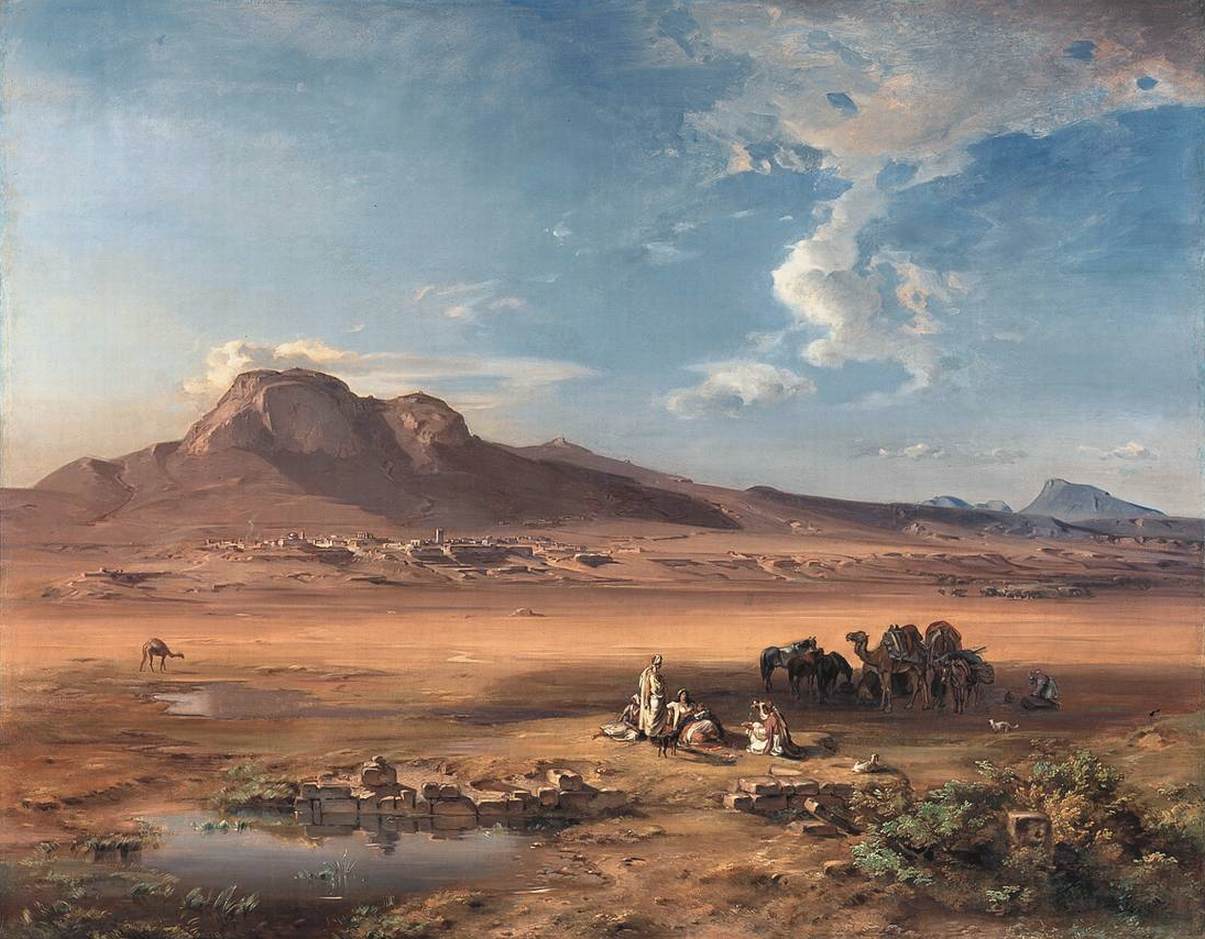
Carl Rottmann, Corinth with Akrocorinth, 1847. Public domain.
Acts 18:1, 1 Corinthians 1:2 and 2 Corinthians 1:1 · Place · Featured Study
Corinth
Corinth was the Roman city of Achaia where Paul founded the church to which he wrote 1 and 2 Corinthians.
After this, Paul left Athens and went to Corinth.
- Today
- Ancient Corinth, Greece
- Region
- Achaia, on the isthmus between the Peloponnese and mainland Greece
- Site
- 37.906, 22.879
- First named
- Acts 18:1 “…left Athens and went to Corinth.”
- Last named
- 2 Timothy 4:20 “Erastus has remained at Corinth, and Trophimus…”
A city Rome had rebuilt on Greek ruins became the home of one of Paul's churches.
Summary
Paul reached Corinth from Athens and stayed a year and a half. When the synagogue opposed him he taught next door in the house of Titus Justus. The proconsul Gallio refused to hear the case the Jews brought against him. He sailed for Syria from Cenchrea with Priscilla and Aquila.
- Seven verses of the Berean text name the city of Corinth.
- Romans 16:1 commends Phoebe, a servant of the church at Cenchrea, the city's eastern harbor.
- Paul came back to Greece later and stayed three months, Acts 20:2 to 3 records.
Paul at Corinth
Acts 18 gives the founding of the church at Corinth in eighteen verses.
So Paul stayed for a year and a half, teaching the word of God among the Corinthians.Corinth on Knecht's Plate
Corinth stands on the isthmus on Knecht's plate of Paul's journeys, with Cenchrea beside it to the east and Athens across the gulf.
Corinth stood on the isthmus of Greece, west of Athens and across the Aegean from Ephesus.
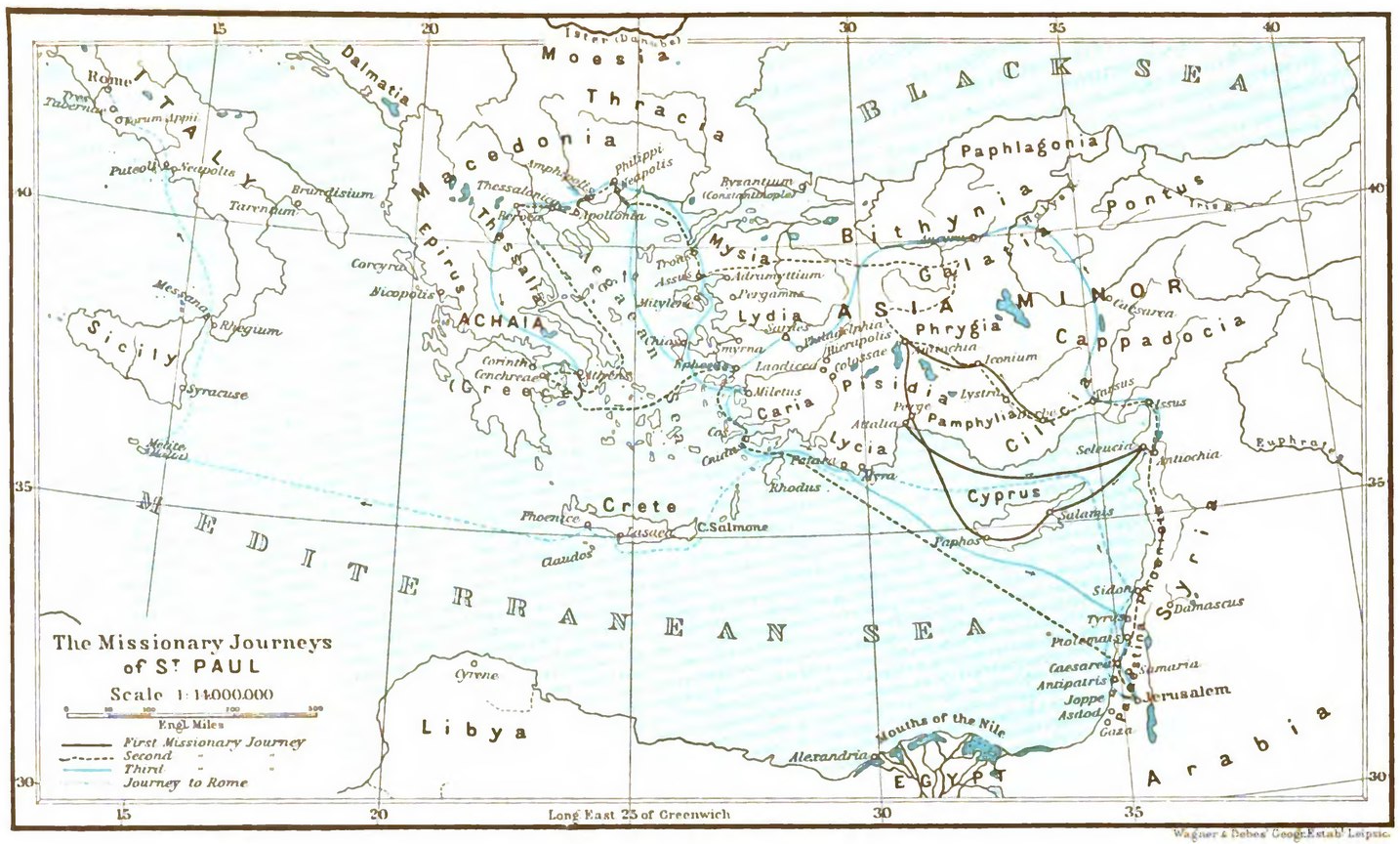
about 500 km (311 miles)
- 1Corinth, The city of the church greeted with all the saints of Achaia 2 Corinthians 1:1
- 2Cenchrea, The eastern harbor, home of the church of Phoebe Romans 16:1
- 3Athens, The city Paul left to go to Corinth Acts 18:1
- 4Ephesus, Where Paul parted from Priscilla and Aquila Acts 18:19
Base map: The missionary journeys of St. Paul, F. J. Knecht, Practical Commentary on Holy Scripture, public domain. Places with a place page stand at its coordinates and the others at the point cited for each, set on the plate by Corinth and Ephesus, as the plate prints them.
Four places, each with its verse. Each ring follows the OpenBible.info identification score out of 1,000; all four score 1,000.
Corinth in Scripture, in Order
These verses follow the city from Paul's arrival to the last word of it in 2 Timothy.
Nine verses on Corinth, from Paul's arrival to Erastus left behind.
- ActsPaul leaves Athens and goes to CorinthActs 18:1
- ActsCrispus and many of the Corinthians believeActs 18:8
- ActsThe Lord tells Paul He has many people in the cityActs 18:10
- ActsThe Jews bring Paul before Gallio's judgment seatActs 18:12
- ActsPaul keeps a vow at the harbor and sails for SyriaActs 18:18
- ActsApollos is at Corinth while Paul goes to EphesusActs 19:1
- 1 CorinthiansThe first letter opens with its greeting to the church1 Corinthians 1:2
- 2 CorinthiansPaul says he did not return to Corinth, to spare them2 Corinthians 1:23
- 2 TimothyPaul's coworker Erastus stays behind in the city2 Timothy 4:20
Six of the nine stand in Acts 18 and 19.
1 Corinthians, 2 Corinthians, 2 Timothy
What Strabo Wrote of Aphrodite's Temple
Strabo's account of Aphrodite's temple stands beside the traditional picture of Paul's Corinth.
Strabo wrote that the temple of Aphrodite was so rich that it owned more than a thousand temple slaves. They were courtesans whom both men and women had dedicated to the goddess. He set that line in his account of the city before Lucius Mummius razed it. Of the summit in his own day he wrote that it has a small temple of Aphrodite.
Many teachers have read Paul's Corinth as a city marked by that temple's worship, and Matthew Henry wrote of it so.
“In this city, though it be a very profane wicked city, full of impurity, and the more so for a temple of Venus there, to which there was a great resort, yet in this heap, that seems to be all chaff, there is wheat; in this ore, that seems to be all dross, there is gold. Let us not despair concerning any place, when even in Corinth Christ had much people.”
Matthew Henry · Commentary on the Whole Bible · on Acts 18:12Puritan
A Roman Colony on the Isthmus
The Corinth Paul knew was a Roman city built on the ruins of a Greek one.
Strabo says the Roman general Lucius Mummius razed Corinth to the ground. After it had lain deserted a long time, Caesar restored it and settled it mostly with freedmen.
Strabo names its two harbors, Lechaeum on one side and Cenchrea on the other, the second about seventy stadia from the city. Between the gulfs ran the Diolcus, where ships were hauled overland from one sea to the other.
What the Excavators Found
The American School of Classical Studies at Athens has dug at Corinth since 1896, and a letter found at Delphi names Gallio.
Gallio at DelphiA letter of Claudius, found at Delphi
Nine fragments of a letter of the emperor Claudius name Junius Gallio as proconsul. The letter was written in AD 52 and found at the temple of Apollo at Delphi. The inscription is a marker for dating the hearing of Acts 18:12 to 17, which Gallio held in AD 51 or 52.
The Erastus pavementFound in 1928, 1929 and 1947
Parts of an inscription were found near a paved area north-east of the theater. They read that Erastus, in return for his aedileship, paved it at his own expense. Romans 16:23 sends greetings from Erastus, the city treasurer.
What Scripture Leaves Unsaid
Paul names an earlier letter to Corinth that Scripture does not give.
Many People in This City
The Lord's word to Paul at night stands beside the greeting of the letter he later sent the church.
For I am with you and no one will lay a hand on you, because I have many people in this city.”To the church of God in Corinth, to those sanctified in Christ Jesus and called to be holy, together with all those everywhere who call on the name of our Lord Jesus Christ, their Lord and ours:These are the many people of Acts 18:10, now a church with a letter of its own.
Voices on Corinth
Three teachers from the third, fifth and sixteenth centuries wrote on Paul's coming to the city and his letter to it.
Origen of Alexandria (died 253)
Origen asked whom the letter was written to.
“Why did Paul write ‘to those called to be saints’ as well as to those who are already ‘sanctified’ and in the church? Surely this means that the letter is addressed not only to those who are already cleansed from their sins but also to those who still await cleansing, though they are among those whom God has called.”
Origen of Alexandria · Commentary on 1 Corinthians 1.1.7 · on 1 Corinthians 1:2Patristic
John Chrysostom (died 407)
John Chrysostom asked why Paul left Athens so soon.
“What can be the reason that, having persuaded some so far as to say that they would hear him again, and there being no dangers, Paul is so in haste to leave Athens? Probably he knew that he should do them no great good; moreover he was led by the Spirit to Corinth. For the Athenians, although fond of hearing strange things, nevertheless did not attend to him; for this was not their study, but only to be always having something to say; which was the cause that made them hold off from him. It seemed to Paul sufficient to have cast the seeds of the doctrines. To Corinth then, as I said, he was led by the Spirit, in which city he was to abide.”
John Chrysostom · Homily on Acts 39 · on Acts 18:1Patristic
John Calvin (1509 to 1564)
John Calvin set the city's wealth beside Paul's work there.
“Furthermore, Luke showeth in this place with what great labor, and how hardly, Paul did win the same to Christ. It is well known what a rich city Corinthus was by reason of the noble mart, how populous, how greatly given to pleasure. And the old proverb doth testify that it was sumptuous and full of riot: All men cannot go to Corinthus.”
John Calvin · Commentaries · on Acts 18:1Reformed
Christ and Him Crucified
Paul later reminded the church what he had preached when he first came to them.
For I resolved to know nothing while I was with you except Jesus Christ and Him crucified.Sources
Scripture is the Berean Standard Bible.
- James Strong, Exhaustive Concordance of the Bible (1890), Greek dictionary, entry 2882, with the STEP Bible brief lexicon.
- OpenBible.info, Bible-Geocoding-Data, ancient.jsonl, entries Corinth, Cenchreae, Athens and Ephesus (each score 1000)
- F. J. Knecht, Practical Commentary on Holy Scripture, the plate The Missionary Journeys of St. Paul.
- Origen, Commentary on 1 Corinthians 1.1.7, on 1 Corinthians 1:2.
- John Chrysostom, Homily 39 on the Acts of the Apostles, on Acts 18:1.
- John Calvin, Commentary upon the Acts of the Apostles (1554), on Acts 18:1.
- Strabo, Geography 8.2.1, 8.6.20 to 23, translated by Horace Leonard Jones, Loeb Classical Library (1927), with the translator's note 414 on 8.6.23.
- American School of Classical Studies at Athens, Ancient Corinth, the excavation's page.
- Wikipedia, Delphi Inscription (Fouilles de Delphes III 4:286)
- Wikipedia, Erastus of Corinth, the Erastus inscription, citing Alexander Weiß, Soziale Elite und Christentum (2015), 108 to 110, and the Packard Humanities Institute, Searchable Greek Inscriptions, PH209961.
- Wikipedia, Sacred prostitution, on Corinth, citing Rebecca Strong, The Most Shameful Practice: Temple Prostitution in the Ancient Greek World (University of California, Los Angeles, 1997), 74 to 75.
- Matthew Henry, Commentary on the Whole Bible (1710), on Acts 18:12.
- Albert Barnes, Notes, Explanatory and Practical, on the Old and New Testaments (1832 to 1869), on Acts 18:1.
Keep Studying
Read it5