

Popular Bible Encyclopedia of Archimandrite Nicephorus, Bethlehem, 1891. Public domain.
Genesis 49:8 to 12 · Place · Featured Study
The Land of Judah
Jacob's fourth son gave his name to a share of Canaan that outlasted the northern kingdom by more than a century.
Judah was named for praise, and the land that took his name gave Israel its kings and the Messiah His birthplace.
About that time, Judah left his brothers and settled near a man named Hirah, an Adullamite.
- Region
- The south of Canaan
- First named
- Deuteronomy 34:2 “all of Naphtali, the land of Ephraim…”
- Last named
- Matthew 2:6 “But you, Bethlehem, in the land of Judah,…”
Judah was named for praise, and the land that took his name gave Israel its kings and the Messiah His birthplace.
Summary
The land of Judah is the territory allotted to the tribe of Judah in the south of Canaan, which became the kingdom of Judah after Solomon.
- Leah named her fourth son Judah, and Jacob's blessing promised the scepter to his line.
- Joshua 15 draws the borders of Judah's lot and lists its towns district by district.
- When the kingdom divided, the tribe of Judah alone followed the house of David.
- Matthew names Bethlehem in the land of Judah as the town where the ruler of Israel would be born.
A Son Named for Praise
Genesis names Judah at his birth and later settles him among the Adullamites.
About that time, Judah left his brothers and settled near a man named Hirah, an Adullamite.Judah's first home apart from his brothers lay in the country that would carry his name.
The Hebrew dictionary of James Strong's concordance of 1890 gives Judah as the name of the son, of the tribe descended from him, and of its territory. Deuteronomy 34:2 is the first verse to call the territory the land of Judah, when the LORD shows it to Moses from the top of Pisgah.
The Hebrew dictionary of James Strong's concordance of 1890 gives Judah as the name of the son, of the tribe descended from him, and of its territory. Deuteronomy 34:2 is the first verse to call the territory the land of Judah, when the LORD shows it to Moses from the top of Pisgah.
Judah on Smith's Plate
George Adam Smith's plate of the kingdom's last century colours Judah apart from the Assyrian provinces to its north.
Judah held the hill country and the wilderness to its east, with Jerusalem on its northern edge.
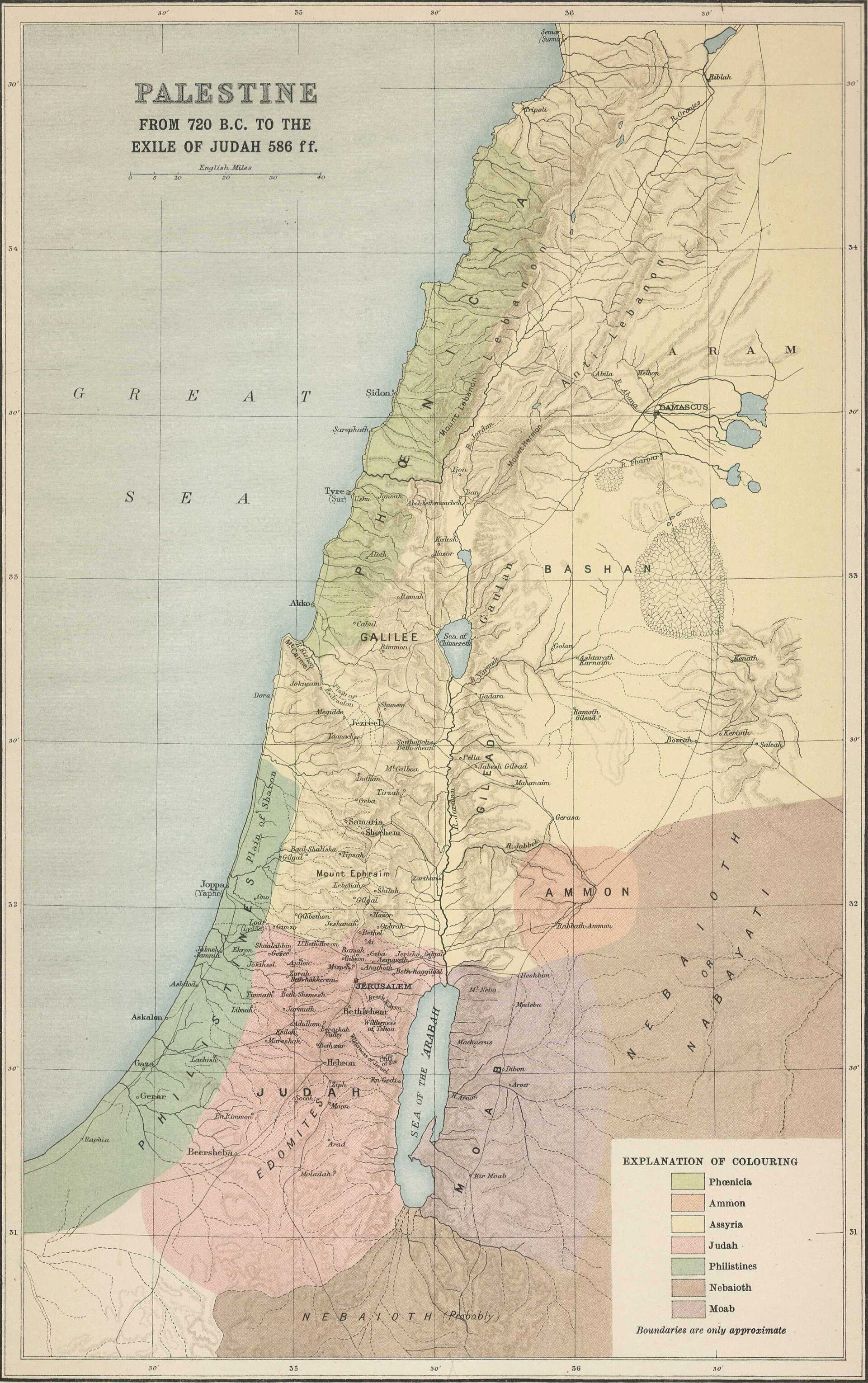
- JudahSmith prints the name across the pink of the kingdom's last century.2 Kings 17:18
- JerusalemThe northern border passed below the city along the Valley of Hinnom.
- BethlehemMicah names Bethlehem small among the clans of Judah, and a ruler comes from it.
- HebronJoshua gave Hebron to Caleb as his portion among the sons of Judah.
- AdullamJoshua 15:35 lists Adullam among the towns of the foothills.Genesis 38:12
- LachishJoshua lists Lachish among the towns of the foothills.
- BeershebaBeersheba stood in the Negev and marks the southern end of the phrase Dan to Beersheba.
- En-gediEn-gedi was one of the six towns of Judah's wilderness.
- The Salt SeaThe Salt Sea formed Judah's eastern border as far as the mouth of the Jordan.Joshua 15:5
George Adam Smith, Palestine from 720 BC to the Exile of Judah, Atlas of the Historical Geography of the Holy Land, 1915. Public domain; Wikimedia Commons, File:Palestine_from_720_BC_to_the_exile_of_Judah_(Smith,_1915).jpg.
Nine places are numbered where the plate prints them, from Jerusalem in the north to Beersheba in the south.
From Tribe to Kingdom
Scripture follows the name of Judah from a son's birth to a kingdom's exile and the promise of return.
Only the tribe of Judah remained when Samaria fell, and Jeremiah promised its land a blessing after the exile.
- Jacob's householdLeah bears her fourth son and names him JudahGenesis 29:35
- Jacob's blessingThe scepter is promised to JudahGenesis 49:10
- The first lotJudah's allotment reaches the border of Edom and the Wilderness of ZinJoshua 15:1
- After the conquestJudah and Simeon go up together against the CanaanitesJudges 1:3
- The fall of SamariaIsrael is removed, and only the tribe of Judah remains2 Kings 17:18
- RiblahJudah is taken into exile away from its own land2 Kings 25:21
- Jeremiah's promiseThe blessing will again be spoken in the land of JudahJeremiah 31:23
Each row gives the step and the verse that tells it.
The Borders of Judah's Lot
Joshua 15 draws Judah's lot on four sides, and Joshua 19 sets Simeon's towns inside it.
Their southern border started at the bay on the southern tip of the Salt Sea,The description of the whole allotment starts from the south-east corner.
It proceeded to Azmon, joined the Brook of Egypt, and ended at the Sea. This was their southern border.The Brook of Egypt is the limit Numbers 34:5 sets for the whole land on that side.
Adam Clarke, on Joshua 15:2, traces the southern limit from the end of the Dead Sea to Sihor, the river of Egypt, and the Mediterranean. He notes that some carried it as far as the Nile. Joshua 15:12 makes the coastline of the Great Sea the western border.
The inheritance of the Simeonites was taken from the territory of Judah, because the share for Judah’s descendants was too large for them. So the Simeonites received an inheritance within Judah’s portion.The verse gives the reason Simeon's inheritance was carved from Judah's.
Judah and the House of David
Judah crowned David first, and Judah stayed with his grandson when the other tribes left.
Then the men of Judah came to Hebron, and there they anointed David king over the house of Judah. And they told David, “It was the men of Jabesh-gilead who buried Saul.”David reigned at Hebron over Judah alone for seven years and six months before he reigned over all Israel.
And when Rehoboam arrived in Jerusalem, he mobilized the whole house of Judah and the tribe of Benjamin—180,000 chosen warriors—to fight against the house of Israel and restore the kingdom to Rehoboam son of Solomon.Benjamin's place in this muster is the fact the readings of 1 Kings 11:13 turn on.
Albert Barnes, on 1 Kings 12:21, finds Benjamin's loyalty to Judah a surprise, since by blood Benjamin was closer to Ephraim.
What Scripture Leaves Unsaid
Scripture leaves two things about the land of Judah untold.
Joshua 15 does not give the year in which each of Judah's towns was taken.
Joshua 19:9 says that Judah's share was too large for it and does not say by how much.
The Ruler from the Land of Judah
Matthew and Hebrews trace Christ's birth and descent to Judah's land and tribe.
‘But you, Bethlehem, in the land of Judah, are by no means least among the rulers of Judah, for out of you will come a ruler who will be the shepherd of My people Israel.’”The chief priests answer Herod with Micah 5:2, and Matthew names the town by its land.
For it is clear that our Lord descended from Judah, a tribe as to which Moses said nothing about priests.The point serves the argument of Hebrews 7 that Christ is a priest of another order than Aaron's.
Adam Clarke, on Hebrews 7:14, reasons that the writer spoke with such confidence because Christ's descent from Judah was beyond dispute, and that the genealogies of Matthew and Luke establish it.
The Voices on Judah
Ambrose, John Calvin, Matthew Henry and John Wesley wrote on Judah's line, its lot and its town.
died 397 · Ambrose of Milan
Ambrose of Milan reads the vine of Jacob's blessing as Christ, to whom the believer is bound.
“Let us be bound with bonds of a faith that is like a fruitful branch and cannot be undone, as it were, to that everlasting vine, that is, to the Lord Jesus, who says, ‘I am the vine; my Father is the gardener.’ This explains the mystery that the Lord Jesus in the Gospel ordered an ass's colt to be loosed and himself sat upon it; thus, like one that was bound to a vine, he could find rest in the everlasting goodness of the saints.”
Ambrose of Milan · On the Blessings of the Patriarchs · on Genesis 49:11Patristic
1509 to 1564 · John Calvin
John Calvin weighs the shame of Judah's house in the line of Christ.
“What is here related, so far from inflating the minds of the sons of Judah, ought rather to cover them with shame. Now although, at first sight, the dignity of Christ seems to be somewhat tarnished by such dishonor: yet since here also is seen that ‘emptying’ of which St. Paul speaks, it rather redounds to his glory, than, in the least degree, detracts from it.”
John Calvin · Commentaries · on Genesis 38:1Reformed
1662 to 1714 · Matthew Henry
Matthew Henry finds equity, and Jacob's word on Simeon, in the land taken from Judah's lot.
“The abundance of some must supply the wants of others, that there may be somewhat of an equality, for which there may be equity where there is not law. That which was thus taken off from Judah to be put into a new lot Providence directed to the tribe of Simeon, that Jacob's prophecy concerning this tribe might be fulfilled, I will divide them in Jacob.”
Matthew Henry · Commentary on the Whole Bible · on Joshua 19:9Puritan
1703 to 1791 · John Wesley
John Wesley explains why Matthew's wording of Micah differs from the prophet's.
“When this and several other quotations from the Old Testament are compared with the original, it plainly appears, the apostles did not always think it necessary exactly to transcribe the passages they cited, but contented themselves with giving the general sense, though with some diversity of language.”
John Wesley · Explanatory Notes upon the New Testament · on Matthew 2:6Evangelical
Matthew Henry, John Wesley
Which Tribe Is the One Tribe?
Ahijah gives Jeroboam ten tribes and leaves one to David's house, though twelve pieces were torn.
Yet I will not tear the whole kingdom away from him. I will give one tribe to your son for the sake of My servant David and for the sake of Jerusalem, which I have chosen.”The LORD's promise to Solomon counts what is left to his son as a single tribe.
Judah, with Benjamin absorbed in itAlbert Barnes
Albert Barnes, on 1 Kings 11:13, takes the one tribe as Judah and holds that Benjamin was looked on as absorbed in Judah. He reads the two pieces Ahijah kept back as a memory that the tribe of Judah was a double one.
The objection: Rehoboam musters the whole house of Judah and the tribe of Benjamin as two bodies in 1 Kings 12:21.
Judah, because Benjamin was dividedJohn Wesley
John Wesley, on 1 Kings 11:13, notes that Benjamin was not wholly Rehoboam's, since Bethel and Ephron, towns of Benjamin, went with Jeroboam.
The objection: 2 Chronicles 11:12 says that Judah and Benjamin belonged to Rehoboam.
Everyone who stayed with RehoboamJamieson, Fausset and Brown
Jamieson, Fausset and Brown, on 1 Kings 11:13, count Judah, Benjamin, the Levites and the Israelites who moved south for the sake of worship as one tribe. They cite 2 Chronicles 11:12 and 13.
The objection: 1 Kings 12:20 says that only the tribe of Judah followed the house of David.
The Lion of the Tribe of Judah
The land of Judah held David's throne until the exile, and the promise made to Judah outlived the kingdom. Christ came from this tribe, and Revelation 5 asks the reader to trust Him as the King the promise to Judah has produced, and to worship Him.
Then one of the elders said to me, “Do not weep! Behold, the Lion of the tribe of Judah, the Root of David, has triumphed to open the scroll and its seven seals.”The elder joins the tribe of Judah and the Root of David in one title for Christ.
Sources
Scripture is the Berean Standard Bible.
- James Strong, Exhaustive Concordance of the Bible (1890), Hebrew dictionary, entry 3063.
- Adam Clarke, Commentary on the Bible (1832), on Joshua 15:2.
- Adam Clarke, Commentary on the Bible (1832), on Hebrews 7:14.
- Albert Barnes, Notes, Explanatory and Practical, on the Old and New Testaments, on 1 Kings 11:13 and 12:21.
- John Wesley, Explanatory Notes upon the Old Testament (1765), on 1 Kings 11:13.
- Jamieson, Fausset and Brown, Commentary Critical and Explanatory on the Whole Bible (1871), on 1 Kings 11:13.
- Ambrose of Milan, On the Blessings of the Patriarchs, on Genesis 49:11.
- John Calvin, Commentaries (1554), on Genesis 38:1.
- Matthew Henry, Commentary on the Whole Bible (1710), on Joshua 19:9.
- John Wesley, Explanatory Notes upon the New Testament (1755), on Matthew 2:6.
Keep Studying
Read it4
Studies4
People and groups6
Places9
Symbols1