
The sixth century to today · Subject · Featured Study
Renewal in the Western Church
Monks, friars and praying students who sought again, inside the Western church, the life the apostles shared.
In 910 William of Aquitaine gave Cluny to monks who would live by the Rule of Benedict and, after their first abbot died, choose their own abbot without any power hindering them.
- Books
- Psalms, Romans, Matthew, Acts
- Hold in memory
- Psalm 119:164, Matthew 19:21
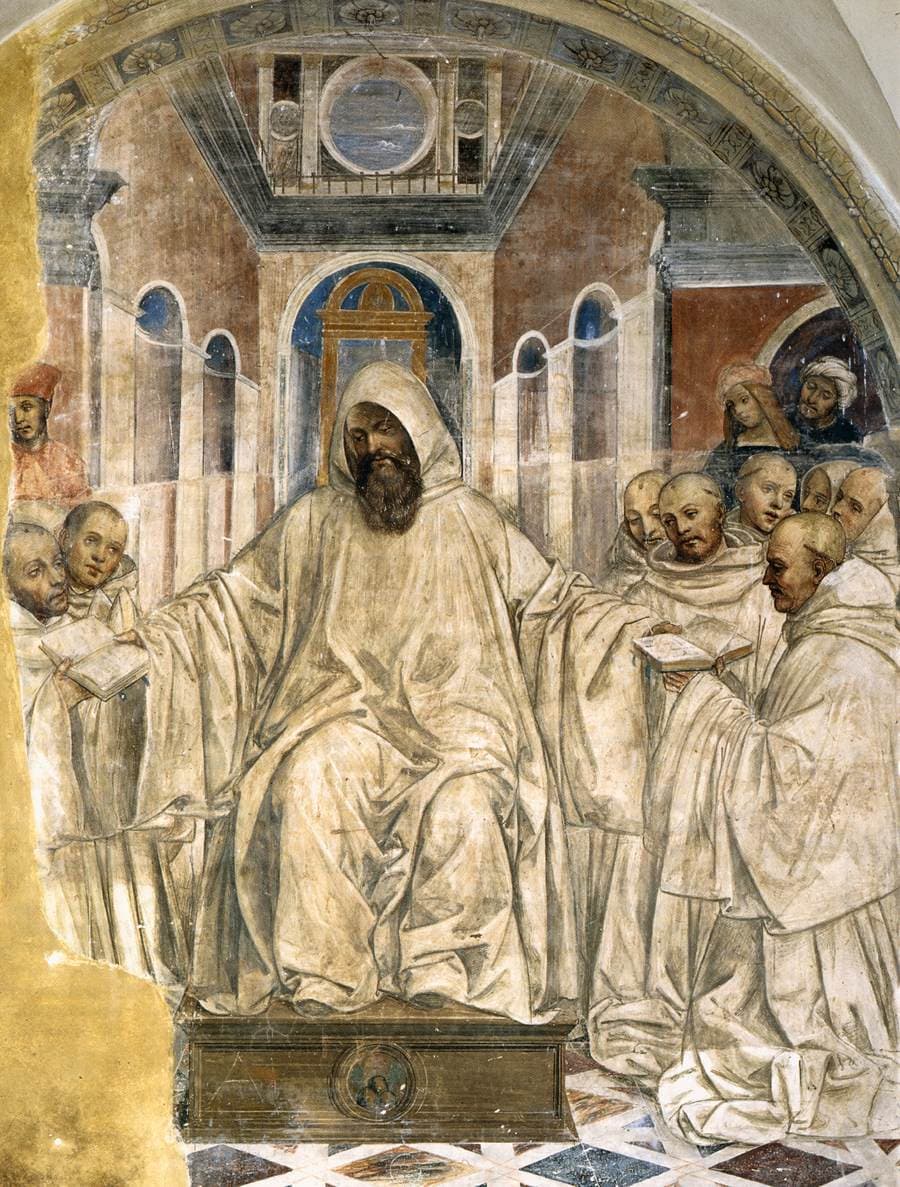
Sodoma, Benedict Presents the Olivetan Monks with His Rule, 1505 to 1508. Public domain.
Jesus told him, “If you want to be perfect, go, sell your possessions and give to the poor, and you will have treasure in heaven. Then come, follow Me.”
Summary
Benedict's Rule, Cluny's charter, Francis's Rules and the retreat of 1967 each turned believers back to Christ's words. Each step rests on its own documents.
- Francis bound his brothers to the Gospel without property.
- Wesley met the Imitation of Christ in 1726.
- Catholic students prayed for the Spirit at Duquesne in 1967.
- Calvin judged the monks of his day by the early monks.
The Texts the Renewals Returned To
The texts come from Psalm 119, Romans 13, Matthew 19 and Acts 2.
The monks, the friars and the students of 1967 each drew on a text of Scripture.
Benedict's hours
Seven times a day I praise You for Your righteous judgments.
Benedict's Rule, chapter 16, sets its seven hours of prayer by day by this verse.
The call to wake
And do this, understanding the occasion. The hour has come for you to wake up from your slumber, for our salvation is nearer now than when we first believed.
Benedict's prologue calls the monk to begin with this verse, in Hunter Blair's English “It is time now for us to rise from sleep.”
Romans 13:11BSB
Francis's first text
Jesus told him, “If you want to be perfect, go, sell your possessions and give to the poor, and you will have treasure in heaven. Then come, follow Me.”
Francis's first Rule quotes this call in its opening chapter.
The first Pentecost
And they were all filled with the Holy Spirit and began to speak in other tongues as the Spirit enabled them.
Luke tells the first Pentecost here, the event the Catholic Pentecostal movement took its name from.
Acts 2:4BSB
Romans 13:11, Matthew 19:21, Acts 2:4
The Renewals by Date
Nine rows from the Rule of Benedict to 2019, each with its witness.
From the Rule of Benedict to the charismatic renewal, each step is dated by its own document or its nearest witness.
| When | What happened | The witness |
|---|---|---|
| The sixth century, the year not known | Benedict writes his Rule for monks. | Hunter Blair's edition and translation, 1907 |
| 11 September 910 | William of Aquitaine founds Cluny under the Rule. | The foundation charter, in Henderson's Select Historical Documents, 1896 |
| 23 April 1209, or the summer of 1210 | Innocent III approves Francis's first Rule by word of mouth. | Robinson, 1906, with the Bollandists; Sabatier, following Wadding |
| 29 November 1223 | Pope Honorius III approves the friars' later form of life. | Robinson, 1906 |
| 4 December 1563 | The Council of Trent closes. | Schaff, The Creeds of Christendom, volume 3 |
| 1726 | Wesley meets Kempis's Christian's Pattern. | Wesley's Plain Account of Christian Perfection |
| 17 to 19 February 1967 | Duquesne students hold their retreat on the Holy Spirit. | One secondary account |
| 1971 | About 5,000 register for the conference at Notre Dame. | Christianity Today |
| 2019 | A worldwide figure is given at Rome. | A news agency report |
17 to 19 February 1967, 1971, 2019
The Rule of Benedict and the Reform of Cluny
A school of the Lord's service, and a house under the apostles at Rome.
The Rule of Benedict comes from the sixth century, and Hunter Blair edited and translated it at London in 1907. Its prologue sets out its aim: “We have, therefore, to establish a school of the Lord's service, in the setting forth of which we hope to order nothing that is harsh or rigorous.”
Chapter 4 lists the instruments of good works, and the twenty-first reads, “To prefer nothing to the love of Christ.”
Chapter 16 keeps the psalmist's “sacred number of seven” in the hours of “Lauds, Prime, Tierce, Sext, None, Vespers and Compline,” and adds prayer in the night.
Cluny's charter of 910 stands in Henderson's English of 1896. It gives the land for a monastery “in honour of the holy apostles Peter and Paul,” where the monks “shall congregate and live according to the rule of St. Benedict.”
Every five years they paid ten shillings to “the church of the apostles at Rome,” and they had “the defence of the Roman pontiff.”
Francis and the Gospel Life
The two Rules and the Canticle, in Paschal Robinson's English of 1906.
Robinson dates Innocent III's approval of the first Rule by word of mouth to 23 April 1209, following the Bollandists. He notes that Sabatier, following Wadding, places it in the summer of 1210.
The first Rule opens, “The Rule and life of these brothers is this: namely, to live in obedience and chastity, and without property, and to follow the doctrine and footsteps of our Lord Jesus Christ.”
Honorius III later confirmed a second Rule, which binds the brothers “to observe the holy Gospel of our Lord Jesus Christ, by living in obedience, without property and in chastity.”
Chapter 17 of the first Rule forbids a brother to preach without his minister's leave, and then adds, “Nevertheless, let all the brothers preach by their works.”
Robinson heads the Canticle of the Sun as the praises Francis made “while he was ill at St. Damian's,” and its first line calls God “Most high, omnipotent, good Lord.”
The Religion of the Heart, From Kempis to Wesley
What Wesley found in Kempis in 1726, in his own account.
John Wesley wrote in his Plain Account of Christian Perfection, “In the year 1726, I met with Kempis's ‘Christian's Pattern.’”
He goes on, “The nature and extent of inward religion, the religion of the heart, now appeared to me in a stronger light than ever it had done before.”
The Spirit Among Catholic Students, 1967
The retreat at Duquesne, a participant's account, and how a magazine reported it.
The Wikipedia article on the Duquesne Weekend, a secondary account, places the retreat at The Ark and the Dove in Gibsonia, Pennsylvania.
It says the leaders, Ralph Keifer and William Storey, had been given The Cross and the Switchblade and They Speak With Other Tongues.
Before the retreat both were baptized in the Holy Spirit at “an Episcopalian charismatic prayer group.”
Patti Gallagher Mansfield, one of the retreatants, describes the Saturday night in an undated account the article quotes: “Some were laughing, others crying. Some prayed in tongues, others (like me) felt a burning sensation coursing through their hands.”
Christianity Today reported on 16 July 1971 that “The Catholic Pentecostal movement began spontaneously on several fronts in early 1967, most notably at a weekend retreat of students at Duquesne University in Pittsburgh.”
The magazine wrote that in 1968 the hierarchy's Committee on Doctrine was told to investigate, and that its report found “a strong biblical basis” and cautioned against “the mistakes of classic Pentecostalism.”
It gave the movement's size as an estimated 50,000 American and Canadian Catholics in 1971, with no method stated.
In 2019 Bishop Peter Smith, a leader of CHARIS, told Catholic News Agency of “an estimated 100 to 112 million active members of the charismatic renewal worldwide.”
He gave no method of counting.
Renewals of the Gospel, or of Discipline?
The Rules' claim to follow Christ, and Calvin's answer in the Institutes.
The founders of these orders, Francis and Benedict among them, wrote their Rules as a return to the Gospel itself.
John Calvin answers in his Institutes, whose definitive edition is of 1559, in Henry Beveridge's English of 1845. In book IV, chapter 13, he grants the early monks their discipline and warns that “the ancient mode of living in monasteries was very different” from the monks of his own day.
Books to Read Next
The Rule of Saint Benedict
Benedict, edited and translated by Hunter Blair · 1907
It gives the Rule in Hunter Blair's English, with his notes.
Free at the Internet ArchiveThe Writings of Saint Francis of Assisi
Francis of Assisi, translated by Paschal Robinson · 1906
It holds both Rules, the Canticle and Robinson's notes on their dates.
Free at the Internet ArchiveSelect Historical Documents of the Middle Ages
Ernest F. Henderson, translator · 1896
It prints the foundation charter of Cluny.
Free at the Internet ArchiveWhat the Renewals Hand On
The renewals hand on a pattern: a few believers read the Gospels again and order their common life by what they read.
Their own documents let a reader test each claim to have returned to the apostles, and Calvin's answer stands beside them.
Sources
Scripture is the Berean Standard Bible.
- The Holy Bible, Berean Standard Bible (read 2026)
- The Rule of Saint Benedict (sixth century), edited and translated by Hunter Blair (London: Sands; St. Louis: Herder, 1907), the prologue and chapters 4 and 16.
- The Foundation Document of Cluny (11 September 910), in Ernest F. Henderson, Select Historical Documents of the Middle Ages (London, 1896), book IV.
- Paschal Robinson, The Writings of Saint Francis of Assisi (Philadelphia, 1906): the first Rule, chapters 1 and 17; the second Rule, chapter 1; the Canticle of the Sun; the introduction to the Rules.
- John Wesley, A Plain Account of Christian Perfection, section 3, in The Works of John Wesley, edited by Thomas Jackson (1872), volume 11.
- Thomas a Kempis, The Imitation of Christ, translated by William Benham, Project Gutenberg eBook 1653 (read 2026; the translation's year not known)
- Philip Schaff, The Creeds of Christendom, volume 3, the note on the Heidelberg Catechism's question 80: the Council of Trent closed December 4, 1563.
- Wikipedia, Duquesne Weekend (read 2026), a secondary account.
- Christianity Today, Catholics Get the Spirit, 16 July 1971.
- Catholic News Agency, 9 June 2019, as printed by Catholic World Report.
- John Calvin, Institutes of the Christian Religion (definitive edition 1559), book IV, chapter 13, sections 8 to 10, translated by Henry Beveridge (1845)
Keep Studying
People and groups6
Subjects1
Church history6
Values1