
Nicaea, AD 325 · Story · Featured Study
The Council of Nicaea
Why the empire's bishops gathered in Bithynia, and the eyewitness letters that still divide historians over one word.
No minutes of the council survive, and its creed is known from the acts of later councils, from Eusebius, from Athanasius and from the historians.
- Where
- Nicaea, Alexandria
- Who
- Arius, Alexander, Athanasius of Alexandria, Eusebius of Caesarea, Constantine
- When
- summer of AD 325
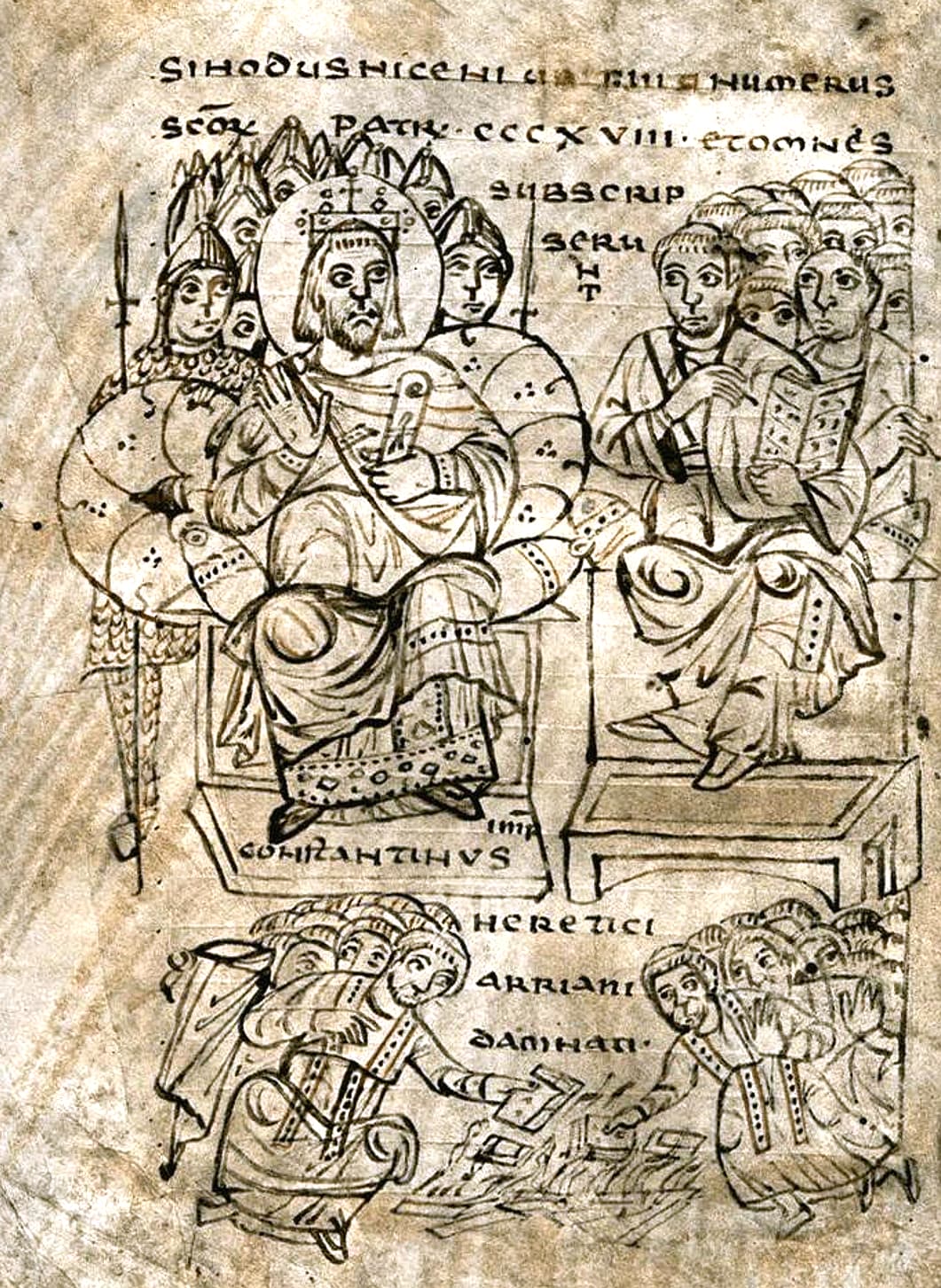
Unknown artist, Constantine and the Council of Nicaea, about 825. Public domain.
In the beginning was the Word, and the Word was with God, and the Word was God.
Summary
In 325 the emperor Constantine called the bishops to Nicaea. Arius, a presbyter of Alexandria, had taught that the Son of God had a beginning. The bishops' creed called the Son begotten and not made, and of one substance with the Father.
- Arius read Proverbs 8:22 to say the Son was made. His bishop answered from Hebrews 1:3.
- Eusebius and Athanasius disagree on who chose the creed's key word.
- The count of the bishops and the first day are each given more than one way.
The Verses the Quarrel Turned On
One verse each side pressed, and the creed's own words from John 1.
Both sides argued from Scripture, and each of these verses was pressed by one side of the quarrel.
The LORD created me as His first course, before His works of old.Athanasius says the Arians read this verse of the Son, and he read it of the Word's taking a body.
The Son is the radiance of God’s glory and the exact representation of His nature, upholding all things by His powerful word. After He had provided purification for sins, He sat down at the right hand of the Majesty on high.Arius's bishop, Alexander, answered him with this verse.
Through Him all things were made, and without Him nothing was made that has been made.The creed of 325 says of the Son, “By whom all things were made.”
Who Tells the Council
Five works by three writers, the earliest first.
The account rests on two men who were there, and each wrote for his own side.
| Witness | Written | Where he stood |
|---|---|---|
| Eusebius of Caesarea, letter to his church | After the council, 325 | A signer, writing home to Caesarea |
| Eusebius, Life of Constantine | 337 to 340 | The emperor's admirer, writing after his death |
| Athanasius, On the Decrees of Nicaea | About 352 | Alexander's successor, the council's defender |
| Athanasius, To the Bishops of Africa | About 369 | The same writer, a generation later |
| Socrates, Church History | A history ending in 439 | A later historian who copies Eusebius's letter |
The Council Told Plainly, From Alexandria to Nicaea
A presbyter's quarrel with his bishop became a council of the whole church.
Socrates tells that Alexander, bishop of Alexandria, was teaching on the Trinity when one of his presbyters, Arius, answered him.
“If,” he said, “the Father begat the Son, he that was begotten had a beginning of existence: and from this it is evident, that there was a time when the Son was not.”
Arius wrote to Eusebius of Nicomedia that before the Son “was begotten, or created, or purposed, or established, He was not.”
The emperor Constantine summoned a council by letter. Eusebius of Caesarea says he gave some bishops the public means of travel and chose “the city Nicæa in Bithynia.”
Eusebius was present, and he writes that the emperor entered in a purple robe adorned “with the brilliant splendor of gold and precious stones,” and sat only when the bishops beckoned to him.
So the apostles and elders met to look into this matter.Like Nicaea, the Jerusalem meeting gathered the church's leaders to settle one disputed question.
Constantine spoke in Latin, and another man put his words into Greek. He told the bishops that strife within the church was worse than any war.
Eusebius writes that then “a violent controversy arose at the very commencement,” and that the emperor heard every side with patience.
that all of them may be one, as You, Father, are in Me, and I am in You. May they also be in Us, so that the world may believe that You sent Me.Jesus prayed that His people be one, the unity the emperor said he wanted.
The creed the council set forth confesses the Son “begotten (gennethenta), not made, being of one substance (homoousion, consubstantialem) with the Father.”
Its anathema falls on any who say “that there was a time when the Son of God was not.”
I and the Father are one.”Athanasius set Jesus's words beside the council's word one in essence.
After the council Constantine wrote that the followers of Arius should be called Porphyrians and that any book of Arius be burned. Anyone found hiding one was to die.
Easter, the Canons and the Books of Scripture
Its ruling on Easter and its twenty canons.
Eusebius says the bishops agreed on the faith and on the time of Easter, and each member signed what was written.
The emperor's letter says Easter was to be kept “by all and in every place on one and the same day” across the church. It rests that ruling on a long attack on the Jews.
The ancient collections give the council twenty canons. They set the rights of the bishop of Alexandria, the receiving of the Novatians and the rebaptism of the followers of Paul of Samosata.
A story often told says Nicaea chose the books of the Bible. No canon, nor the creed, nor the synod's letter lists them, and the lists of the books came later, in letters and in regional synods.
What the Record Leaves Unsaid
Where the witnesses differ, and a legend told long after.
The count of the bishops is not known. Eusebius, who was there, wrote that they “exceeded two hundred and fifty.” Athanasius wrote about 352 that they were “three hundred more or less.”
The number 318 appears in Athanasius's letter to the bishops of Africa, of about 369, more than forty years after the council. His editor, Archibald Robertson, ties the number to Genesis 14:14.
And when Abram heard that his relative had been captured, he mobilized the 318 trained men born in his household, and they set out in pursuit as far as Dan.Robertson's note on the count points to this verse.
The day is given two ways. Socrates read in the record that the synod was convened on 20 May. Hefele found 19 June in the copy of the creed read at Chalcedon, and held that the council opened in May and set out its creed in June.
The story that Nicholas of Myra struck Arius is later tradition. The Catholic Encyclopedia of 1911 notes that Nicholas is named in none of the old lists of the bishops. The Teubner edition of the lists (1898) says three later lists seem to have taken his name from his Life.
How the Key Verse Was Taught
Four writers on John 1:1, from the third century to the sixteenth.
Tertullian (died 220)
Against Praxeas
Tertullian, the earliest of the four, read the verse as two who are God, One who was and One with whom He was.
“That is a still grander statement which you will find expressly made in the Gospel: ‘In the beginning was the Word, and the Word was with God, and the Word was God.’ There was One ‘who was,’ and there was another ‘with whom’ He was.”
on John 1:1Patristic
John Chrysostom (died 407)
Homilies on the Gospel of John 2
John Chrysostom, preaching on John, set the Son begotten of the Father against any who would count Him second.
“we confess that the Father is from none, and that the Son is begotten of the Father.”
Patristic
Augustine of Hippo (died 430)
Tractates on the Gospel of John 1.11
Augustine answered at Hippo the Arian claim that the Word of God was made.
“How can it be that the Word of God was made, when God by the Word made all things? If the Word of God was itself also made, by what other Word was it made?”
Patristic
John Calvin (1509 to 1564)
Institutes of the Christian Religion 1.13.22
John Calvin, in the Institutes, used the verse to show the Word a distinct person with the Father from eternity.
“For when John declares that before the world was created the Logos was God (John 1:1), he shows that he was something very different from an idea.”
Reformed
Augustine of Hippo, John Calvin
In Their Own Words
Arius, his bishop, a signer and the council's defender.
Alexander of Alexandria (died 328)
Letter to Alexander of Byzantium, in Theodoret, Ecclesiastical History 1.3
The Son always existed
“And in accordance with this we believe that the Son always existed of the Father; for he is the brightness of His glory, and the express image of His Father's Person”
Early Church
About this saying1 paragraph
Alexander of Alexandria wrote against Arius to Alexander of Byzantium before the council of 325, and Theodoret keeps his letter as well as Arius's.
Eusebius of Caesarea (died 339)
Letter to the people of his diocese, in Socrates, Ecclesiastical History 1.8
For the sake of peace
“We ourselves therefore concurred in this exposition; nor do we cavil at the word ‘homoousios’ having regard to peace, and fearing to lose a right understanding of the matter.”
Patristic
About this saying1 paragraph
After the council of 325 he explained to his people why he had signed. Socrates copies the letter, here in A. C. Zenos's revision in the Nicene and Post-Nicene Fathers.
Athanasius of Alexandria (296 to 373)
On the Incarnation of the Word, 54.3
Made man that we might be made God
“For He was made man that we might be made God ; and He manifested Himself by a body that we might receive the idea of the unseen Father; and He endured the insolence of men that we might inherit immortality.”
Early Church
About this saying1 paragraph
His editor gives On the Incarnation the probable date 318, before the quarrel came to Nicaea.
Arius
Letter to Eusebius of Nicomedia, in Theodoret, Ecclesiastical History 1.4
A Son with a beginning
“We are persecuted, because we say that the Son has a beginning, but that God is without beginning.”
Presbyter of Alexandria
About this saying1 paragraph
Arius wrote to Eusebius of Nicomedia before the council. Theodoret keeps the letter, given here in Blomfield Jackson's English of 1892.
Athanasius of Alexandria, Arius
Where the Witnesses Disagree
Who chose the word one in essence, whether a word not in Scripture may be the test, and who refused.
Who put “one in essence” into the creed?3 paragraphs
In his letter home, Eusebius says the emperor approved his own creed first and urged all to sign it. He adds, “with the insertion, however, of that single word ‘homoousios’ (consubstantial), an expression which the emperor himself explained.”
Athanasius wrote that the bishops first meant to use the words of Scripture. The party of Eusebius of Nicomedia were “caught whispering to each other and winking with their eyes” that those words fitted creatures as well, so the bishops wrote “one in essence.”
John Henry Newman, in The Arians of the Fourth Century (1833), held that the bishops had to overcome their own reluctance to adopt a word “which was not found in Scripture.” H. M. Gwatkin, in Studies of Arianism (1900), held that the emperor followed the council and then pressed the holdouts: “Whatever pleased the council pleased the emperor too.”
May a word that Scripture does not use be the test?4 paragraphs
The creed of Sirmium of 357 said there ought to be no mention of essence in the church, “for this reason and for this consideration, that in divine Scripture nothing is written about them.”
Eusebius of Caesarea had already noted that the Arian phrases were not in Scripture either: no Scripture contains “there was a time when he was not.”
Hilary of Poitiers, in On the Councils, wrote that the word must be explained and not used alone, and “let no one think that our words were meant to deny the one substance. We are giving the very reason why it should not be denied.”
MannaFest stands in the Wesleyan-Pentecostal line, which confesses with Wesley's Articles of Religion of 1784 three persons “of one substance, power, and eternity.”
Who refused to sign?3 paragraphs
Socrates names five who would not receive the creed, Eusebius of Nicomedia, Theognis, Maris, Theonas and Secundus, and says Eusebius and Theognis were exiled with Arius.
His editor, A. C. Zenos, writes that “The letter of the Council only mentions two,” Theonas and Secundus. Eusebius and Theognis later wrote, “we subscribed the declaration of faith; we did not subscribe the anathematizing.”
Zenos adds that Jerome and Philostorgius ascribe the exile of Eusebius and Theognis “to a later period and a different cause.”
The strongest evidence against the bishops' freedom1 paragraph
The evidence that the emperor decided the matter is the witnesses' own. Eusebius gives Constantine the word, and Athanasius, the other witness, gives it to the bishops and wrote as their party's champion.
Books to Read Next
The Seven Ecumenical Councils
Henry R. Percival, editor · 1899
It prints the creed, the canons and the synod's letter of Nicaea in English.
Free at the Christian Classics Ethereal LibraryThe Arians of the Fourth Century
John Henry Newman · 1833
Newman tells the quarrel from Alexandria to the council and reads the word one in essence.
Free at the Internet ArchiveStudies of Arianism
H. M. Gwatkin · 1900
Gwatkin weighs the emperor's part and the bishops' in the second edition of his study.
Free at the Internet ArchiveWhat the Council Left
Nicaea answered a presbyter who said the Son had a beginning with a creed that calls Him begotten and not made. The church still confesses that answer, and the council's own letters show how hard it was won.
Sources
Scripture is the Berean Standard Bible.
- The Holy Bible, Berean Standard Bible (read 2026)
- Henry R. Percival, ed., The Seven Ecumenical Councils, Nicene and Post-Nicene Fathers, second series, volume 14 (preface dated Pentecost 1899): the creed of Nicaea, its canons and the synodal letter.
- Socrates, Ecclesiastical History 1.5, 1.8, 1.9, 1.13 and 1.14, revised by A. C. Zenos, Nicene and Post-Nicene Fathers, second series, volume 2 (CCEL print basis 1886), with Eusebius of Caesarea's letter to his church in 1.8 and Zenos's introduction.
- Theodoret, Ecclesiastical History 1.3 and 1.4 (the letters of Alexander and of Arius), translated by Blomfield Jackson, Nicene and Post-Nicene Fathers, second series, volume 3 (1892)
- Eusebius, Life of Constantine 3.6 to 3.20, revised by E. C. Richardson, Nicene and Post-Nicene Fathers, second series, volume 1 (1890), with Richardson's prolegomena.
- Athanasius, On the Decrees of Nicaea 3, 16, 19 and 20, To the Bishops of Africa 2, Discourses against the Arians 2.1 and 2.44, and On the Councils 28, edited by Archibald Robertson, Nicene and Post-Nicene Fathers, second series, volume 4 (1892)
- Charles Joseph Hefele, A History of the Councils of the Church, volume 1, translated by William R. Clark, second edition (Edinburgh: T. and T. Clark, 1872), pages 274 to 275.
- Heinrich Gelzer, Heinrich Hilgenfeld and Otto Cuntz, eds., Patrum Nicaenorum nomina (Leipzig: Teubner, 1898), praefatio.
- Michael Ott, St. Nicholas of Myra, The Catholic Encyclopedia, volume 11 (New York, 1911)
- John Henry Newman, The Arians of the Fourth Century (London: Rivington, 1833), pages 271 to 273.
- H. M. Gwatkin, Studies of Arianism, second edition (Cambridge: Deighton Bell, 1900), page 52.
- Hilary of Poitiers, On the Councils 70, translated by E. W. Watson and others, Nicene and Post-Nicene Fathers, second series, volume 9 (1898)
- The Methodist Articles of Religion (1784), article 1, in Philip Schaff, The Creeds of Christendom, volume 3.
- Tertullian, Against Praxeas 13, translated by Peter Holmes, Ante-Nicene Fathers, volume 3.
- John Chrysostom, Homilies on the Gospel of John 2, Nicene and Post-Nicene Fathers, series 1, volume 14.
- John Calvin, Institutes of the Christian Religion 1.13.22, translated by Henry Beveridge.
- Augustine, Tractates on the Gospel of John 1.11, translated by John Gibb, Nicene and Post-Nicene Fathers, first series, volume 7 (CCEL print basis 1886)
Keep Studying
People and groups11
Subjects1
Church history2