
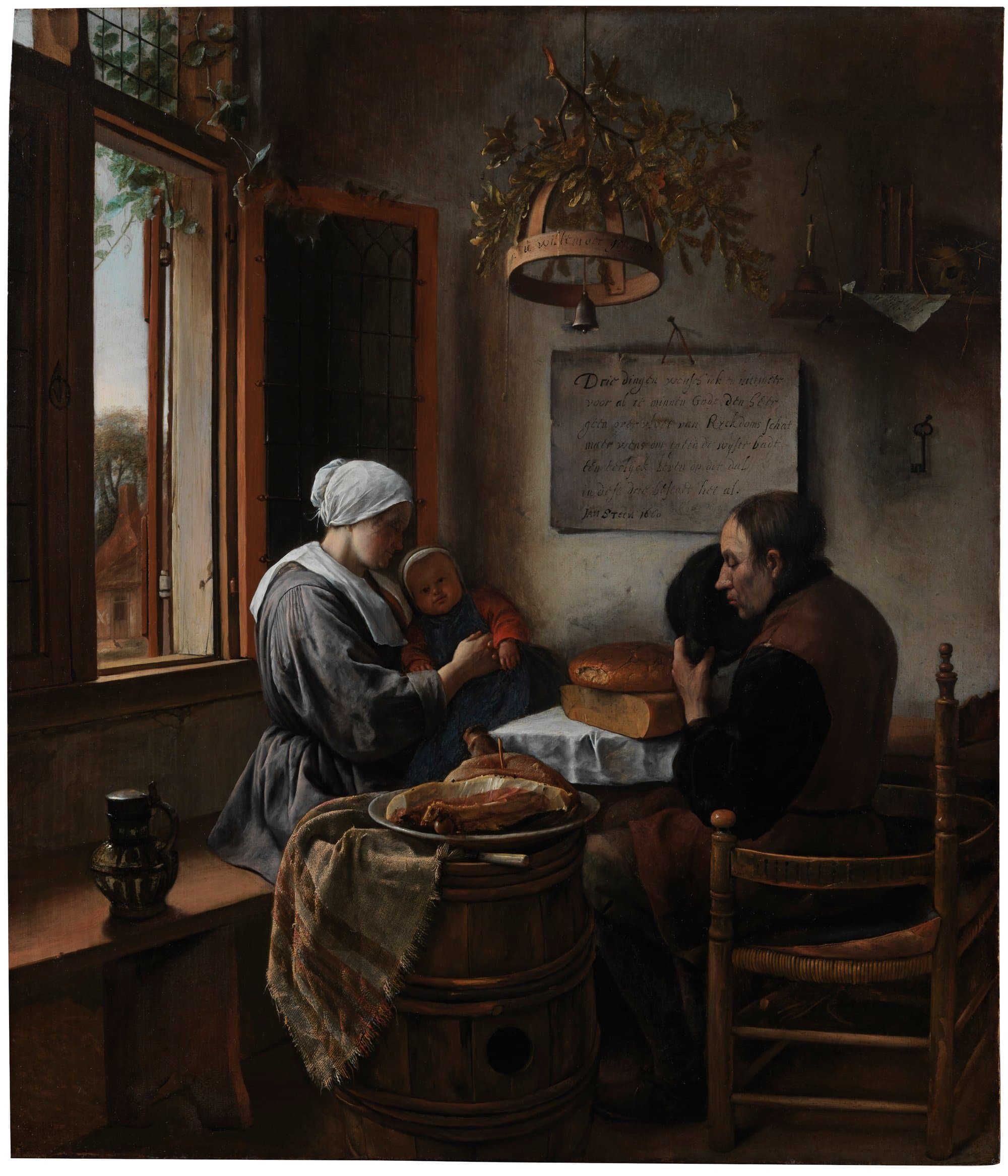
Matthew 6:11 and Exodus 16 · Passage · Money and Want
Give Us This Day
The fourth petition of the Lord's Prayer asks for bread for one day, as Israel gathered the manna one day at a time.
The Israelites ate manna forty years, until they came to a land where they could settle (Exodus 16:35).
Give us this day our daily bread.
- The passage
- Matthew 6:11, Exodus 16:4 to 21, Deuteronomy 8:3
- Books
- Matthew, Exodus, Deuteronomy
- Hold in memory
- Deuteronomy 8:3
Summary
The petition for daily bread asks the Father to supply what the present day requires. Behind it stands the manna of Exodus 16, the bread by which God fed Israel in the wilderness. The petition carries that lesson into the life of every disciple, and the teachers of the church have read its bread in more than one way.
- The bread petition opens the requests the prayer makes for the one who prays.
- The word rendered daily, epiousios, is rare, and its sense has been debated since the early church.
- Teachers have read the bread as the body's food, as Christ, or as both.
Bread for This Day
Matthew and Luke give the petition in two forms.
This study takes up Matthew 6:11, the petition for daily bread, with the manna of Exodus 16 behind it, as a passage of the trial of money and want. It asks what a disciple requests in this petition, and why God fed Israel in the wilderness as He did.
The study sets the petition beside the gathering of the manna and the lesson Moses drew from it. It reads the Greek of the petition and the Hebrew of the command to gather. It closes with three readings of the bread, each with its holders and the objection to it.
The petition stands in the prayer Jesus taught in the Sermon on the Mount (Matthew 6:9 to 13). Luke's form asks, “Give us each day our daily bread” (Luke 11:3).
In the Greek of Matthew 6:11 the word for today, semeron, stands last. The study Sufficient for the Day sets out the readings of the word rendered “daily”.
The Manna and Its Lesson
Exodus 16 gives the rules of the manna, and Deuteronomy 8 names what they taught.
God set the measure of the manna and its limit, and Moses named the trust it was meant to teach.
- The Berean words
- “Each day the people are to go out and gather enough for that day.”
- What it adds
- God sets the measure of the gathering.
- The Berean words
- “he who gathered much had no excess, and he who gathered little had no shortfall”
- What it adds
- Each household had what it needed and no more.
- The Berean words
- “some people left part of it until morning, and it became infested with maggots”
- What it adds
- Bread stored against God's word spoiled overnight.
- The Berean words
- “man does not live on bread alone, but on every word that comes from the mouth of the LORD”
- What it adds
- Moses names what the manna was for.
A chain of four links, from Exodus 16:4 to Deuteronomy 8:3, each with its Berean words and what it adds.
Bread Measured by the Day
Exodus 16 sets the rules of the gathering and shows what came of breaking them.
In the Desert of Sin, Israel complained that in Egypt they had eaten their fill of bread (Exodus 16:3), and the study of grumbling teaches that complaint.
The LORD's answer came with a purpose, “In this way I will test whether or not they will follow My instructions” (Exodus 16:4). The Hebrew of the rule reads “a matter of a day in its day”.
Each person was to gather “as much as he needs”, an omer for each one in the tent (Exodus 16:16). Paul quoted the result when he asked the Corinthians to give out of their surplus for the need of others, “that there may be equality” (2 Corinthians 8:13 to 15).
Adam Clarke, in his Commentary on the Bible (1832), said of those who kept the manna until morning, “Their sinful curiosity and covetousness led them to make the trial”.
John Wesley, in his Explanatory Notes upon the Old Testament (1765), called the wilderness a market “where so many hundred thousand men were daily furnished without money, and without price”.
On the sixth day the people gathered twice as much, and the study of the six days of labour teaches that rule.
Bread and the Word of God
Deuteronomy 8:3 and John 6 tie the bread of the wilderness to the word of God and to Christ.
When He was hungry in the wilderness, Jesus answered the tempter with Deuteronomy 8:3 (Matthew 4:4).
When a crowd recalled that their fathers “ate the manna in the wilderness”, Jesus answered, “I am the bread of life” (John 6:31 to 35).
Want of bread can weigh on the body and the mind as well as the soul. Where it does, a physician's care belongs beside prayer, and where a debt cannot be paid, the help of a church's deacons and of a qualified debt adviser belongs beside it.
Three Readings of the Bread
Each reading has its holders and the objection to it.
All that the body requiresJohn Calvin
John Calvin, in his Institutes of the Christian Religion (3.20.44), wrote, “we pray in general that God would give us all things which the body requires in this sublunary state”.
He judged that “The speculations of some concerning supersubstantial bread seem to be very little accordant with our Savior's meaning”.
The objection: Cyprian and Augustine read the petition of the Eucharist as well as of food.
Both the bread of the table and Christ in the EucharistCyprian; Augustine of Hippo
Cyprian, in his treatise On the Lord's Prayer, wrote that the petition “may be understood both spiritually and literally”. He read “our bread” as Christ and wrote of “we who are in Christ, and daily receive the Eucharist for the food of salvation”.
Augustine held in his Sermon 57 that the petition is “to be understood in two ways”, for “our bodily food” and for “our spiritual support”. He counted the Eucharist among that spiritual food.
The objection: Jesus taught the prayer in the Sermon on the Mount, long before He gave the bread of the Supper (Matthew 26:26).
The true bread that nourishes the soulOrigen
Origen, in On Prayer, set aside the request for material bread and asked how Christ “should command us to intercede with the Father for what is small and of the earth”.
The objection: Jamieson, Fausset and Brown, in their Commentary Critical and Explanatory (1871), held that this reading “deprives the Christian of one of the sweetest of his privileges”.
That privilege, they wrote, is “to cast his bodily wants in this short prayer, by one simple petition, upon his heavenly Father”.
This Day's Bread
The petition is the prayer of a disciple who depends on God for bread.
Jesus put the request for bread into the prayer His disciples pray. It is made to the Father who fed Israel in the wilderness.
Sources
Scripture is the Berean Standard Bible.
- STEP Bible, Translators Amalgamated Hebrew Old Testament and Greek New Testament, the tagged texts (Tyndale House, Cambridge), CC BY 4.0.
- John Wesley, Explanatory Notes upon the Old Testament (1765), on Exodus 16:19.
- Adam Clarke, Commentary on the Bible (1832), on Exodus 16:20.
- John Calvin, Institutes of the Christian Religion, Book 3, chapter 20, section 44.
- Augustine of Hippo, Sermon 57 (Sermon VII on the New Testament), On the Lord's Prayer.
- Cyprian, Treatise IV, On the Lord's Prayer, section 18.
- Origen, On Prayer, chapter 27.
- Robert Jamieson, A. R. Fausset and David Brown, Commentary Critical and Explanatory on the Whole Bible (1871), on Matthew 6:11.
Keep Studying
In this trial5
People and groups9
Places1
Subjects1
Doctrines2