
Deuteronomy · Subject · Featured Study
The Treaty Form of Deuteronomy
Scholars compare Deuteronomy with treaties from two empires of the ancient Near East.
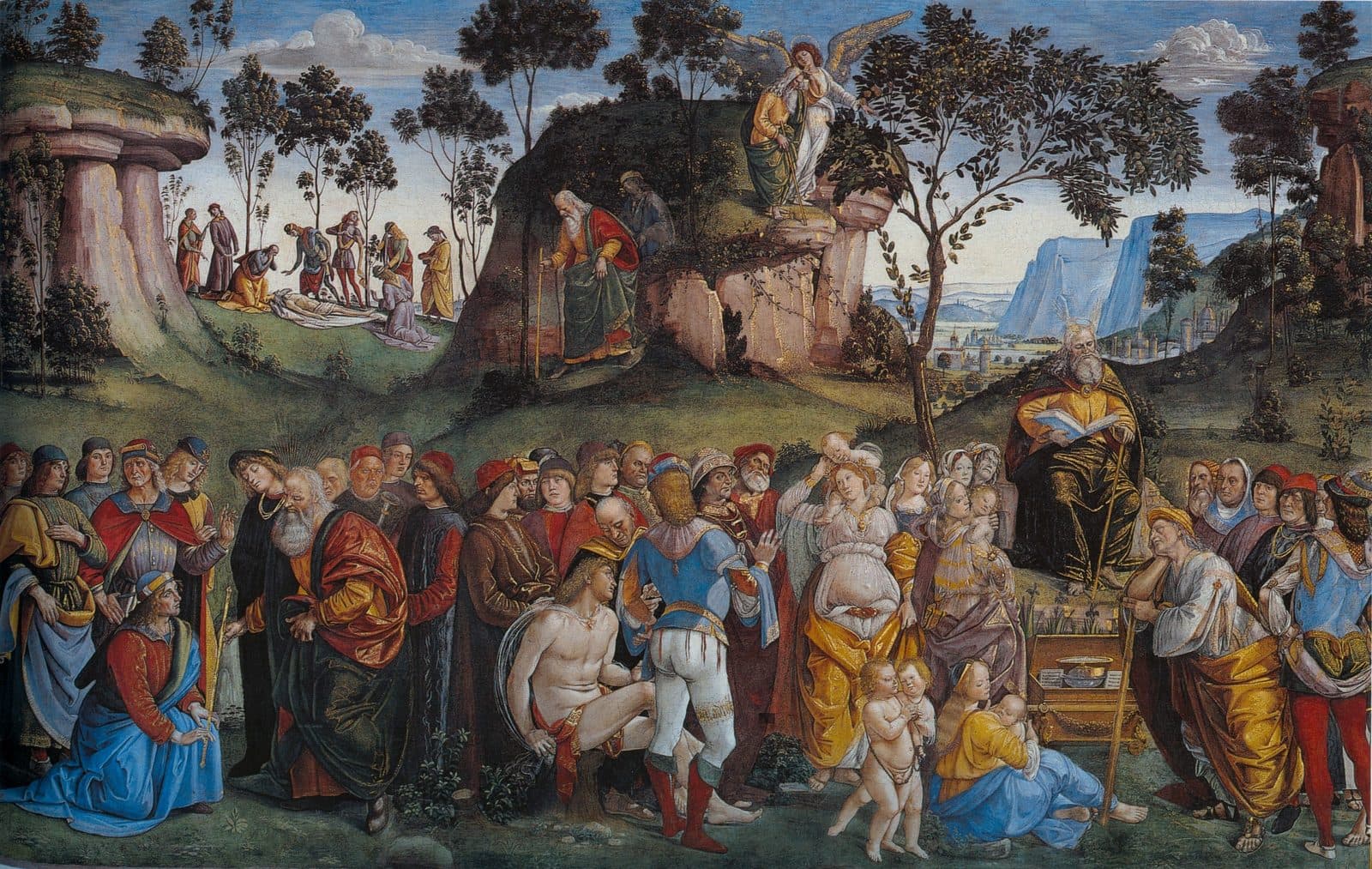
Luca Signorelli with Bartolomeo della Gatta, Moses's Testament and Death, fresco, 1482, Sistine Chapel, Vatican. Public domain.
THE ARTWORKSignorelli and della Gatta painted the last events of Moses's life in one scene. At the right he sits above a gilded chest and reads from an open book to the crowd. At the lower left he gives his staff to Joshua, on the hilltop an angel shows him the land, and at the upper left the people mourn over his body.
The shape of Deuteronomy is read as evidence for an early date and for a late one.
Summary
Deuteronomy is the covenant Moses made with Israel in Moab, at the end of the forty years in the wilderness.
- Deuteronomy has a passage for each of the six parts of a Hittite vassal treaty.
- Its laws come after the history, the order a treaty followed.
- Its call to love the LORD matches the word treaties used for a vassal's loyalty.
The Covenant Made at Moab
Deuteronomy calls itself a covenant, made with an oath, written down, kept beside the ark and witnessed.
On the east side of the Jordan in the land of Moab, Moses began to explain this law, saying:This verse closes the preamble, the first of the six parts in the table below.
The LORD our God made a covenant with us at Horeb. He did not make this covenant with our fathers, but with all of us who are alive here today.so that you may enter into the covenant of the LORD your God, which He is making with you today, and into His oath,The oath here is alah, the second word in the Hebrew section below.
So Moses wrote down this law and gave it to the priests, the sons of Levi, who carried the ark of the covenant of the LORD, and to all the elders of Israel. Then Moses commanded them, “At the end of every seven years, at the appointed time in the year of remission of debt, during the Feast of Tabernacles, when all Israel comes before the LORD your God at the place He will choose, you are to read this law in the hearing of all Israel.These verses supply the public reading, one half of the fourth part in the table below.
“Take this Book of the Law and place it beside the ark of the covenant of the LORD your God, so that it may remain there as a witness against you.This verse supplies the deposit and so completes the fourth part.
I call heaven and earth as witnesses against you today that I have set before you life and death, blessing and cursing. Therefore choose life, so that you and your descendants may live,The covenant on two tabletsDeuteronomy 4:13 and Deuteronomy 10:2
He declared to you His covenant, which He commanded you to follow—the Ten Commandments that He wrote on two tablets of stone.And I will write on the tablets the words that were on the first tablets, which you broke; and you are to place them in the ark.”Heaven and earth as witnessesDeuteronomy 4:26 and Deuteronomy 32:1
I call heaven and earth as witnesses against you this day that you will quickly perish from the land that you are crossing the Jordan to possess. You will not live long upon it, but will be utterly destroyed.Moses calls these witnesses here, and he calls them again at Deuteronomy 30:19.
Give ear, O heavens, and I will speak; hear, O earth, the words of my mouth.This verse opens the song Moses is told to write down as a witness against Israel, at Deuteronomy 31:19.
Six Parts of a Treaty in Deuteronomy
The rows follow the order of a Hittite treaty, from the preamble to the blessings and curses.
| Part of the treaty | What the treaty held | Where Deuteronomy holds it |
|---|---|---|
| Preamble | The great king gives his name and titles | Deuteronomy 1:1 to 5, the words Moses spoke in Moab |
| Historical prologue | What the king has done for the vassal | Deuteronomy 1:6 to 4:43, from Horeb to the plains of Moab |
| Stipulations | The vassal's duties, loyalty first | Deuteronomy 4:44 to 26:19, the Ten Commandments and the laws |
| Deposit and public reading | A copy kept in the temple and read aloud | Deuteronomy 31:9 to 13 and Deuteronomy 31:26, the book beside the ark |
| Witnesses | The gods called to witness the oath | Deuteronomy 30:19 and Deuteronomy 32:1, heaven and earth |
| Blessings and curses | What follows loyalty and what follows breach | Deuteronomy 27 and 28 |
- Part of the treaty
- Preamble
- What the treaty held
- The great king gives his name and titles
- Where Deuteronomy holds it
- Deuteronomy 1:1 to 5, the words Moses spoke in Moab
- Part of the treaty
- Historical prologue
- What the treaty held
- What the king has done for the vassal
- Where Deuteronomy holds it
- Deuteronomy 1:6 to 4:43, from Horeb to the plains of Moab
- Part of the treaty
- Stipulations
- What the treaty held
- The vassal's duties, loyalty first
- Where Deuteronomy holds it
- Deuteronomy 4:44 to 26:19, the Ten Commandments and the laws
- Part of the treaty
- Deposit and public reading
- What the treaty held
- A copy kept in the temple and read aloud
- Where Deuteronomy holds it
- Deuteronomy 31:9 to 13 and Deuteronomy 31:26, the book beside the ark
- Part of the treaty
- Witnesses
- What the treaty held
- The gods called to witness the oath
- Where Deuteronomy holds it
- Deuteronomy 30:19 and Deuteronomy 32:1, heaven and earth
- Part of the treaty
- Blessings and curses
- What the treaty held
- What follows loyalty and what follows breach
- Where Deuteronomy holds it
- Deuteronomy 27 and 28
Treaties of the Hittite and Assyrian Kings
Two families of treaty texts, written about six centuries apart.
The Hittite kings of Anatolia bound lesser kings to themselves by written treaties between about 1400 and 1200 BC. Viktor Korošec set out the parts of these treaties in 1931. George Mendenhall argued in 1954 that the covenant at Sinai follows the same form.
The second family comes from Assyria. In 672 BC Esarhaddon made his vassals swear to accept his son Ashurbanipal as the next king. Copies of that oath were found at Nimrud and, in 2009, at Tell Tayinat in Turkey.
In 1963 William Moran traced the love of God in Deuteronomy to the language of the treaties, where loyalty to a king is called love.
And you shall love the LORD your God with all your heart and with all your soul and with all your strength.Moran's study turns on this verse.
Gerhard von Rad read Deuteronomy's sequence of history, law, commitment, and blessing and curse as the order of a liturgy.
Covenant, Oath and Love in Hebrew
Each word stands in Deuteronomy 29 and 30, where the covenant is renewed in Moab.
BERIT, COVENANT (H1285)
The lexicon glosses berit a compact, made by passing between pieces of flesh, and counts 284 occurrences.
ALAH, OATH (H423)
The lexicon glosses alah an imprecation, a calling down of a curse, and counts 35 occurrences.
AHAV, TO LOVE (H157)
The lexicon glosses ahav to have affection for, and counts 211 occurrences.
What Deuteronomy Leaves Unsaid
No verse of Deuteronomy names the six parts; they come from comparison.
These are the words of the covenant that the LORD commanded Moses to make with the Israelites in the land of Moab, in addition to the covenant He had made with them at Horeb.Here the book gives its own name for what it holds.
The book uses the word treaty once, at Deuteronomy 7:2, for the pact Israel must refuse the nations of Canaan. Of the treaty peoples it names only the Hittites, and them only among the nations of Canaan.
The treaty texts it is set beside were dug up in modern times. The likeness shows a shared way of binding a people, and the text leaves unsaid which treaties its writer knew.
Grace Before the Terms
The order of the table puts what the LORD has done before what He commands.
The Ten Commandments keep the same order, one line of history and then the commands.
“I am the LORD your God, who brought you out of the land of Egypt, out of the house of slavery.The same words open the commandments at Exodus 20:2.
John Calvin finds the same order in the blessings of Deuteronomy 28.
“Although their adoption was gratuitous, still, inasmuch as they were called unto purity, it is not without reason that God promises that what He had spoken should be sure, if by keeping the Law the Israelites themselves should continue in the covenant; as much as to say, that their sanctification should be firm and perpetual if they walked in the commandments of the Law.”
John Calvin · Commentaries · on Deuteronomy 28:9Reformed
Three Commentaries on the Covenant
Four notes on the covenant made at Moab, from commentaries of the eighteenth and nineteenth centuries.
John Wesley settles who was bound by the covenant made at Horeb.
“Not with our fathers - Only: but with us, who are all alive - He saith not, that all who made the covenant at Sinai are now alive, but this covenant was made with all that are now alive; which is most true, for it was made with the elders in their persons, and with the rest in their parents, who covenanted for them.”
John Wesley · Explanatory Notes upon the Old Testament · on Deuteronomy 5:3Evangelical
He also names what made the covenant at Moab binding.
“Into covenant and into his oath - Into covenant, confirmed by a solemn oath.”
John Wesley · Explanatory Notes upon the Old Testament · on Deuteronomy 29:12Evangelical
Adam Clarke's note speaks to the part of the treaty that calls witnesses.
“I call heaven and earth to witness against you - A most solemn method of adjuration, in use among all nations in the world.”
Adam Clarke · Commentary on the Bible · on Deuteronomy 4:26Evangelical
Jamieson, Fausset and Brown's note speaks to the deposit of the written copy.
“It was usual in cases of public or private contract for two copies of the engagement to be made--one to be deposited in the national archives or some secure place for reference, should occasion require. The other was to remain in the hands of the contracting parties (Jer 32:12-14). The same course was followed on this renewal of the covenant between God and Israel.”
Jamieson, Fausset & Brown · Commentary Critical and Explanatory on the Whole Bible · on Deuteronomy 31:9-13Reformed
The Date Read From the Form
Each reading is set out with its holders and the objection raised against it.
Adam Barr's timeline in Exploring the Story (2011) sets the speeches at Moab about 1406 BC, on the early date.
The book found under Josiah2 Kings 22:8; John Wesley; Wilhelm de Wette
“Take this book - Probably the very same book, which (after having been some way misplaced) was found in the house of the Lord, in the days of Josiah, and publickly read by the king himself, for a witness against a people, who were then almost ripe for ruin.”
John Wesley · Explanatory Notes upon the Old Testament · on Deuteronomy 31:26Evangelical
Then Hilkiah the high priest said to Shaphan the scribe, “I have found the Book of the Law in the house of the LORD!” And he gave it to Shaphan, who read it.Wesley's note refers to the find this verse records.
Wilhelm de Wette made the same identification in 1805, and the find is dated to about 622 BC.
The second millenniumMeredith Kline; Kenneth Kitchen
Meredith Kline outlined Deuteronomy in 1963 as a treaty of the Hittite kind, from its preamble to its provisions for succession.
Kenneth Kitchen argued in 2003 that a historical prologue and paired blessings mark the Hittite treaties and are rare in Assyrian ones. On this reading the book's shape fits the age of Moses.
The objection: in chapter 7 of Treaty and Covenant (1978), Dennis McCarthy finds a basic unity in the Hittite, Syrian and Assyrian treaties that reaches into the first millennium.
The seventh centuryMoshe Weinfeld; Hans Ulrich Steymans; Bernard Levinson and Jeffrey Stackert
Moshe Weinfeld argued that the curses of Deuteronomy 28 follow the order of the Assyrian gods in Esarhaddon's oath, and he dated the book to the seventh century.
Hans Ulrich Steymans argued in 1995 that Deuteronomy 28:20 to 44 follows an Assyrian model and that Manasseh was bound by Esarhaddon's oath. In 2012 Bernard Levinson and Jeffrey Stackert read Deuteronomy 13 between the Covenant Code and Esarhaddon's succession treaty.
On that reading the borrowing ran from Assyria, and an early date must explain the order.
If, however, you do not obey the LORD your God by carefully following all His commandments and statutes I am giving you today, all these curses will come upon you and overtake you:The curses this reading compares begin at this verse.
The objection, as Carly Crouch makes it in Israel and the Assyrians (2014): lists of curses were common across the region, and the Tayinat copy does not show that Judah held the oath. She argues that Deuteronomy answers Assyrian claims without copying Esarhaddon's text.
Books on the Treaty Form
Six works: the Hittite treaties in English and the case for each date.
Hittite Diplomatic Texts
Beckman · 1999
Beckman translates the Hittite treaties themselves, the texts the comparison starts from.
In print: find it wherever books are sold.
Treaty of the Great King
Kline · 1963
Kline gathers his studies of the covenant with a commentary on Deuteronomy in one volume.
In print: find it wherever books are sold.
On the Reliability of the Old Testament
Kitchen · 2003
Kitchen sets the Old Testament against the finds of its world, with a chapter on treaty, law and covenant.
In print: find it wherever books are sold.
Deuteronomy and the Deuteronomic School
Weinfeld · 1972
Weinfeld studies the speeches of Deuteronomy, their treaty phrasing and the school that wrote them.
In print: find it wherever books are sold.
Treaty and Covenant
McCarthy · 1978
McCarthy reads the treaties first and then turns to the covenants of the Old Testament.
In print: find it wherever books are sold.
Israel and the Assyrians
Crouch · 2014
Crouch sets Deuteronomy beside Esarhaddon's succession treaty, curse by curse.
In print: find it wherever books are sold.
The LORD Is the One King
Three verses carry the covenant from Moab to the Last Supper.
Whatever its date, the form puts the LORD in the place of the great king and Israel in the place of His people.
and that you may love the LORD your God, obey Him, and hold fast to Him. For He is your life, and He will prolong your life in the land that the LORD swore to give to your fathers, to Abraham, Isaac, and Jacob.”The close of Moses's third speech gathers the stipulations into one demand.
Jesus declared, “‘Love the Lord your God with all your heart and with all your soul and with all your mind.’ This is the first and greatest commandment.An expert in the law tests Him, and He answers from Deuteronomy 6:5.
In the same way, after supper He took the cup, saying, “This cup is the new covenant in My blood, which is poured out for you.The covenant of Moab points ahead to this covenant, sealed by the death of its King.
Keep studying
Places1
Symbols1