

Francesco Cozza, Hagar and Ishmael in the Wilderness, 1665. Public domain.
Genesis 12:9 to 13:3 · Place · Featured Study
Negeb
The Negeb is the dry south of Judah, the country of Beersheba and of the wells the patriarchs dug.
Abraham, Isaac and David each lived in the dry south of the land.
And Abram journeyed on toward the Negev.
- Today
- The Negev, around Beersheba
- Region
- Southern Judah, toward Edom
- First named
- Genesis 12:9 “And Abram journeyed on toward the Negev.”
- Last named
- Zechariah 7:7 “Are these not the words that the LORD…”
Abraham, Isaac and David each lived in the dry south of the land.
Summary
The Negeb is the dry south of Canaan. Scripture names it from Abram's first travels to the prophets of the return.
- Abram moved on toward the Negev after Bethel. He came back into it from Egypt.
- Abraham settled between Kadesh and Shur. Isaac was living in the Negev when Rebekah came.
- Joshua lists Beersheba among the cities of Judah in the far south, toward the border of Edom.
- The Amalekites raided the Negev and burned Ziklag while David was away.
The Dry South
Abram moved through the Negev on his way to Egypt and back.
And Abram journeyed on toward the Negev.This is the stage of Abram's road that the famine of the next verse cut short.
So Abram went up out of Egypt into the Negev—he and his wife and all his possessions—and Lot was with him.Lot is still with Abram here, before the two part company later in the chapter.
The Berean text spells the name Negev. Negeb is the same Hebrew word, which the lexicon glosses as the south, from its drought, and which the Hebrew Bible uses 112 times.
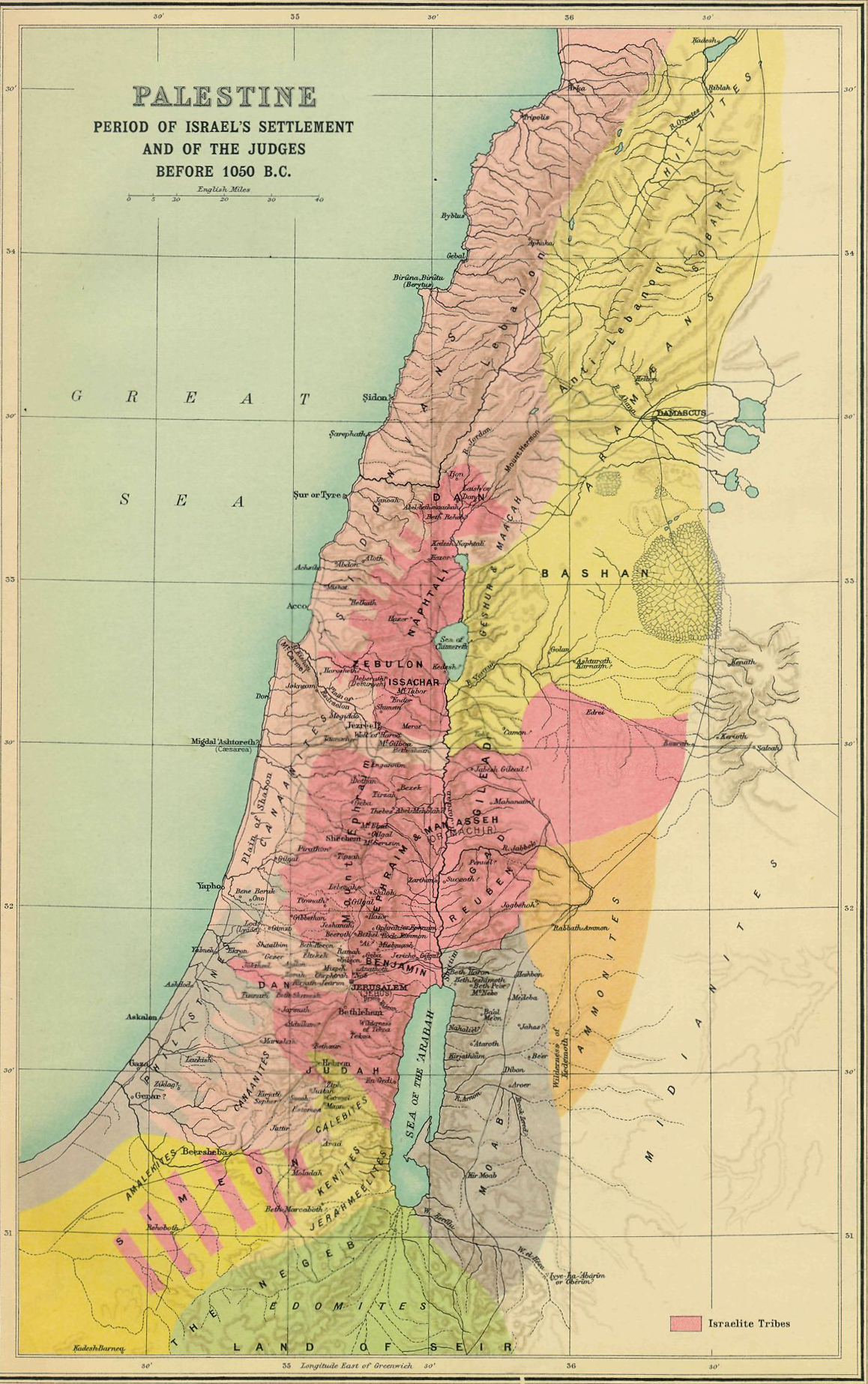
The Negeb on the Map
Abraham's stations in the south ran from the Kadesh country by Gerar to Beersheba.
Gerar and Beersheba stand west of Arad on the plate, and Kadesh lies far to the south.
- Located: the site is known
- Identified: the point stands for an area, or is rounded
- The route, in the order the text gives
- 1Kadesh-barnea, The Kadesh country marked one side of Abraham's stay in the south. Genesis 20:1
- 2Gerar, Abraham stayed there with Abimelech. Genesis 20:1
- 3Beersheba, Abraham settled there after he came down from Moriah. Genesis 22:19
- 4Arad, Its Canaanite king lived in the Negev. Numbers 21:1
- 5Hormah, Joshua lists it among Judah's southern towns. Joshua 15:30
- 6Ziklag, The Amalekites burned it in a raid on the Negev. 1 Samuel 30:1
Base map: Israel's settlement and the period of the Judges, George Adam Smith, Atlas of the Historical Geography of the Holy Land (1915), public domain. Places with a place page stand at its coordinates and the others at the point OpenBible.info gives, set on the plate by Jerusalem and Damascus, as the plate prints them.
Each mark gives what the text sets there, with the later towns of Arad, Hormah and Ziklag off the route.
The Negeb in Scripture, in Order
The region appears from Abram's wanderings to the promises of the return.
The patriarchs lived in the Negeb before Israel took it, and the prophets promised it back after the exile.
- Abram's journeyAbram moves on toward the NegevGenesis 12:9
- After EgyptAbram comes up into the Negev with all his possessionsGenesis 13:1
- After Sodom's fallAbraham settles between Kadesh and ShurGenesis 20:1
- Isaac's weaningHagar wanders in the Wilderness of BeershebaGenesis 21:14
- Rebekah's arrivalIsaac is living in the NegevGenesis 24:62
- Isaac's wellsIsaac names a well Rehoboth because the LORD made roomGenesis 26:22
- The spiesMoses sends the spies up through the NegevNumbers 13:17
- On the road to AtharimThe king of Arad attacks IsraelNumbers 21:1
- The allotmentJudah receives its cities in the NegevJoshua 15:21
- David at ZiklagThe Amalekites raid the Negev1 Samuel 30:1
- The return from captivityThe returning people pray for streams in the NegevPsalm 126:4
- Jeremiah's purchaseFields will again be bought in the cities of the NegevJeremiah 32:44
Twelve moments in the order of the canon, each with its verse.
The spies, On the road to Atharim, The allotment, David at Ziklag, The return from captivity, Jeremiah's purchase
Hagar in the Wilderness of BeershebaGenesis 21:14 to 19
Then God heard the voice of the boy, and the angel of God called to Hagar from heaven, “What is wrong, Hagar? Do not be afraid, for God has heard the voice of the boy where he lies.The boy's name, Ishmael, means God hears, and the verse says God heard him.
Then God opened her eyes, and she saw a well of water. So she went and filled the skin with water and gave the boy a drink.In a dry country the rescue came as a well she had not seen.
Isaac's wellsGenesis 26:18 to 22
Isaac reopened the wells that had been dug in the days of his father Abraham, which the Philistines had stopped up after Abraham died. And he gave these wells the same names his father had given them.Isaac's first work in the Valley of Gerar was to restore what had been stopped up.
Ambrose of Milan sets the wells of the patriarchs beside the other wells of Scripture.
“For Abraham dug wells and Isaac too—that is, the mighty patriarchs—and Jacob also, as we find in the Gospel, as if they were fountains of the human race, and specifically fountains of faith and devotion. For what is a well of living water but a depth of profound instruction? On this account Hagar saw the angel by a well and Jacob found his wife Rachel by a well; Moses too earned the first rewards of his future marriage beside a well.”
Ambrose of Milan · On Isaac and the Soul, Chapter 4, Sections 21-22 · on Genesis 26:19Patristic
Three Things the Text Says Plainly
Three facts of the text about the region, each with its verse.
LAND IN THE NEGEV NEEDED SPRINGS
Achsah asked Caleb for springs because the land he had given her lay in the Negev, and he gave her the upper and lower springs.
THE NEGEV HAD SEVERAL DISTRICTS
David named the Negev of Judah, the Negev of Jerahmeel and the Negev of the Kenites when Achish asked where he had raided.
THE AMALEKITES HELD THE NEGEV
The spies reported that the Amalekites lived in the land of the Negev, and the hill country belonged to other peoples.
The South Country
Joshua's list of Judah's towns opens with the Negeb, and Isaiah knew it as hard country.
Albert Barnes, on Joshua 15:21, notes that Judah's towns are listed in four groups by the lie of the land: the Negeb or south country, the lowland, the hill country and the wilderness. He calls the Negeb for the most part rocky and arid, and never thickly populated.
This is the burden against the beasts of the Negev: Through a land of hardship and distress, of lioness and lion, of viper and flying serpent, they carry their wealth on the backs of donkeys and their treasures on the humps of camels, to a people of no profit to them.The burden falls on envoys carrying Judah's treasure through the Negev to Egypt, whose help Isaiah calls futile.
What Scripture Leaves Unsaid
The text leaves two things about the region unsaid.
Joshua 15:21 to 32 lists the towns of the Negev, and no verse gives the region a northern edge. Genesis never says where Abram's tent stood in the Negev on his way to Egypt.
Streams in the Negeb
Psalm 126 turns the dry south into a picture of the return from captivity.
Restore our captives, O LORD, like streams in the Negev.The returning exiles ask God to restore them as suddenly as water fills the dry streambeds of the south.
“The point of comparison is joy at the reappearing of what has been so painfully missed. As in husbandry the sower may cast his seed in a dry and parched soil with desponding fears, so those shall reap abundant fruit who toil in tears with the prayer of faith.”
Jamieson, Fausset & Brown · Commentary Critical and Explanatory on the Whole Bible · on Psalm 126:4Reformed
He who goes out weeping, bearing a trail of seed, will surely return with shouts of joy, carrying sheaves of grain.The psalm ends with the sower, who goes out weeping and comes home with sheaves.
The Negeb in the promises of the returnJeremiah 32:44 and Obadiah 1:20
Fields will be purchased with silver, and deeds will be signed, sealed, and witnessed in the land of Benjamin, in the areas surrounding Jerusalem, and in the cities of Judah—the cities of the hill country, the foothills, and the Negev—because I will restore them from captivity, declares the LORD.”The purchase at Anathoth was a pledge that ordinary life would return to every district of Judah.
And the exiles of this host of the Israelites will possess the land of the Canaanites as far as Zarephath; and the exiles from Jerusalem who are in Sepharad will possess the cities of the Negev.The promise reaches the far south, the last region named in the verse.
The Voices on the Negeb
Calvin, Henry, Wesley, and Jamieson, Fausset and Brown have each written on a scene of the south country.
1509 to 1564 · John Calvin
John Calvin admits that Genesis gives no reason for Abraham's move south.
“It is, however, unknown what was his intention in removing, or what necessity impelled him to change his place: we ought, however, to be persuaded, that he had not transferred his abode to another place for any insufficient cause; especially since a son, whom he had not even dared to wish for, had been lately promised him, through Sarah.”
John Calvin · Commentaries · on Genesis 20:1Reformed
1662 to 1714 · Matthew Henry
Matthew Henry reads the name of Hagar's well, Beer-lahai-roi, near which Isaac later lived.
“It is probable that Hagar put this name upon it; and it was retained long after, in perpetuam rei memoriam--a lasting memorial of this event. This was a place where the God of glory manifested the special cognizance and care he took of a poor woman in distress.”
Matthew Henry · Commentary on the Whole Bible · on Genesis 16:14Puritan
1703 to 1791 · John Wesley
John Wesley follows Isaac into the field at evening, before Rebekah's camels came.
“Merciful providences are then doubly comfortable, when they find us in the way of our duty: some think Isaac was now praying for good success in this affair, and meditating upon that which was proper to encourage his hope in God concerning it; and now when he sets himself, as it were, upon his watch-tower, to see what God would answer him, he sees the camels coming.”
John Wesley · Explanatory Notes upon the Old Testament · on Genesis 24:63Evangelical
1802 to 1910 · Jamieson, Fausset & Brown
Jamieson, Fausset and Brown reckoned the wealth Abram brought up from Egypt into the Negev.
“An Arab sheik is considered rich who has a hundred or two hundred tents, from sixty to a hundred camels, a thousand sheep and goats respectively. And Abram being very rich, must have far exceeded that amount of pastoral property. ‘Gold and silver’ being rare among these peoples, his probably arose from the sale of his produce in Egypt.”
Jamieson, Fausset & Brown · Commentary Critical and Explanatory on the Whole Bible · on Genesis 13:2Reformed
John Wesley, Jamieson, Fausset & Brown
The Name Beersheba
Readers explain the name of the Negeb's chief well by the oath or by the seven ewe lambs.
So that place was called Beersheba, because it was there that the two of them swore an oath.Genesis names the place in the same verse that records the oath.
The well of the oathAdam Clarke, 1832
The objection: the seven ewe lambs of Genesis 21:28 to 30 stand as the witness of the well, so the number seven belongs to the story.
Seven or the oathJerome, Hebrew Questions on Genesis
Jerome, in his Hebrew Questions on Genesis, gives two reasons for the name: the seven lambs Abimelech received from Abraham, or the oath the two men swore. He holds that the Hebrew word serves for both.
The objection: Genesis 21:31 names the oath alone as the reason the place was called Beersheba.
Room in the Land
Hagar, Isaac and Achsah each had to find water in the south country. The text asks the reader to trust God in dry places and to come to Christ for the water He gives.
But whoever drinks the water I give him will never thirst. Indeed, the water I give him will become in him a fount of water springing up to eternal life.”Jesus spoke of this water beside Jacob's well at Sychar.
Sources
Scripture is the Berean Standard Bible.
- James Strong, Exhaustive Concordance of the Bible (1890), Hebrew dictionary, entry 5045.
- Albert Barnes, Notes, Explanatory and Practical, on the Old and New Testaments, on Joshua 15:21.
- Adam Clarke, Commentary on the Bible (1832), on Genesis 21:31 and 26:33.
- Jerome, Hebrew Questions on Genesis, on Genesis 21:30.
- John Calvin, Commentaries on Genesis (1554), on Genesis 20:1.
- Matthew Henry, Commentary on the Whole Bible (1710), on Genesis 16:14.
- Jamieson, Fausset and Brown, Commentary Critical and Explanatory on the Whole Bible (1871), on Genesis 13:2.
- John Wesley, Explanatory Notes upon the Old Testament (1765), on Genesis 16:11.
- John Wesley, Explanatory Notes upon the Old Testament (1765), on Genesis 24:63.
- Jamieson, Fausset and Brown, Commentary Critical and Explanatory on the Whole Bible (1871), on Psalm 126:4.
- Ambrose of Milan, On Isaac and the Soul, chapter 4, on Genesis 26:19.
- George Adam Smith, Atlas of the Historical Geography of the Holy Land (1915), Israel's settlement and the period of the Judges, public domain.
Keep Studying
Read it4
Studies1
People and groups5
Places7