
Exodus 4 to Numbers 20 · Person · Featured Study
Aaron
Aaron, the brother of Moses, spoke for him before Pharaoh, wore the first high priest's garments and died on Mount Hor at 123.
The man who made the golden calf at Sinai was anointed Israel's first high priest, and he once stood with a censer between the living and the dead.
- Died
- at 123, on Mount Hor, in the fortieth year after the exodus
- Family
- father: Amram; mother: Jochebed; brother: Moses; sister: Miriam; wife: Elisheba; son: Nadab; son: Abihu; son: Eleazar; son: Ithamar
- Places
- Egypt, Mount Sinai, Kadesh-Barnea, Mount Hor
- First named
- Exodus 4:14
- Last named
- Hebrews 9:4
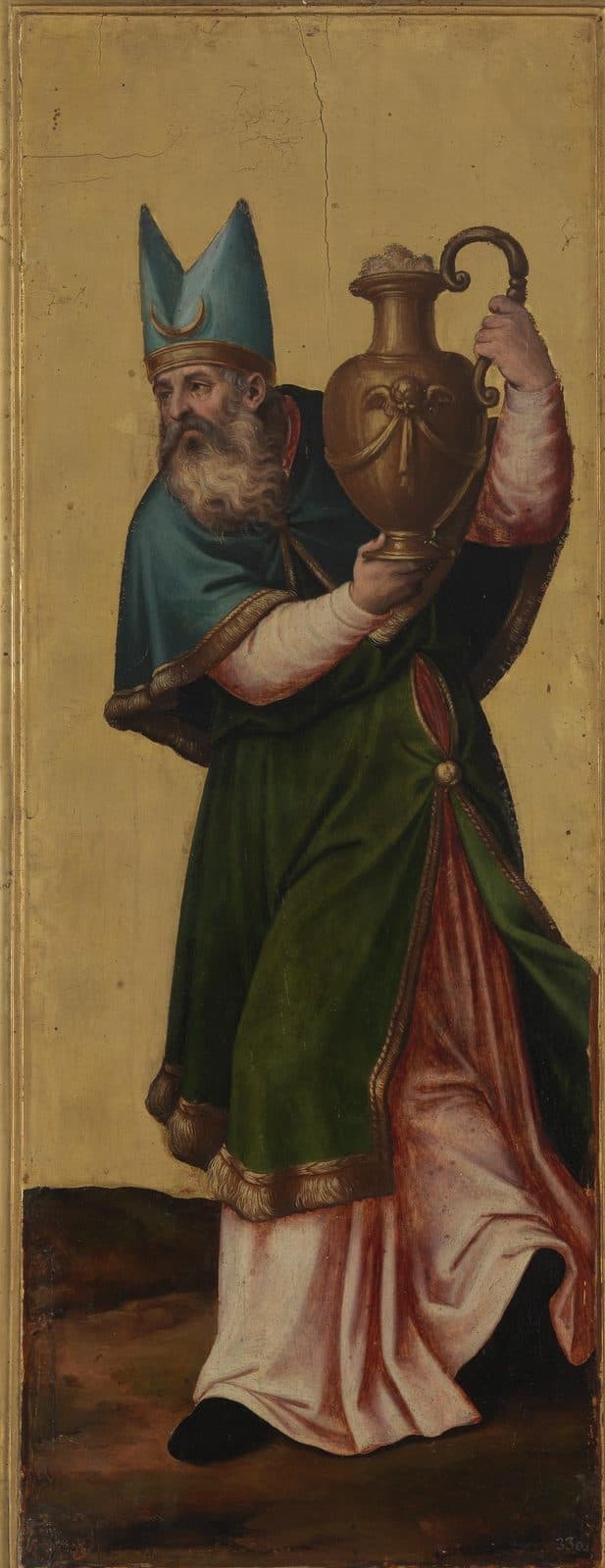
Juan de Juanes, The High Priest Aaron, about 1545 to 1550, Museo del Prado. Public domain.
THE ARTWORKJuan de Juanes painted Aaron full length in priestly dress, carrying a golden vessel, as one panel of the tabernacle of a high altarpiece.
Summary
Aaron, son of Amram and Jochebed, was the elder brother of Moses and Miriam and the first high priest of Israel.
- The LORD gave him to Moses as a spokesman, and his staff swallowed the staffs of Pharaoh's magicians.
- While Moses was on the mountain, Aaron made the golden calf, and Moses prayed for him when the LORD was angry enough to destroy him.
- Moses ordained Aaron and his sons in seven days, and on the eighth day fire from the LORD consumed his offering on the altar.
- After Korah's rebellion his staff alone of the twelve sprouted, as the sign of the LORD's choice.
- Hebrews sets his priesthood, ended by death, beside the priesthood of Christ, who lives forever.
Where Aaron Stands in Scripture
His first appearance in Exodus 4 and his death in Numbers 20
Then the anger of the LORD burned against Moses, and He said, “Is not Aaron the Levite your brother? I know that he can speak well, and he is now on his way to meet you. When he sees you, he will be glad in his heart.Moses had asked the LORD to send someone else, and the LORD answered by naming Aaron as the brother who can speak well.
After Moses had removed Aaron’s garments and put them on his son Eleazar, Aaron died there on top of the mountain. Then Moses and Eleazar came down from the mountain.This is the last verse of his life, and the next tells that the whole house of Israel mourned him thirty days.
His Life, Turn by Turn
Fourteen turns from the mountain of God to Mount Hor
- Meets Moses and kisses himthe mountain of God, Exodus 4:27
- Tells the elders the LORD's wordsEgypt, Exodus 4:30
- Throws down his staff before Pharaohaged 83, Exodus 7:10
- Holds up Moses' hands with HurRephidim, Exodus 17:12
- Sees the God of Israel with the eldersSinai, Exodus 24:10
- Fashions the golden calfthe camp below the mountain, Exodus 32:4
- Is ordained with his sonsseven days at the Tent of Meeting, Leviticus 8:33
- Lifts his hands and blesses the peoplethe eighth day, Leviticus 9:22
- Loses Nadab and Abihu to fire from the LORDthe same day, Leviticus 10:2
- Speaks against Moses with Miriamthe wilderness, Numbers 12:1
- Stands between the living and the deadafter Korah's rebellion, Numbers 16:48
- His staff sprouts and bears almondsthe Tent of the Testimony, Numbers 17:8
- Fails to show the LORD's holiness at the rockMeribah in Kadesh, Numbers 20:12
- Dies on the mountain topMount Hor, aged 123, Numbers 33:39
The two ages in the right-hand column come from Exodus 7:7 and Numbers 33:39.
From the Mountain of God to Mount Hor
Exodus 4 to Numbers 20
Aaron went out to meet his brother in the wilderness, and together they gathered the elders of Israel in Egypt. The people believed when they heard that the LORD had seen their affliction.
The LORD answered Moses, “See, I have made you like God to Pharaoh, and your brother Aaron will be your prophet. You are to speak all that I command you, and your brother Aaron is to tell Pharaoh to let the Israelites go out of his land.The LORD sets the order of the brothers' work before the king: Moses speaks to Aaron, and Aaron speaks to Pharaoh.
The staff before PharaohExodus 7:8 to 19
Each one threw down his staff, and it became a serpent. But Aaron’s staff swallowed up the other staffs.The magicians copy the sign, and the swallowing of their staffs shows that their power is less than the LORD's.
And the LORD said to Moses, “Tell Aaron, ‘Take your staff and stretch out your hand over the waters of Egypt—over their rivers and canals and ponds and reservoirs—that they may become blood.’ There will be blood throughout the land of Egypt, even in the vessels of wood and stone.”The first plague begins when Aaron stretches out his staff at the LORD's word through Moses.
Left in charge of the campExodus 24:14 and 32:1 to 4
And he said to the elders, “Wait here for us until we return to you. Aaron and Hur are here with you. Whoever has a dispute can go to them.”Moses names Aaron and Hur as the judges of the camp while he is away, which makes Aaron answerable for what follows.
Now when the people saw that Moses was delayed in coming down from the mountain, they gathered around Aaron and said, “Come, make us gods who will go before us. As for this Moses who brought us up out of the land of Egypt, we do not know what has happened to him!”The people ask for gods to go before them, which shows that they wanted a visible guide in place of the absent Moses.
He took the gold from their hands, and with an engraving tool he fashioned it into a molten calf. And they said, “These, O Israel, are your gods, who brought you up out of the land of Egypt!”Every reading of Aaron's guilt must answer this verse, since it gives the work to his own hands.
The first offering and the death of two sonsLeviticus 9 and 10
Moses and Aaron then entered the Tent of Meeting. When they came out, they blessed the people, and the glory of the LORD appeared to all the people. Fire came out from the presence of the LORD and consumed the burnt offering and the fat portions on the altar. And when all the people saw it, they shouted for joy and fell facedown.The LORD accepts the first offering of the new priesthood with fire from His presence.
Now Aaron’s sons Nadab and Abihu took their censers, put fire in them and added incense, and offered unauthorized fire before the LORD, contrary to His command. So fire came out from the presence of the LORD and consumed them, and they died in the presence of the LORD. Then Moses said to Aaron, “This is what the LORD meant when He said: ‘To those who come near Me I will show My holiness, and in the sight of all the people I will reveal My glory.’” But Aaron remained silent.The same fire falls on two of Aaron's sons when they bring fire the LORD had not commanded, and Aaron makes no answer.
Rashi says in his commentary on Leviticus that Aaron was rewarded for his silence, since the next word of the LORD was spoken to him alone.
With Miriam against MosesNumbers 12
Then Miriam and Aaron criticized Moses because of the Cushite woman he had married, for he had taken a Cushite wife. “Does the LORD speak only through Moses?” they said. “Does He not also speak through us?” And the LORD heard this.The complaint begins with Moses' wife and turns into a claim that the LORD speaks through Aaron and Miriam as well.
and said to Moses, “My lord, please do not hold against us this sin we have so foolishly committed.Aaron confesses the sin as folly and asks his brother to plead for their sister.
Matthew Henry, in his Commentary on Numbers 12:11, calls repentance the unsaying of what was said amiss and notes that Aaron, who served at the altar, had first to be reconciled to his brother.
Korah and the censerNumbers 16
They came together against Moses and Aaron and told them, “You have taken too much upon yourselves! For everyone in the entire congregation is holy, and the LORD is in their midst. Why then do you exalt yourselves above the assembly of the LORD?”Korah and his company charge Moses and Aaron with raising themselves above a congregation that is all holy.
Moses said to Aaron, “Take your censer, place fire from the altar in it, and add incense. Go quickly to the congregation and make atonement for them, because wrath has come out from the LORD; the plague has begun.” So Aaron took the censer as Moses had ordered and ran into the midst of the assembly. And seeing that the plague had begun among the people, he offered the incense and made atonement for the people.When the plague begins among the people who had blamed him, Aaron runs into the assembly with the incense at Moses' word.
The staff that buddedNumbers 17
The staff belonging to the man I choose will sprout, and I will rid Myself of the constant grumbling of the Israelites against you.”The LORD names the sign before the staffs are laid up: the staff of the man He chooses will sprout.
The LORD said to Moses, “Put Aaron’s staff back in front of the Testimony, to be kept as a sign for the rebellious, so that you may put an end to their grumbling against Me, lest they die.”The sign was meant to settle the dispute over who may serve as priest, so the LORD has it kept in plain sight.
What the Text Says
Three details of Exodus and Numbers that retellings often pass over
AARON'S HAND HELD THE STAFF
At the LORD's word Aaron throws down the staff before Pharaoh and its first sign is done by his hand.
A FEAST PROCLAIMED TO THE LORD
Aaron built an altar before the calf and called the next day a feast to the LORD, using the covenant name of God.
THE GARMENTS PASSED WHILE HE LIVED
Moses was told to dress Eleazar in Aaron's priestly garments before Aaron was gathered to his people.
The Garments and the Ordination
The holy garments of Exodus 28 and the seven days of Leviticus 8
The LORD told Moses to make holy garments for Aaron to give him glory and splendor. Exodus 28:4 lists six of them, and the chapter adds the engraved stones and a plate of gold.
| Piece | What it bore | Verse |
|---|---|---|
| Ephod | Two onyx stones on its shoulder pieces, each engraved with six names. | Exodus 28:12 |
| Breastpiece of judgment | Twelve names, worn over his heart before the LORD. | Exodus 28:29 |
| Urim and Thummim | Placed inside the breastpiece. | Exodus 28:30 |
| Robe of the ephod | Pomegranates and gold bells around the hem, heard as he entered and left. | Exodus 28:35 |
| Turban and gold plate | The words HOLY TO THE LORD, worn on his forehead. | Exodus 28:36 |
| Tunic and sash | Fine linen and embroidered work. | Exodus 28:39 |
- Piece
- Ephod
- What it bore
- Two onyx stones on its shoulder pieces, each engraved with six names.
- Verse
- Exodus 28:12
- What it bore
- Twelve names, worn over his heart before the LORD.
- Verse
- Exodus 28:29
- Piece
- Urim and Thummim
- What it bore
- Placed inside the breastpiece.
- Verse
- Exodus 28:30
- Piece
- Robe of the ephod
- What it bore
- Pomegranates and gold bells around the hem, heard as he entered and left.
- Verse
- Exodus 28:35
- What it bore
- The words HOLY TO THE LORD, worn on his forehead.
- Verse
- Exodus 28:36
- Piece
- Tunic and sash
- What it bore
- Fine linen and embroidered work.
- Verse
- Exodus 28:39
The anointing oil and the bloodLeviticus 8:12 and 8:30
He also poured some of the anointing oil on Aaron’s head and anointed him to consecrate him.Psalm 133:2 remembers this rite, and only the high priest receives it here.
Next, Moses took some of the anointing oil and some of the blood that was on the altar and sprinkled them on Aaron and his garments, and on his sons and their garments. So he consecrated Aaron and his garments, as well as Aaron’s sons and their garments.Oil and blood together are sprinkled on the priests and their garments, so that both the men and their dress are consecrated.
“You must know that this chrism [chrismation] is prefigured in the Old Testament. When Moses, conferring on his brother the divine appointment, was ordering him high priest, he anointed him after he had bathed in water, and thenceforward he was called ‘christ’ [‘anointed’], clearly after the figurative Chrism.”
Cyril of Jerusalem · Catechetical Lecture 3.6 · on Leviticus 8:12Patristic
Seven days at the TentLeviticus 8:33 and 9:1
On the eighth day Moses summoned Aaron and his sons and the elders of Israel.Aaron's ministry begins only when the seven days of ordination are complete.
“This shows the imperfection of the legal sacrifices, which, because they could not take away sin, were often repeated ( Heb. x. 1, 2 ), but were here repeated seven times (a number of perfection), because they typified that one offering, which perfected for ever those that were sanctified.”
Matthew Henry · Commentary on the Whole Bible · on Leviticus 8:34Puritan
The Family of Aaron
Ten ties, each with its verse
| Person | Tie to Aaron | Verse |
|---|---|---|
| Amram | His father, who lived 137 years. | Exodus 6:20 |
| Jochebed | His mother, a daughter of Levi. | Numbers 26:59 |
| Miriam | His sister, called the prophetess. | Exodus 15:20 |
| Moses | His younger brother, by three years. | Exodus 7:7 |
| Elisheba | His wife, daughter of Amminadab. | Exodus 6:23 |
| Nahshon | His wife's brother. | Exodus 6:23 |
| Nadab and Abihu | His elder sons, who died before the LORD. | Numbers 3:4 |
| Eleazar | His son, who succeeded him as priest. | Deuteronomy 10:6 |
| Ithamar | His fourth son, a priest with Eleazar. | Exodus 6:23 |
| Phinehas | His grandson, Eleazar's son. | Exodus 6:25 |
- Person
- Amram
- Tie to Aaron
- His father, who lived 137 years.
- Verse
- Exodus 6:20
- Person
- Jochebed
- Tie to Aaron
- His mother, a daughter of Levi.
- Verse
- Numbers 26:59
- Person
- Miriam
- Tie to Aaron
- His sister, called the prophetess.
- Verse
- Exodus 15:20
- Person
- Moses
- Tie to Aaron
- His younger brother, by three years.
- Verse
- Exodus 7:7
- Person
- Elisheba
- Tie to Aaron
- His wife, daughter of Amminadab.
- Verse
- Exodus 6:23
- Person
- Nahshon
- Tie to Aaron
- His wife's brother.
- Verse
- Exodus 6:23
- Person
- Nadab and Abihu
- Tie to Aaron
- His elder sons, who died before the LORD.
- Verse
- Numbers 3:4
- Person
- Eleazar
- Tie to Aaron
- His son, who succeeded him as priest.
- Verse
- Deuteronomy 10:6
- Person
- Ithamar
- Tie to Aaron
- His fourth son, a priest with Eleazar.
- Verse
- Exodus 6:23
- Person
- Phinehas
- Tie to Aaron
- His grandson, Eleazar's son.
- Verse
- Exodus 6:25
The Places of His Life
Six places, from the mountain of God to Moserah
- Proposed: one candidate among several
- Placed: the point stands for an area, or is rounded
- Located: the gazetteer fixes one site
about 100 km (62 miles)
- 1The mountain of God, He met Moses there on the LORD's word. Exodus 4:27
- 2Egypt, He spoke for Moses before Pharaoh. Exodus 7:10
- 3Rephidim, Moses, Aaron and Hur went up the hill there while Joshua fought. Exodus 17:10
- 4Kadesh, Miriam died there, and the rock gave water at Meribah. Numbers 20:1
- 5Mount Hor, He died on its top, near the border of Edom. Numbers 20:23
- 6Moserah, Deuteronomy names it as the place where he died and was buried. Deuteronomy 10:6
Not located: Egypt, Rephidim, Moserah.
The coastline is simplified; each place stands at its place page's coordinates.
The places in the order his story reaches them.
Questions His Life Raises
Four questions answered from their verses
Why was Miriam struck and Aaron spared?Numbers 12:1 and 12:10
Why did Aaron's sons not eat the sin offering?Leviticus 10:16 to 20
But Aaron replied to Moses, “Behold, this very day they presented their sin offering and their burnt offering before the LORD. Since these things have happened to me, if I had eaten the sin offering today, would it have been acceptable in the sight of the LORD?” And when Moses heard this explanation, he was satisfied.Aaron answers his brother's anger with the grief of that day, and Moses accepts the answer.
Adam Clarke says in his Commentary that Aaron's argument had good sense and strong reason, and that Moses as a reasonable man felt its force.
Why was Aaron kept from the land?Numbers 20:12 and 20:24
But the LORD said to Moses and Aaron, “Because you did not trust Me to show My holiness in the sight of the Israelites, you will not bring this assembly into the land that I have given them.”The LORD's sentence falls on both brothers at Meribah, because they did not show His holiness before the people.
“Aaron will be gathered to his people; he will not enter the land that I have given the Israelites, because both of you rebelled against My command at the waters of Meribah.At Mount Hor the LORD gives the same reason again for Aaron's death outside the land.
Matthew Henry, in his Commentary on Numbers 20:12, says the sin was aggravated because it was public, before the eyes of the people. Rashi makes the same point in his commentary on Numbers: an earlier doubt of Moses was spoken in private and was not punished in this way.
Did Aaron die on Mount Hor or at Moserah?Numbers 20:28, 33:38 and Deuteronomy 10:6
At the LORD’s command, Aaron the priest climbed Mount Hor and died there on the first day of the fifth month, in the fortieth year after the Israelites had come out of the land of Egypt.This verse gives the one exact date of Aaron's life, counted from the exodus.
The Israelites traveled from Beeroth Bene-jaakan to Moserah, where Aaron died and was buried, and Eleazar his son succeeded him as priest.Deuteronomy names Moserah as the place of his death and burial in its list of Israel's stations.
John Wesley, in his Explanatory Notes on Numbers 20:28, reads Moserah as the general name of the district and Mount Hor as a particular place in it. Albert Barnes, in his Notes on Numbers 20:22, identifies Mount Hor with Jebel Harun, on the eastern side of the Arabah near Petra.
What the Text Leaves Unsaid
His years in Egypt, his grief and his last words
Aaron and Christ
Hebrews 5 and 7 set Aaron's priesthood beside the priesthood of Christ
| Aaron | Old Testament | Christ | Hebrews |
|---|---|---|---|
| Brought near by God's command to serve as priest | Exodus 28:1 | Called by the One who said, You are My Son | Hebrews 5:5 |
| Offered first for his own sin, then for the people | Leviticus 9:7 | Sacrificed for sin once for all when He offered up Himself | Hebrews 7:27 |
| Bore the names of Israel over his heart | Exodus 28:29 | Always lives to intercede for those who draw near | Hebrews 7:25 |
| Served until death ended his priesthood at 123 | Numbers 33:39 | Lives forever, with a permanent priesthood | Hebrews 7:24 |
- Old Testament
- Exodus 28:1
- Christ
- Called by the One who said, You are My Son
- Hebrews
- Hebrews 5:5
- Old Testament
- Leviticus 9:7
- Christ
- Sacrificed for sin once for all when He offered up Himself
- Hebrews
- Hebrews 7:27
- Old Testament
- Exodus 28:29
- Christ
- Always lives to intercede for those who draw near
- Hebrews
- Hebrews 7:25
- Old Testament
- Numbers 33:39
- Christ
- Lives forever, with a permanent priesthood
- Hebrews
- Hebrews 7:24
Hebrews quotes Psalm 110:4, You are a priest forever in the order of Melchizedek, and sets that order beside the order of Aaron.
Now if perfection could have been attained through the Levitical priesthood (for on this basis the people received the law), why was there still need for another priest to appear—one in the order of Melchizedek and not in the order of Aaron? For when the priesthood is changed, the law must be changed as well.This verse ties Aaron's priesthood to the law of Moses, so the change of priest that Hebrews announces reaches the law as well.
For the law appoints as high priests men who are weak; but the oath, which came after the law, appointed the Son, who has been made perfect forever.The letter's comparison ends here, with the weakness of the priests the law appointed set against the Son appointed by the oath.
Voices on Aaron
Eight quotations, from Ambrose of Milan in the fourth century to Jamieson, Fausset and Brown in 1871
The call of Aaron and Korah's chargeAmbrose of Milan; Matthew Henry; Jamieson, Fausset and Brown
“And so He Himself also chose Aaron as priest, that not the will of man but the grace of God should have the chief part in the election of the priest; not the voluntary offering of himself, nor the taking it upon himself, but the vocation from heaven, that he should offer gifts for sins who could be touched for those who sinned, for He Himself, it is said, bears our weakness. No one ought to take this honour upon himself but they are called of God, as was Aaron, and so Christ did not demand but received the priesthood.”
Ambrose of Milan · Epistle 63 · on Numbers 17:8Patristic
“They unjustly charge Moses and Aaron with taking the honour they had to themselves, whereas it was evident, beyond contradiction, that they were called of God to it, Heb. v. 4 .”
Matthew Henry · Commentary on the Whole Bible · on Numbers 16:3Puritan
“The appointment was a special act of God's sovereignty, so that there could be no ground for popular umbrage by the selection of Aaron's family, with whom the office was inalienably established and continued in unbroken succession till the introduction of the Christian era.”
Jamieson, Fausset & Brown · Commentary Critical and Explanatory on the Whole Bible · on Exodus 28:1Reformed
The garments read forward to ChristJohn Calvin; Matthew Henry
“But we must chiefly recollect what I have said, viz., that in these garments the supreme purity and wondrous glory of Christ were represented; as if God should promise that the Mediator would be far more august than the condition of man could produce.”
John Calvin · Commentaries · on Exodus 28:2Reformed
“How near should Christ's name be to our hearts, since he is pleased to lay our names so near his! and what a comfort it is to us, in all our addresses to God, that the great high priest of our profession has the names of all his Israel upon his breast before the Lord for a memorial, presenting them to God as the people of his choice, who were to be made accepted in the beloved!”
Matthew Henry · Commentary on the Whole Bible · on Exodus 28:29Puritan
Between the living and the deadAmbrose of Milan; Albert Barnes
“A man clearly worthy to be proposed that all should follow him was he, for when a terrible death on account of the rebels was spreading over the people, he offered himself between the dead and the living, that he might arrest death, and that no more should perish. A man truly of priestly mind and soul, who as a good shepherd with pious affection offered himself for the Lord's flock. And so he broke the sting of death, restrained its violence, refused it further course. Affection aided his deserts, for he offered himself for those who were resisting him.”
Ambrose of Milan · Epistle 63 · on Numbers 16:47Patristic
“A striking proof of the efficacy of that very Aaronic priesthood which the rebels had presumed to reject. The incense offering which had brought down destruction when presented by unauthorised hands, now in the hand of the true priest is the medium of instant salvation to the whole people. Aaron by his acceptable ministration and his personal self-devotion foreshadows emphatically in this transaction the perfect mediation and sacrifice of Himself made by Christ.”
Albert Barnes · Notes, Explanatory and Practical, on the Old and New Testaments (1832-1869) · on Numbers 16:47Evangelical
The priest who blessesMatthew Henry
“This was one part of the priest's work, in which he was a type of Christ, who came into the world to bless us, and when he was parted from his disciples, at his ascension, lifted up his hands and blessed them, and in them his whole church, of which they were the elders and representatives, as the great high priest of our profession.”
Matthew Henry · Commentary on the Whole Bible · on Leviticus 9:22Puritan
How Aaron Is Read
Two readings of his part in the calf, and two of his priesthood after Hebrews 7
The LORD was angry enough with Aaron to destroy him, but at that time I also prayed for Aaron.Moses, retelling the calf forty years later, says Aaron lived because Moses prayed for him.
Teachers also differ over what Hebrews 7:12 leaves of Aaron's order once the priesthood is changed.
Aaron answerable for the calfJamieson, Fausset and Brown; Adam Clarke; Jerome
Moses saw that the people were out of control, for Aaron had let them run wild and become a laughingstock to their enemies.This verse gives the narrator's own judgment on Aaron, apart from anything Moses says to him.
Jamieson, Fausset and Brown, in their Commentary on Exodus 32:22, say Aaron made a shuffling excuse and feared the anger of Moses more than the anger of the Lord. Adam Clarke, in his Commentary on Exodus 32:24, calls the answer about the calf coming out of the fire a subterfuge. Jerome, in his Letter 77, counts the calf a sacrilege for which his brother's prayers made amends.
The objection is that the LORD kept Aaron in the priesthood and had him ordained after the calf, which a reading of plain apostasy must explain.
Aaron pressed by the peopleRashi
So I said to them, ‘Whoever has gold, let him take it off,’ and they gave it to me. And when I threw it into the fire, out came this calf!”Aaron's own account to Moses puts the demand on the people and the shape of the calf on the fire.
Rashi, in his commentary on Exodus, reads Aaron's altar of Exodus 32:5 as the act of a man who saw that he had no argument left to put the people off. On Exodus 32:24 he says Aaron asked them for nothing beyond the gold, and they broke it off and gave it to him.
The objection is that Exodus 32:4 says Aaron fashioned the calf with an engraving tool, and Exodus 32:35 names it the calf that Aaron had made.
One high priest, and a priestly peopleJohn Wesley
John Wesley's reading holds that the order of Aaron ends when Christ enters His priesthood, and the people He serves are called a royal priesthood. John Wesley, in his Explanatory Notes on Exodus 28:38, says that Christ our high priest now bears the iniquity of our holy things, so that our services are accepted through Him.
But you are a chosen people, a royal priesthood, a holy nation, a people for God’s own possession, to proclaim the virtues of Him who called you out of darkness into His marvelous light.Peter gives the whole people of God the name of a royal priesthood.
The objection is that Hebrews 5:4 still speaks of an honor that no one takes on himself unless God calls him.
Aaron's call carried into the church's ministryAmbrose of Milan
Ambrose of Milan, in his Epistle 63, reads Numbers 20:26 as a rule for the church, in which a priest consecrates a priest and clothes him with priestly virtues before admitting him to the altar. On Ambrose's reading Hebrews 5:4 still governs who may serve at the church's altar.
The objection is that Hebrews 7:12 and 7:24 speak of a priesthood changed and now held permanently by one who lives forever.
Books to Read Next
Four books, from Calvin's Harmony to Jamieson, Fausset and Brown
Commentaries on the Four Last Books of Moses Arranged in the Form of a Harmony
John Calvin · 1563
Calvin arranges the laws of the last four books of Moses side by side under the title Harmony of the Law.
READ IT FREE AT CCEL →Commentary on the Whole Bible
Matthew Henry · 1710
Henry's first volume runs from Genesis to Deuteronomy, so it covers every chapter of Aaron's life.
READ IT FREE AT CCEL →Explanatory Notes upon the Old Testament
John Wesley · 1765
Wesley wrote notes on the chapters of Aaron's life, from the call in Exodus 4 to the death on Mount Hor.
READ IT FREE AT CCEL →Commentary Critical and Explanatory on the Whole Bible
Jamieson, Fausset & Brown · 1871
The commentary of Jamieson, Fausset and Brown gives short notes on the verses of the chapters where Aaron stands.
READ IT FREE AT CCEL →The Priest Who Lives Forever
Aaron carried the names of Israel's tribes into the holy place and wore the gold plate of holiness on his forehead.
Hebrews points past him to Jesus, who is able to save completely those who draw near to God through Him. Aaron's life asks the reader to draw near through that priest, who lives forever.
Keep studying
Read it5
People3
Doctrines8
Peoples and groups1