
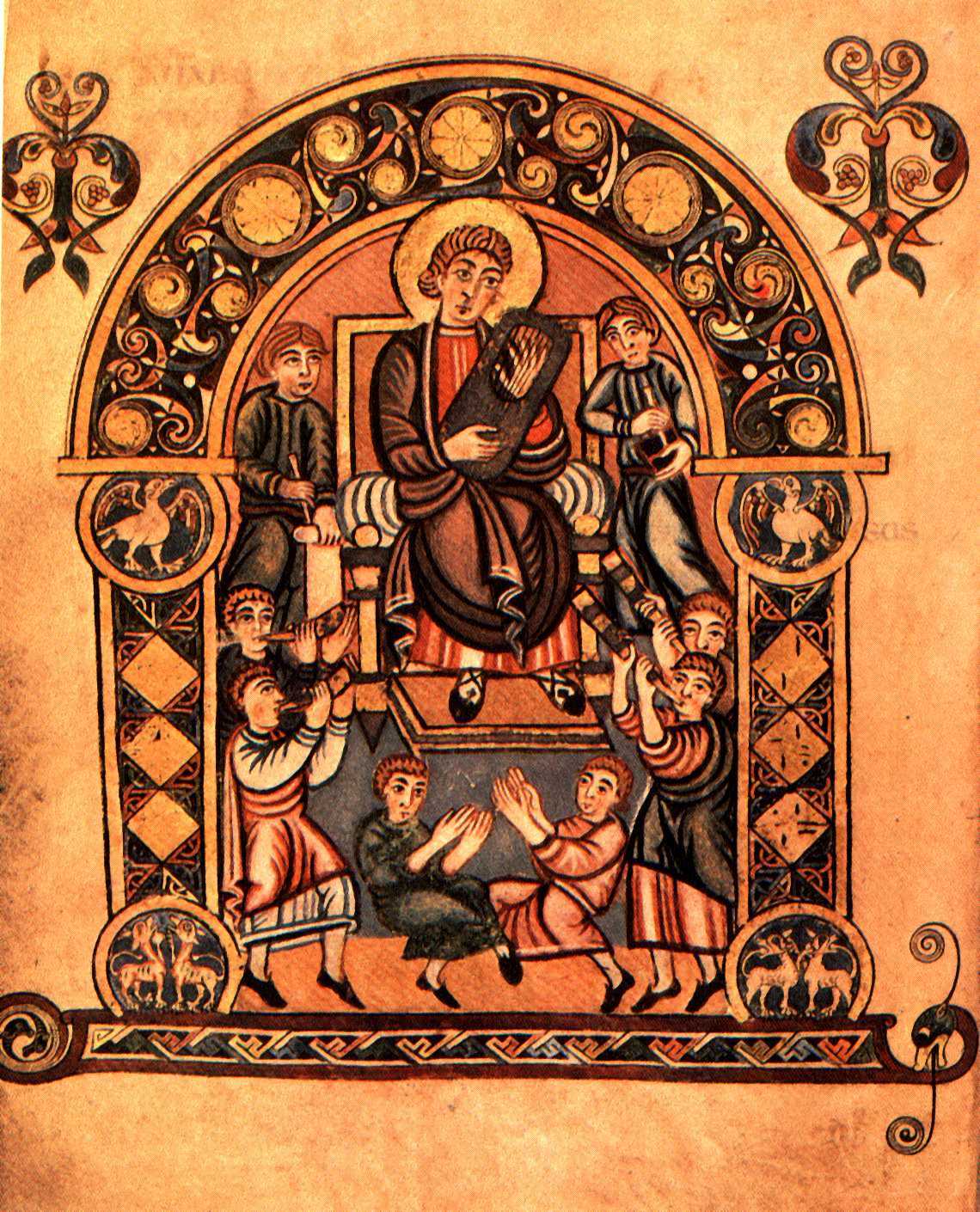
The Vespasian Psalter, folio 30v, David with his musicians, eighth century. Public domain.
Psalms 3 to 145 · Passage · Featured Study
The Superscriptions of the Psalms
In the Berean text 116 of the 150 psalms open with a heading that names a singer, a kind of song, a tune or an occasion.
No heading stands over the first two psalms or the last five.
God again designated a certain day as “Today,” when a long time later He spoke through David as was just stated: “Today, if you hear His voice, do not harden your hearts.”
- The passage
- Psalm 3:1 to 8, Psalm 88:1 to 18, Psalm 90:1 to 17, Habakkuk 3:1 to 19
- Books
- Psalms, Habakkuk
- Hold in memory
- Habakkuk 3:19
Summary
The headings are short lines written above the psalms. Some of their words, like Miktam, were already hard for the ancient Greek translators. Readers still ask whether a name marks an author or a collection, and whether the musical lines belong to the psalm above them.
- Some psalms carry more names in the Greek translation than in the Hebrew.
- Beside David, the headings name Asaph, the sons of Korah, Solomon, Moses, Heman, Ethan and Jeduthun.
- Hebrews 4:7 hears Psalm 95 as David's words.
The Headings in the Psalter
Twenty-eight of the 34 untitled psalms come from Psalm 90 on, where the fourth book begins.
The other six are Psalms 1, 2, 10, 33, 43 and 71.
A. F. Kirkpatrick listed the same 34 untitled psalms in his Cambridge Bible commentary of 1902.
This is a prayer of Habakkuk the prophet, according to Shigionoth:Habakkuk's prayer, outside the Psalter, is headed with its singer and its kind, as the psalms are.
GOD the Lord is my strength; He makes my feet like those of a deer; He makes me walk upon the heights! For the choirmaster. With stringed instruments.The same prayer ends with a musical line that opens 55 psalms in the Berean text.
The headings that tie a psalm to a day in David's life are taught one by one on their own page.
The Names in the Headings
Eight singers are named, and 50 psalms name no one.
David is named in nearly half of the 150 psalms.
| Named in the heading | Psalms | Books of the Psalter | Where the name stands |
|---|---|---|---|
| David | 73 | All five books | Psalms 3 to 41 but 10 and 33, Psalms 51 to 70 but 66 and 67, and 18 more from Psalm 86 to Psalm 145 |
| Asaph | 12 | Books II and III | Psalm 50, and Psalms 73 to 83, which open the third book |
| The sons of Korah | 11 | Books II and III | Psalm 42, which opens the second book, Psalms 44 to 49, and Psalms 84, 85, 87 and 88 |
| Solomon | 2 | Books II and V | Psalm 72, which closes the second book, and Psalm 127 |
| Moses | 1 | Book IV | Psalm 90, the first psalm of the fourth book |
| Heman the Ezrahite | 1 | Book III | Psalm 88, where the sons of Korah are named with him |
| Ethan the Ezrahite | 1 | Book III | Psalm 89, the last psalm of the third book |
| Jeduthun | 3 | Books I, II and III | Psalms 39 and 62 with David, and Psalm 77 with Asaph |
| No one named | 50 | Books I, II, IV and V | Psalms with no heading, and 16 headings with no singer's name |
Ethan the Ezrahite, Jeduthun, No one named
Headings in the Greek
The Septuagint, the old Greek translation, has headings the Hebrew lacks.
Kirkpatrick notes that the Greek adds David's name to Psalms 91 and 93 to 99, among others. Franz Delitzsch notes that it adds the names of Jeremiah, Haggai and Zechariah to psalms near the end of the book.
Psalm 95 has no heading in the Berean text, yet Hebrews speaks of it as words spoken through David.
What a Heading Says
Ten lines recur in the headings beside the singers' names.
Ten lines of the headings, the number of psalms that carry each, and where they stand.
| In the heading | Psalms | What it gives | Where it stands |
|---|---|---|---|
| For the choirmaster | 55 | A direction to the leader of the music | First at Psalm 4, last at Psalm 140 |
| A song of ascents | 15 | One of fifteen songs in a row | Every psalm from Psalm 120 to Psalm 134 |
| Maskil | 13 | An instructive poem, in Strong's sense | First at Psalm 32, last at Psalm 142 |
| To the tune of | 11 | A named melody to sing it to | First at Psalm 9, last at Psalm 80 |
| With stringed instruments | 7 | The instruments to play | First at Psalm 4, last at Psalm 76 |
| Miktam | 6 | An engraving, a poem, in Strong's sense | At Psalm 16 and at Psalms 56 to 60 |
| A prayer | 5 | The kind of song | At Psalms 17, 86, 90, 102 and 142 |
| According to Gittith | 3 | A Gittite harp, in Strong's sense | At Psalms 8, 81 and 84 only |
| Shiggaion | 1 | A rambling poem, in Strong's sense | The one heading of Psalm 7 |
| A song for the Sabbath day | 1 | Its day of use | The one heading of Psalm 92 |
A prayer, According to Gittith, Shiggaion, A song for the Sabbath day
Voices on the Headings
Jerome and Calvin wrote on a heading hard to read and a heading with no singer.
Jerome (died 420)
Homily 61, on Psalm 15
Jerome, preaching on the psalm the Hebrew numbers 16, set out how the Greek translators rendered the word Miktam.
“An inscription of a title, to David himself. In place of this the fifth edition put the Hebrew word itself, ‘MACTHAM David,’ which Aquila translated as ‘of the humble and simple David,’ and Symmachus as ‘of the humble and unstained David.’ And Aquila himself again, in the fifty-fifth psalm and in the rest as far as the fifty-ninth, rendered this very thing so as to say ‘of the humble and perfect David.’”
on Psalm 16:1Patristic
John Calvin (1509 to 1564)
Commentaries
Calvin gives Psalm 120, whose heading names no singer, to David from its style.
“The name of the author of the Psalm is not expressed, but the style of it throughout presents David to our view. Although, therefore, I cannot positively affirm, yet I am rather inclined to think that it was composed by him. Nor will it be improper, in my judgment, to explain it as if his name had been mentioned in the inscription.”
on Psalm 120:1Reformed
Do the Headings Belong to the Psalms?
Readers hold three views of what the names and the musical lines mean.
When the titles were written is set out with its holders on another page.
A name marks the collectionA. F. Kirkpatrick; C. A. Briggs
Kirkpatrick holds that a name in a heading often marks the collection a psalm was taken from. C. A. Briggs holds that the headings came from editors and record the stages of the book's editing and use.
Against this reading, Delitzsch points to Habakkuk 3:1 and 2 Samuel 1:18, where a singer's own name stands with his song.
The choirmaster's line ends the psalm beforeJames William Thirtle
Thirtle takes Habakkuk 3 as the pattern, with its heading at the top and its musical line at the foot. He holds that in the Psalter the choirmaster's line was moved to the head of the next psalm, and he gives the double heading of Psalm 88 as his example.
Against this reading, Thirtle himself grants that the move, if it happened, is older than every Hebrew manuscript that survives.
David and ten eldersThe Babylonian Talmud, Bava Batra 14b to 15a
Books to Read Next
Both books are in the public domain, and each has a free copy to read.
The Book of Psalms
A. F. Kirkpatrick · 1902
Kirkpatrick sorts the titles into five kinds on page xviii.
Read at the Internet ArchiveThe Titles of the Psalms: Their Nature and Meaning Explained
James William Thirtle · 1904
Thirtle sets out his reading of the choirmaster's line from Habakkuk 3 on pages 11 to 14.
Read at the Internet ArchiveIn the Book of Psalms
The heading of Psalm 110 names David, and Jesus quoted that psalm as David's own words.
For David himself says in the book of Psalms: ‘The Lord said to my Lord, “Sit at My right handLuke's Gospel gives the book its title, the book of Psalms.
Sources
Scripture is the Berean Standard Bible.
- Berean Standard Bible, Psalms in USFM, with the headings of the psalms.
- Strong's lexicon.
- A. F. Kirkpatrick, The Book of Psalms, Cambridge Bible for Schools and Colleges, Cambridge University Press, 1902, pp. xviii, xxxi to xxxiii and 575.
- Franz Delitzsch, Biblical Commentary on the Psalms, translated by Francis Bolton, T. and T. Clark, 1871, vol. 1 pp. 22 to 23, vol. 3 p. 338.
- James William Thirtle, The Titles of the Psalms: Their Nature and Meaning Explained, Henry Frowde, 1904, pp. 11 to 14.
- C. A. Briggs, A Critical and Exegetical Commentary on the Book of Psalms, International Critical Commentary, vol. 1, 1906, pp. lvii to lviii.
- Babylonian Talmud, Bava Batra 14b to 15a, William Davidson edition.
- Jerome, Homily 61, on Psalm 15 (Psalm 16 in the Hebrew numbering)
- John Calvin, Commentaries, on Psalm 120:1.
Keep Studying
Studies7
Subjects5
Go further2