
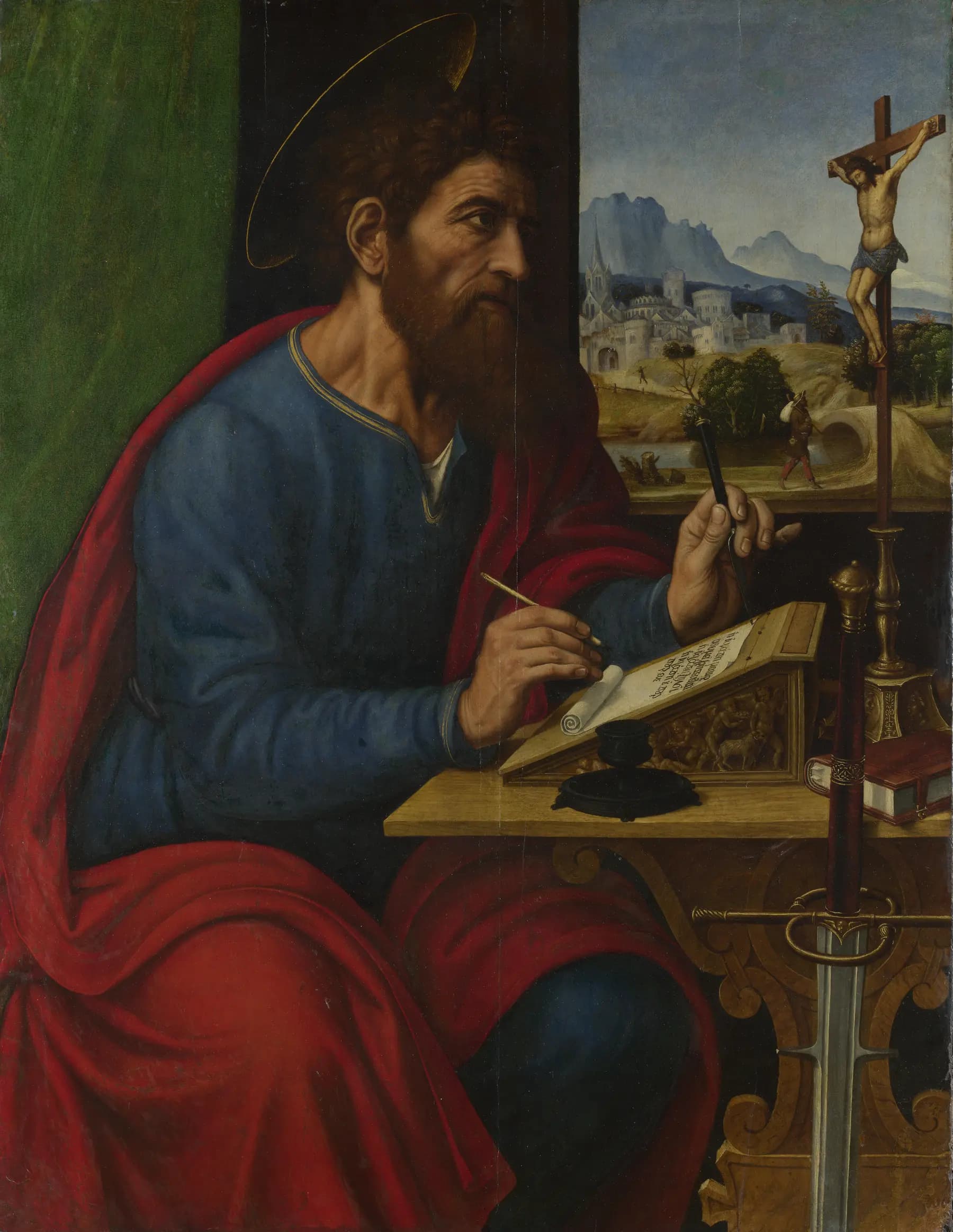
Saint Paul Writing, Pier Francesco Sacchi, the 1520s, National Gallery, London. Public domain.
New Testament · Book 54 of 66
1 Timothy
1 Timothy is Paul's letter to Timothy, whom he left in Ephesus to guard the church. He warns against false teachers and sets out the qualities of overseers and deacons and the order of worship.
1 Timothy is Paul's letter to Timothy, whom he left in Ephesus to guard the church. He warns against false teachers and sets out the qualities of overseers and deacons and the order of worship.
What is 1 Timothy about?
1 Timothy is a letter from Paul to Timothy, whom he left at Ephesus to stop certain men teaching false doctrine. Paul sets the gospel at the head of the charge: “Christ Jesus came into the world to save sinners” (1:15). He then orders the church's prayer, its worship and its overseers and deacons, and gives God's household its confession in six lines. He tells Timothy how to be a good servant of Christ. The letter closes on widows, elders, slaves and money, and on the charge to fight the good fight and guard what was entrusted to him.
All 6 chapters
Every chapter of the book, in one grid. Each cell opens that chapter.
- The charge and the gospelChapter 1
- The household of GodChapters 2 to 3
- The good servantChapter 4
- The good fightChapters 5 to 6
The colour is the movement of the letter the chapter stands in, and every cell opens that chapter's Study level.
Who wrote it, where, when, for whom, and why?
The letter opens with its writer's name: Paul, an apostle by the command of God our Savior (1:1). He speaks of his own past as a blasphemer shown mercy (1:13) and of being appointed a preacher, an apostle and a teacher of the Gentiles (2:7). He writes to Timothy, his true child in the faith (1:2), whom Acts names as a disciple at Lystra, son of a believing Jewish woman and a Greek father (Acts 16:1).
For this reason I was appointed as a preacher, an apostle, and a faithful and true teacher of the Gentiles. I am telling the truth; I am not lying about anything.
1 Timothy 2:7, Berean Standard Bible.
Paul had urged Timothy to stay on at Ephesus when he left for Macedonia (1:3). Acts records Paul's long ministry at Ephesus (Acts 19:10) and his warning to its elders at Miletus that savage wolves would come in among them (Acts 20:29).
The letter stands after Paul's departure for Macedonia (1:3), while he hopes to come to Timothy soon (3:14), and while Timothy can still be told not to let anyone despise his youth (4:12). Acts ends with Paul two years in Rome under guard (Acts 28:30).
The letter is written to Timothy (1:2, 6:20), and through him to the church at Ephesus. It closes with a blessing in the plural, Grace be with you all (6:21), and it gives instruction for the believers, the widows, the elders, the slaves and the rich of that church (5:7, 6:1, 6:17).
Paul writes in case he is delayed, so that Timothy will know how each one must conduct himself in God's household (3:14 to 15). Certain men were teaching false doctrines and devoting themselves to myths and endless genealogies (1:3 to 4), and some were forbidding marriage and foods (4:3). The goal of the instruction is love (1:5).
The church the letter describes meets for prayer and the public reading of Scripture (2:1, 4:13). It has overseers, deacons and elders (3:1, 3:8, 5:17), keeps a roll of widows (5:9), and holds slaves and masters and the rich in one company (6:1 to 2, 6:17). Its members pray for kings and all in authority (2:2), and its Lord made the good confession before Pontius Pilate (6:13).
Sources. 1 Timothy 1:1 to 5, 1:13, 2:1 to 2, 2:7, 3:1, 3:8, 3:14 to 15, 4:3, 4:12 to 13, 5:7, 5:9, 5:17, 6:1 to 2, 6:13, 6:17 and 6:20 to 21; Acts 16:1, 19:10, 20:29 and 28:30. Every verse is read in the Berean Standard Bible.
How is 1 Timothy arranged, and what is it for?
The four movements the letter falls into, then what it teaches and what it was written to do.
- The charge and the gospelChapter 1, 20 verses, the turn at 1:15
Timothy is left at Ephesus to stop false doctrine, and Paul tells how Christ showed mercy to him.
- The household of GodChapters 2 to 3, 31 verses, the turn at 3:15
Prayer for everyone, men and women in worship, overseers and deacons, and the confession of 3:16.
- The good servantChapter 4, 16 verses, the turn at 4:16
Teachings that forbid marriage and foods, and Timothy trained for godliness and set as an example.
- The good fightChapters 5 to 6, 46 verses, the turn at 6:12
Widows, elders and slaves, godliness with contentment, the good confession and the deposit guarded.
The theme
The church is God's household, and the truth it holds up is the gospel that Christ came into the world to save sinners (1:15). Paul charges Timothy to stop teaching that turns from it, to order the church's prayer, its offices and its care for widows and elders, and to live what he teaches. The letter ties sound teaching to godly living throughout, and it sets both on one God and one mediator, and on the Christ who appeared in the flesh and was taken up in glory (2:5, 3:16).
The purpose
Paul wrote so that Timothy would know how each one must conduct himself in God's household if Paul was delayed (3:14 to 15). The letter gives Timothy the authority of the apostle's charge in a church troubled by other teachers, and it ends by handing him the deposit to guard (6:20).
The confession of God's household, in three pairs
“By common confession, the mystery of godliness is great” (3:16), and the confession follows in six lines.
- Line 1, fleshHe appeared in the fleshPair 1flesh and SpiritLine 2, Spiritwas vindicated by the Spirit
- Line 3, angelswas seen by angelsPair 2angels and nationsLine 4, nationswas proclaimed among the nations
- Line 5, worldwas believed in throughout the worldPair 3world and gloryLine 6, glorywas taken up in glory
The charge and the gospel, 1 Timothy 1
What the text says in these 20 verses, and the pages they open on.
Paul writes to Timothy, his true child in the faith, and reminds him why he was left at Ephesus: to instruct certain men not to teach false doctrines or devote themselves to myths and endless genealogies (1:3 to 4). The goal of the instruction is love from a pure heart, a clear conscience and a sincere faith (1:5). The law is good when it is used as law, against the lawless and against all that is contrary to sound teaching (1:8 to 11). Paul then tells his own story. He was a blasphemer, a persecutor and a violent man, and he was shown mercy, so that Christ might display his patience in the worst of sinners (1:13 to 16). He breaks into praise of the King eternal (1:17), charges Timothy to fight the good fight, and names Hymenaeus and Alexander, who have shipwrecked their faith (1:18 to 20).
This is a trustworthy saying, worthy of full acceptance: Christ Jesus came into the world to save sinners, of whom I am the worst.
- Study
1 Timothy 1the charge at Ephesus, the law used rightly, and mercy to the worst of sinnersShow the summary and 3 pagesShow summary, 3 pagesHide the summary
Paul, an apostle of Jesus Christ by the commandment of God our Saviour, to Timothy, his own son in the faith. Charge some that they teach no other doctrine, neither give heed to fables and endless genealogies, which minister questions rather than godly edifying. The end of the commandment is charity out of a pure heart. I thank him who enabled me, though a blasphemer and persecutor, because I did it ignorantly in unbelief. This is a faithful saying. Christ Jesus came into the world to save sinners, of whom I am chief. Henry reads the chapter as the apostle's catechism for pastors.
On this chapter (3)
- Jesus on salvation
What Christ said he came to do.
- Who were the teachers the letter answers?
Answered under Where do readers disagree, lower on this page, with each reading and who holds it.
- 1 Timothy 1:15
The verse on its own page, with the commentators on it by era.
- Jesus on salvation
Paul before and after mercy
- 1:13“a blasphemer”
- 1:13“a persecutor”
- 1:13“a violent man”
Characters (3)
Who the text names. A name with a page carries its door.
Places (2)
Where the chapters stand.
- Ephesus
Where Timothy is to stay and instruct certain men (1:3).
- Macedonia
Where Paul was going when he left Timothy behind (1:3).
Themes (3)
What these chapters raise, each on its own page where one stands.
- Sound doctrine
The teaching that agrees with the glorious gospel (1:10 to 11).
- The law
Good if one uses it legitimately (1:8).
- Mercy to sinners
The worst of sinners shown mercy, as an example (1:13 to 16).
Where these chapters take up the Old Testament (0)each marked as a quotation or an allusion, with the evidence
- No Old Testament passage is quoted or named in these chapters.
- Beside it Paul warned the elders of Ephesus at Miletus that men would rise up among them and distort the truth. Acts 20:29 to 30.
The household of God, 1 Timothy 2 to 3
What the text says in these 31 verses, and the pages they open on.
First of all the church is to pray for everyone, for kings and all in authority, because God wants everyone to be saved (2:1 to 4). There is one God and one mediator between God and men, who gave himself as a ransom for all (2:5 to 6). The men are to pray without anger; the women are to adorn themselves with good deeds, and a woman is to learn in quietness, for Adam was formed first (2:8 to 15). An overseer must be above reproach, able to teach and a good manager of his own household (3:1 to 7). Deacons are tested first and hold the mystery of the faith with a clear conscience (3:8 to 13). Paul then says why he writes: so that Timothy will know how to conduct himself in God's household (3:14 to 15). The movement ends with the confession of 3:16, the mystery of godliness in six lines.
in case I am delayed, so that you will know how each one must conduct himself in God’s household, which is the church of the living God, the pillar and foundation of the truth.
- Study
1 Timothy 2prayer for all, one mediator, men and women in worshipShow the summary and 6 pagesShow summary, 6 pagesHide the summary
I exhort therefore, that, first of all, supplications, prayers, intercessions, and giving of thanks, be made for all men. For kings, and for all in authority, that we may lead a quiet and peaceable life. God will have all men to be saved. There is one God, one mediator between God and men, the man Christ Jesus, who gave himself a ransom for all. I will that men pray every where, lifting up holy hands. The women's conduct in the assembly. In modest apparel, with shamefacedness, learning in silence. Calvin reads the chapter as the church's public worship guideline.
On this chapter (6)
- The ransom
Christ who gave himself as a ransom for all.
- Women in ministry
The readings of 2:9 to 15 and their holders.
- What does 2:11 to 15 teach about women and teaching?
Answered under Where do readers disagree, lower on this page, with each reading and who holds it.
- What does 'saved through childbearing' of 2:15 mean?
Answered under Where do readers disagree, lower on this page, with each reading and who holds it.
- How do 2:4 and 4:10 stand in the debate on the extent of salvation?
Answered under Where do readers disagree, lower on this page, with each reading and who holds it.
- 1 Timothy 2:5
The verse on its own page, with the commentators on it by era.
- The ransom
- Study
1 Timothy 3the overseer, the deacons, God's household and its confessionShow the summary and 4 pagesShow summary, 4 pagesHide the summary
If a man desire the office of a bishop, he desireth a good work. A bishop must be blameless, the husband of one wife, vigilant, sober, of good behaviour, given to hospitality, apt to teach; not given to wine, no striker, not greedy; patient, not a brawler, not covetous; ruling his own house well. Deacons likewise. Grave, not double-tongued, not given to much wine, holding the mystery of the faith in a pure conscience. Without controversy great is the mystery of godliness: God was manifest in the flesh, justified in the Spirit. JFB reads the chapter as the qualification-catechism for office.
On this chapter (4)
- Elders and deacons
The offices of the church, and what each asks.
- The mystery of godliness
The confession of 3:16.
- What does 'husband of but one wife' of 3:2 require?
Answered under Where do readers disagree, lower on this page, with each reading and who holds it.
- 1 Timothy 3:16
The verse on its own page, with the commentators on it by era.
- Elders and deacons
The confession that closes this movement is drawn as six lines in three pairs, under The book as a whole.
The overseer beside the deacons
The elder's list Paul gives Titus for Crete stands beside this one: Titus 1:5 to 9, the elder's list for Crete.
Characters (4)
Who the text names. A name with a page carries its door.
- Christ
The one mediator, who gave himself as a ransom for all (2:5 to 6).
- Adam and Eve
Named at 2:13 to 14 from the account of the garden.
- The overseers
Above reproach and able to teach (3:1 to 7).
- The deacons
Tested first, holding the mystery of the faith (3:8 to 13).
Places (1)
Where the chapters stand.
- God's household
The church of the living God, the pillar and foundation of the truth (3:15).
Themes (4)
What these chapters raise, each on its own page where one stands.
- The mediator
One God and one mediator between God and men (2:5).
- Women in ministry
The instruction of 2:9 to 15, read in more than one way.
- Order in worship
How the church prays and gathers (2:8 to 12).
- The mystery of godliness
The confession of 3:16.
Where these chapters take up the Old Testament (1)each marked as a quotation or an allusion, with the evidence
- Probable allusionGenesis 2 to 3 at 1 Timothy 2:13 to 14. Paul grounds his instruction in the order of the garden: Adam formed first, then Eve, and the woman deceived. The store pairs 2:13 with Genesis 2:7, 2:18 and 2:22, and 2:14 with Genesis 3:6 and 3:12 to 13. Paul names Adam and Eve and retells the account in his own words.
- Beside it Titus is given the same charge for Crete, with a list of an elder's qualities beside this one. Titus 1:5 to 9.
The good servant, 1 Timothy 4
What the text says in these 16 verses, and the pages they open on.
The Spirit says that in later times some will abandon the faith for teachings that forbid marriage and require abstinence from foods (4:1 to 3). Paul answers that every creation of God is good when it is received with thanksgiving (4:4 to 5). By pointing this out Timothy will be a good servant of Christ (4:6). He is to reject silly myths and train himself for godliness, which holds promise for this life and the next (4:7 to 8), because the living God is the Savior of everyone, and especially of those who believe (4:10). No one is to despise his youth. He is to set an example in speech, conduct, love, faith and purity, give himself to the public reading of Scripture, exhortation and teaching, and not neglect the gift given him through prophecy and the laying on of hands (4:12 to 14). He is to watch his life and his teaching (4:16).
Pay close attention to your life and to your teaching. Persevere in these things, for by so doing you will save both yourself and those who hear you.
- Study
1 Timothy 4the later times, good creation, training for godliness, the example and the giftShow the summary and 2 pagesShow summary, 2 pagesHide the summary
The Spirit says expressly, that in the latter times some shall depart from the faith, giving heed to seducing spirits and doctrines of devils; forbidding to marry, commanding to abstain from meats. Every creature of God is good. Train yourself rather for godliness. Godliness is profitable for all things. Till I come, give attendance to reading, to exhortation, to doctrine. Neglect not the gift that is in you. Meditate upon these things; give yourself wholly to them; that your progress may appear to all. Wesley reads the chapter as the charge to ministerial diligence.
On this chapter (2)
- Spiritual gifts
The gifts the Spirit gives the church.
- 1 Timothy 4:12
The verse on its own page, with the commentators on it by era.
- Spiritual gifts
10 commands to Timothy, in order
- 14:6“By pointing out these things to the brothers”
- 24:7“reject irreverent, silly myths”
- 34:7“train yourself for godliness”
- 44:11“Command and teach these things”
- 54:12“set an example for the believers”
- 64:13“devote yourself to the public reading of Scripture”
- 74:14“Do not neglect the gift that is in you”
- 84:15“Be diligent in these matters”
- 94:16“Pay close attention to your life and to your teaching”
- 104:16“Persevere in these things”
Characters (2)
Who the text names. A name with a page carries its door.
- Timothy
Young, trained for godliness, and set as an example (4:7, 4:12).
- The elders
Laid hands on Timothy when the gift was given (4:14).
Places (1)
Where the chapters stand.
- The assembly
Where Scripture is read aloud, with exhortation and teaching (4:13).
Themes (3)
What these chapters raise, each on its own page where one stands.
- Godliness
Valuable in every way, for this life and the next (4:8).
- Spiritual gifts
The gift given through prophecy and the laying on of hands (4:14).
- Marriage
Forbidden by the teachers of 4:3, and good as God's creation.
Where these chapters take up the Old Testament (0)each marked as a quotation or an allusion, with the evidence
- No Old Testament passage is quoted or named in these chapters.
- Beside it Paul told the Ephesian elders to keep watch over themselves and the flock, as Timothy is told to watch his life and his teaching. Acts 20:28.
The good fight, 1 Timothy 5 to 6
What the text says in these 46 verses, and the pages they open on.
Timothy is to treat older men as fathers and younger women as sisters (5:1 to 2). Widows who are truly widows are to be honored, their families are to provide for them first, and a widow of sixty known for good deeds may be enrolled (5:3 to 16). Elders who lead well are worthy of double honor, and an accusation against one needs two or three witnesses (5:17 to 22). Slaves are to honor their masters so that God's name is not discredited (6:1 to 2). Those who teach another doctrine think godliness is a means of gain, but godliness with contentment is great gain, and the love of money is a root of all kinds of evil (6:3 to 10). Timothy, the man of God, is to flee these things, fight the good fight and keep the commandment until the appearing of Christ (6:11 to 16). The rich are to be rich in good works (6:17 to 19). The letter ends: guard what has been entrusted to you (6:20).
Fight the good fight of the faith. Take hold of the eternal life to which you were called when you made the good confession before many witnesses.
- Study
1 Timothy 5older and younger, the widows' roll, the elders honored and chargedShow the summary and 4 pagesShow summary, 4 pagesHide the summary
Rebuke not an elder, but intreat him as a father. Honour widows that are widows indeed. She who lives for pleasure is dead while she lives. Let the elders that rule well be counted worthy of double honour. Against an elder receive not an accusation, but before two or three witnesses. Lay hands suddenly on no man. Drink no longer water, but use a little wine for your stomach's sake. Some men's sins are open beforehand, going before to judgment; and some men they follow after. Henry reads the chapter as the pastoral manual's middle chapter.
On this chapter (4)
- Elders and deacons
The offices of the church, and what each asks.
- The widow, the orphan and the stranger
Those Scripture charges God's people to care for.
- Are the overseer and the elder one office or two?
Answered under Where do readers disagree, lower on this page, with each reading and who holds it.
- 1 Timothy 5:17
The verse on its own page, with the commentators on it by era.
- Elders and deacons
- Study
1 Timothy 6slaves, contentment, the good confession, the rich and the depositShow the summary and 3 pagesShow summary, 3 pagesHide the summary
Let as many servants as are under the yoke count their own masters worthy of all honour. If any man teach otherwise. He is proud, knowing nothing. Godliness with contentment is great gain. They that will be rich fall into temptation and a snare. The love of money is the root of all evil. But you, O man of God, flee these things; and follow after righteousness, godliness, faith, love, patience, meekness. Fight the good fight of faith; lay hold on eternal life. Keep the commandment without spot. Calvin reads the chapter as the apostolic charge enduring past Paul's life.
On this chapter (3)
- Jesus on money
Wealth, contentment and the heart.
- The Bible and slavery
The instruction of 6:1 to 2 and how it has been read.
- 1 Timothy 6:10
The verse on its own page, with the commentators on it by era.
- Jesus on money
The widows' roll
- 1Truly a widow“truly in need and left all alone” (5:5)
- 2Family first“show godliness to their own family” (5:4)
- 3Her hope“puts her hope in God” (5:5)
- 4Her age“at least sixty years old” (5:9)
- 5Her marriage“the wife of one man” (5:9)
- 6Her deeds“well known for good deeds” (5:10)
- Younger widows. “refuse to enroll younger widows” (5:11)
- Their counsel. “I advise the younger widows to marry” (5:14)
- The believing woman. “she must assist them” (5:16)
Two words on riches
Characters (4)
Who the text names. A name with a page carries its door.
- The widows
Honored, provided for by their own, and enrolled at sixty (5:3 to 16).
- The elders
Worthy of double honor, and rebuked in front of all when they persist in sin (5:17 to 20).
- The rich
Charged to be rich in good works (6:17 to 18).
- Pontius Pilate
Before whom Christ made the good confession (6:13).
Themes (4)
What these chapters raise, each on its own page where one stands.
- Contentment
Godliness with contentment is great gain (6:6).
- Slavery
The instruction of 6:1 to 2, and how it has been read.
- The deposit
What has been entrusted to Timothy, to be guarded (6:20).
- The good confession
Made by Timothy, and by Christ before Pilate (6:12 to 13).
Where these chapters take up the Old Testament (3)each marked as a quotation or an allusion, with the evidence
- Explicit quotationDeuteronomy 25:4 at 1 Timothy 5:18. Paul quotes the law's ox that is not muzzled while it treads out the grain for the elders who labor in preaching and teaching. Introduced with the words For the Scripture says. Paul quotes the same verse at 1 Corinthians 9:9, and the second saying of 5:18 stands in Luke 10:7.
- Probable allusionDeuteronomy 19:15 at 1 Timothy 5:19. An accusation against an elder needs the testimony of two or three witnesses, the rule the law gives for every charge. The phrase two or three witnesses is the law's own, and the store pairs 5:19 with Deuteronomy 19:15 and 17:6.
- Probable allusionJob 1:21 and Ecclesiastes 5:15 at 1 Timothy 6:7. We brought nothing into the world and can carry nothing out, as Job said at his loss and the Preacher said of the rich. The store pairs 6:7 with Job 1:21 and Ecclesiastes 5:15 to 16. The thought is the same and the wording is Paul's own.
- Beside it Titus is told to teach older men, older women, the young and slaves, as Timothy is told here. Titus 2:1 to 10.
- Author
- Paul (1:1)
- Date
- c. AD 62–66, from Macedonia after a first release
- Audience
- Timothy at Ephesus, leading the church in Paul's absence
Where do readers disagree?
One list: the readings with their holders, and what the evidence does not settle.
Did Paul write the letters to Timothy and Titus, and what do their vocabulary, their church order and their travels show?
Who Wrote the Pastoral Letters→- Paul wrote them after a release from Rome. Held by Luke Timothy Johnson, The First and Second Letters to Timothy, Anchor Bible (2001).
- Paul's letters, written out by a secretary. Held by C. F. D. Moule, 'The Problem of the Pastoral Epistles: A Reappraisal', Bulletin of the John Rylands Library 47 (1965).
- Written after Paul by a disciple in his name. Held by P. N. Harrison, The Problem of the Pastoral Epistles (1921).
What the evidence does not settle: The three letters are short, so word counts drawn from them prove little either way, and no source outside them tells what Paul did after Acts 28.
The argument in full
Paul wrote them after a release from Rome. Acts leaves Paul alive in Rome (Acts 28:30), so travels after it fit, and personal notes such as the advice on Timothy's stomach (5:23) are hard to explain as invention.
Paul's letters, written out by a secretary. Paul wrote through others, and a secretary given room with the wording would account for the vocabulary while the substance stays Paul's.
Written after Paul by a disciple in his name. The three letters share many words Paul uses nowhere else, their church order looks settled, and their travels fit nowhere in Acts.
What does 2:11 to 15 teach about women and teaching?
Women in Ministry→- A standing order grounded in creation. Held by Andreas J. Köstenberger, Thomas R. Schreiner and H. Scott Baldwin, eds., Women in the Church: A Fresh Analysis of 1 Timothy 2:9 to 15 (1995).
- An instruction for Ephesus and its false teaching. Held by Gordon D. Fee, 1 and 2 Timothy, Titus, New International Biblical Commentary (1988), and Philip B. Payne, Man and Woman, One in Christ (2009).
- Women called by the Spirit may preach. Held by Catherine Booth, Female Ministry; or, Woman's Right to Preach the Gospel (1859).
- The Spirit's gifts to women, and an order of headship. Held by Derek Prince, Women in the Church, Parts 1 and 2 (teaching series).
What the evidence does not settle: The verb at 2:12 stands once in the New Testament, so its force is argued from Greek writers outside it, and the letter does not say how far the instruction reaches beyond Ephesus.
The argument in full
A standing order grounded in creation. Paul's reason is the order of creation, Adam formed first (2:13), and an argument from creation reaches beyond one city.
An instruction for Ephesus and its false teaching. The letter exists because teaching had gone wrong at Ephesus (1:3 to 7, 4:1 to 3), and the new command of 2:11 is that a woman must learn.
Women called by the Spirit may preach. Women pray and prophesy in the assembly (1 Corinthians 11:5) and Philip's daughters prophesied (Acts 21:9), so the Spirit's call on women stands beside Paul's words at Ephesus.
The Spirit's gifts to women, and an order of headship. The gifts the Spirit gives to women and the order of headship Paul names are held together, each in its place.
What does 'saved through childbearing' of 2:15 mean?
Marriage and Family→- Saved through the birth of the Christ. Held by Philip B. Payne, Man and Woman, One in Christ (2009).
- Kept safe in the ordinary calling the false teachers despised. Held by Gordon D. Fee, 1 and 2 Timothy, Titus, New International Biblical Commentary (1988).
- Saved as her children continue in the faith. Held by John Chrysostom in his Homilies on First Timothy, Homily 9.
What the evidence does not settle: Whom the plural they of 2:15 names, and whether the verb means kept safe or saved, since the verse moves from one woman to many in one clause.
The argument in full
Saved through the birth of the Christ. The noun carries the article in Greek, and after Eve and the deception of 2:14 the verse hears the promise of Genesis 3:15.
Kept safe in the ordinary calling the false teachers despised. The teachers at Ephesus forbade marriage (4:3), and Paul answers that a woman's salvation is not at risk in marriage and motherhood kept in faith.
Saved as her children continue in the faith. The plural of if they continue reads as the children, so a mother's reward stands in children raised in faith, love and holiness.
What does 'husband of but one wife' of 3:2 require?
Elders and Deacons→- Faithful to his one wife. Held by Philip H. Towner, The Letters to Timothy and Titus, New International Commentary on the New Testament (2006).
- Not a man with more than one wife. Held by John Calvin, Commentaries on the Epistles to Timothy, Titus and Philemon (1548), on 3:2.
- Married only once. Held by Tertullian in On Monogamy, written early in the third century.
What the evidence does not settle: The phrase stands only in the Pastoral letters (3:2, 3:12, 5:9, Titus 1:6), so its sense is argued from its form and from the church's practice after it.
The argument in full
Faithful to his one wife. The Greek reads a one-woman man, a phrase about the man's faithfulness now, and the same form is used of the widow at 5:9.
Not a man with more than one wife. Polygamy was practised among the Jews of that day, and Paul bars a man living with more than one wife from the office.
Married only once. The widow enrolled must be the wife of one man (5:9), and the phrase was read to bar a second marriage after a wife's death.
Are the overseer and the elder one office or two?
Elders and Deacons→- One office with two names. Held by J. B. Lightfoot, 'The Christian Ministry', in Saint Paul's Epistle to the Philippians (1868).
- The overseer rose from among the elders. Held by R. Alastair Campbell, The Elders: Seniority within Earliest Christianity (1994).
- Distinct offices from the apostles' time. Held by Ignatius of Antioch in his Letter to the Magnesians, 6.
What the evidence does not settle: The letter lists the overseer's qualities in the singular (3:2) and speaks of elders in the plural (5:17), and it never says in one sentence how the two relate.
The argument in full
One office with two names. Titus 1:5 to 7 calls the same men elders and then overseer, and Acts 20:17 and 28 does the same for the leaders of Ephesus.
The overseer rose from among the elders. Elder names a standing and overseer a task, so each house church's leading elder was its overseer, and the singular of 3:2 fits one such man.
Distinct offices from the apostles' time. Within a generation of the letter the churches of Asia had one overseer over the elders and deacons, and Timothy himself stands over the elders at 5:19 to 22.
How do 2:4 and 4:10 stand in the debate on the extent of salvation?
Predestination and Election→- All kinds of people. Held by Augustine, Enchiridion, 103, and John Calvin, Commentaries on the Epistles to Timothy, Titus and Philemon (1548), on 2:4.
- Every person, and grace offered to all. Held by John Wesley, Explanatory Notes upon the New Testament (1755), on 2:4.
- Savior of all, and especially of believers. Held by John Gill, Exposition of the New Testament (1748), on 4:10.
What the evidence does not settle: Whether want in 2:4 names God's decree or his desire, and what especially of those who believe (4:10) adds to the Savior of everyone.
The argument in full
All kinds of people. The chapter prays for kings and all in authority (2:2), so everyone of 2:4 names every rank and nation, and God saves his own from all of them.
Every person, and grace offered to all. God wants everyone to be saved (2:4) and Christ gave himself as a ransom for all (2:6), so the offer is as wide as the wish, and faith receives it.
Savior of all, and especially of believers. God preserves and provides for every life, and saves those who believe with an everlasting salvation, so especially marks two kinds of saving.
Who were the teachers the letter answers?
- An early form of the knowledge falsely so called. Held by Irenaeus, Against Heresies (about 180), preface.
- Teachers of the law with Jewish speculations. Held by Matthew Henry in his Commentary on the Whole Bible (1710), on 1:4.
- Elders inside the church who said the resurrection had come. Held by Philip H. Towner, The Letters to Timothy and Titus, New International Commentary on the New Testament (2006).
What the evidence does not settle: The letter describes the teaching by what it did, myths, genealogies and bans on marriage and food, and never states its doctrine whole.
The argument in full
An early form of the knowledge falsely so called. Paul warns against the opposing arguments of so-called knowledge (6:20) and endless genealogies (1:4), the words Irenaeus turned against the Gnostic teachers of his day.
Teachers of the law with Jewish speculations. They want to be teachers of the law (1:7), and myths and genealogies were the stock of Jewish speculation on the Scriptures.
Elders inside the church who said the resurrection had come. Hymenaeus is named here (1:20) and in 2 Timothy 2:17 to 18 for saying the resurrection has already taken place, which would lead to forbidding marriage and foods (4:3).
The Text and the Spade
- The Artemision at Ephesusthe fourth-century BC temple; located by John Turtle Wood in 1869 and further excavated by David George Hogarth in 1904 and 1905
Wood searched for six years before finding the temple platform under many feet of silt, and Hogarth's later work recovered a deposit of jewelry, coins, and ivory figures from the earlier shrine beneath it. The finds establish the scale and antiquity of the cult Timothy's congregation lived beside, and they give the background to the riot of Acts 19 and to the ordinary pressure on a small church in a temple city.
- The terrace houses on the Curetes Street1st to 3rd centuries AD, excavated from 1960
A block of wealthy Ephesian homes with marble floors, frescoed walls, mosaic courts, and private baths, preserved by later collapse. They show what a rich household in this city looked like within a generation of the letter, which puts flesh on the instructions about 'gold or pearls or expensive clothes' (2:9) and on the charge to those 'those who are rich in the present age' (6:17). Congregations in cities like this held slaves and slaveholders, the poor and the wealthy, in one room.
- The Pilate inscription from Caesarea Maritimafound in 1961 in the theatre at Caesarea, cut in the 1st century
A limestone block naming Pontius Pilate as prefect of Judea, reused in a later repair. It fixes in stone the office and the name of the man before whom Christ 'made the good confession' (6:13), and it corrected an old assumption about his title, since the inscription reads prefect where later writers say procurator. A letter written in Macedonia to a church in Asia is anchored to a Roman official whose name is on a wall in Caesarea.
The pages 1 Timothy opens on
Studies46
- Who Wrote the Pastoral Letters
- Women in Ministry
- Elders and Deacons
- The Mystery of Godliness
- The Ransom
- Predestination and Election
Show the next 6 titles
- Spiritual Gifts
- Marriage and Family
- Jesus on Money
- The Bible and Slavery
- The Widow, the Orphan and the Stranger
- Order in Worship
Show the next 6 titles
- The False Teaching at Ephesus
- The Trustworthy Sayings
- King of Kings
- Father, Forgive Them
- Forgiving Yourself: What Scripture Says
- Holiness and Legalism
Show the next 6 titles
Words8
Sources for this page
The painting in the band is Saint Paul Writing, Pier Francesco Sacchi, the 1520s, National Gallery, London. Public domain. The movements, the chapter entries, the figures and the Context are read off the text of 1 Timothy. The Old Testament pairs are rows of the store's cross references. The works behind the readings under Where do readers disagree are Ignatius of Antioch, Letter to the Magnesians; Irenaeus, Against Heresies (about 180); Tertullian, On Monogamy; John Chrysostom, Homilies on First Timothy; Augustine, Enchiridion; John Calvin, Commentaries on the Epistles to Timothy, Titus and Philemon (1548); Matthew Henry, Commentary on the Whole Bible (1710); John Gill, Exposition of the New Testament (1748); John Wesley, Explanatory Notes upon the New Testament (1755); Catherine Booth, Female Ministry (1859); J. B. Lightfoot, The Christian Ministry (1868); P. N. Harrison, The Problem of the Pastoral Epistles (1921); C. F. D. Moule, The Problem of the Pastoral Epistles: A Reappraisal (1965); Gordon D. Fee, 1 and 2 Timothy, Titus (1988); R. Alastair Campbell, The Elders (1994); Andreas J. Köstenberger, Thomas R. Schreiner and H. Scott Baldwin, eds., Women in the Church (1995); Luke Timothy Johnson, The First and Second Letters to Timothy (2001); Philip H. Towner, The Letters to Timothy and Titus (2006); Philip B. Payne, Man and Woman, One in Christ (2009); and Derek Prince, Women in the Church, Parts 1 and 2. The hymn form of 3:16 names Robert H. Gundry, The Form, Meaning and Background of the Hymn Quoted in 1 Timothy 3:16 (1970), and William D. Mounce, Pastoral Epistles (2000). Every verse quoted on this page is the Berean Standard Bible, read from the store.