
Featured Study · The Craft of Scripture
Parallelism: the Bible's Rhyme of Thoughts
Hebrew poetry sets its lines in pairs, and Jesus taught in the same form.
English poetry rhymes sounds. Hebrew poetry rhymes ideas. One line says a thing, and the next line echoes it, sharpens it, or answers it with its opposite. Scholars call the form parallelism, and a reader who hears it reads the Psalms, Proverbs, the prophets and the words of Jesus with new ears.
- First appears
- Genesis 4:23 to 24
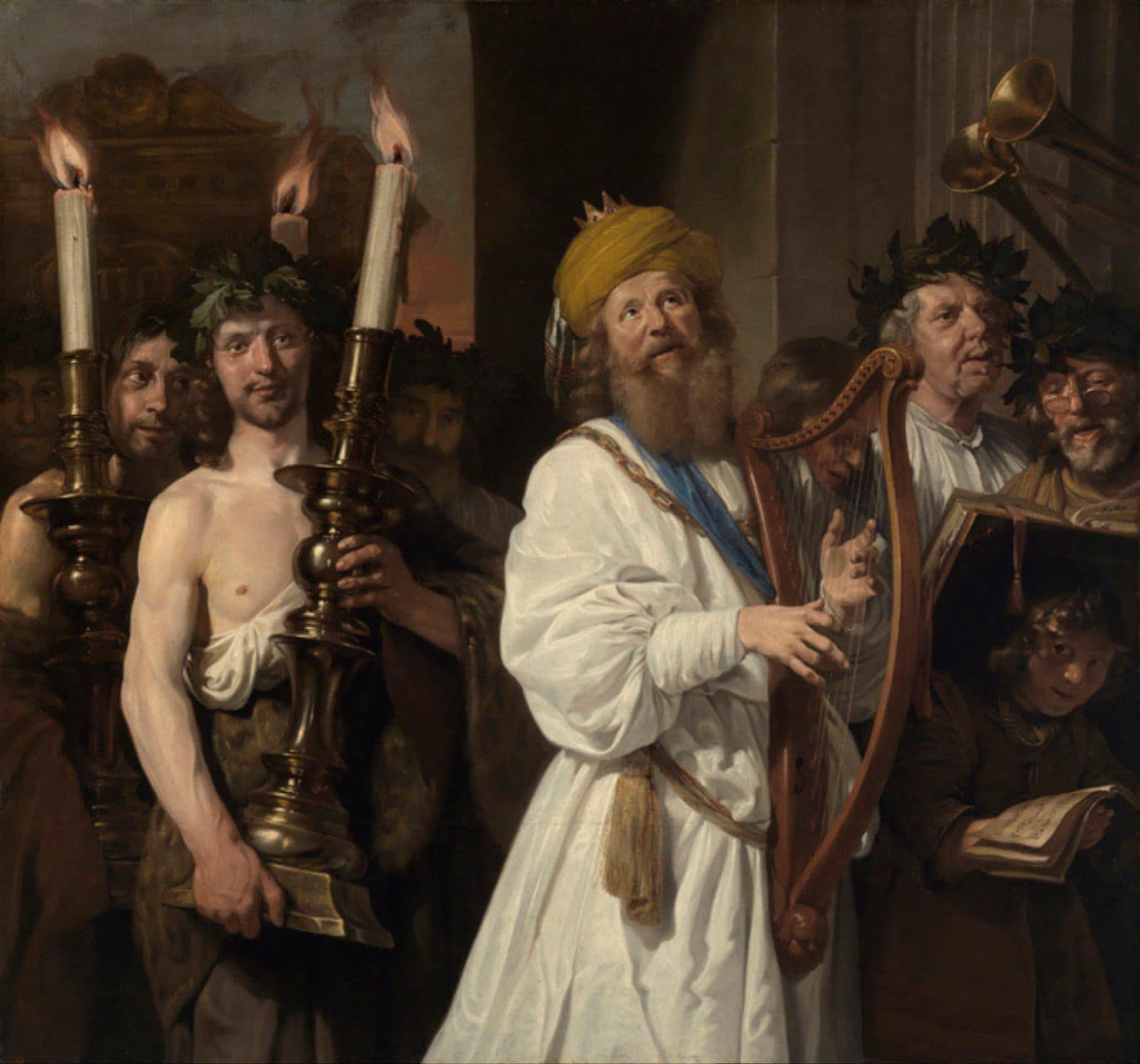
Jan de Bray, David Playing the Harp, 1670. Public domain.
THE ARTWORKJan de Bray painted David, the singer of Israel, with his harp in 1670. The Psalms, many of them David's, are the largest book of paired lines in Scripture.
Summary
Hebrew poetry sets lines in pairs, and the second line answers the first in thought.
- Psalm 19:1-2 says one thing twice: once in the sky, and once in time.
- In 1753 Robert Lowth named three kinds: the second line says the first again, says its opposite, or builds on it.
- Scholars now read every second line as doing more than the first, so the three names are a help for learning to hear the form.
- Jesus taught in this form, in the Beatitudes and in ask, seek and knock in Matthew 7.
What Parallelism Is
Psalm 19:1-2 gives one testimony in two lines.
Read Psalm 19:1-2 slowly. Line A tells you the heavens declare God's glory. Line B says the same thing again, in a different picture, from a different angle:
The heavens declare the glory of God; the skies proclaim the work of His hands.The firmament repeats the heavens' claim in a second picture, and day and night repeat it again in time.
Day after day they pour forth speech; night after night they reveal knowledge.The expanse above testifies; then day and night testify again, in time instead of space. Nothing new is added in information; everything is added in weight.
The form was named and organized by Robert Lowth, Bishop of Oxford, in his 1753 Oxford lectures. He called it parallelismus membrorum, parallelism of the members, the paired lines of a verse, and sorted it into working categories still taught today.
Lamech's words to his wives in Genesis 4:23-24 are among the oldest paired lines in Scripture.
Then Lamech said to his wives: “Adah and Zillah, hear my voice; wives of Lamech, listen to my speech. For I have slain a man for wounding me, a young man for striking me. If Cain is avenged sevenfold, then Lamech seventy-sevenfold.”Each line is said twice: voice and speech, a man and a young man.
The Three Kinds
Nine verses and six worked pairs show the synonymous, antithetic and synthetic kinds.
Lowth's three kinds run from Genesis to the words of Jesus.
The earth is the LORD’s, and the fullness thereof, the world and all who dwell therein. For He has founded it upon the seas and established it upon the waters.In this synonymous pair, line B names the ground of line A's claim: the earth is His because He built it. The same ownership, seen from the planet, then from its foundation.
The proverbs of Solomon: A wise son brings joy to his father, but a foolish son grief to his mother.Wisdom and folly are measured by the grief or joy they cause a parent. Line B is line A's mirror opposite, and the contrast is the whole lesson.
A gentle answer turns away wrath, but a harsh word stirs up anger.Two kinds of speech, two opposite outcomes, set eye to eye. Line B is line A turned inside out.
The wounds of a friend are faithful, but the kisses of an enemy are deceitful.This antithetic pair sets a wound that heals against a kiss that harms: friendship and flattery weighed by what they cost later rather than how they feel now.
Ascribe to the LORD, O heavenly beings, ascribe to the LORD glory and strength. Ascribe to the LORD the glory due His name; worship the LORD in the splendor of His holiness.Each line repeats the command and adds a step: glory and strength, then the glory due His name, then worship itself. The lines climb like a staircase, by repetition plus addition.
I lift up my eyes to the hills. From where does my help come? My help comes from the LORD, the Maker of heaven and earth.The question in line A is answered and then grounded in line B: a two-step climb from question, to answer, to reason.
A longer staircase: Psalm 19:7-9six lines
Bullinger's example of the simple synthetic kind is Psalm 19:7-9. Its six lines name God's law by six titles, each with its own attribute and effect. The staircase is longer than Psalm 29 or Psalm 121 above.
Why It Matters
Parallelism survives translation, where rhyme and meter are lost.
English rhyme is lost when a poem is turned into another language, and Homer's Greek meter is lost when it is turned into English. Sound-based poetry is bound to its own language. C. S. Lewis made this observation in Reflections on the Psalms. It is either a wonderful piece of luck, he wrote, or a wise provision of God's, that the poetry meant for every language was built on a device that translation keeps.
Parallelism is built from the relationship between ideas, so it carries over into every language Scripture is translated into. A reader in English still hears Psalm 19 rhyme in its thought.
How It Teaches Reading
The second line interprets the first.
Readers trained on English prose read each line as new information. Hebrew poetry trains the reader to let line B explain, sharpen, or complete line A, as Psalm 51:1 does.
Have mercy on me, O God, according to Your loving devotion; according to Your great compassion, blot out my transgressions.David makes one appeal to one mercy, named twice: first loving devotion, then compassion.
One animal or two: Zechariah 9:9 and Matthew 21two positions
Zechariah pictures the coming king riding on one animal, described twice in classic synonymous parallelism.
Rejoice greatly, O Daughter of Zion! Shout in triumph, O Daughter of Jerusalem! See, your King comes to you, righteous and victorious, humble and riding on a donkey, on a colt, the foal of a donkey.Matthew's account of the triumphal entry names two animals, a donkey and her colt, both brought to Jesus (Matthew 21:2, 21:7).
Many commentators, John P. Meier among them in The Vision of Matthew (1979), read this as Matthew over-literalizing Hebrew parallelism, taking a poetic doubling as two distinct animals. Others, David Instone-Brewer among them, read it as intentional. Matthew, the most Jewish of the four Gospel writers, uses Hebrew poetic forms elsewhere in his Gospel, and he brought both animals to make the fulfillment of Zechariah's wording plain to a Jewish audience.
Both positions stand in real scholarship.
On either reading, Matthew 21 shows that a reader must decide whether a pair of lines names one thing twice or two separate things.
Jesus Speaks in Parallelism
The Beatitudes, Luke 6:27-28 and Matthew 7:7-8 set His teaching in paired lines.
Jesus, the Word made flesh, taught in Hebrew poetry Himself, because it was the poetic grammar of the Scripture He came to fulfill.
“Blessed are the poor in spirit, for theirs is the kingdom of heaven.A condition named, then the kingdom blessing that answers it. The Beatitudes are eight tight A/B units in a row, the same architecture Lowth catalogued seventeen centuries later.
Blessed are those who mourn, for they will be comforted.Luke's record of the same sermon climbs in a four-step staircase, each line a different angle on the same command.
But to those of you who will listen, I say: Love your enemies, do good to those who hate you,bless those who curse you, pray for those who mistreat you.General love, then active good, then verbal blessing, then intercessory prayer: one command in four rising steps.
Matthew 7:7-8 climbs in three steps, as Psalm 29 and Psalm 121 do.
Ask, and it will be given to you; seek, and you will find; knock, and the door will be opened to you.For everyone who asks receives; he who seeks finds; and to him who knocks, the door will be opened.Three verbs of rising effort, ask, seek, knock, answered by three matching verbs, receive, find, opened: a staircase built from parallel lines.
The Voices
Four commentators from the sixteenth century to the nineteenth read four verses by the line beside each.
“He tells us, not merely that he had waited, but by the repetition of the same expression, he shows that he had been a long time in anxious suspense. In proportion then as his trial was prolonged, the evidence and proof of his faith in enduring the delay with calmness and equanimity of mind was so much the more apparent.”
John Calvin · Commentaries · on Psalms 40:1Reformed
“To the second of these parallel clauses, there is an accession of meaning, that is, that a brother's love is specially seen in adversity.”
Jamieson, Fausset & Brown · Commentary Critical and Explanatory on the Whole Bible · on Proverbs 17:17Reformed
“The contrast is carried on between the life of industry and that of the idle, ‘vain person’ of the ‘baser sort’ (the ‘Raca’ of Mat 5:22). We might have expected that the second clause would have ended with such words as ‘shall lack bread,’ but the contrast goes deeper. Idleness leads to a worse evil than that of hunger.”
Albert Barnes · Notes, Explanatory and Practical, on the Old and New Testaments (1832-1869) · on Proverbs 12:11Evangelical
“This he does once, yea, twice, that is, again and again; when one warning is neglected he gives another, not willing that any should perish. Precept must be upon precept, and line upon line; it is so, that sinners may be left inexcusable.”
Matthew Henry · Commentary on the Whole Bible · on Job 33:14Puritan
Four Ways to Sort the Lines
Lowth, Bullinger, Kugel and Alter each sort the paired lines in a different way.
Lowth's grid of synonymous, antithetic and synthetic pairs remains useful teaching scaffolding. Scholarship since Kugel treats "synthetic" as Lowth's catch-all category, the leftover bin for pairs that are neither straightforwardly restating nor contrasting. Line B specifies, intensifies, or moves the thought forward: in his own phrase, there is A, and what's more there is B.
So read the three kinds above as a ladder for learning to hear the form. The categories are real and useful, and they map only part of what the form can do.
Three kinds: Robert Lowth, 1753
Lectures on the Sacred Poetry of the Hebrews (1753, tr. 1787) · public domain
His three kinds, synonymous, antithetic and synthetic, are still the field's starting vocabulary.
Lowth held that the second line of a pair restates the first, sets its opposite against it, or builds on it.
The objection, in Kugel's terms: the synthetic kind takes every pair that fits neither of the first two, so it names a remainder rather than a kind.
Six kinds: E. W. Bullinger, 1898
Figures of Speech Used in the Bible (1898) · public domain, section "Parallelism: or, Parallel Lines"
His own examples of the simple synonymous kind are Genesis 4:23-24 and Psalm 1:1.
Bullinger kept Lowth's three as simple kinds and added three complex kinds, in which lines answer each other in alternation across a longer passage.
The objection, from Kugel's case: more kinds sort more verses, but each kind still treats the second line as a copy, an opposite or an addition.
One movement: James Kugel, 1981
The Idea of Biblical Poetry (Yale University Press, 1981)
Kugel holds that the three kinds are one movement, in which the second line always carries the first further.
The objection: teachers keep Lowth's three kinds because they help a new reader hear the pairs.
Heightening: Robert Alter, 1985
The Art of Biblical Poetry (Basic Books, 1985)
Alter reads the second line as a step up from the first: most often it makes the first line stronger, more exact or more concrete.
The objection: the antithetic proverbs set the second line against the first rather than raising it, as Proverbs 10:1 does.
Hear the Second Line
Jesus ended the Sermon on the Mount with one more pair of lines set against each other.
Therefore everyone who hears these words of Mine and acts on them is like a wise man who built his house on the rock.But everyone who hears these words of Mine and does not act on them is like a foolish man who built his house on sand.Both men hear the same words, and the second line differs from the first only in what the hearer does. Parallelism teaches the reader to listen for the second line, and this last pair asks the hearer to act on what was heard.
Keep studying
Studies6
Symbols7
Doctrines1