
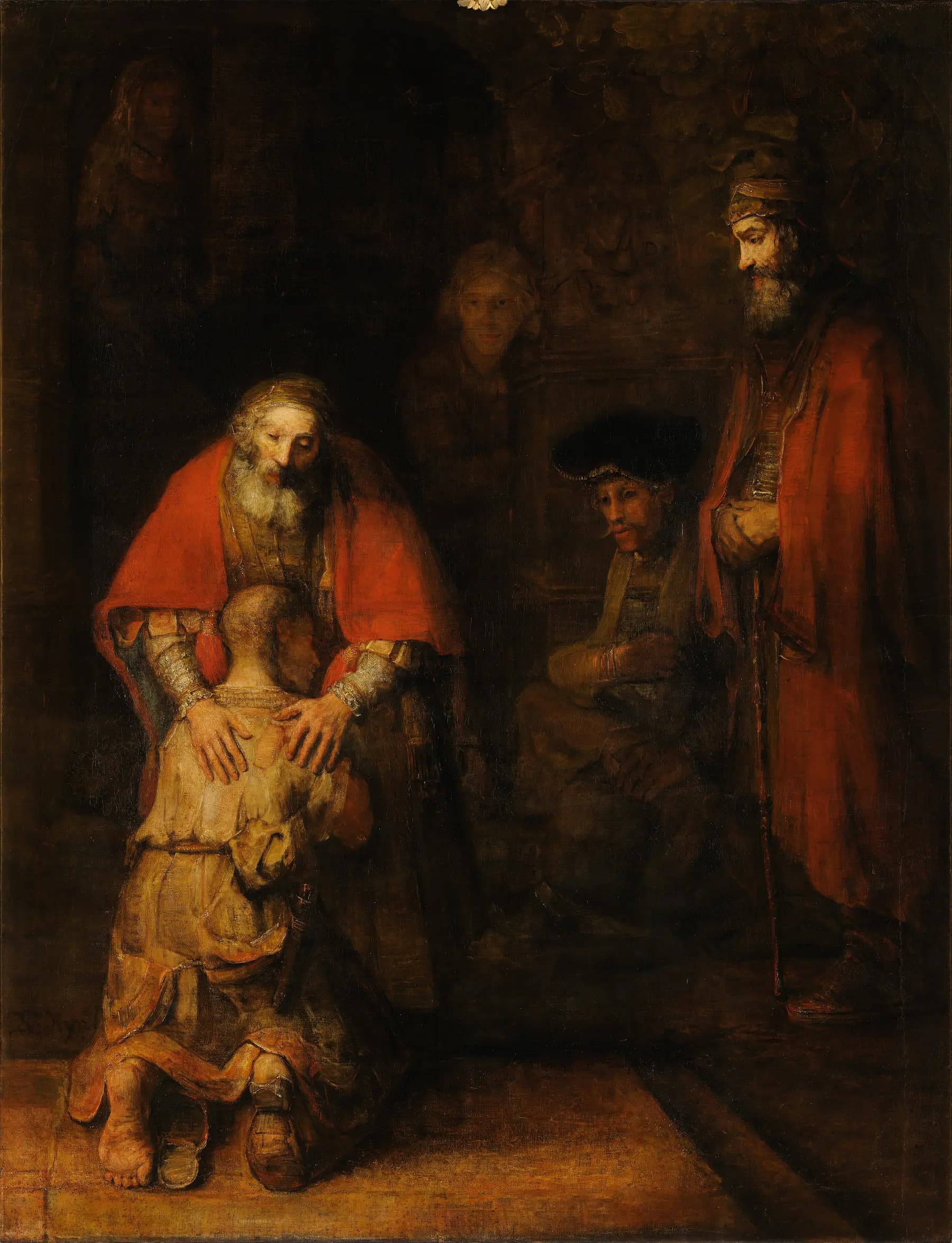
The Return of the Prodigal Son, Rembrandt, about 1668. Public domain.
New Testament · Book 42 of 66
Luke
Luke's 'orderly account' (1:3) follows Jesus from Bethlehem through the long travel narrative to Jerusalem and the Emmaus road.
Luke's 'orderly account' (1:3) follows Jesus from Bethlehem through the long travel narrative to Jerusalem and the Emmaus road.
What is Luke about?
Luke is an orderly account of the life of Jesus, written for a reader named Theophilus. It opens in the temple with two births announced and sung over. Jesus is baptized, reads from Isaiah at Nazareth, and heals and teaches in Galilee. Then he sets out for Jerusalem, and the road fills the middle of the book with his teaching. He eats with tax collectors and sinners, tells of the lost sheep, coin and son, and says he came “to seek and to save the lost” (19:10). In the city he is rejected and crucified, and on the third day he rises and opens the Scriptures to his disciples.
All 24 chapters
Every chapter of the book, in one grid. Each cell opens that chapter.
- The births and the boy in the templeChapters 1 to 2
- The Son of God in Galilee3:1 to 9:50
- The road set toward Jerusalem9:51 to 14:35
- The lost found15:1 to 19:27
- Jerusalem and the cross19:28 to 23:56
- The risen LordChapter 24
The colour is the movement of the book the chapter stands in, and every cell opens that chapter's Study level. The road begins at 9:51, inside chapter 9, and the city at 19:28, inside chapter 19.
Who wrote it, where, when, for whom, and why?
The writer's name comes from the church's report and from Paul's letters. The book says many had written an account from what eyewitnesses handed down, and that the writer investigated everything before writing in order for Theophilus (1:1 to 3). Acts opens by naming a first account to Theophilus of all that Jesus began to do and teach (Acts 1:1). Paul names Luke the beloved physician among his companions (Colossians 4:14, 2 Timothy 4:11).
Therefore, having carefully investigated everything from the beginning, it seemed good also to me to write an orderly account for you, most excellent Theophilus,
Luke 1:3, Berean Standard Bible.
The book begins and ends in the temple at Jerusalem (1:9, 24:53). Its middle runs from Nazareth and Capernaum in Galilee along a road through Samaria and Jericho (9:52, 17:11, 19:1) up to the city, and the risen Lord appears at Emmaus and at Bethany.
Luke dates the births to the days of Herod king of Judea and a decree of Caesar Augustus (1:5, 2:1), and John's preaching to the fifteenth year of Tiberius, when Pilate governed Judea and Herod was tetrarch of Galilee (3:1). Jesus is about thirty when he begins (3:23). The book ends forty days short of Pentecost by the count Acts gives (Acts 1:3).
The book is written for most excellent Theophilus, so that he may know the certainty of the things he was taught (1:3 and 4). Its reach goes wider: Simeon names the child a light for revelation to the Gentiles (2:32), and the book ends with the good news for all nations (24:47).
The book gives its reason in its first sentence: certainty for a reader already taught (1:4). Jesus gives the reason for his coming at Zacchaeus's house, to seek and to save the lost (19:10), and the risen Lord gives the reason for his death in the Scriptures, that the Christ would suffer and rise on the third day (24:46).
Luke's world is the Roman Empire under Augustus and Tiberius, with Judea under a governor and Galilee under Herod's son (3:1). The book names the census that sends families to their towns (2:3), the tax collectors and soldiers who come to John (3:12 and 14), Samaritans who refuse a man bound for Jerusalem (9:53), and the temple with its priests and its daily incense (1:8 and 9).
Sources. Luke 1:1 to 5, 1:8 and 9, 2:1, 2:3, 2:32, 3:1, 3:12, 3:14, 3:23, 9:52 and 53, 17:11, 19:1, 19:10, 24:46, 24:47 and 24:53; Acts 1:1 and 1:3; Colossians 4:14; 2 Timothy 4:11. Every verse is read in the Berean Standard Bible.
How is Luke arranged, and what is it for?
The six movements the book falls into, then what it teaches and what it was written to do.
- The births and the boy in the temple1 to 2, 132 verses, the turn at 1:38
Two births announced and sung over, and the boy of twelve in his Father's house.
- The Son of God in Galilee3:1 to 9:50, 326 verses, the turn at 4:21
The baptism and the line to Adam, the scroll read at Nazareth, and the works in Galilee.
- The road set toward Jerusalem9:51 to 14:35, 237 verses, the turn at 9:51
The face set toward the city, and the teaching on the way: the neighbour, prayer, the banquet.
- The lost found15:1 to 19:27, 170 verses, the turn at 19:10
The sheep, the coin and the son, the rich and the poor, and Zacchaeus at Jericho.
- Jerusalem and the cross19:28 to 23:56, 233 verses, the turn at 23:43
The King enters and weeps over the city, the supper, the four hearings and the cross.
- The risen Lord24, 53 verses, the turn at 24:27
The empty tomb, the road to Emmaus, the Scriptures opened and the Lord taken up.
The theme
God keeps his word to Israel in the birth of a Saviour, and the good news goes to the poor, the sinner, the Samaritan and the Gentile. Jesus comes anointed by the Spirit, prays at every turn, eats with tax collectors, and sets his face toward Jerusalem, where he is rejected and crucified as the Scriptures said. The joy of heaven over one who repents runs through the book, and the risen Lord shows that the Law, the Prophets and the Psalms were written about him.
The purpose
Luke wrote so that Theophilus might know the certainty of what he had been taught (1:4), setting down in order what eyewitnesses handed on. The book shows that Jesus is the Christ the Scriptures promised and the Saviour of all people, and it ends with repentance and forgiveness to be preached in his name to all nations, beginning at Jerusalem (24:47), which is where Acts takes up the account.
The road to Jerusalem, marked by Luke's own notices
- The births and the boy in the temple, 132
- The Son of God in Galilee, 326
- The road set toward Jerusalem, 237
- The lost found, 170
- Jerusalem and the cross, 233
- The risen Lord, 53
- a travel notice
- 19:51
“Jesus resolutely set out for Jerusalem”
Then The cost of following; the seventy-two sent.
- 29:53
“because He was heading for Jerusalem”
Then James and John rebuked; the good Samaritan.
- 313:22
“teaching as He made His way toward Jerusalem”
Then The narrow door, and the first and the last.
- 413:33
“it is not admissible for a prophet to perish outside of Jerusalem”
Then The lament over the city; the great banquet.
- 517:11
“He was passing between Samaria and Galilee”
Then The ten lepers; the days of the Son of Man.
- 618:31
“we are going up to Jerusalem”
Then His death foretold; Jericho and Zacchaeus.
- 719:11
“He was near Jerusalem”
Then The parable of the ten minas.
- 819:28
“going up to Jerusalem”
Then The descent from the Mount of Olives.
The births and the boy in the temple, Luke 1 to 2
What the text says in these 132 verses, and the pages they open on.
Luke tells Theophilus that he investigated everything from the beginning and writes it in order (1:1 to 4). In the temple an angel tells the old priest Zechariah that his wife Elizabeth will bear a son, John. The same angel tells Mary of Nazareth that she will bear the Son of the Most High, and she answers that she is the Lord's servant. Mary and Zechariah each sing. Under a decree of Augustus, Jesus is born in Bethlehem and laid in a manger, angels sing to shepherds, and Simeon and Anna greet the child in the temple. At twelve he stays behind there, in his Father's house (2:49).
“I am the Lord’s servant,” Mary answered. “May it happen to me according to your word.” Then the angel left her.
- Study
Luke 1the orderly account; Zechariah, the annunciation and two songsShow the summary and 4 pagesShow summary, 4 pagesHide the summary
Luke's prologue to Theophilus. Zacharias at the altar, Gabriel, the naming of John promised. Annunciation to Mary: 'behold the handmaid of the Lord.' The Visitation; Mary's Magnificat. Birth of John; Zacharias's Benedictus. Two song-bracketed scenes open Luke's infancy narrative.
On this chapter (4)
- The annunciation
The angel's word to Mary, and her answer.
- The canticles
The songs of the birth chapters.
- Who was Luke, and was he the physician and companion of Paul of Colossians 4:14 and the we passages of Acts?
Answered under Where do readers disagree, lower on this page, with each reading and who holds it.
- Luke 1:38
The verse on its own page, with the commentators on it by era.
- The annunciation
- Study
Luke 2the birth in Bethlehem, Simeon and Anna, the boy at twelveShow the summary and 4 pagesShow summary, 4 pagesHide the summary
Bethlehem birth under Augustus's decree; manger and swaddling clothes. Angels and shepherds: 'Glory to God in the highest, and on earth peace to men on whom His favor rests!' Circumcision and naming; Simeon's Nunc dimittis; Anna the prophetess. The twelve-year-old Jesus in the temple: 'Did you not know that I had to be in My Father’s house?'
On this chapter (4)
- The shepherds of Bethlehem
Good news of great joy, given first to shepherds.
- Jesus at twelve
The boy in his Father's house.
- What of the census under Quirinius in 2:2, and what does the record hold?
Answered under Where do readers disagree, lower on this page, with each reading and who holds it.
- Luke 2:11
The verse on its own page, with the commentators on it by era.
- The shepherds of Bethlehem
Four songs at the birth
- MaryLuke 1:46 to 55
“My soul magnifies the Lord”
Sung at Elizabeth's house, of the mighty brought down and the humble lifted up.
- ZechariahLuke 1:68 to 79
“Blessed be the Lord, the God of Israel”
Sung at John's naming, of the horn of salvation and the child who goes before the Lord.
- The angelsLuke 2:14
“Glory to God in the highest”
Sung to the shepherds in the fields the night of the birth.
- SimeonLuke 2:29 to 32
“Sovereign Lord, as You have promised”
Sung in the temple with the child in his arms, of a light for the Gentiles.
Characters (3)
Who the text names. A name with a page carries its door.
- Mary
Answers the angel: I am the Lord's servant.
- Zechariah and Elizabeth
The old priest and his wife, John's parents.
- Simeon and Anna
They greet the child in the temple.
Places (3)
Where the chapters stand.
- The temple
Where the book begins, and the boy stays behind.
- Nazareth
Mary's town in Galilee (1:26).
- Bethlehem
The town of David, where he is born.
Themes (3)
What these chapters raise, each on its own page where one stands.
- The annunciation
The angel's word to Mary.
- The canticles
The four songs of the birth.
- The virgin birth
Conceived by the Holy Spirit (1:35).
Where these chapters take up the earlier Scripture (0)each marked as a quotation or an allusion, with the evidence, then the parallels
No passage of the earlier Scripture is quoted in these chapters.
The parallels Matthew 1 and 2 tell the birth from Joseph's side; Mark and John give no birth account, and the songs, the shepherds, Simeon, Anna and the boy at twelve stand in Luke alone.
The Son of God in Galilee, Luke 3:1 to 9:50
What the text says in these 326 verses, and the pages they open on.
Luke dates John's preaching by the rulers of the world (3:1 and 2). Jesus is baptized while praying, the Spirit descends, and his line runs back to Adam. He answers each test in the wilderness from Deuteronomy. At Nazareth he reads Isaiah's words of good news to the poor and says they are fulfilled today, and the town tries to throw him from a cliff. He calls fishermen, heals, eats with tax collectors, chooses twelve and teaches on a level place. He raises a widow's son at Nain, forgives a woman who anoints his feet, stills a storm and feeds five thousand. Peter calls him the Christ of God (9:20), and he is transfigured on the mountain.
and He began by saying, “Today this Scripture is fulfilled in your hearing.”
- Study
Luke 3John in the wilderness, the baptism, the line back to AdamShow the summary and 4 pagesShow summary, 4 pagesHide the summary
John the Baptist's ministry dated to Tiberius's fifteenth year; brood of vipers; 'bring forth therefore fruits worthy of repentance.' Practical counsel to soldiers and publicans. Baptism of Jesus; Spirit descending; Father's voice. Luke's genealogy ascends through David to Abraham to Seth to Adam, the son of God.
On this chapter (4)
- The baptism of Jesus
The Spirit descends while he prays.
- The genealogy of Jesus
Luke's line to Adam beside Matthew's.
- Why do Luke's and Matthew's genealogies differ?
Answered under Where do readers disagree, lower on this page, with each reading and who holds it.
- Luke 3:22
The verse on its own page, with the commentators on it by era.
- The baptism of Jesus
- Study
Luke 4the temptation, the scroll at Nazareth, CapernaumShow the summary and 3 pagesShow summary, 3 pagesHide the summary
Temptation in the wilderness. Three testings, three Scripture answers. Nazareth manifesto. Isaiah 61 read in the synagogue, 'this day is this scripture fulfilled in your ears.' Rejection. Capernaum's demoniac healed; Peter's mother-in-law; withdrawal at dawn to a desert place: 'I must preach the kingdom of God to other cities also.'
On this chapter (3)
- The temptation in the wilderness
Three tests, answered from Deuteronomy.
- His mission
Good news to the poor.
- Luke 4:18
The verse on its own page, with the commentators on it by era.
- The temptation in the wilderness
- Study
Luke 5the great catch, the leper, the paralytic, LeviShow the summary and 2 pagesShow summary, 2 pagesHide the summary
Miraculous draught of fishes; Peter's 'Go away from me, Lord … for I am a sinful man.' Leper cleansed. Paralytic lowered through the roof: 'your sins are forgiven.' Call of Levi at the receipt of custom. Fasting question; new wine, new bottles; the old-wine saying unique to Luke.
On this chapter (2)
- The twelve disciples
The men he called and sent.
- Luke 5:32
The verse on its own page, with the commentators on it by era.
- The twelve disciples
- Study
Luke 6the Sabbath, the twelve chosen, the Sermon on the PlainShow the summary and 4 pagesShow summary, 4 pagesHide the summary
Sabbath grain and withered hand; Luke uniquely notes the all-night prayer before the choice of the Twelve. Sermon on the Plain. Blessings and woes paralleling Matthew's Beatitudes. Love your enemies; judge not; good tree, good fruit; the two houses on rock and sand.
On this chapter (4)
- Love your enemies
The heart of the Sermon on the Plain.
- The two builders
The house on the rock and the house without a foundation.
- Is the Sermon on the Plain the Sermon on the Mount?
Answered under Where do readers disagree, lower on this page, with each reading and who holds it.
- Luke 6:20
The verse on its own page, with the commentators on it by era.
- Love your enemies
- Study
Luke 7the centurion, the widow of Nain, the woman who anointsShow the summary and 2 pagesShow summary, 2 pagesHide the summary
Centurion at Capernaum: 'I have not found so great faith, no, not in Israel.' Widow of Nain's son raised. Luke's unique resurrection miracle. John the Baptist's question and Jesus' answer. Woman anointing his feet in Simon the Pharisee's house: 'her sins, which are many, are forgiven; for she loved much.'
On this chapter (2)
- The anointing
The woman who anoints his feet.
- Luke 7:22
The verse on its own page, with the commentators on it by era.
- The anointing
- Study
Luke 8the sower, the storm, Legion, Jairus's daughterShow the summary and 3 pagesShow summary, 3 pagesHide the summary
Parable of the sower with interpretation. Lamp under a bushel. True family. Storm stilled; Legion of Gadara; Jairus's daughter and the woman with the issue of blood. Luke notes Jairus's only child and (in the previous chapter) Nain's only son. The evangelist of single-children restored.
On this chapter (3)
- Calming the storm
Who is this, that even the winds obey him?
- The women who followed
Those who provided out of their means.
- Luke 8:25
The verse on its own page, with the commentators on it by era.
- Calming the storm
- Study
Luke 9the twelve sent, the five thousand, the confession, the transfigurationShow the summary and 5 pagesShow summary, 5 pagesHide the summary
The Twelve sent. Herod's question: 'who is this?' Feeding of the five thousand. Peter's confession: 'the Christ of God.' First passion saying; cross-bearing. Transfiguration; descent; demoniac boy; argument about greatness; the Samaritan-village rebuff ('not to destroy men's lives, but to save'). 9:51. He set his face to go to Jerusalem.
On this chapter (5)
- Feeding the five thousand
The loaves and the fish.
- The transfiguration
His departure at Jerusalem.
- Take up your cross
Daily, and follow.
- What is the great omission, Mark 6:45 to 8:26 absent from Luke?
Answered under Where do readers disagree, lower on this page, with each reading and who holds it.
- Luke 9:20
The verse on its own page, with the commentators on it by era.
- Feeding the five thousand
What Jesus read at Nazareth, and where he stopped
“The Spirit of the Lord is on Me, because He has anointed Me to preach good news to the poor. He has sent Me to proclaim liberty to the captives and recovery of sight to the blind, to release the oppressed, to proclaim the year of the Lord’s favor.”
The Spirit of the Lord GOD is on Me, because the LORD has anointed Me to preach good news to the poor. He has sent Me to bind up the brokenhearted, to proclaim liberty to the captives and freedom to the prisoners, to proclaim the year of the LORD’s favor and the day of our God’s vengeance, to comfort all who mourn,
Isn’t this the fast that I have chosen: to break the chains of wickedness, to untie the cords of the yoke, to set the oppressed free and tear off every yoke?
Characters (3)
Who the text names. A name with a page carries its door.
- Jesus
Anointed by the Spirit to preach to the poor.
- John the Baptist
Preaches repentance at the Jordan (3:3).
- Peter and the twelve
Chosen after a night of prayer (6:12 and 13).
Places (3)
Where the chapters stand.
- The Jordan
Where John preaches and baptizes.
- Capernaum
The town where he teaches and heals.
- Nain
Where he raises a widow's only son.
Themes (3)
What these chapters raise, each on its own page where one stands.
- The baptism of Jesus
The Spirit descends while he prays.
- His mission
Good news to the poor.
- Love your enemies
The heart of the Sermon on the Plain.
Where these chapters take up the earlier Scripture (5)each marked as a quotation or an allusion, with the evidence, then the parallels
- Explicit quotationIsaiah 40:3 to 5 at Luke 3:4 to 6. Luke sets John's preaching under the voice crying in the wilderness, and runs the quotation on to all humanity seeing the salvation of God. Held by Luke, who introduces it as written in the book of the words of Isaiah the prophet.
- Explicit quotationDeuteronomy 8:3, 6:13 and 6:16 at Luke 4:4, 4:8 and 4:12. Jesus answers each of the three tests in the wilderness with a word Moses spoke to Israel in its own wilderness. Held by Jesus, as Luke records him: It is written, twice, and It is said.
- Explicit quotationIsaiah 61:1 and 2, with 58:6 at Luke 4:18 and 19. Jesus reads the Spirit of the Lord upon him to preach good news to the poor, with a line of 58:6 joined in, and stops before the day of vengeance. Held by Luke, who says the scroll of the prophet Isaiah was handed to him and he found the place where it was written.
- Explicit quotationMalachi 3:1 at Luke 7:27. Jesus names John as the messenger sent ahead to prepare the way. Held by Jesus, as Luke records him: This is the one about whom it is written.
- Probable allusionIsaiah 6:9 at Luke 8:10. Jesus gives the reason for the parables in the words Isaiah was sent with: seeing they may not see, and hearing they may not understand. Held by the wording, which follows Isaiah 6:9 in the Greek; Matthew 13:14 names Isaiah at this saying, and Luke gives the words alone.
The parallels Mark 1:1 to 9:40 runs beside this movement in the same order, with Matthew 3 to 18; the sermon at Nazareth, the great catch, the widow of Nain and the women who provided stand in Luke alone.
The road set toward Jerusalem, Luke 9:51 to 14:35
What the text says in these 237 verses, and the pages they open on.
As the day of his being taken up draws near, Jesus sets out resolutely for Jerusalem, and from here Luke follows him on the road. A Samaritan village refuses him. He sends out seventy-two ahead of him. Asked who is my neighbour, he tells of a Samaritan who stops on the Jericho road, and at Martha's house he praises Mary for listening at his feet. He teaches his disciples to pray, warns against greed with the rich fool, and calls for servants ready for their master. He calls for repentance, speaks of the narrow door, and laments over the city that kills the prophets (13:34). At a Pharisee's table he tells of a banquet filled with the poor, and names the cost of following him.
As the day of His ascension approached, Jesus resolutely set out for Jerusalem.
- Study
Luke 10the seventy-two, the good Samaritan, Martha and MaryShow the summary and 4 pagesShow summary, 4 pagesHide the summary
Seventy sent; the harvest plenteous. Woes on Chorazin and Bethsaida. 'Lord of heaven and earth, because You have hidden these things from the wise and learned, and revealed them to little children.' The Good Samaritan: 'Which of these three do you think was a neighbor to the man who fell into the hands of robbers?' Mary and Martha at Bethany; 'only one thing is necessary.'
On this chapter (4)
- The good Samaritan
Who is my neighbour.
- Mary and Martha
The one thing needed.
- I saw Satan fall
The seventy-two return with joy.
- Luke 10:27
The verse on its own page, with the commentators on it by era.
- The good Samaritan
- Study
Luke 11the Lord's prayer, Beelzebul, the sign of Jonah, woesShow the summary and 4 pagesShow summary, 4 pagesHide the summary
The Lord's Prayer (Luke's shorter form). Ask, seek, knock; the friend at midnight. Beelzebub controversy; the stronger-than-the-strong-man. Sign of Jonah. The inner-light saying. Woes on Pharisees and lawyers at the dinner table.
On this chapter (4)
- Prayer in Luke
The Lord's prayer and the friend at midnight.
- The sign of Jonah
No sign but Jonah's.
- Ask, seek, knock
The Father who gives the Spirit.
- Luke 11:13
The verse on its own page, with the commentators on it by era.
- Prayer in Luke
- Study
Luke 12do not fear, the rich fool, servants ready for the masterShow the summary and 4 pagesShow summary, 4 pagesHide the summary
Leaven of the Pharisees. The rich fool: 'This very night your life will be required of you.' Consider the ravens, the lilies; seek first the kingdom. The faithful and wise servant. 'I have come to ignite a fire on the earth, and how I wish it were already kindled!' Discerning the time; agreeing with the adversary.
On this chapter (4)
- The rich fool
A life that is not in possessions.
- Do not worry
The ravens and the lilies.
- Watchfulness
Servants ready for the master.
- Luke 12:15
The verse on its own page, with the commentators on it by era.
- The rich fool
- Study
Luke 13repent or perish, the narrow door, the lament over the cityShow the summary and 2 pagesShow summary, 2 pagesHide the summary
Galileans slain by Pilate; the fig tree given one more year. Infirm woman loosed on the Sabbath. Mustard seed, leaven. Narrow gate. 'Go tell that fox' Herod; the lament over Jerusalem: 'how often I have longed to gather your children together as a hen gathers her chicks under her wings, but you were unwilling!'
On this chapter (2)
- The narrow door
Strive to enter.
- Luke 13:24
The verse on its own page, with the commentators on it by era.
- The narrow door
- Study
Luke 14the great banquet and the cost of followingShow the summary and 3 pagesShow summary, 3 pagesHide the summary
Dropsical man healed on the Sabbath at the chief Pharisee's table. Parable of the lowest seat; the great supper and the compelling 'go out into the highways and hedges.' Costs of discipleship. The tower-builder, the warring king, the salt that loses its savour.
On this chapter (3)
- Count the cost
The tower and the king at war.
- The least is greatest
Whoever humbles himself will be exalted.
- Luke 14:23
The verse on its own page, with the commentators on it by era.
- Count the cost
Five stations on the Jericho road
- 1The man10:30
Going down to Jericho, stripped, beaten and left half dead.
Left on the road
- 2The priest10:31
Sees him and passes by on the other side.
Passes by
- 3The Levite10:32
Comes to the place, sees him, and passes by.
Passes by
- 4The Samaritan10:33
Sees him and has compassion, binds his wounds with oil and wine.
Stops
- 5The inn10:35
Two denarii to the innkeeper, and a promise to repay the rest.
Cared for
Characters (3)
Who the text names. A name with a page carries its door.
- The seventy-two
Sent ahead in pairs to every town (10:1).
- Martha and Mary
One serves and one listens.
- The Pharisees
Hosts and critics at the tables on the road.
Places (3)
Where the chapters stand.
Themes (3)
What these chapters raise, each on its own page where one stands.
- The good Samaritan
Who is my neighbour.
- Prayer in Luke
The Lord's prayer, the friend at midnight.
- Count the cost
The tower and the king at war.
Where these chapters take up the earlier Scripture (2)each marked as a quotation or an allusion, with the evidence, then the parallels
- Explicit quotationDeuteronomy 6:5 and Leviticus 19:18 at Luke 10:27. The lawyer answers from the Law with the love of God and of the neighbour, and Jesus says he has answered correctly. Held by the lawyer, as Luke records him, answering the question What is written in the Law?
- Explicit quotationPsalm 118:26 at Luke 13:35. Jesus tells Jerusalem it will not see him until it says Blessed is He who comes in the name of the Lord. Held by Jesus, as Luke records him; the words stand in Psalm 118:26 as the Berean prints them.
The parallels Matthew 19 and 20 and Mark 10 carry a shorter account of the way up; most of what Luke sets on this road, the seventy-two, the Samaritan, Martha and Mary and the rich fool, stands in Luke alone.
The lost found, Luke 15:1 to 19:27
What the text says in these 170 verses, and the pages they open on.
The Pharisees and scribes grumble that Jesus receives sinners and eats with them (15:2). He answers with three parables: a sheep, a coin and a son, each lost, each found, and each found with a feast. He tells of a shrewd manager, and of a rich man who ignores Lazarus at his gate and then begs from Hades. Of ten lepers healed, only a Samaritan returns to give thanks. He tells of a widow who keeps asking and a tax collector who goes home justified, and tells a rich ruler to sell everything. At Jericho a blind man sees, and Zacchaeus comes down from a tree to receive him. The parable of the ten minas answers those who think the kingdom will appear at once.
For the Son of Man came to seek and to save the lost.”
- Study
Luke 15the lost sheep, the lost coin, the lost sonShow the summary and 3 pagesShow summary, 3 pagesHide the summary
Three parables of the lost. Lost sheep. Joy over one that repenteth more than over ninety and nine. Lost coin. Lost son. The father who saw him 'when he was yet a great way off' and ran to meet him; the elder brother at the end refuses to come in. Perhaps Luke's most beloved chapter.
On this chapter (3)
- The prodigal son
The lost son and the father who runs.
- Repentance
Joy in heaven over one who repents.
- Luke 15:7
The verse on its own page, with the commentators on it by era.
- The prodigal son
- Study
Luke 16the shrewd manager, the rich man and LazarusShow the summary and 3 pagesShow summary, 3 pagesHide the summary
Unjust steward: 'the sons of this age are more shrewd in dealing with their own kind than are the sons of light.' You cannot serve God and mammon. Rich man and Lazarus: 'If they do not listen to Moses and the prophets, they will not be persuaded even if someone rises from the dead.' Luke pairs the two parables on wealth and eternity.
On this chapter (3)
- Jesus on money
The shrewd manager and the rich man.
- Two masters and mammon
You cannot serve God and money.
- Luke 16:31
The verse on its own page, with the commentators on it by era.
- Jesus on money
- Study
Luke 17faith like a mustard seed, the ten lepers, the days of the Son of ManShow the summary and 2 pagesShow summary, 2 pagesHide the summary
Offenses; forgiveness 'seven times in a day.' The mustard-seed-faith saying. Unprofitable servants. Ten lepers cleansed; only the Samaritan returns. The kingdom within/among you. Days of the Son of man. As it was in Noah's day, as it was in Lot's.
On this chapter (2)
- The kingdom within
The kingdom of God in your midst.
- Luke 17:21
The verse on its own page, with the commentators on it by era.
- The kingdom within
- Study
Luke 18the persistent widow, the Pharisee and the tax collector, the rich rulerShow the summary and 4 pagesShow summary, 4 pagesHide the summary
The persistent widow; the Pharisee and the publican: 'God be merciful to me a sinner.' Children received; the rich ruler; third passion prediction; the blind man at Jericho healed. Luke's two prayer parables frame the larger journey toward Jerusalem.
On this chapter (4)
- The rich young ruler
One thing lacking.
- Receiving children
Let the little children come.
- The passion predictions
Everything the prophets wrote.
- Luke 18:14
The verse on its own page, with the commentators on it by era.
- The rich young ruler
- Study
Luke 19Zacchaeus, the ten minas, the entry and the tears over the cityShow the summary and 3 pagesShow summary, 3 pagesHide the summary
Zacchaeus: 'the Son of Man came to seek and to save the lost.' Parable of the pounds. Triumphal entry; the stones would cry out. Lament over Jerusalem: 'If only you had known on this day what would bring you peace!' Temple cleansed.
On this chapter (3)
- Zacchaeus
Salvation come to this house.
- The cleansing of the temple
A den of robbers.
- Luke 19:10
The verse on its own page, with the commentators on it by era.
- Zacchaeus
Lost, sought, found, and the feast
The sheepone of a hundred
- Lost
- One strays from the ninety-nine. (15:4)
- Sought
- The shepherd goes after it until he finds it. (15:4)
- Found
- He lays it on his shoulders, rejoicing. (15:5)
- Rejoicing
- Friends called in; joy in heaven over one who repents. (15:6 and 7)
The coinone of ten
- Lost
- One silver coin lost in the house. (15:8)
- Sought
- She lights a lamp and sweeps until she finds it. (15:8)
- Found
- I have found my lost coin. (15:9)
- Rejoicing
- Friends called in; joy before the angels of God. (15:9 and 10)
The sonone of two
- Lost
- He takes his share to a far country and wastes it. (15:13)
- Sought
- The father sees him far off, runs and embraces him. (15:20)
- Found
- Dead and alive again, lost and found. (15:24)
- Rejoicing
- The fattened calf, and the elder brother asked in. (15:23 and 32)
Characters (3)
Who the text names. A name with a page carries its door.
- The tax collectors and sinners
Those who come near to listen (15:1).
- The father and his two sons
One comes home; one will not go in.
- Zacchaeus
The chief tax collector of Jericho.
Places (2)
Where the chapters stand.
- Between Samaria and Galilee
Where ten lepers meet him (17:11).
- Jericho
The blind man and the sycamore-fig tree.
Themes (3)
What these chapters raise, each on its own page where one stands.
- The prodigal son
The father who runs.
- The great reversal
The humble lifted up (18:14).
- Repentance
Joy in heaven over one who repents.
Where these chapters take up the earlier Scripture (0)each marked as a quotation or an allusion, with the evidence, then the parallels
No passage of the earlier Scripture is quoted in these chapters.
The parallels The lost sheep stands also in Matthew 18:12 to 14, and the rich ruler and the blind man at Jericho in Matthew 19 and 20 and Mark 10; the lost coin, the lost son, Lazarus, the ten lepers and Zacchaeus stand in Luke alone.
Jerusalem and the cross, Luke 19:28 to 23:56
What the text says in these 233 verses, and the pages they open on.
From 19:28 Jesus goes up to Jerusalem. He rides down the Mount of Olives to the disciples' praise, weeps over the city, and clears the temple. In its courts he answers the chief priests, the Sadducees and the scribes, praises a widow's two small coins, and speaks of the temple's fall and the Son of Man coming in a cloud. At the Passover he gives the bread and the cup of the new covenant, prays on the Mount of Olives and is arrested, and Peter denies him three times. He is heard by the council, by Pilate, by Herod and by Pilate again. On the cross he forgives, promises Paradise to a criminal, and commits his spirit to the Father. Joseph of Arimathea buries him.
And Jesus said to him, “Truly I tell you, today you will be with Me in Paradise.”
- Study
Luke 20his authority questioned, the tenants, Caesar, the resurrectionShow the summary and 3 pagesShow summary, 3 pagesHide the summary
Question about authority. John's baptism counter-question. Parable of the wicked husbandmen. Tribute to Caesar. Sadducees on resurrection. David's son question. 'Beware of the scribes, which desire to walk in long robes.'
On this chapter (3)
- Render to Caesar
What is Caesar's and what is God's.
- The resurrection and the Sadducees
The God of the living.
- Luke 20:25
The verse on its own page, with the commentators on it by era.
- Render to Caesar
- Study
Luke 21the widow's two coins and the discourse on the endShow the summary and 3 pagesShow summary, 3 pagesHide the summary
Widow's two mites. The temple's coming fall; wars, earthquakes, famines, pestilences, signs in heaven. 'When these things begin to happen, stand up and lift up your heads, because your redemption is drawing near.' Fig tree near to summer. Watch therefore, and pray always.
On this chapter (3)
- The widow's mite
All she had to live on.
- The times of the Gentiles
Jerusalem trampled until they are fulfilled.
- Luke 21:24
The verse on its own page, with the commentators on it by era.
- The widow's mite
- Study
Luke 22the supper, the Mount of Olives, the arrest, Peter's denialShow the summary and 5 pagesShow summary, 5 pagesHide the summary
Passover; institution of the Supper: 'this cup is the new testament in my blood.' Greatness reconsidered; Peter's coming denial predicted; two swords. Gethsemane. Agony, sweat as it were great drops of blood (Luke's note). Arrest; Peter's denial; mocking in Caiaphas's hall; Jesus' Son-of-man-at-the-right-hand-of-power confession.
On this chapter (5)
- The Lord's supper
The new covenant in his blood.
- Gethsemane
Not my will, but yours.
- Peter's denial
Three denials and the Lord's look.
- What do the manuscripts hold at 22:19 to 20 and 22:43 to 44?
Answered under Where do readers disagree, lower on this page, with each reading and who holds it.
- Luke 22:42
The verse on its own page, with the commentators on it by era.
- The Lord's supper
- Study
Luke 23Pilate and Herod, the cross, the two criminals, the burialShow the summary and 2 pagesShow summary, 2 pagesHide the summary
Pilate and Herod; Barabbas released. Simon of Cyrene. 'Daughters of Jerusalem, do not weep for Me, but weep for yourselves and for your children.' Crucifixion between two thieves: 'today you will be with Me in Paradise.' Seven last words (Luke preserves three). 'Father, into Your hands I commit My Spirit.' Joseph of Arimathea; the tomb; the women.
On this chapter (2)
- The trial of Jesus
The council, Pilate and Herod.
- Luke 23:43
The verse on its own page, with the commentators on it by era.
- The trial of Jesus
Four hearings in one morning
- 1The council22:66 to 71
“We have heard it for ourselves from His own lips” (22:71)
Led to Pilate
- 2Pilate23:1 to 7
“I find no basis for a charge against this man” (23:4)
Sent to Herod
- 3Herod23:8 to 12
“He has done nothing deserving of death” (23:15)
Mocked and sent back
- 4Pilate again23:13 to 25
“Pilate sentenced that their demand be met” (23:24)
Handed over to be crucified
Characters (3)
Who the text names. A name with a page carries its door.
- Pilate
Finds no fault, and hands him over.
- Herod Antipas
Questions him, mocks him, sends him back.
- The two criminals
One mocks; one asks to be remembered.
Places (3)
Where the chapters stand.
- The Mount of Olives
The descent, and the prayer before the arrest.
- The temple
Cleared, and taught in every day.
- The Skull
Where he is crucified (23:33).
Themes (3)
What these chapters raise, each on its own page where one stands.
- The cleansing of the temple
A house of prayer made a den of robbers.
- The Lord's supper
The cup of the new covenant.
- The trial of Jesus
The council, Pilate and Herod.
Where these chapters take up the earlier Scripture (9)each marked as a quotation or an allusion, with the evidence, then the parallels
- Explicit quotationPsalm 118:26 at Luke 19:38. The disciples descending the Mount of Olives cry out the psalm's blessing, and Luke adds the word the King. Held by the disciples, as Luke records them, praising God with loud voices.
- Explicit quotationIsaiah 56:7 and Jeremiah 7:11 at Luke 19:46. Jesus clears the temple with two prophets joined: a house of prayer, and a den of robbers. Held by Jesus, as Luke records him: It is written.
- Explicit quotationPsalm 118:22 at Luke 20:17. After the parable of the tenants, Jesus asks what is meant by the stone the builders rejected becoming the cornerstone. Held by Jesus, as Luke records him: What then is the meaning of this that is written?
- Explicit quotationDeuteronomy 25:5 at Luke 20:28. The Sadducees build their question about the resurrection on the law of a brother's widow. Held by the Sadducees, as Luke records them: Moses wrote for us.
- Explicit quotationExodus 3:6 at Luke 20:37. Jesus answers them from the burning bush: the Lord is the God of Abraham, Isaac and Jacob, so the dead are raised. Held by Jesus, as Luke records him, citing the account of the bush.
- Explicit quotationPsalm 110:1 at Luke 20:42 and 43. Jesus asks how the Christ can be David's son when David calls him Lord. Held by Jesus, as Luke records him: David himself says in the Book of Psalms.
- Explicit quotationIsaiah 53:12 at Luke 22:37. At the supper Jesus says the Scripture must be fulfilled in him: he was numbered with the transgressors. Held by Jesus, as Luke records him: It is written.
- Explicit quotationHosea 10:8 at Luke 23:30. On the way to the cross Jesus tells the daughters of Jerusalem that people will say to the mountains Fall on us. Held by the wording, which follows Hosea 10:8; Jesus, as Luke records him, speaks the words as his own.
- Explicit quotationPsalm 31:5 at Luke 23:46. Jesus dies with the psalm's words: into Your hands I commit My spirit. Held by the wording, which follows Psalm 31:5 with Father added; Luke alone records this cry.
The parallels Matthew 21 to 27, Mark 11 to 15 and John 12 to 19 tell the same days; the tears over the city, the hearing before Herod and the word to the criminal stand in Luke alone.
The risen Lord, Luke 24
What the text says in these 53 verses, and the pages they open on.
At dawn on the first day of the week the women find the stone rolled away, and two men in shining garments ask why they look for the living among the dead (24:5). That day two disciples walk to Emmaus, and Jesus walks with them unrecognized, explains the Scriptures, and is known to them in the breaking of the bread. He stands among the eleven, shows his hands and feet, eats fish before them, and opens their minds to understand the Scriptures. He tells them to wait in the city for power from on high, blesses them at Bethany and is carried up into heaven, and they return to the temple praising God.
And beginning with Moses and all the Prophets, He explained to them what was written in all the Scriptures about Himself.
- Study
Luke 24the empty tomb, Emmaus, the upper room, the ascensionShow the summary and 4 pagesShow summary, 4 pagesHide the summary
Resurrection morning; empty tomb; angels. Emmaus road: 'did not our heart burn within us?' Appearance to the eleven: 'behold my hands and my feet.' Scripture opened; 'thus it is written, and thus it behoved Christ to suffer.' Ascension from Bethany with hands lifted up in blessing.
On this chapter (4)
- The road to Emmaus
The Scriptures opened on the road.
- The ascension
Carried up into heaven.
- The promise of the Father
Power from on high.
- Luke 24:27
The verse on its own page, with the commentators on it by era.
- The road to Emmaus
The road to Emmaus and back
- 124:13The walk
Two disciples going to Emmaus, talking of all that had happened.
- 224:15The stranger
Jesus comes near and walks with them; their eyes are kept from knowing him.
- 324:27The Scriptures opened
From Moses and all the Prophets, what was written about himself.
- 424:30The bread broken
At the table he takes bread, blesses and breaks it.
- 524:31The eyes opened
They know him, and he vanishes from their sight.
- 624:33The return
They rise that same hour and go back to Jerusalem.
Characters (3)
Who the text names. A name with a page carries its door.
- The women from Galilee
First at the empty tomb (24:10).
- Cleopas
One of the two on the Emmaus road.
- The eleven
Shown his hands and his feet.
Places (3)
Where the chapters stand.
- Emmaus
About seven miles from Jerusalem.
- Bethany
Where he is carried up into heaven.
- The temple
Where the book ends in praise (24:53).
Themes (3)
What these chapters raise, each on its own page where one stands.
- The road to Emmaus
The Scriptures opened on the road.
- Jesus on the Scriptures
The Law, the Prophets and the Psalms (24:44).
- The ascension
Carried up into heaven.
Where these chapters take up the earlier Scripture (0)each marked as a quotation or an allusion, with the evidence, then the parallels
No passage of the earlier Scripture is quoted in these chapters.
The parallels Matthew 28, Mark 16 and John 20 and 21 tell of the empty tomb and the risen Lord; the road to Emmaus and the ascension at Bethany stand in Luke alone, and Acts 1:9 tells the ascension again.
- Author
- Luke, beloved physician (Col 4:14), travel-companion of Paul
- Date
- c. AD 60–62
- Audience
- Theophilus and the broader Gentile church
Where do readers disagree?
One list: the readings with their holders, and what the evidence does not settle.
Who was Luke, and was he the physician and companion of Paul of Colossians 4:14 and the we passages of Acts?
Luke the Historian→- Luke the physician, who travelled with Paul. Held by Irenaeus in his Against Heresies, 3.1.1, by the Muratorian Fragment, and by Eusebius in his Ecclesiastical History, 3.4.
- A later writer who used a companion's travel notes. Held by Joseph A. Fitzmyer, The Gospel According to Luke, Anchor Bible (1981), in part, and by Raymond E. Brown, An Introduction to the New Testament (1997).
- The medical words prove the physician. Held by William Kirk Hobart, The Medical Language of St. Luke (1882), and answered by Henry J. Cadbury, The Style and Literary Method of Luke (1919).
What the evidence does not settle: The name of the writer rests on the church's report and on the we of Acts; whether the we is the writer's own memory or a source he used is argued from the style.
The argument in full
Luke the physician, who travelled with Paul. The writer of Acts says we from 16:10, so he travelled with Paul, and Paul names Luke among his companions; no other name was given for the book in the early church.
A later writer who used a companion's travel notes. The Paul of Acts differs from the Paul of the letters at some points, so the we passages are read as a source taken over.
The medical words prove the physician. Cadbury found most of Hobart's words in writers who were not physicians, so the tradition rests on Colossians 4:14.
What of the census under Quirinius in 2:2, and what does the record hold?
Luke the Historian, argued in full→- An earlier enrolment, before the one under Quirinius. Held by Nigel Turner, Grammatical Insights into the New Testament (1965), and by N. T. Wright, Who Was Jesus? (1992).
- Quirinius held a command in Syria twice. Held by William M. Ramsay, Was Christ Born at Bethlehem? (1898), and by Jack Finegan, Handbook of Biblical Chronology (revised edition 1998).
- Luke has joined two events ten years apart. Held by Emil Schürer, A History of the Jewish People in the Time of Jesus Christ (English translation 1890), and by Raymond E. Brown, The Birth of the Messiah (1977).
What the evidence does not settle: No surviving record names an enrolment reaching Herod's kingdom before 4 BC, and none rules one out; the record holds the census of AD 6 and the house-by-house enrolments of Roman Egypt, which ordered people to their own districts as 2:3 describes.
The argument in full
An earlier enrolment, before the one under Quirinius. The Greek word at 2:2 can be read as before, so Luke sets this enrolment apart from the one of AD 6.
Quirinius held a command in Syria twice. An inscription from near Tivoli honours an unnamed officer who governed Syria twice.
Luke has joined two events ten years apart. Josephus records the census of Quirinius in AD 6, and Luke places the birth under Herod, who died about 4 BC.
The anchor Luke gives is Herod (1:5) and Augustus (2:1), both fixed by the record; Quirinius is the name in question. Luke knew the census of AD 6, since Gamaliel names Judas of Galilee in the days of the census at Acts 5:37.
Why do Luke's and Matthew's genealogies differ?
The Genealogy of Jesus→- Luke gives Mary's line. Held by Adam Clarke, Commentary on the Bible (1832), on 3:23.
- Both lines are Joseph's, one by birth and one by law. Held by Julius Africanus in his Letter to Aristides, preserved by Eusebius, 1.7.
- Each list is built for its own purpose. Held by Raymond E. Brown, The Birth of the Messiah (1977).
What the evidence does not settle: Neither Gospel says whose line it gives beyond naming Joseph, and no other record of either line survives from the first century.
The argument in full
Luke gives Mary's line. Jesus was the son, so it was thought, of Joseph (3:23), and Heli is read as Mary's father, her line running through Nathan.
Both lines are Joseph's, one by birth and one by law. A marriage under the law of a brother's widow gave Joseph one father by birth and one by law.
Each list is built for its own purpose. Matthew groups his list in three fourteens from Abraham; Luke runs his back to Adam, the son of God.
What did Luke mean by an orderly account, and how did he use Mark and his other sources?
- Mark and a sayings source, with Luke's own material. Held by B. H. Streeter, The Four Gospels: A Study of Origins (1924).
- Mark and Matthew, with no second source. Held by Austin Farrer, On Dispensing with Q (1955), and by Mark Goodacre, The Case Against Q (2002).
- Matthew first, then Luke, then Mark. Held by William R. Farmer, The Synoptic Problem (1964).
What the evidence does not settle: Whether orderly in 1:3 means the order of events, the order of an argument, or a well arranged whole; Luke says he used what eyewitnesses handed down (1:2), and the written sources he used are identified by comparing his text with Mark and Matthew.
The argument in full
Mark and a sayings source, with Luke's own material. About half of Mark stands in Luke in order, and the sayings Luke shares with Matthew are read as a second source.
Mark and Matthew, with no second source. The shared sayings are read as taken from Matthew itself.
Matthew first, then Luke, then Mark. The ancient order is kept, and Mark is read as drawing on both.
The order is argued most over the road of 9:51 to 19:27. Hans Conzelmann, The Theology of St. Luke (1954; English translation 1960), reads the road as Luke's own frame, set by the travel notices, that carries Jesus toward the city where salvation is accomplished. Kenneth E. Bailey, Poet and Peasant (1976), reads the same chapters as a ring of matching sections around a centre. The road figure on this page draws the notices where Luke sets them and takes neither outline further.
What is the great omission, Mark 6:45 to 8:26 absent from Luke?
- Luke left it out on purpose. Held by Joseph A. Fitzmyer, The Gospel According to Luke, Anchor Bible (1981).
- Luke's copy of Mark lacked it. Held as a possibility by John C. Hawkins, Three Limitations to St. Luke's Use of St. Mark's Gospel, in Oxford Studies in the Synoptic Problem (1911).
- There is nothing omitted. Held by William R. Farmer, The Synoptic Problem (1964).
What the evidence does not settle: Why a writer who says he investigated everything would pass over eighty verses, since the reason is argued from the text and the copies of Mark he used are lost.
The argument in full
Luke left it out on purpose. The stretch repeats a feeding and a crossing and goes into Gentile country, which Luke keeps for Acts.
Luke's copy of Mark lacked it. Luke moves from the feeding at Bethsaida straight to Peter's confession, where a gap in a shorter copy would fall.
There is nothing omitted. If Mark wrote after Luke, the stretch is Mark's addition.
Is the Sermon on the Plain the Sermon on the Mount?
- One sermon, the level place on the mountain. Held by Augustine, The Harmony of the Gospels, book 2, chapter 19.
- One body of teaching, gathered by each writer. Held by John Calvin, Commentary on a Harmony of the Evangelists (1555), on Matthew 5:1.
- Two sermons on two occasions. Held by Matthew Henry, Commentary on the Whole Bible (1710), on Luke 6:20.
What the evidence does not settle: Whether the two settings, a mountain and a level place, name one place or two, since both writers begin with the blessed poor and end with the two builders.
The argument in full
One sermon, the level place on the mountain. Jesus comes down from the mountain to a level place (6:17), read as a level spot on the mountain itself.
One body of teaching, gathered by each writer. Both writers gather the chief heads of his teaching into one place, at two lengths.
Two sermons on two occasions. Luke's has four blessings and four woes, and Jesus taught the same things more than once.
What do the manuscripts hold at 22:19 to 20 and 22:43 to 44?
Gethsemane→- Both passages were added. Held by B. F. Westcott and F. J. A. Hort, The New Testament in the Original Greek (1881).
- The cup of 22:20 is original, the angel doubtful. Held by Bruce M. Metzger, A Textual Commentary on the Greek New Testament (1971).
- Both passages were in Luke from the first. Held by Justin Martyr in his Dialogue with Trypho, 103, and by Irenaeus in his Against Heresies, 3.22.2.
What the evidence does not settle: Whether the verses were dropped by copyists uneasy with a Christ who needed strength, or added from early report; the Berean prints both passages, and the store holds them.
The argument in full
Both passages were added. Codex Bezae lacks 22:19b to 20, and P75 and Codex Vaticanus lack 22:43 and 44.
The cup of 22:20 is original, the angel doubtful. Nearly every witness has the longer supper; the committee kept 22:43 and 44 in double brackets.
Both passages were in Luke from the first. Two writers of the second century, older than every surviving copy, know the agony's verses.
The Text and the Spade
- The Abila inscription naming Lysanias as tetrarchcarved during the reign of Tiberius, AD 14-29
Luke dates John's ministry partly by 'Lysanias tetrarch of Abilene' (3:1), and for most of the nineteenth century this looked like his clearest mistake: the only Lysanias known from Josephus ruled Chalcis and was executed in 34 BC, sixty years too early. A Greek inscription from Abila, north-west of Damascus, records a dedication made by a freedman of a tetrarch Lysanias and dates itself by the reigning imperial house, placing it in Tiberius's reign. Emil Schurer, who was no friend of harmonising, worked through the evidence in his history of the Jewish people and concluded that a second Lysanias holding a tetrarchy in that district in this period is the reading the inscription supports. Luke's incidental detail turned out to be the accurate one.
- Roman census documents from Egypt1st and 2nd centuries AD
Bearing on 'And everyone went to his own town to register' (2:3). Hundreds of household registration returns survive on papyrus from Roman Egypt, showing a recurring enrolment on a fourteen-year cycle, conducted household by household. One surviving edict, issued by Gaius Vibius Maximus as prefect of Egypt in AD 104, requires people who are away from their own districts to return home for the registration. This does not prove the enrolment of Luke 2, which is argued on other grounds under The Hard Questions. It does remove the objection that the procedure Luke describes was invented, because it is the procedure Rome used.
- First-century Nazarethexcavations from 1955 onward, with domestic remains published from 2009
Luke says Jesus 'came to Nazareth, where He had been brought up' and entered the synagogue 'As was His custom' (4:16). Nazareth appears in no source outside the New Testament before the third century, which led to a long-running claim that the village did not exist in the first century. Excavation has answered it: Franciscan work under Bellarmino Bagatti from the 1950s recovered first-century tombs, silos and cisterns, and salvage excavation directed by Yardenna Alexandre for the Israel Antiquities Authority uncovered a first-century courtyard house near the modern basilica. The picture is a small agricultural settlement of perhaps a few hundred people, which is what the Gospels assume.
- The Pilate stone from Caesarea Maritimadiscovered 1961; inscription of the AD 20s or early 30s
A limestone block reused in the Caesarea theatre, carrying a dedication that names Pontius Pilate and his office. It confirms both halves of Luke's dating formula at 3:1, that Pilate held Judea and that he held it in Tiberius's reign, and it fixes his title in the local Latin usage. Before its discovery, Pilate was known only from literary sources, and his existence and rank rested on Josephus, Tacitus and the Gospels alone.
- The Caiaphas ossuarydiscovered 1990; burial of the mid-1st century AD
An ornate limestone bone box from a tomb in the Peace Forest south of Jerusalem, inscribed with a form of the name Caiaphas. Luke names him in the same verse as Annas, 'during the high priesthood of Annas and Caiaphas' (3:2). The identification with the high priest of the Gospels is widely held and has been questioned on the spelling of the inscription, so it is offered as strong rather than settled. Either way it puts a priestly family of that name in Jerusalem in exactly the period Luke describes.
The pages Luke opens on
Studies225
- Luke the Historian
- Prayer in Luke
- The Prodigal Son
- The Good Samaritan
- The Road to Emmaus
- The Annunciation
Show the next 6 titles
Show the next 6 titles
Show the next 6 titles
- The Pharisee and the Tax Collector
- Jesus
- Jesus at Twelve (Luke 2)
- Jonah, the Study Guide
- Malachi, the Study Guide
- Naaman the Leper: 2 Kings 5
Show the next 6 titles
- The Sects of Second Temple Judaism
- The Women Who Followed: Luke 8:1-3 and the Passion Witnesses
- The Exodus: Redemption's Master-Type
- The God Who Sings: Zephaniah 3:17
- The Covenants
- Power Made Perfect in Weakness: 2 Corinthians 12:7-10
Show the next 6 titles
- The Ending of Mark: 16:9-20
- Angelology
- Archaeology and the Bible
- David
- David, a Type of Christ
- Elijah the Tishbite
Show the next 6 titles
- Hannah: 1 Samuel 1:1-2:21
- Hannah's Prayer: 1 Samuel 2:1-10
- How We Got the Bible
- The Hebrew and Greek Words for Humility
- Incense and the Censers
- John the Baptist
Show the next 6 titles
- The Words Simchah and Chara
- Theological Words
- Mary of Nazareth
- The Compassion of Jesus
- The Words Rachamim, Chesed and Eleos
- No king in Israel: the refrain that closes Judges
Show the next 6 titles
- The Seed Promise
- Shiloh and the Scepter: Genesis 49:10
- The Horn
- The Incarnation
- The Intertestamental Period
- The lot in Israel
Show the next 6 titles
- The Nazirite Vow
- The Sanctity of Human Life
- The Virgin Birth
- Raphael, the Angel on the Road
- Type-Scenes: the Stories Scripture Tells Twice
- Unto Us a Child Is Born
Show the next 6 titles
Show the next 6 titles
- The Cleansing of the Temple: John 2 · Matthew 21
- The Dove
- The Firstborn
- The Humanity of Christ
- The Shepherd's Life: Psalm 23
- The First People Told: The Shepherds of Bethlehem, Luke 2
Show the next 6 titles
Show the next 6 titles
Show the next 6 titles
- The Temptation in the Wilderness: Matthew 4
- The toledot formula of Genesis
- The Two Lines of Cain and Seth
- War and Peace: Just War and Christian Nonresistance
- Who the Holy Spirit Is
- Bread
Show the next 6 titles
- The Words Nasa, Salach and Aphiemi
- The Generous Will Prosper
- Jubilee
- Justice
- Lending, Pledges and the Year of Release
- Sidon
Show the next 6 titles
- The Anointing
- The Haftarah
- The Sabbath in Jewish Practice
- The 153 Fish
- Peter
- Chesed, the Loyalty No Law Compels
Show the next 6 titles
- Kindness
- Be Kind to One Another
- Kindness and the Body
- The Kindness of God Leads to Repentance
- Blessed Are the Merciful
- Mercy in the Plague Years
Show the next 6 titles
- Obedience
- Parallelism: the Bible's Rhyme of Thoughts
- Afterlife Vocabulary
- Demonology
- Mary Magdalene: the Witness at the Tomb
- Jesus Stills the Storm
Show the next 6 titles
- Phoebe: Servant, Patron, Letter-Carrier
- The Questions Jesus Asked
- The Seed
- The Tassels and the Blue Cord
- I Believe; Help My Unbelief
- Feeding the Five Thousand, John 6:1-15
Show the next 6 titles
- Meekness
- Moses
- Peter's Confession
- He Told Them Three Times
- The seventy elders and the Spirit given to them
- The Transfiguration: Matthew 17 · Mark 9 · Luke 9
Show the next 6 titles
- Hospitality in Israel and the Early Church
- Lydia and the House Church
- I Saw Satan Fall
- Joy in the Spirit
- Mary and Martha: Luke 10:38-42
- Mercy
Show the next 6 titles
Show the next 6 titles
- The Table of Nations
- The Greatest Commandment
- The Shema
- Work and Vocation
- Jonah: History or Parable?
- The Words Shama and Hypakoe
Show the next 6 titles
- The Key
- The Promise of the Father
- Ananias and Sapphira (Acts 5)
- You Shall Not Covet
- Faithful in Very Little
- Fire
Show the next 6 titles
- The Jewish Day and the Watches of the Night
- The Rich Fool
- The Goodness of God and the Problem of Evil
- Hard Questions in the Old Testament
- Repentance
- The Door & the Gate
Show the next 6 titles
- The Retribution Teaching and Its Limits
- The Shunammite Woman and Elisha
- He Humbled Himself
- David and Mephibosheth
- Jesus on Salvation
- The stubborn and rebellious son
Show the next 6 titles
- Prayers, Merits, and the Dead
- Gain All You Can, Give All You Can
- Hell and the Final State of the Lost
- The Intermediate State
- Whose Money Is It
- Faith
Show the next 6 titles
- The Words Todah, Yadah and Eucharisteo
- Lot
- Noah's Ark as a Type
- Seventy Times Seven
- Sodom
- Sodom and Gomorrah
Show the next 6 titles
- The Kingdom Within
- Tsara'at: the affliction of Leviticus 13 and 14
- The Tithe
- Well Done, Good and Faithful Servant
- Hospitality
- Jerusalem
Show the next 6 titles
- Jesus Wept
- Peace
- Restitution and the Added Fifth
- The Entry into Jerusalem
- The Qinah, the Rhythm of the Hebrew Lament
- The Stone
Show the next 6 titles
- Zion & Jerusalem
- 1 Enoch: The Book Jude Quotes
- The Resurrection and the Sadducees
- The Right Hand
- Forgiving Yourself: What Scripture Says
- Passover
Show the next 6 titles
- Peter Freed from Prison: Acts 12
- Peter's Denial: Matthew 26 · Mark 14 · Luke 22 · John 18
- The Suffering Servant
- The Book of the Covenant
- The Covenant of Salt
- The Least Is Greatest
Show the next 6 titles
- The Lord's Supper
- The New Covenant: Jeremiah 31:31-34
- The New Heart and the New Spirit
- The Peace Offering
- The Seder, the Meal Exodus 12 Is Kept By
- The Treaty Form of Deuteronomy
Show the next 6 titles
People and groups9
Show the next 3 titles
Words6
Sources for this page
The movements, the chapter entries, the figures and the Context are read off the text of Luke. The works behind the readings under Where do readers disagree are Justin Martyr, Dialogue with Trypho; Irenaeus, Against Heresies (about 180); the Muratorian Fragment; Julius Africanus, Letter to Aristides; Eusebius, Ecclesiastical History (about 325); Augustine, The Harmony of the Gospels; John Calvin, Commentary on a Harmony of the Evangelists (1555); Matthew Henry, Commentary on the Whole Bible (1710); Adam Clarke, Commentary on the Bible (1832); B. F. Westcott and F. J. A. Hort, The New Testament in the Original Greek (1881); William Kirk Hobart, The Medical Language of St. Luke (1882); Emil Schürer, A History of the Jewish People in the Time of Jesus Christ (1890); William M. Ramsay, Was Christ Born at Bethlehem? (1898); John C. Hawkins, in Oxford Studies in the Synoptic Problem (1911); Henry J. Cadbury, The Style and Literary Method of Luke (1919); B. H. Streeter, The Four Gospels (1924); Hans Conzelmann, The Theology of St. Luke (1954); Austin Farrer, On Dispensing with Q (1955); William R. Farmer, The Synoptic Problem (1964); Nigel Turner, Grammatical Insights into the New Testament (1965); Bruce M. Metzger, A Textual Commentary on the Greek New Testament (1971); Kenneth E. Bailey, Poet and Peasant (1976); Raymond E. Brown, The Birth of the Messiah (1977) and An Introduction to the New Testament (1997); Joseph A. Fitzmyer, The Gospel According to Luke (1981); N. T. Wright, Who Was Jesus? (1992); Jack Finegan, Handbook of Biblical Chronology (1998); and Mark Goodacre, The Case Against Q (2002). The record of the census is Josephus, Antiquities of the Jews. Every verse quoted on this page is the Berean Standard Bible, read from the store.