
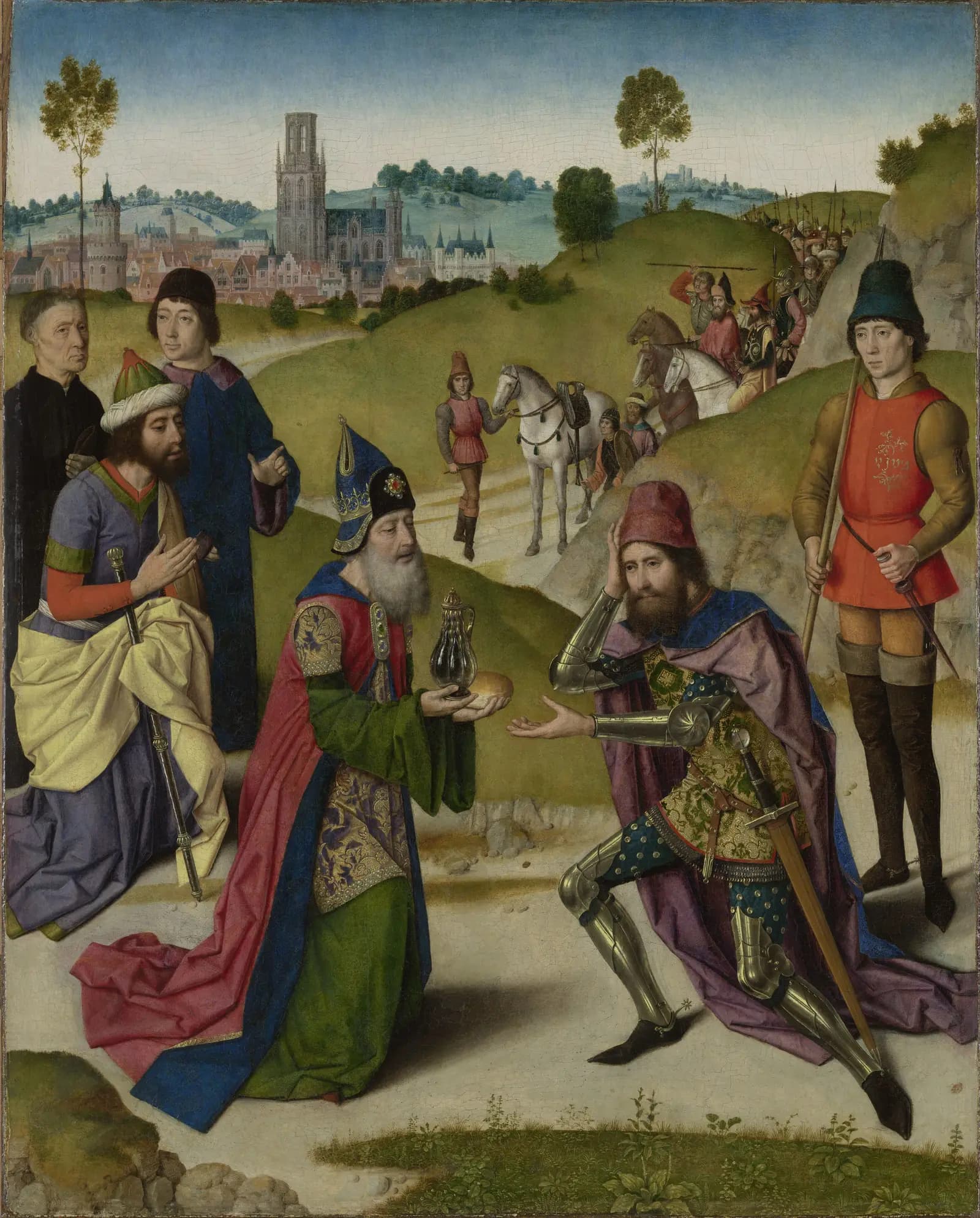
The Meeting of Abraham and Melchizedek, Dieric Bouts, 1464 to 1467. Public domain.
New Testament · Book 58 of 66
Hebrews
Hebrews is a letter showing that Jesus is greater than the angels, Moses and the priests of the old covenant. His one sacrifice fulfils the tabernacle and its offerings, and the letter calls its readers to hold on in faith.
Hebrews is a letter showing that Jesus is greater than the angels, Moses and the priests of the old covenant. His one sacrifice fulfils the tabernacle and its offerings, and the letter calls its readers to hold on in faith.
What is Hebrews about?
Hebrews is a sermon sent as a letter to believers who were tempted to turn back. It opens with God, who spoke through the prophets and now “has spoken to us by His Son” (1:2). The Son is above the angels, greater than Moses, and a high priest in the order of Melchizedek. His one offering of himself opens the new covenant Jeremiah promised and ends the offerings made year after year. After each stretch of teaching the writer warns his hearers to hold fast. He calls up the witnesses of faith from Abel onward and ends with a kingdom that cannot be shaken.
All 13 chapters
Every chapter of the book, in one grid. Each cell opens that chapter.
- The Son above the angelsChapters 1 to 2
- The rest that remainsChapters 3 to 4
- A priest like MelchizedekChapters 5 to 7
- The better covenantChapters 8 to 10
- By faithChapter 11
- The unshaken kingdomChapters 12 to 13
The colour is the movement of the sermon the chapter stands in, and every cell opens that chapter's Study level.
Who wrote it, where, when, for whom, and why?
The writer counts himself among those to whom the salvation first announced by the Lord was confirmed by those who heard him (2:3). He calls Timothy our brother (13:23), asks prayer to be restored to his readers soon (13:19), and calls what he has sent a word of exhortation, written briefly (13:22).
I urge you, brothers, to bear with my word of exhortation, for I have only written to you briefly.
Hebrews 13:22, Berean Standard Bible.
The only place the letter names for its own setting is in a greeting: those from Italy send greetings (13:24). Its argument stands on the tabernacle Moses was shown on the mountain (8:5) and on the tent of Exodus and Leviticus with its two rooms (9:1 to 7).
The readers came to faith through those who heard the Lord, and they remember early days in the light, when they lost their property and stood with those in prison (10:32 to 34). They have not yet resisted to the point of shedding blood (12:4). The writer speaks of the priests' daily offerings as still made (10:11) and of the first covenant as aging and soon to disappear (8:13).
It is written to holy brothers who share in the heavenly calling (3:1). By now they ought to be teachers but have become dull of hearing (5:11 to 12), and some have made a habit of not meeting together (10:25).
The writer calls them to hold firmly to the hope they profess (10:23). He shows the Son as the great high priest whose one offering has made perfect for all time those who are being sanctified (10:14), so that they would go to Jesus outside the camp (13:13) and be among those who have faith and preserve their souls (10:39).
Sources. Hebrews 2:3, 3:1, 5:11 to 12, 8:5, 8:13, 9:1 to 7, 10:11, 10:14, 10:23, 10:25, 10:32 to 34, 10:39, 12:4, 13:13, 13:19, 13:22 to 24. Every verse is read in the Berean Standard Bible.
How is Hebrews arranged, and what is it for?
The six movements the sermon falls into, then what it teaches and what it was written to do.
- The Son above the angels1 to 2, 32 verses, the turn at 1:3
God has spoken by his Son, who is above the angels and was made like his brothers to be their high priest.
- The rest that remains3 to 4, 35 verses, the turn at 4:9
Jesus is greater than Moses, and the rest the wilderness generation missed still stands open today.
- A priest like Melchizedek5 to 7, 62 verses, the turn at 7:25
Christ is called by God as high priest in the order of Melchizedek, confirmed by an oath and living forever.
- The better covenant8 to 10, 80 verses, the turn at 9:12
The true tent, the new covenant Jeremiah promised, and the one offering that takes away sins.
- By faith11, 40 verses, the turn at 11:1
What faith is, and the men and women who lived by it from Abel to the prophets.
- The unshaken kingdom12 to 13, 54 verses, the turn at 12:2
The race run with eyes on Jesus, the heavenly city in place of Sinai, and the life of a church outside the camp.
The theme
The Son of God is better than all that came before him: better than the angels through whom the law was spoken, than Moses who served in God's house, than Aaron's priesthood, than the first covenant and its tent, and than the blood of goats and bulls. What the law showed as a copy and a shadow, the Son has done in fact and once for all, and he now sits at the right hand of God.
The purpose
The writer wrote to a tired church under pressure so that it would hold fast to Christ. Each stretch of teaching ends in a call to pay closer attention (2:1), to hear his voice today (3:7), to press on to maturity (6:1), to hold resolutely to the hope (10:23) and to heed him who speaks (12:25). The letter closes by sending its readers to Jesus outside the camp with a sacrifice of praise.
Teaching, then warning: the shape of the sermon
- Teaching, 1:1 to 14
God has spoken by his Son, heir of all things and above the angels.
Warning 1, 2:1 to 4“We must pay closer attention, therefore, to what we have heard, so that we do not drift away.” (2:1)
- Teaching, 2:5 to 3:6
The Son made lower than the angels for a little while, and faithful over God's house.
Warning 2, 3:7 to 4:13“See to it, brothers, that none of you has a wicked heart of unbelief that turns away from the living God.” (3:12)
- Teaching, 4:14 to 5:10
The great high priest who sympathizes, called by God as Aaron was.
Warning 3, 5:11 to 6:12“But land that produces thorns and thistles is worthless, and its curse is imminent.” (6:8)
- Teaching, 6:13 to 10:25
The oath, Melchizedek, the new covenant and the one offering for sins.
Warning 4, 10:26 to 31“If we deliberately go on sinning after we have received the knowledge of the truth, no further sacrifice for sins remains” (10:26)
- Teaching, 10:32 to 12:24
Endurance, the roll of faith, the race, and the city of the living God.
Warning 5, 12:25 to 29“See to it that you do not refuse Him who speaks.” (12:25)
Closing, 13:1 to 25The life of the church, the altar outside the camp, and the blessing.
The Son above the angels, Hebrews 1 to 2
What chapters 1 to 2 say, and the pages they open on.
God once spoke through the prophets and now has spoken by his Son, through whom he made the universe and who sat down at God's right hand after making purification for sins. Seven Scriptures set him above the angels, so the hearers must not drift from what they heard. Jesus was made lower than the angels for a little while and tasted death for everyone. He shared flesh and blood to destroy the devil's power and became a merciful and faithful high priest.
The Son is the radiance of God’s glory and the exact representation of His nature, upholding all things by His powerful word. After He had provided purification for sins, He sat down at the right hand of the Majesty on high.
- Study
Hebrews 1the Son who speaks, and seven Scriptures on the Son and the angelsShow the summary and 3 pagesShow summary, 3 pagesHide the summary
No greeting, no sender, the letter opens like a trumpet. God spoke of old to the fathers in the prophets: 'On many past occasions and in many different ways,' but 'in these last days He has spoken to us by His Son' (1:1-2). He is heir of all things, maker of the worlds, 'the radiance of God’s glory and the exact representation of His nature,' who sat down on the right hand of the Majesty on high. The rest is a catena of seven Old Testament texts proving the Son greater than angels: Psalm 2's 'You are My Son;' 2 Samuel 7, Psalm 45, and Psalm 110's 'Sit at My right hand', the psalm that governs this whole letter.
On this chapter (3)
- The deity of Christ
The Son addressed as God.
- Who wrote Hebrews?
Answered under Where do readers disagree, lower on this page, with each reading and who holds it.
- Hebrews 1:3
The verse on its own page, with the commentators on it by era.
- The deity of Christ
- Study
Hebrews 2the first warning, and the Son made like his brothersShow the summary and 2 pagesShow summary, 2 pagesHide the summary
The first warning interrupts the argument: 'how shall we escape if we neglect such a great salvation?' (2:3). Psalm 8 is then read through the incarnation, all things put under man’s feet, 'Yet at present we do not see everything subject to him' (2:8). What we do see is Jesus, made a little lower than the angels, 'now crowned with glory and honor because He suffered death' (2:9), tasting death for everyone. Through death He destroyed 'him who holds the power of death, that is, the devil' (2:14), and freed those who all their lives were held in slavery by their fear of death.
On this chapter (2)
- The priest
The office the Son takes up.
- Hebrews 2:17
The verse on its own page, with the commentators on it by era.
- The priest
Seven Scriptures set the Son above the angels
Each card: the words of Hebrews, then the passage they quote
- Hebrews 1:5“You are My Son; today I have become Your Father”Psalm 2:7You are My Son; today I have become Your Father
- and again“I will be His Father, and He will be My Son”2 Samuel 7:14I will be his Father, and he will be My son
- Hebrews 1:6“Let all God’s angels worship Him.”Deuteronomy 32:43let all God’s angels worship Him
- Hebrews 1:7“He makes His angels winds, His servants flames of fire.”Psalm 104:4He makes the winds His messengers, flames of fire His servants.
- Hebrews 1:8“Your throne, O God, endures forever and ever”Psalm 45:6Your throne, O God, endures forever and ever
- Hebrews 1:10“You laid the foundations of the earth, and the heavens are the work of Your hands.”Psalm 102:25In the beginning You laid the foundations of the earth, and the heavens are the work of Your hands.
- Hebrews 1:13“Sit at My right hand until I make Your enemies a footstool for Your feet”Psalm 110:1Sit at My right hand until I make Your enemies a footstool for Your feet
Characters (3)
Who the text names. A name with a page carries its door.
- The Son
The radiance of God's glory, through whom God made the universe (1:2 to 3).
- The angels
Ministering spirits sent to serve those who will inherit salvation (1:14).
- The devil
Who held the power of death, destroyed by the Son's death (2:14).
Themes (2)
What these chapters raise, each on its own page.
- The deity of Christ
The Son addressed as God at 1:8.
- The priest
The office the Son takes up at 2:17.
Where these chapters take up the Old Testament (9)each marked as the store marks it, with Romans beside it
- Explicit quotationHebrews 1:5 at Psalm 2:7. Marked a quotation in the store's table of quotations.
- Explicit quotationHebrews 1:6 at Deuteronomy 32:43. Marked a quotation in the store's table of quotations.
- Explicit quotationHebrews 1:7 at Psalm 104:4. Marked a quotation in the store's table of quotations.
- Explicit quotationHebrews 1:8 at Psalm 45:6. Marked a quotation in the store's table of quotations.
- Explicit quotationHebrews 1:10 at Psalm 102:25. Marked a quotation in the store's table of quotations.
- Explicit quotationHebrews 1:13 at Psalm 110:1. Marked a quotation in the store's table of quotations.
- Explicit quotationHebrews 2:6 at Psalm 8:4. Marked a quotation in the store's table of quotations.
- Explicit quotationHebrews 2:12 at Psalm 22:22. Marked a quotation in the store's table of quotations.
- Explicit quotationHebrews 2:13 at Isaiah 8:17. Marked a quotation in the store's table of quotations.
Beside it in Romans, the store’s cross reference with the most votes: Hebrews 2:14 with Romans 8:3.
The rest that remains, Hebrews 3 to 4
What chapters 3 to 4 say, and the pages they open on.
Moses was faithful as a servant in God's house, and Christ is faithful as the Son over it. Psalm 95 warns the hearers not to harden their hearts as the generation did that fell in the wilderness through unbelief. The promise of rest still stands, since David spoke of another day long after Joshua, so a Sabbath rest remains for the people of God. The word of God judges the heart, and the great high priest who has passed through the heavens invites them to the throne of grace.
There remains, then, a Sabbath rest for the people of God.
- Study
Hebrews 3the Son over God's house, and the generation that fellShow the summary and 1 pageShow summary, 1 pageHide the summary
Consider Jesus, 'the apostle and high priest whom we confess.' Moses was faithful in God's house as a servant; Christ over it as a son, and the builder has more honor than the house. Then Psalm 95 is quoted whole: 'Today, if you hear His voice, do not harden your hearts, as you did in the rebellion.' The wilderness generation saw his works forty years and still erred in heart, and he sware in his wrath, 'They shall never enter My rest.' The remedy is urgency in company, exhort one another day by day, lest any be hardened by the deceitfulness of sin.
On this chapter (1)
- Hebrews 3:6
The verse on its own page, with the commentators on it by era.
- Hebrews 3:6
- Study
Hebrews 4the rest that remains, the living word, and the throne of graceShow the summary and 2 pagesShow summary, 2 pagesHide the summary
The promise of rest is still open, so let us fear lest any come short of it. Psalm 95 and Genesis 2 are set side by side (God rested on the seventh day, Joshua did not give them the true rest, David spoke of another 'Today' long after), therefore 'There remains, then, a Sabbath rest for the people of God.' (4:9). Then the disclosure: 'the word of God is living and active. Sharper than any double-edged sword … It judges the thoughts and intentions of the heart' (4:12). Having a high priest 'tempted in every way that we are, yet was without sin', draw near with boldness to the throne of grace.
On this chapter (2)
- Sabbath rest
The rest that remains.
- Hebrews 4:12
The verse on its own page, with the commentators on it by era.
- Sabbath rest
Three rests, and the today that keeps the last one open
“Today, if you hear His voice, do not harden your hearts.” (4:7, from Psalm 95)
- 1. God's rest
“And on the seventh day God rested from all His works.” (4:4)
Genesis 2:2He rested from all His work
God's own rest since his works were finished.
- 2. The rest of the land
“For if Joshua had given them rest, God would not have spoken later about another day.” (4:8)
Joshua 21:44the LORD gave them rest on every side
The rest Joshua gave in Canaan, which David's psalm shows was still to come.
- 3. The rest that remains
“There remains, then, a Sabbath rest for the people of God.” (4:9)
The rest the people of God enter by faith.
Characters (3)
Who the text names. A name with a page carries its door.
Places (2)
Where the chapters stand.
- The wilderness
Where the generation that rebelled fell (3:17).
- Egypt
The land Moses led them out of (3:16).
Themes (1)
What these chapters raise, each on its own page.
- Sabbath rest
The rest that remains for the people of God.
Where these chapters take up the Old Testament (3)each marked as the store marks it, with Leviticus 16 and Romans beside it
- Explicit quotationHebrews 3:7 at Psalm 95:7. Marked a quotation in the store's table of quotations.
- Explicit quotationHebrews 4:3 at Psalm 95:11. Marked a quotation in the store's table of quotations.
- Explicit quotationHebrews 4:4 at Genesis 2:2. Marked a quotation in the store's table of quotations.
Beside it in Leviticus 16 and in Romans, the store’s cross references with the most votes: Hebrews 4:16 with Leviticus 16:2; Hebrews 4:12 with Romans 1:16.
A priest like Melchizedek, Hebrews 5 to 7
What chapters 5 to 7 say, and the pages they open on.
Every high priest is called by God, as Aaron was, and Christ was called by the One who said, You are my Son. He learned obedience from what he suffered and became the source of eternal salvation. The hearers are dull of hearing, and the writer warns of those who fall away, yet he is sure of better things for them. God's promise to Abraham was made sure by an oath, and hope is an anchor within the curtain. Melchizedek blessed Abraham and took a tenth, and Christ is a priest after his order, by an oath and forever.
Therefore He is able to save completely those who draw near to God through Him, since He always lives to intercede for them.
- Study
Hebrews 5the high priest called by God, and milk and solid foodShow the summary and 2 pagesShow summary, 2 pagesHide the summary
Priesthood defined from the ground up: every high priest is taken from among men, bears gently with the erring because he is himself compassed with infirmity, and takes the honor not to himself. So Christ glorified not himself; God said 'You are a priest forever in the order of Melchizedek' (Psalm 110:4, the verse this letter mines deeper than anyone). In the days of his flesh he offered prayers with strong crying and tears, and 'Although He was a Son, He learned obedience from what He suffered.' (5:8). Then the rebuke: you are dull of hearing and need milk, when solid food belongs to the fullgrown.
On this chapter (2)
- The high-priestly line
Aaron's line and its office.
- Hebrews 5:8
The verse on its own page, with the commentators on it by era.
- The high-priestly line
- Study
Hebrews 6the third warning, the oath to Abraham, and the anchorShow the summary and 3 pagesShow summary, 3 pagesHide the summary
'Therefore let us leave the elementary teachings about Christ and go on to maturity', the foundation named and left behind: repentance from dead works, faith toward God, baptisms, laying on of hands, resurrection, eternal judgment. Then the letter's hardest paragraph: those once enlightened, who tasted the heavenly gift and the powers of the age to come and then fell away, impossible to renew them again to repentance. But 'we are convinced of better things in your case'. God confirmed his promise to Abraham with an oath, two immutable things, and hope is 'as an anchor for the soul, firm and secure' (6:19), entering within the veil where Jesus went as forerunner.
On this chapter (3)
- Eternal security
The readings of the warnings.
- What do 6:4 to 6 and 10:26 to 31 teach of one who falls away?
Answered under Where do readers disagree, lower on this page, with each reading and who holds it.
- Hebrews 6:19
The verse on its own page, with the commentators on it by era.
- Eternal security
- Study
Hebrews 7Melchizedek, the change of priesthood, and the priest who lives foreverShow the summary and 3 pagesShow summary, 3 pagesHide the summary
Melchizedek at last: king of Salem, priest of God Most High, who met Abraham returning from the slaughter of the kings and received tithes: King of righteousness, King of peace: 'Without father or mother or genealogy,' made like the Son of God, abiding a priest continually (7:3). Levi, still in Abraham's loins, paid tithes to him. A change of priesthood requires a change of law, and this priest rises from Judah, 'by the power of an indestructible life.' Because he abides for ever, 'He is able to save completely those who draw near to God through Him, since He always lives to intercede for them' (7:25).
On this chapter (3)
- Melchizedek
The king-priest of Salem.
- Who is Melchizedek?
Answered under Where do readers disagree, lower on this page, with each reading and who holds it.
- Hebrews 7:25
The verse on its own page, with the commentators on it by era.
- Melchizedek
The order of Aaron and the order of Melchizedek
Then Melchizedek king of Salem brought out bread and wine—since he was priest of God Most High— and he blessed Abram and said: “Blessed be Abram by God Most High, Creator of heaven and earth, and blessed be God Most High, who has delivered your enemies into your hand.” Then Abram gave Melchizedek a tenth of everything.
Genesis 14:18–20, Berean Standard Bible
The LORD has sworn and will not change His mind: “You are a priest forever in the order of Melchizedek.”
Psalm 110:4, Berean Standard Bible
In each row the first line is the order of aaron and the second the order of melchizedek.
- The tribe
“the sons of Levi who become priests” (7:5)
“our Lord descended from Judah” (7:14)
- The oath
“others became priests without an oath” (7:20)
“Jesus became a priest with an oath” (7:21)
- The death
“mortal men collect the tenth” (7:8)
“it is affirmed that he lives on” (7:8)
- The number
“there have been many other priests” (7:23)
“He has a permanent priesthood” (7:24)
- The offering
“offer daily sacrifices, first for His own sins and then for the sins of the people” (7:27)
“He sacrificed for sin once for all when He offered up Himself” (7:27)
Characters (3)
Who the text names. A name with a page carries its door.
- Aaron
Called by God to the priesthood (5:4).
- Melchizedek
King of Salem, who blessed Abraham (7:1).
- Abraham
Who received the oath and gave Melchizedek a tenth (6:13, 7:4).
Places (1)
Where the chapters stand.
- Salem
The city of Melchizedek, whose name means peace (7:2).
Themes (2)
What these chapters raise, each on its own page.
- The high priestly line
Aaron's line and the priest of another order.
- Eternal security
The readings of the warning of 6:4 to 8.
Where these chapters take up the Old Testament (5)each marked as the store marks it, with Leviticus 16 and Romans beside it
- Explicit quotationHebrews 5:5 at Psalm 2:7. Marked a quotation in the store's table of quotations.
- Explicit quotationHebrews 5:6 at Psalm 110:4. Marked a quotation in the store's table of quotations.
- Explicit quotationHebrews 6:13 at Genesis 22:16. Marked a quotation in the store's table of quotations.
- Explicit quotationHebrews 7:1 at Genesis 14:18. Marked a quotation in the store's table of quotations.
- Explicit quotationHebrews 7:17 at Psalm 110:4. Marked a quotation in the store's table of quotations.
Beside it in Leviticus 16 and in Romans, the store’s cross references with the most votes: Hebrews 6:19 with Leviticus 16:15; Hebrews 7:25 with Romans 8:34.
The better covenant, Hebrews 8 to 10
What chapters 8 to 10 say, and the pages they open on.
Christ serves in the true tabernacle, and the covenant he mediates is better, as Jeremiah promised a new covenant with the house of Israel and the house of Judah. The high priest entered the earthly tent's second room once a year with blood; Christ entered once for all by his own blood. The law's offerings were a yearly reminder of sins (10:3), so Christ came to do God's will in a body prepared for him and offered one sacrifice for all time. The hearers may draw near by a new and living way, and they are warned against deliberate sin.
He did not enter by the blood of goats and calves, but He entered the Most Holy Place once for all by His own blood, thus securing eternal redemption.
- Study
Hebrews 8the true tabernacle and the new covenant of JeremiahShow the summary and 3 pagesShow summary, 3 pagesHide the summary
The chief point: we have such a high priest, seated on the right hand of the throne of the Majesty in the heavens, minister of the true tabernacle which the Lord pitched, not man. Earthly priests serve a copy and shadow: Moses was warned to make all things according to the pattern showed him in the mount. Christ's covenant is better, enacted upon better promises. Then the longest Old Testament quotation in the New: Jeremiah 31:31-34 entire, a new covenant with the house of Israel, laws written on the heart, all knowing him from the least to the greatest, sins remembered no more. In calling it new, he made the first old.
On this chapter (3)
- The new covenant
The covenant of Jeremiah 31.
- What does 8:13 say of the first covenant, and what of Israel?
Answered under Where do readers disagree, lower on this page, with each reading and who holds it.
- Hebrews 8:10
The verse on its own page, with the commentators on it by era.
- The new covenant
- Study
Hebrews 9the earthly tent, the blood of Christ, and once for allShow the summary and 4 pagesShow summary, 4 pagesHide the summary
The old sanctuary is walked through room by room, candlestick, table and showbread; behind the second veil the ark, the golden pot of manna, Aaron's rod that budded, and the cherubim of glory overshadowing the mercy-seat, entered once a year 'never without blood'. But Christ came as high priest of the good things to come, entering once for all 'by His own blood, thus securing eternal redemption' (9:12), for 'without the shedding of blood there is no forgiveness' (9:22). 'Just as man is appointed to die once, and after that to face judgment', so Christ, once offered, shall appear a second time, apart from sin, to them that wait for him.
On this chapter (4)
- The Day of Atonement
The day chapter 9 reads.
- The tabernacle
The tent and its rooms.
- Where does 9:4 place the altar of incense?
Answered under Where do readers disagree, lower on this page, with each reading and who holds it.
- Hebrews 9:22
The verse on its own page, with the commentators on it by era.
- The Day of Atonement
- Study
Hebrews 10the shadow, the one offering, the new way, and the fourth warningShow the summary and 4 pagesShow summary, 4 pagesHide the summary
The law had only a shadow, and 'it is impossible for the blood of bulls and goats to take away sins.' Psalm 40 is put in the Son's mouth ('a body You prepared for Me … I have come to do Your will, O God') and by that will we are sanctified through the offering of the body of Jesus Christ once for all (10:10). Every priest stands daily; this priest sat down (Psalm 110), and Jeremiah 31 returns for the punch line: 'Their sins and lawless acts I will remember no more.' So draw near, hold fast, provoke one another to love and good works, for 'It is a fearful thing to fall into the hands of the living God.' (10:31).
On this chapter (4)
- Once for all
The finished sacrifice.
- Eternal security
The readings of the warnings.
- Why does 10:5 read a body where Psalm 40:6 reads ears?
Answered under Where do readers disagree, lower on this page, with each reading and who holds it.
- Hebrews 10:14
The verse on its own page, with the commentators on it by era.
- Once for all
The earthly tent and the true tent: every year and once for all
In each row the first line is the earthly tent and the second the true tent.
- The tent
“a man-made copy of the true sanctuary” (9:24)
“the greater and more perfect tabernacle that is not made by hands” (9:11)
- Who enters
“only the high priest entered the second room, and then only once a year” (9:7)
“He entered the Most Holy Place once for all by His own blood” (9:12)
- The blood
“the blood of goats and bulls and the ashes of a heifer” (9:13)
“how much more will the blood of Christ” (9:14)
- What it cleanses
“unable to cleanse the conscience of the worshiper” (9:9)
“purify our consciences from works of death” (9:14)
- How often
“every year with blood that is not his own” (9:25)
“He has appeared once for all at the end of the ages” (9:26)
Characters (2)
Who the text names. A name with a page carries its door.
- Moses
Who sprinkled the blood of the first covenant (9:19).
- The high priest
Who entered the second room once a year (9:7).
Places (2)
Where the chapters stand.
- The earthly tent
Its two rooms behind two curtains (9:2 to 3).
- Heaven itself
Where Christ appears on our behalf (9:24).
Themes (3)
What these chapters raise, each on its own page.
- The new covenant
The covenant of Jeremiah 31.
- Once for all
The finished sacrifice.
- The Day of Atonement
The day chapter 9 reads.
Where these chapters take up the Old Testament (7)each marked as the store marks it, with Leviticus 16 and Romans beside it
- Explicit quotationHebrews 8:5 at Exodus 25:40. Marked a quotation in the store's table of quotations.
- Explicit quotationHebrews 8:8 at Jeremiah 31:31. Marked a quotation in the store's table of quotations.
- Explicit quotationHebrews 9:20 at Exodus 24:8. Marked a quotation in the store's table of quotations.
- Explicit quotationHebrews 10:5 at Psalm 40:6. Marked a quotation in the store's table of quotations.
- Explicit quotationHebrews 10:16 at Jeremiah 31:33. Marked a quotation in the store's table of quotations.
- Explicit quotationHebrews 10:30 at Deuteronomy 32:35. Marked a quotation in the store's table of quotations.
- Explicit quotationHebrews 10:37 at Habakkuk 2:3. Marked a quotation in the store's table of quotations.
Beside it in Leviticus 16 and in Romans, the store’s cross references with the most votes: Hebrews 9:7 with Leviticus 16:34; Hebrews 8:10 with Romans 9:25 to 26.
By faith, Hebrews 11
What chapter 11 says, and the pages it opens on.
Faith is the assurance of what is hoped for and the certainty of what is not seen. By faith Abel offered a better sacrifice, Enoch was taken up, and Noah built the ark. Abraham went out without knowing where he was going and looked for the city whose builder is God. The patriarchs, Moses, the people at the sea and Rahab acted by faith; others conquered kingdoms, and others were tortured and killed. All were commended, yet they did not receive what was promised, for God had planned something better.
Now faith is the assurance of what we hope for and the certainty of what we do not see.
- Study
Hebrews 11what faith is, and the roll from Abel to the prophetsShow the summary and 3 pagesShow summary, 3 pagesHide the summary
'Now faith is the assurance of what we hope for and the certainty of what we do not see' (11:1), then the roll call. By faith we understand the worlds were framed by the word of God. Abel offered a better sacrifice; Enoch was translated that he should not see death, for 'without faith it is impossible to please God'; Noah built an ark. Abraham went out 'without knowing where he was going', looking for 'the city with foundations, whose architect and builder is God.' Moses 'persevered because he saw Him who is invisible.' Then the Red Sea, Jericho, Rahab, the judges, David, the prophets, and the tortured and sawn asunder, 'The world was not worthy of them.'
On this chapter (3)
- The hall of faith
The roll read name by name.
- Faith
The assurance of what we hope for.
- Hebrews 11:6
The verse on its own page, with the commentators on it by era.
- The hall of faith
The roll of faith, in the order the chapter gives it (14)
- 1Abel 11:4 “offered God a better sacrifice than Cain did”
- 2Enoch 11:5 “was taken up so that he did not see death”
- 3Noah 11:7 “built an ark to save his family”
- 4Abraham 11:8 “obeyed and went, without knowing where he was going”
- 5Sarah 11:11 “was enabled to conceive a child”
- 6Abraham 11:17 “offered up Isaac on the altar”
- 7Isaac 11:20 “blessed Jacob and Esau concerning the future”
- 8Jacob 11:21 “blessed each of Joseph’s sons”
- 9Joseph 11:22 “spoke about the exodus of the Israelites”
- 10Moses’ parents 11:23 “hid him for three months after his birth”
- 11Moses 11:24 “refused to be called the son of Pharaoh’s daughter”
- 12The people 11:29 “passed through the Red Sea as on dry land”
- 13Jericho 11:30 “the walls of Jericho fell”
- 14Rahab 11:31 “welcomed the spies in peace”
Named in one line“Gideon, Barak, Samson, Jephthah, David, Samuel, and the prophets” (11:32)
Characters (4)
Who the text names. A name with a page carries its door.
- Abel and Enoch
A better sacrifice, and a man taken up (11:4 to 5).
- Noah
Warned about things not yet seen (11:7).
- Sarah
Who considered him faithful who had promised (11:11).
- Rahab
Who welcomed the spies in peace (11:31).
Places (2)
Where the chapters stand.
- Jericho
Its walls fell after seven days (11:30).
- The Red Sea
Crossed as on dry land (11:29).
Themes (2)
What these chapters raise, each on its own page.
- Faith
The assurance of what we hope for.
- The hall of faith
The roll of chapter 11 read name by name.
Where these chapters take up the Old Testament (1)each marked as the store marks it, with Romans beside it
- Explicit quotationHebrews 11:18 at Genesis 21:12. Marked a quotation in the store's table of quotations.
Beside it in Romans, the store’s cross reference with the most votes: Hebrews 11:1 with Romans 8:24 to 25.
The unshaken kingdom, Hebrews 12 to 13
What chapters 12 to 13 say, and the pages they open on.
Surrounded by a cloud of witnesses, the hearers are to run their race with endurance, their eyes on Jesus. Their hardship is the discipline of a father who loves his sons, and Esau, who sold his birthright for a single meal, stands as their warning (12:16). They have come to Mount Zion and the city of the living God, so they must heed him who speaks from heaven, for they are receiving a kingdom that cannot be shaken. The letter ends with brotherly love, the altar outside the camp, a sacrifice of praise, a blessing and greetings.
Let us fix our eyes on Jesus, the author and perfecter of our faith, who for the joy set before Him endured the cross, scorning its shame, and sat down at the right hand of the throne of God.
- Study
Hebrews 12the race, discipline, Zion, and the fifth warningShow the summary and 2 pagesShow summary, 2 pagesHide the summary
'let us throw off every encumbrance and the sin that so easily entangles, and let us run with endurance the race set out for us. Let us fix our eyes on Jesus, the author and perfecter of our faith' (12:1-2), who for the joy set before him endured the cross. Proverbs 3 reframes hardship as fathering ('the Lord disciplines the one He loves') and chastening afterward yields the peaceable fruit of righteousness. Remember Esau, who sold his birthright. Then two mountains: not Sinai's fire and blackness and tempest, but 'Mount Zion, to the city of the living God, the heavenly Jerusalem', and blood that speaks better than Abel's. 'For our God is a consuming fire.'
On this chapter (2)
- The new Jerusalem
The city that is to come.
- Hebrews 12:28
The verse on its own page, with the commentators on it by era.
- The new Jerusalem
- Study
Hebrews 13brotherly love, outside the camp, and the blessingShow the summary and 3 pagesShow summary, 3 pagesHide the summary
The letter lands in ordinary rooms. 'Continue in brotherly love. Do not neglect to show hospitality to strangers, for by so doing some people have entertained angels without knowing it' (13:1-2). Remember prisoners; honor marriage; be free from the love of money, because he has said, 'Never will I leave you, never will I forsake you', so we say boldly with Psalm 118, 'The Lord is my helper; I will not be afraid.' 'Jesus Christ is the same yesterday and today and forever' (13:8). The sin-offering beasts burned outside the camp become the last image: go forth to him without the camp, 'For here we do not have a permanent city, but we are looking for the city that is to come.'
On this chapter (3)
- The blood
The blood of the eternal covenant.
- To whom was it written, and was the temple still standing?
Answered under Where do readers disagree, lower on this page, with each reading and who holds it.
- Hebrews 13:8
The verse on its own page, with the commentators on it by era.
- The blood
Sinai and Zion, the two mountains
In each row the first line is sinai and the second zion.
- The mountain
“a mountain that can be touched and that is burning with fire” (12:18)
“Mount Zion, to the city of the living God, the heavenly Jerusalem” (12:22)
- Around it
“darkness, gloom, and storm” (12:18)
“myriads of angels” (12:22)
- The people
“they could not bear what was commanded” (12:20)
“the congregation of the firstborn, enrolled in heaven” (12:23)
- The mediator
“The sight was so terrifying” (12:21)
“Jesus the mediator of a new covenant” (12:24)
- The word
“a voice that made its hearers beg that no further word be spoken” (12:19)
“the sprinkled blood that speaks a better word than the blood of Abel” (12:24)
Characters (3)
Who the text names. A name with a page carries its door.
- Esau
Who sold his birthright for a single meal (12:16).
- Timothy
Released, and coming with the writer (13:23).
- Those from Italy
Who send greetings (13:24).
Places (3)
Where the chapters stand.
- Mount Sinai
The mountain that burned with fire (12:18).
- Mount Zion
The heavenly Jerusalem (12:22).
- Outside the camp
Where Jesus suffered and where the hearers go to him (13:12 to 13).
Themes (2)
What these chapters raise, each on its own page.
- The new Jerusalem
The city that is to come.
- The blood
The blood that speaks a better word.
Where these chapters take up the Old Testament (4)each marked as the store marks it, with Leviticus 16 and Romans beside it
- Explicit quotationHebrews 12:5 at Proverbs 3:11. Marked a quotation in the store's table of quotations.
- Explicit quotationHebrews 12:26 at Haggai 2:6. Marked a quotation in the store's table of quotations.
- Explicit quotationHebrews 13:5 at Deuteronomy 31:6. Marked a quotation in the store's table of quotations.
- Explicit quotationHebrews 13:6 at Psalm 118:6. Marked a quotation in the store's table of quotations.
Beside it in Leviticus 16 and in Romans, the store’s cross references with the most votes: Hebrews 13:11 with Leviticus 16:27; Hebrews 13:6 with Romans 8:31.
- Author
- Unknown: the book itself does not name its author. Traditional attribution is Pauline (Clement of Alexandria, Origen, much of the Eastern church); Luther proposed Apollos; Tertullian preferred Barnabas; Harnack proposed Priscilla. Site does not adjudicate
- Date
- Mid-to-late 1st century AD, almost certainly before AD 70 (the book argues against the ongoing Temple liturgy as if the Temple still stands)
- Audience
- Jewish Christians (traditional) facing pressure to return to Judaism; possibly a mixed community with Jewish-rooted concerns
Where do readers disagree?
One list: the readings with their holders, and what the evidence does not settle.
Who wrote Hebrews?
- Paul. Held by Clement of Alexandria, as Eusebius reports him in the Church History, book 6, chapter 14, and by Thomas Aquinas, Commentary on the Epistle to the Hebrews.
- Barnabas. Held by Tertullian, On Modesty, chapter 20.
- Apollos. Held by Martin Luther, Lectures on Genesis, on 48:20, and by Luke Timothy Johnson, Hebrews: A Commentary (2006).
- Luke. Held by David L. Allen, Lukan Authorship of Hebrews (2010).
- The writer is unknown. Held by Origen, as Eusebius quotes him in the Church History, book 6, chapter 25, and by Harold W. Attridge, The Epistle to the Hebrews (1989).
What the evidence does not settle: The writer's name. The writer counts himself among those who received the message from those who heard the Lord (2:3).
The argument in full
Paul. The Eastern church received the letter as Paul's, the oldest copy of Paul's letters (Papyrus 46, about AD 200) sets it after Romans, and the writer names Timothy (13:23). Clement held that Paul wrote in Hebrew and Luke put it into Greek.
Barnabas. Barnabas was a Levite from Cyprus whose name means son of encouragement (Acts 4:36), and the letter calls itself a word of exhortation and argues from the priesthood.
Apollos. Acts calls Apollos an eloquent Jew of Alexandria, well versed in the Scriptures (Acts 18:24), which fits the letter's polished Greek and its reading of the Greek Old Testament. No ancient writer names him.
Luke. The vocabulary and style of Hebrews stand closer to Luke and Acts than to any other writing in the New Testament.
The writer is unknown. Origen judged the thoughts to be the apostle's and the wording another's, and concluded that God alone knows who wrote the letter.
To whom was it written, and was the temple still standing?
- Jewish believers in or near Rome, before AD 70. Held by F. F. Bruce, The Epistle to the Hebrews (1964), and by William L. Lane, Hebrews, Word Biblical Commentary (1991).
- Jewish believers in Judea. Held by John Chrysostom in his Homilies on Hebrews, in the argument before the first homily.
What the evidence does not settle: Where the readers lived and whether the temple still stood. The letter names Italy only in a greeting, and its argument stands on the tabernacle of Moses.
The argument in full
Jewish believers in or near Rome, before AD 70. Those from Italy send greetings, the offerings are spoken of as still made, and the writer asks whether they would not have ceased had they made the worshipers perfect (10:2); Clement of Rome draws on the letter in his own letter to Corinth.
Jewish believers in Judea. The readers' long suffering, their knowledge of the priesthood and the name the letter bears fit believers who lived beside the temple and were pressed to return to it.
What do 6:4 to 6 and 10:26 to 31 teach of one who falls away?
Eternal security→- A believer can fall away and be lost. Held by John Wesley, Explanatory Notes upon the New Testament (1755), on 6:4 and 10:29, and by I. Howard Marshall, Kept by the Power of God (1969).
- Those described were in the church and outside Christ. Held by John Owen, An Exposition of the Epistle to the Hebrews (1668), on 6:4 to 6, and by John Calvin, Commentary on Hebrews (1549), on 6:4.
- The warnings are the means by which God keeps his own. Held by Thomas R. Schreiner and Ardel B. Caneday, The Race Set Before Us (2001).
- A case stated to press the readers on to maturity. Held by Homer A. Kent, The Epistle to the Hebrews (1972).
- What is lost is reward. Held by Zane C. Hodges, Hebrews, in The Bible Knowledge Commentary (1983).
What the evidence does not settle: Whether the persons described are believers, and what the burning of 6:8 and the judgment of 10:27 name. Every reading holds that the warnings are to be heeded, and the writer ends each with confidence in his readers (6:9, 10:39).
The argument in full
A believer can fall away and be lost. The words enlightened, tasted the heavenly gift and shared in the Holy Spirit describe believers, and the one who profanes the blood of the covenant is said to have been sanctified by it (10:29).
Those described were in the church and outside Christ. They tasted the gifts and fell away, and those who belong to Christ remain (1 John 2:19); the writer is convinced of better things in his readers' case, things that accompany salvation.
The warnings are the means by which God keeps his own. The warnings are written to believers and are fully serious, and God uses them to bring those who are Christ's to the end.
A case stated to press the readers on to maturity. The writer states what would follow if it happened in order to press his readers on to maturity, and turns at once to what he expects of them.
What is lost is reward. The land that bears thorns is burned, and a field burned is a crop lost; the warning concerns a believer's reward and usefulness.
This site holds eternal security: the believer is in the Father's hand, and the Son holds him there (John 10:28 to 29). The perseverance reading, held across much of the site's own Wesleyan heritage, is presented at full weight and is never disparaged.
Who is Melchizedek?
Melchizedek→- A king of Salem, and a type of Christ. Held by John Calvin, Commentary on Hebrews, on 7:3, and by F. F. Bruce, The Epistle to the Hebrews.
- An appearance of the Son before his birth. Held by James A. Borland, Christ in the Old Testament (1978), and reported by Epiphanius, Panarion, section 55, of some in the church of his day.
- Shem, the son of Noah. Held in the Babylonian Talmud, Nedarim 32b, and by Rashi, Commentary on Genesis, on 14:18.
What the evidence does not settle: Whether 7:3 speaks of the man or of the record Genesis keeps of him, and whether like the Son of God names a likeness or an identity.
The argument in full
A king of Salem, and a type of Christ. Genesis gives him three verses, from the bread and wine to the tenth (Genesis 14:18 to 20), and the letter reasons from that record; he is made like the Son of God, which sets two figures side by side.
An appearance of the Son before his birth. The text says he is like the Son of God and remains a priest for all time (7:3).
Shem, the son of Noah. The years of Genesis 11 let Shem live into Abram's day, and the rabbis read the priest of Genesis 14 as Noah's son.
What does 8:13 say of the first covenant, and what of Israel?
Why God is not finished with Israel→- What grows old is the covenant of the tent and its offerings. Held by John Owen, An Exposition of the Epistle to the Hebrews, on 8:13.
- The new covenant is Israel's, and the nations share in it. Held by Charles C. Ryrie, The Basis of the Premillennial Faith (1953), and by Arnold G. Fruchtenbaum, Israelology (1989).
What the evidence does not settle: How the new covenant is fulfilled for Israel as a people and for the nations with it. The verse speaks of a covenant and its worship.
The argument in full
What grows old is the covenant of the tent and its offerings. The next verse names what the first covenant had: regulations for worship and an earthly sanctuary (9:1), and the chapters that follow set its offerings beside the one offering of Christ.
The new covenant is Israel's, and the nations share in it. The quotation names the parties, the house of Israel and the house of Judah, in Jeremiah's own words, and Gentile believers come into a covenant God made with that people.
This site's tradition, Wesleyan-Pentecostal, holds that God has a plan for Israel and refuses replacement theology: the new covenant is promised to the house of Israel and the house of Judah by name. The site draws no present-day political reading from the passage.
Why does 10:5 read a body where Psalm 40:6 reads ears?
- The writer quotes the Greek Old Testament as it stood. Held by F. F. Bruce, The Epistle to the Hebrews, on 10:5, and by Gleason L. Archer and Gregory Chirichigno, Old Testament Quotations in the New Testament (1983).
- The Greek gives the sense of the Hebrew, the part for the whole. Held by John Calvin, Commentary on Hebrews, on 10:5, and by Walter C. Kaiser Jr., The Uses of the Old Testament in the New (1985).
- The writer shaped the wording to his argument. Held by Karen H. Jobes, “Rhetorical Achievement in the Hebrews 10 Misquote of Psalm 40”, in Biblica.
What the evidence does not settle: Whether the word body entered the Greek by translation, by a copyist or by the writer. The Hebrew witnesses read ears, and the Greek witnesses read body.
The argument in full
The writer quotes the Greek Old Testament as it stood. The Septuagint of the psalm reads a body you prepared for me, while the Masoretic Hebrew reads my ears you have opened, and the letter quotes the Greek throughout.
The Greek gives the sense of the Hebrew, the part for the whole. Ears opened to hear and obey stand for the whole person given to do God's will, and the writer builds on the words I have come to do your will.
The writer shaped the wording to his argument. The small changes in the quotation are the writer's own, made so that the psalm speaks of the body offered once for all (10:10).
Where does 9:4 place the altar of incense?
The tabernacle→- A golden censer. Held by Jerome, the Latin Vulgate (405), which renders the word as a censer, followed by the King James Version (1611).
- The altar of incense, tied to the inner room by its use. Held by F. F. Bruce, The Epistle to the Hebrews, on 9:4, and by William L. Lane, Hebrews, Word Biblical Commentary.
What the evidence does not settle: Whether the word means the altar or a censer, and whether the writer placed the altar behind the veil or joined it to the inner room by its service. The Berean Standard Bible prints altar of incense.
The argument in full
A golden censer. The Greek word can name a censer, and the high priest carried a censer of coals behind the veil on the Day of Atonement (Leviticus 16:12 to 13).
The altar of incense, tied to the inner room by its use. The Greek word names the altar of incense in Philo and Josephus. Exodus sets the altar in front of the veil before the mercy seat (Exodus 30:6), and 1 Kings calls it the altar that belonged to the inner sanctuary (1 Kings 6:22), so the writer joins it to the inner room.
The pages Hebrews opens on
Studies257
Show the next 6 titles
Show the next 6 titles
Show the next 6 titles
- 1 Peter: the Study Guide
- Cities of Refuge
- Colossians, the Study Guide
- Habakkuk, the Study Guide
- Haggai, the Study Guide
- The Anchor of the Soul
Show the next 6 titles
- Hospitality
- Entertaining Angels Unaware
- Jeremiah, the Study Guide
- The Joy Set Before Him
- Outside the Camp
- Perseverance
Show the next 6 titles
- Prophet, Priest and King: The Threefold Office of Christ
- A Royal Priesthood: 1 Peter 2:4-10
- The Ark of the Covenant
- The Mountain
- The Ordination of the Priests
- The prophet like Moses
Show the next 6 titles
Show the next 6 titles
- The Covenants
- Son of God
- Second Adam
- The God Who Sings: Zephaniah 3:17
- Creation to New Creation
- Great High Priest
Show the next 6 titles
- The Scarlet Thread
- The Suffering Servant
- The Just Shall Live by His Faith: Habakkuk 2:4
- Taw: The Mark of God
- Christ / Messiah
- Alpha and Omega
Show the next 6 titles
- Angelology
- The Divine Council
- Hearing God
- Michael the archangel
- Samuel
- Stephen, the First Martyr: Acts 6-7
Show the next 6 titles
- The Ascension: Acts 1:1-11 · Luke 24:50-53
- The Haftarah
- The Image of God
- The Incarnation
- The Song of Moses
- The Sons of Korah
Show the next 6 titles
- The Two Gates: Psalms 1 and 2
- The Urim and Thummim and Inquiring of the LORD
- Wisdom, the Radiance
- How the Cross Saves: The Views of the Atonement
- Levirate Marriage
- Blessed Are the Merciful
Show the next 6 titles
- Redemption
- Satan
- Satan Across the Testaments
- The Fall & the Protoevangelium
- The Flight to Egypt: Matthew 2
- The Humanity of Christ
Show the next 6 titles
- Those Who Denied Christ Came in the Flesh
- Caleb
- Caleb and the Twelve Spies
- The Words Emunah and Pistos
- Moses, the Most Humble Man
- Moses
Show the next 6 titles
- Mouth to Mouth: How God Spoke with Moses
- Paran
- The death of Moses
- The Fall of Samaria and the Indictment of 2 Kings 17
- The Hardening of the Heart
- The House
Show the next 6 titles
- The Intercession of Moses
- The Tent of Meeting Outside the Camp
- The Wilderness Itinerary
- The Words Chazaq, Amats and Parrhesia
- Jesus: Titles & Roles
- Types of Christ: Joseph and Joshua
Show the next 6 titles
- Joseph and the Tale of Two Brothers
- Joshua son of Nun
- Josiah Finds the Book (2 Kings 22-23)
- The Compassion of Jesus
- Precious Stones
- The Baptism of Jesus: Matthew 3
Show the next 6 titles
- The land Israel did not take
- The Register of the Thirty-One Kings
- The Sabbath in Jewish Practice
- The Sevens of Scripture
- The Sword
- The Temptation in the Wilderness: Matthew 4
Show the next 6 titles
- The Words Charuts and Spoude
- Gethsemane (The Garden Called the Oil Press)
- Jesus at Twelve (Luke 2)
- Jesus Wept
- Korah's Rebellion
- The Words Shama and Hypakoe
Show the next 6 titles
- The Lament Form in the Psalter
- The Silent Years
- The Abrahamic Covenant
- The Sluggard in Proverbs
- Abraham and Sarah: The Twenty-Five Years
- The Covenant of the Pieces
Show the next 6 titles
Show the next 6 titles
- Jebusite Jerusalem before David
- Judah, the Brother Who Stood Surety
- The Covenant of Phinehas
- Shiloh and the Scepter: Genesis 49:10
- Sodom and Gomorrah
- The Branch and the King: the Four Plantings of Tsemach
Show the next 6 titles
Show the next 6 titles
- The Mosaic Covenant
- The Book of the Covenant
- The covenant at Shechem
- The Heart
- The Law Fulfilled
- The Night Visions of Zechariah
Show the next 6 titles
- Prayers, Merits, and the Dead
- Blue, Purple and Scarlet
- Clean and Unclean
- The Hebrew Feasts
- Forgiving Yourself: What Scripture Says
- The Words Tom and Tamim
Show the next 6 titles
- Who May Dwell on Your Holy Mountain?
- Manna
- Noah's Ark as a Type
- Shiloh
- The Appointed Times Read as a Calendar of Prophecy
- The blood rule after the cross
Show the next 6 titles
- The Lampstand
- The Scapegoat and the Word Azazel
- Tsara'at: the affliction of Leviticus 13 and 14
- The Fall Feasts
- Hope
- Jephthah's vow
Show the next 6 titles
- Nadab and Abihu: the unauthorized fire
- Patience and the Impulse
- The Farmer Waits for the Rain
- The Bronze Laver
- The Burnt Offering
- The Cherubim
Show the next 6 titles
- The Death Penalty in the Law of Moses
- The Door & the Gate
- The Glory That Filled the House
- The Vision That Waits for Its Appointed Time
- Two or three witnesses
- Types of Christ
Show the next 6 titles
- Enoch, the Man Who Walked with God
- The Seven Brothers and Their Mother
- Abraham
- Adam to Noah
- The Binding of Isaac
- The Apocrypha
Show the next 6 titles
- Cain and Abel
- Covenant Theology and Dispensationalism
- Daniel in the Lions' Den: Daniel 6
- David and Goliath
- Deborah and Jael
- Enoch Walked With God
Show the next 6 titles
- Ephraim and Manasseh, the two tribes of Joseph
- Esau
- Faith and Works
- Daniel in Babylon
- Gideon
- Gideon's Fleece
Show the next 6 titles
- Haran
- Hard Questions in the Old Testament
- Hebron
- Abraham's Three Visitors
- The Shunammite Woman and Elisha
- Isaac
Show the next 6 titles
Show the next 6 titles
- Rahab and the Scarlet Cord
- Samson
- The Fourth Man in the Fire: Daniel 3
- Shiphrah and Puah, the Hebrew Midwives
- Let Us Now Praise Famous Men
- The Angel Who Redeemed: the Goel of Genesis 48:16
Show the next 6 titles
- The Call of Abraham
- The City
- The Intertestamental Period
- The Land of Israel
- The Prosperity Message
- The Red Sea Crossing
Show the next 6 titles
- The Rod and the Staff
- The Two Lines of Cain and Seth
- The Younger Set Before the Elder
- Truth-Telling and the Hard Cases of Deception
- Ur
- Was Enoch a King?
Show the next 6 titles
- Edom, the nation of Esau
- Fire
- Forgiveness and Health
- You Are Good, and You Do What Is Good
- Jerusalem
- Patience
Show the next 6 titles
- Blessed Are the Peacemakers
- I Can Plod
- Run with Endurance
- The Word Hypomone
- Made Holy
- Sinai, the Mountain of God
Show the next 6 titles
Words6
Sources for this page
The movements, the chapter entries, the figures and the Context are read off the text of Hebrews. The store's table of quotations marks 29 quotations of the Old Testament in it, listed under each movement, and the lines to Leviticus 16 and to Romans are its cross references. The works behind the readings under Where do readers disagree are Tertullian, On Modesty; Origen and Clement of Alexandria as Eusebius reports them in the Church History; Epiphanius, Panarion; John Chrysostom, Homilies on Hebrews; Jerome, the Latin Vulgate (405); the Babylonian Talmud, Nedarim 32b; Rashi, Commentary on Genesis; Thomas Aquinas, Commentary on the Epistle to the Hebrews; Martin Luther, Lectures on Genesis; John Calvin, Commentary on Hebrews (1549); the King James Version (1611); John Owen, An Exposition of the Epistle to the Hebrews (1668); John Wesley, Explanatory Notes upon the New Testament (1755); Charles C. Ryrie, The Basis of the Premillennial Faith (1953); F. F. Bruce, The Epistle to the Hebrews (1964); I. Howard Marshall, Kept by the Power of God (1969); Homer A. Kent, The Epistle to the Hebrews (1972); James A. Borland, Christ in the Old Testament (1978); Gleason L. Archer and Gregory Chirichigno, Old Testament Quotations in the New Testament (1983); Zane C. Hodges on Hebrews in The Bible Knowledge Commentary (1983); Walter C. Kaiser Jr., The Uses of the Old Testament in the New (1985); Harold W. Attridge, The Epistle to the Hebrews (1989); Arnold G. Fruchtenbaum, Israelology (1989); William L. Lane, Hebrews (1991); Karen H. Jobes in Biblica (1991); Thomas R. Schreiner and Ardel B. Caneday, The Race Set Before Us (2001); Luke Timothy Johnson, Hebrews: A Commentary (2006); David L. Allen, Lukan Authorship of Hebrews (2010). Every verse quoted on this page is the Berean Standard Bible, read from the store.