
Proverbs 5 · Subject · Marriage in Its Trials
Adultery and the Way Back
Proverbs 5 is a father's speech to his son about the forbidden woman and the wife of his youth.
The price Hosea paid to bring his unfaithful wife home was fifteen shekels of silver and a homer and a lethech of barley.
May your fountain be blessed, and may you rejoice in the wife of your youth:
- Books
- Proverbs, Matthew, 2 Samuel, Hosea
- Hold in memory
- Colossians 3:13, 1 Corinthians 6:11
Summary
Scripture sets warning and remedy side by side. The warning shows a sin that promises sweetness and ends in ruin, and it points a man to joy in his own wife. Jesus carries the command into the heart, where the look itself is judged. The remedy runs through confrontation, confession and forgiveness to a vow kept again, and Paul told the Corinthians that some among them, once adulterers, had been washed.
- The command against adultery stands among the Ten Commandments in Exodus 20:14.
- Proverbs 6 compares adultery to carrying fire against the body and warns of a husband's jealous rage.
- Nathan's confrontation of David ends with the LORD taking away David's sin, though the sword never left his house.
- Christians disagree over whether adultery permits divorce and remarriage, and whether forgiving the sin requires restoring the marriage.
A Father's Warning
Proverbs sets the price of the sin beside the joy of a faithful marriage.
Adultery and the Way Back studies what Scripture says to a marriage that is tempted toward unfaithfulness and to one that has been broken by it. It belongs to the trial of marriage, because adultery breaks the bond that Malachi 2:14 calls a covenant.
Its question is how Scripture warns against adultery and what way back it shows after the sin. It gives the father's warning in Proverbs and the steps of the way back with their verses. It adds the repentance of a king, the return of a prophet's wife, and the two questions on which Christians divide.
Though the lips of the forbidden woman drip honey and her speech is smoother than oil, in the end she is bitter as wormwood, sharp as a double-edged sword. Her feet go down to death; her steps lead straight to Sheol.The father begins with the promise the sin makes and the end it brings, so that the son sees both before he is tempted.
Drink water from your own cistern, and running water from your own well.The verse stands here because it gives the son the remedy for the temptation the verses before it describe.
Can a man embrace fire and his clothes not be burned? Can a man walk on hot coals without scorching his feet? So is he who sleeps with another man’s wife; no one who touches her will go unpunished.These verses stand here because they answer the man who thinks he can sin this way and stay unharmed.
“That thou mayest not say, What harm is there in the eyes, when there is no necessity that he should be perverted who looks? he shows thee that desire is a fire, and the flesh is like a garment. The latter is an easy prey, and the former is a tyrant. And when anything harmful is not only taken within, but also held fast, it will not go forth again until it has made an exit for itself. For he who looks upon a woman, even though he escape the temptation, does not come away pure of all lust.”
Hippolytus of Rome · Hippolytus Exegetical Fragments · on Proverbs 6:27Patristic
Proverbs 6:34 to 35 ends the warning with the wronged husband, whose jealousy will accept no ransom and no gift.
Proverbs 6:27 to 29, Hippolytus of Rome
Five Steps on the Way Back
The first links come from David's repentance, and the prophets supply the rest.
Scripture's way back from unfaithfulness runs from the word that names the sin to the vow kept again.
- The Berean words
- “You are that man!”
- The Berean words
- “I have sinned against the LORD.”
- The Berean words
- “The LORD has taken away your sin”
- The Berean words
- “You must live with me for many days”
- The Berean words
- “do not break faith with the wife of your youth”
A chain of five links, from confrontation to the kept vow.
The Law and the Heart
Jesus quotes the commandment against adultery and then speaks of the look and of divorce.
You shall not commit adultery.The commandment stands here because every later word on adultery in Scripture builds on it.
In Matthew 5:27 to 30 Jesus counts the lustful look as adultery committed in the heart. He tells His hearers to deal with the eye and the hand that lead them into sin. Lust and Adultery of the Heart teaches these verses in full.
In Matthew 5:31 to 32 He answers the rule of the certificate of divorce with a stricter word, and He names one exception, sexual immorality. Divorce: What Jesus Said teaches His words and the readings of the exception.
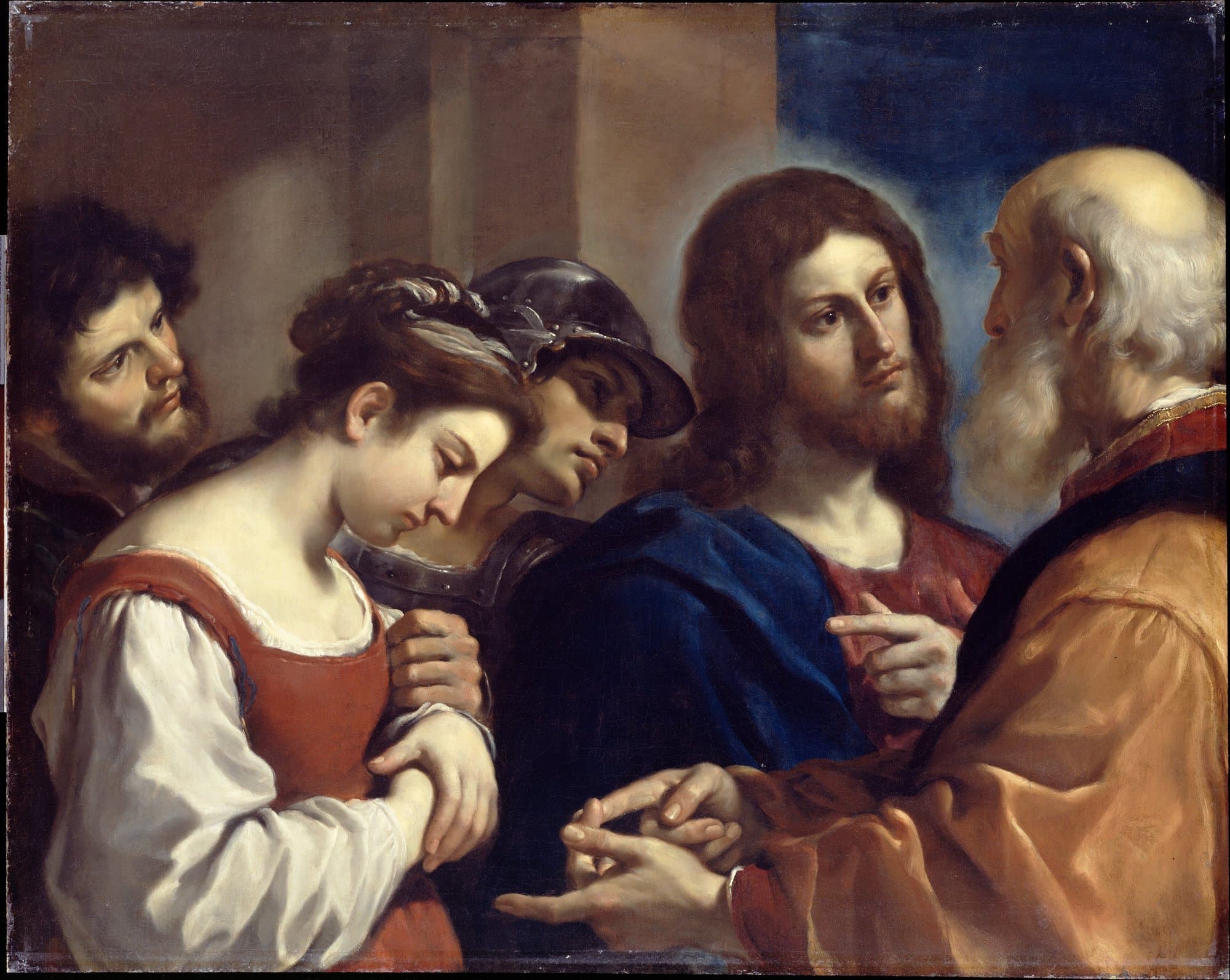
The Woman Brought to Jesus
Commentators weigh whether the account belongs to the original text of John's Gospel.
Then Jesus straightened up and asked her, “Woman, where are your accusers? Has no one condemned you?” “No one, Lord,” she answered. “Then neither do I condemn you,” Jesus declared. “Now go and sin no more.”The verses stand here because they hold together mercy and the call to leave sin, the two halves of the way back.
Albert Barnes, in his Notes, Explanatory and Practical, wrote that the passage, with the last verse of John 7, “is wanting in many of the ancient manuscripts and versions”. He named Erasmus, Calvin and Beza among those who rejected it, and judged that “It is not easy to decide the question”.
Jamieson, Fausset and Brown, in their Commentary Critical and Explanatory (1871), granted that it is missing from “some of the earliest and most valuable manuscripts”. They held that “The internal evidence in its favor is almost overpowering.”
The Way Back in Scripture
A king, a prophet and a church each show a way back after adultery.
The LORD sent Nathan to David after David had taken Bathsheba and had her husband Uriah killed. Nathan told a story of a rich man who took a poor man's only lamb, and David condemned the man before he learned that he was hearing about himself.
Now, therefore, the sword will never depart from your house, because you have despised Me and have taken the wife of Uriah the Hittite to be your own.’The verse names the judgment that remained on David's house, the part of Nathan's word that forgiveness did not lift.
“It will be a wound to his good name, a dishonour to his family, and, though the guilt of it may be done away by repentance, the reproach of it never will, but will stick to his memory when he is gone. David's sin in the matter of Uriah was not only a perpetual blemish upon his own character, but gave occasion to the enemies of the Lord to blaspheme his name too.”
Matthew Henry · Commentary on the Whole Bible · on Proverbs 6:33Puritan
David's prayer after Nathan's visit is Psalm 51, taught in Create in Me a Clean Heart.
Then the LORD said to me, “Go show love to your wife again, though she is loved by another and is an adulteress. Love her as the LORD loves the Israelites, though they turn to other gods and offer raisin cakes to idols.”The verse stands here because it grounds a husband's return to his wife in God's own faithfulness to His people.
The story of Hosea and Gomer is taught in Gomer, Bought Back.
And that is what some of you were. But you were washed, you were sanctified, you were justified, in the name of the Lord Jesus Christ and by the Spirit of our God.Paul names adulterers among the sins of the past of the church at Corinth and then names the washing that made them new.
Hosea 3:1, 1 Corinthians 6:11
Two Hard Questions
Readers of Matthew 5:32 divide three ways, and Hermas answers whether a penitent spouse must be taken back.
Divorce and remarriage after adulterythe Westminster Confession; the Shepherd of Hermas; John Piper
The Westminster Confession allows the innocent party to divorce and “to marry another, as if the offending party were dead”. Against it, Mark 10:11 to 12 gives Jesus' word on marrying another with no exception.
The Shepherd of Hermas told the husband of an unrepentant wife to put her away and “remain by himself”. It warned that “if he put his wife away and marry another, he also commits adultery”. Against it, Matthew 19:9 sets the exception in the same sentence as marrying another.
John Piper reads the exception as unfaithfulness during betrothal, the case of Joseph in Matthew 1:19, as Jason Meyer reports him in a sermon of 2018. Piper allows remarriage only after a spouse has died. Against it, Matthew 5:32 and Matthew 19:9 set the exception inside a word about a man and his wife.
The penitent spouse is to be taken backthe Shepherd of Hermas
Hermas asked what a husband should do if a wife he had put away repented and wished to return. The answer he received was plain: “If the husband do not take her back, he sins, and brings a great sin upon himself; for he ought to take back the sinner who has repented.”
The same rule bound husband and wife alike, for “In this matter man and woman are to be treated exactly in the same way.”
Against it, Jesus' exception in Matthew 5:32 allows divorce for sexual immorality and adds no condition about repentance.
Forgiveness and Its Limits
Jesus sets forgiveness beyond the count Peter offered.
Then Peter came to Jesus and asked, “Lord, how many times shall I forgive my brother who sins against me? Up to seven times?” Jesus answered, “I tell you, not just seven times, but seventy-seven times!The verses stand here because a wronged spouse faces the same question Peter asked.
Bear with one another and forgive any complaint you may have against someone else. Forgive as the Lord forgave you.The verse stands here because it sets a wronged spouse's forgiving inside the life of the whole church.
Forgiveness answers the sin, while the trust between husband and wife is rebuilt over time. A couple on the way back should seek the help of a pastor or a counsellor beside prayer and never in its place.
Sources
Scripture is the Berean Standard Bible.
- Hippolytus of Rome, Exegetical Fragments, on Proverbs 6:27.
- Matthew Henry, Commentary on the Whole Bible (1710), on Proverbs 6:33.
- The Shepherd of Hermas, Book 2, Commandment 4, chapter 1, tr. F. Crombie, Ante-Nicene Fathers, vol. 2 (Buffalo: Christian Literature Publishing Co., 1885).
- The Westminster Confession of Faith, chapter 24, sections 5 and 6.
- Jason Meyer, “... Except for Sexual Immorality ...”, sermon on Matthew 19:7 to 9, Bethlehem Baptist Church, 1 and 2 September 2018, reporting John Piper, What Jesus Demands from the World (2006).
- Albert Barnes, Notes, Explanatory and Practical, on the Old and New Testaments (1832 to 1869), on John 8:11.
- Robert Jamieson, A. R. Fausset and David Brown, Commentary Critical and Explanatory on the Whole Bible (1871), on John 8:11.
Keep Studying
Read it2
Studies6