
2 Peter 1 · Subject · Featured Study
Partakers of the Divine Nature
One verse of Peter's second letter, read by twelve writers from the second century to the twentieth.
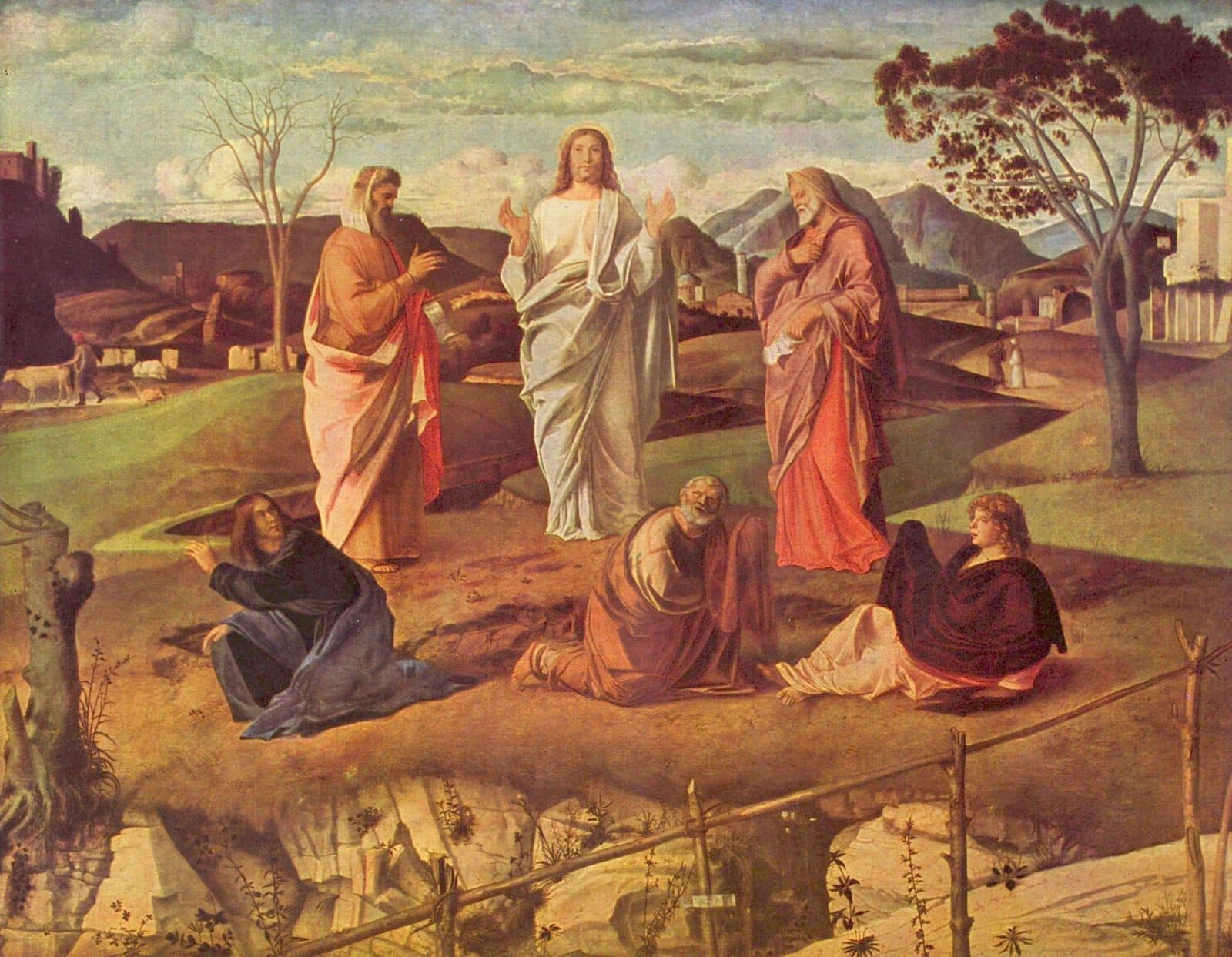
Giovanni Bellini, The Transfiguration, 1480 to 1485, Museo di Capodimonte, Naples. Public domain, via Wikimedia Commons.
THE ARTWORKBellini set the transfigured Christ on a grassy rise above a wide valley, with the two prophets standing at His sides and the three disciples thrown down before Him.
Peter promised his readers a share in the divine nature, and the church has asked ever since how a creature can share God's life.
Summary
In 2 Peter 1 the promise stands after a gift God has already given and before seven virtues the readers are to add.
- The Greek fathers read the promise as union with God by grace; Aquinas, Calvin and Wesley read it as grace, the image of God renewed, and communion with Him.
- Each of these traditions holds that the believer never becomes God in essence.
- Josephus quotes Manetho using the same phrase of a gifted seer, and Bigg set out how Peter's use differs.
The Promise in 2 Peter 1
Four passages of 2 Peter 1 set the promise in its chapter.
His divine power has given us everything we need for life and godliness through the knowledge of Him who called us by His own glory and excellence.God's power gives before Peter asks for any effort, so the promise rests on a gift.
Through these He has given us His precious and magnificent promises, so that through them you may become partakers of the divine nature, now that you have escaped the corruption in the world caused by evil desires.It is the one verse of the New Testament that speaks of sharing the divine nature.
For this very reason, make every effort to add to your faith virtue; and to virtue, knowledge; and to knowledge, self-control; and to self-control, perseverance; and to perseverance, godliness; and to godliness, brotherly kindness; and to brotherly kindness, love.These virtues are how the share shows in conduct, and Peter asks for them because of the promise.
For we did not follow cleverly devised fables when we made known to you the power and coming of our Lord Jesus Christ, but we were eyewitnesses of His majesty. For He received honor and glory from God the Father when the voice came to Him from the Majestic Glory, saying, “This is My beloved Son, in whom I am well pleased.” And we ourselves heard this voice from heaven when we were with Him on the holy mountain.Peter saw on the mountain the glory he promises a share in, so he writes the promise as a witness.
What the Verse Says
Peter writes the promise to believers still living in the world.
Peter writes to people who remain creatures, and he says they "have escaped the corruption in the world" already, so the share has begun.
What "through them" refers toJohn Calvin; Charles Bigg
John Calvin noted that the Greek copies vary at the start of 2 Peter 1:4, and held that on either reading the promises are of the highest worth and freely given.
Charles Bigg reports that Calvin, de Wette and Spitta referred "them" to the things that pertain to life and godliness, and that Bengel referred it to glory and excellence. Bigg himself took "them" to mean the promises.
The Phrase in the Greek World
Peter's phrase stood in Greek writing before him, and it bears on when the letter was written.
Josephus, in his reply to Apion, quotes Manetho on a seer named Amenophis, who seemed to partake of a divine nature in wisdom and knowledge of the future.
Charles Bigg, in his 1901 commentary on the letter, set Peter's phrase beside that line and beside Stoic writers and Philo, and judged that it had a Greek rather than a biblical ring. He then marked where Peter parts from those writers.
“What he says is that the Christian becomes by grace partaker of the Divine nature. What the heathen philosopher taught was that all men are so by nature.”
Charles Bigg · A Critical and Exegetical Commentary on the Epistles of St. Peter and St. Jude, page 256 · on 2 Peter 1:4Anglican
Harnack's late date and Bigg's answerBigg, pages 255 to 256
Bigg reports that Adolf von Harnack took the phrase as one proof that the letter was written after the middle of the second century.
Bigg answered that the writer uses some half-dozen words current among educated men in the first century, and shows less acquaintance with Greek thought than Luke or Paul.
The Words of the Promise
Five Greek words of the verse, from the lexicon.
KOINŌNOS (GREEK, G2844)
A noun that means a sharer, a partner or a companion, and Peter calls himself one in his first letter.
THEIOS (GREEK, G2304)
An adjective that means divine, which the lexicon counts three times in the New Testament, in this verse, in the verse before it and in Paul's speech at Athens.
PHYSIS (GREEK, G5449)
A noun that means nature, the kind or the constitution of a thing, and Paul uses it of Gentiles who do by nature what the law requires.
PHTHORA (GREEK, G5356)
A noun that means decay or ruin, and Peter calls the false teachers its slaves.
APOPHEUGŌ (GREEK, G668)
A verb that means to escape, used again in 2 Peter 2:20 of those who escaped the corruption of the world.
What the Text Leaves Unsaid
The verse leaves three questions open.
Peter names the share and gives no account of how a creature holds it.
The verse names neither the Holy Spirit nor baptism nor the Lord's Supper.
The verse gives no day when the share is complete, and Jamieson, Fausset & Brown supply one from 1 John 3:2.
What the Promise Means
Peter's own contrast in the verse decides what the share is.
Peter sets the divine nature against the corruption that evil desire brings.
A commentary of 1871 follows that contrast back into the verse before.
“not God's essence, but His holiness, including His ‘glory’ and ‘virtue,’ 2Pe 1:3; the opposite to ‘corruption through lust.’”
Jamieson, Fausset & Brown · Commentary Critical and Explanatory on the Whole Bible, the note on "the divine nature" · on 2 Peter 1:4Evangelical
Voices on the Divine Nature
Teachers from the second century to the nineteenth wrote of sharing God's life.
The earliest of these voices, from the second century, ties the believer's share to the incarnation of the Son.
“who did, through His transcendent love, become what we are, that He might bring us to be even what He is Himself.”
Irenaeus · Against Heresies, book 5, preface · on 2 Peter 1:4Early Church
In the fourth century the same exchange was set out as the purpose of the incarnation, with the gifts it brings.
“For He was made man that we might be made God ; and He manifested Himself by a body that we might receive the idea of the unseen Father; and He endured the insolence of men that we might inherit immortality.”
Athanasius of Alexandria · On the Incarnation of the Word, 54.3 · on 2 Peter 1:4Early Church
A Reformer of the sixteenth century, who guarded the line between God and the creature, still used the fathers' boldest word.
“Let us then mark, that the end of the gospel is, to render us eventually conformable to God, and, if we may so speak, to deify us.”
John Calvin · Commentaries on the Catholic Epistles, the end of the gospel · on 2 Peter 1:4Reformed
A Baptist preacher of the nineteenth century states the limit the other voices assume.
“To be a partaker of the divine nature is not, of course, to become God. That cannot be. The essence of Deity is not to be participated in by the creature.”
Charles Spurgeon · Faith and Life, sermon 551, The Metropolitan Tabernacle Pulpit, volume 10, the sermon, preached 24 January 1864 · on 2 Peter 1:4
Hilary of Poitiers, Cyril of Jerusalem and Leo the GreatOn the Trinity 1.18; Mystagogical Lectures 4.3; Sermons 21.3
Hilary turned the verse into a rule for the student of Scripture.
“And again, though he be aware that he is partaker of the Divine nature, as the holy apostle Peter says in his second Epistle, yet he must not measure the Divine nature by the limitations of his own, but gauge God's assertions concerning Himself by the scale of His own glorious self-revelation. For he is the best student who does not read his thoughts into the book, but lets it reveal its own; who draws from it its sense, and does not import his own into it, nor force upon its words a meaning which he had determined was the right one before he opened its pages. Since then we are to discourse of the things of God, let us assume that God has full knowledge of Himself, and bow with humble reverence to His words. For He Whom we can only know through His own utterances is the fitting witness concerning Himself.”
Hilary of Poitiers · On the Trinity 1.18 · on 2 Peter 1:4Patristic
Cyril tied the share to the Lord's Supper.
“When Christ's body and blood become the tissue of our members, we become Christ-bearers and ‘partakers of the divine nature,’ as the blessed Peter said.”
Cyril of Jerusalem · Mystagogical Lectures 4.3 · on 2 Peter 1:4Patristic
Leo preached the verse at the Feast of the Nativity as a call to holy living.
“Christian, acknowledge thy dignity, and becoming a partner in the Divine nature, refuse to return to the old baseness by degenerate conduct. Remember the Head and the Body of which thou art a member. Recollect that thou wert rescued from the power of darkness and brought out into God's light and kingdom. By the mystery of Baptism thou wast made the temple of the Holy Ghost: do not put such a denizen to flight from thee by base acts, and subject thyself once more to the devil's thraldom: because thy purchase money is the blood of Christ, because He shall judge thee in truth Who ransomed thee in mercy.”
Leo the Great · SERMONS 21.3 · on 2 Peter 1:4Patristic
Irenaeus on adoption and Athanasius on sharing the SonAgainst Heresies 3.19.1; Against the Arians 1.16
Irenaeus, in the third book of Against Heresies, read Psalm 82:6 against those who deny the incarnation.
I have said, ‘You are gods; you are all sons of the Most High.’Irenaeus read its sons of the Most High as those who receive adoption through the Son of God and so reach incorruptibility.
Athanasius, in his first discourse against the Arians, quotes 2 Peter 1:4 by name and says that to share in God is no division of God's essence.
How the Churches Read the Promise
Four traditions read the promise, from the Greek fathers of the fourth century to Spurgeon in the nineteenth.
Union with God by graceAthanasius of Alexandria; John Damascene · The Greek fathers
This reading grew from the fourth-century debate over the Son's own nature.
“For as, although there be one Son by nature, True and Only-begotten, we too become sons, not as He in nature and truth, but according to the grace of Him that calls, and though we are men from the earth, are yet called gods , not as the True God or His Word, but as has pleased God who has given us that grace”
Athanasius of Alexandria · Four Discourses against the Arians, discourse 3, chapter 19 · on 2 Peter 1:4Early Church
The Greek church still held the reading four centuries later.
“becomes deified by merely inclining himself towards God; becoming deified, in the way of participating in the divine glory and not in that of a change into the divine being.”
John Damascene · An Exposition of the Orthodox Faith, book 2, chapter 12 · on 2 Peter 1:4Patristic
Calvin warns against the Manicheans, who made men a part of God, and against readers of his day who imagined a passage into God's nature, and Athanasius's line between grace and nature answers both.
Grace as a share by likenessThomas Aquinas · Latin scholastic theology
The Latin schools of the thirteenth century named the share a likeness to God that He grants the creature, and they began from this account of grace.
“Now the gift of grace surpasses every capability of created nature, since it is nothing short of a partaking of the Divine Nature, which exceeds every other nature.”
Thomas Aquinas · Summa Theologica, first part of the second part, question 112, article 1 · on 2 Peter 1:4Patristic
The objection, drawn from Athanasius in Against the Arians 3.19, is that a likeness alone can seem to say less than the fathers said.
The image of God renewed and finished in gloryJohn Calvin; Charles Spurgeon · Reformed
Calvin's reading turns on one word of the verse.
“But the word nature is not here essence but quality.”
John Calvin · Commentaries on the Catholic Epistles, the word nature · on 2 Peter 1:4Reformed
Calvin held that the image of God in holiness and righteousness is restored to believers so that they may share His eternal life and glory.
The objection comes from within the same tradition: Spurgeon said believers share the divine nature in a higher sense than likeness, as members of the body of Christ.
Renewal and communionJohn Wesley · Methodist
This reading looks to what the believer holds in this life.
“Being renewed in the image of God, and having communion with them, so as to dwell in God and God in you.”
John Wesley · Explanatory Notes upon the New Testament · on 2 Peter 1:4Evangelical
The objection is Calvin's timing, which puts the full share after the vices of the flesh are put off.
Books to Read Next
Five works free to read, four of them with a comment on the verse.
On the Incarnation of the Word
Athanasius of Alexandria · 4th century
Athanasius answers the Jews and the Greeks who scorned the cross of Christ.
Read it at New AdventCommentaries on the Catholic Epistles
John Calvin · 1551
Calvin's commentary on James, Peter, John and Jude gives a full note on this verse.
Read it at the Christian Classics Ethereal LibraryExplanatory Notes upon the New Testament
John Wesley · 1754
Wesley gives the Methodist reading of the verse in a single sentence.
Read it at the Christian Classics Ethereal LibraryA Critical and Exegetical Commentary on the Epistles of St. Peter and St. Jude
Charles Bigg · 1901
Bigg weighs the Greek of both letters of Peter and of Jude, word by word.
Read it at the Internet ArchiveFaith and Life, sermon 551
Charles Spurgeon · 1864
Spurgeon takes 2 Peter 1:1 to 4 as one text on faith and the life it brings.
Read it at the Christian Classics Ethereal LibraryPartakers in Christ
Peter grounds the promise in Jesus Christ, whom he names our God and Savior in the letter's first verse.
Peter tells his readers to "strive to make your calling and election sure," and promises those who do "a lavish reception into the eternal kingdom of our Lord and Savior Jesus Christ."
Keep studying
Studies1
Doctrines7