
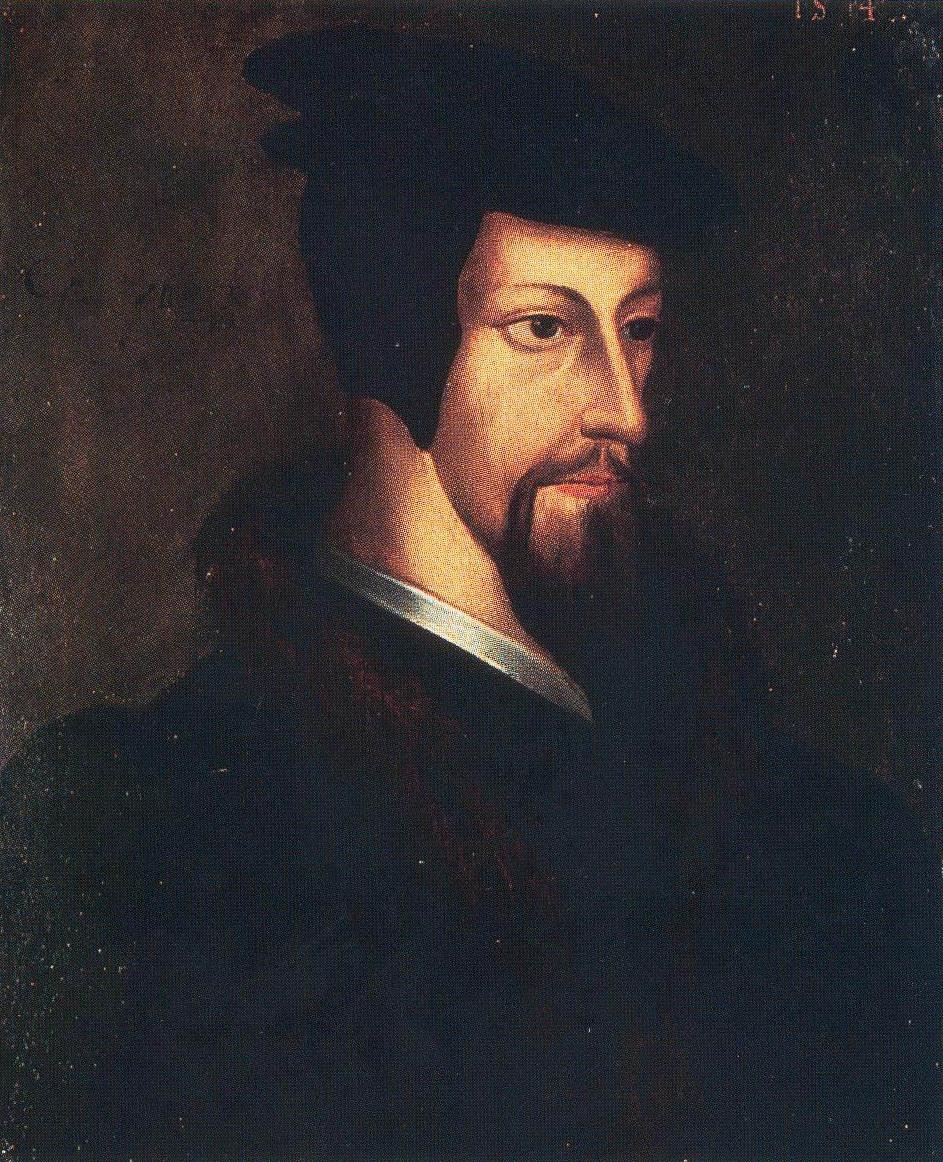
Flemish school, Portrait of John Calvin as a young man, 16th century. Public domain.
Geneva, to 1564 · Person · Featured Study
John Calvin
He wrote the Institutes, taught at Geneva from 1536 and died there in 1564.
He meant to stop one night at Geneva, and William Farel kept him there with a curse.
And it was He who gave some to be apostles, some to be prophets, some to be evangelists, and some to be pastors and teachers,
- Born
- 10 July 1509 at Noyon
- Died
- 27 May 1564 at Geneva
- Family
- wife: Idelette de Bure
- Places
- Noyon, Orleans, Paris, Basel, Geneva, Strassburg
Summary
John Calvin was a French student of law who left the Roman church and fled France. He printed the Institutes at Basel in March 1536. Geneva kept him that year, expelled him two years later and called him back three years after that. He taught there for the rest of his life.
- He held no civil office at Geneva and became a citizen there late in life.
- Michael Servetus was burned at Geneva, and Calvin's letters show he sought the sentence.
- His Academy trained men who carried the work to France, Scotland and beyond.
Pastors and Teachers
Calvin cited Ephesians 4 for the ministers of the church, and Colossians 1 gives the body its head.
In the Institutes Calvin cites Ephesians 4:11 for those who preside over the church, and he says only the two last of those offices have an ordinary place. The Geneva Ordinances of 1541 set four orders: pastors, doctors, elders and deacons.
The question of this life is how a refugee came to order a city's church, and what that order did to those who refused it. His own letters answer the second part.
And He is the head of the body, the church; He is the beginning and firstborn from among the dead, so that in all things He may have preeminence.Paul names Christ as the head of the church, which is the body these offices serve.
The Life in Order
Schaff gives the dates, and Calvin's preface to the Psalms gives his own account of the turns.
He spent twenty-three years at Geneva without a break after his return.
- 10 July 1509He was born at NoyonSchaff, vol. 8, §69
- About 1532He tells of a sudden conversion, and Schaff dates it hereCalvin, preface to the Psalms; Schaff, §72
- 1533Nicolas Cop's address drove reformers from ParisSchaff, vol. 8
- March 1536The Institutes appeared at BaselSchaff, vol. 8, §79
- July 1536Farel detained him at GenevaCalvin, preface; Schaff, §81
- April 1538Geneva expelled him and FarelSchaff, vol. 8, §84
- 1538 to 1541He was a pastor at Strassburg and married thereSchaff, vol. 8, §§86 and 92
- September 1541He came back to GenevaSchaff, vol. 8, §95
- 20 November 1541The General Council passed the OrdinancesSchaff, vol. 8, §96
- 27 October 1553Michael Servetus was burned at ChampelSchaff, vol. 8, §155
- 1559He became a citizen, and the Academy openedSchaff, vol. 8, §§101 and 161
- 27 May 1564He died at GenevaSchaff, vol. 8, §96
Each step of the life stands with its witness.
1538 to 1541, September 1541, 20 November 1541, 27 October 1553, 1559, 27 May 1564
From Noyon to Geneva
Calvin told the turns of his life himself in 1557, and Schaff fills the rest from the records.
John Calvin was a French Reformer, a theologian and a commentator on Scripture.
His father meant him for the church and then turned him to law, and he studied at Orleans and Bourges.
He wrote in 1557 that God "by a sudden conversion subdued and brought my mind to a teachable frame." Schaff places the change in 1532. When the rector Nicolas Cop's address stirred Paris in 1533, Cop fled to Basel, and Calvin was soon on the road as well.
At Basel he finished the Institutes and printed them with a preface to Francis I of France. It opens by saying that true wisdom has two parts, "the knowledge of God and of ourselves."
He meant to pass one night at Geneva that summer on the way to Strassburg. Farel found him and told him God would curse his retirement if he left. He stayed, and in April 1538 the Council of Two Hundred deposed him and Farel and ordered them out of the city within three days.
He served a congregation of French refugees at Strassburg and there married Idelette de Bure, a widow of his congregation. Geneva called him back, and he returned in September 1541.
From then on he preached, lectured and wrote commentaries for twenty-three years. He held no civil office, and Schaff writes that "he never occupied a political or civil office" and that he was no citizen of Geneva until 1559.
The Academy opened the same year. Schaff reports nine hundred young men in its first year, with almost as many refugees from France and England at Calvin's theological lectures, and he names Knox among them.
He preached his last sermon on 6 February 1564 and died on 27 May. He forbade pomp at his funeral and any monument over his grave.
The Burning of Servetus
Servetus denied the Trinity in print, and Calvin's letters show what he wanted done.
On 13 February 1546 Calvin wrote to Farel that if Servetus came, "I shall never permit him to depart alive". On 20 August 1553, after the arrest, he wrote, "I hope that sentence of death will at least be passed upon him". He went on, "I desire that the severity of the punishment may be mitigated."
The council condemned him, and he was burned at Champel. Farel walked with him to the stake. Schaff prints a last prayer for mercy to Jesus Christ, "Son of the eternal God", and his note says Farel does not mention it.
Schaff writes that Catholic and Protestant opinion alike approved the death of obstinate heretics and continued so to the close of the seventeenth century. Sebastian Castellio answered in Latin that to kill a man is not to defend a doctrine but to kill a man, and that sentence reached print in 1612.
In Their Own Words
These passages stand in his own books and letters, each with its year.
John Calvin (1509 to 1564)
Commentary on the Psalms, the author's preface, the preface, on Farel
Farel's dreadful imprecation
“William Farel detained me at Geneva, not so much by counsel and exhortation, as by a dreadful imprecation, which I felt to be as if God had from heaven laid his mighty hand upon me to arrest me.”
Reformed
About this saying1 paragraph
He wrote this in the preface to his commentary on the Psalms, dated Geneva, 22 July 1557.
John Calvin
Commentary on the Psalms, the author's preface, the preface, on his conversion
A sudden conversion
“God by a sudden conversion subdued and brought my mind to a teachable frame, which was more hardened in such matters than might have been expected from one at my early period of life.”
Reformed
About this saying1 paragraph
In the same preface of 1557 he looked back on his youth.
John Calvin
Institutes of the Christian Religion, book 1, chapter 1, section 1
True wisdom in two parts
“Our wisdom, in so far as it ought to be deemed true and solid Wisdom, consists almost entirely of two parts: the knowledge of God and of ourselves.”
Reformed
About this saying1 paragraph
This opens the last edition of the Institutes, which he finished in 1559, in Beveridge's English of 1845.
John Calvin
Farewell to the Ministers of Geneva, 28 April 1564, as Schaff prints it, volume 8, §165
His farewell to the ministers
“But if, while under this disease, you have experienced any degree of peevishness from me, I beg your pardon, and heartily thank you, that when I was sick, you have borne the burden imposed upon you.”
Reformed
About this saying1 paragraph
He spoke to the ministers of Geneva on 28 April 1564, and Schaff prints Beza's report of it.
The People Around Him
The record ties him to a friend who kept him, a wife, a successor, an opponent and a pupil.
Farel kept him at Geneva, and Beza kept his work after him.
| Person | Tie to Calvin | The witness |
|---|---|---|
| William Farel | He detained Calvin at Geneva and was expelled beside him. | Calvin's preface; Schaff, §84 |
| Idelette de Bure | A widow of his Strassburg congregation, she became his wife. | Schaff, vol. 8, §92 |
| Theodore Beza | He was proclaimed rector of the Academy and reported Calvin's farewell. | Schaff, §§161 and 165 |
| Nicolas Cop | A friend of Calvin, he spoke for reform as head of the university. | Schaff, vol. 8 |
| Michael Servetus | Calvin wrote against him, and the council had him burned. | Bonnet; Schaff, §155 |
| Sebastian Castellio | He answered Calvin over the burning. | Schaff, vol. 8, §158 |
| John Knox | He called Geneva the most perfect school of Christ. | Knox to Mrs Locke, 1556 |
The Places of His Life
He left France for good in his twenties and worked from two cities of the Rhine and the Rhone.
France stayed in view from Geneva.
| Place | What the record says | The witness |
|---|---|---|
| Noyon | He was born in this cathedral city of Picardy. | Schaff, vol. 8, §69 |
| Orleans and Bourges | He studied law at both universities. | Schaff, vol. 8, §70 |
| Paris | He was a student there, and Cop's address stirred the city. | Schaff, vol. 8 |
| Basel | Cop and Calvin found refuge here. | Schaff, vol. 8, §§78 and 79 |
| Geneva | He preached and lectured here, and he died here. | Schaff, vol. 8, §§81 and 96 |
| Strassburg | He spent his three years of exile here. | Schaff, vol. 8, §§85 and 86 |
| Champel | Servetus was burned on this hill outside Geneva. | Schaff, vol. 8, §155 |
What Geneva Became
Refugees trained at Geneva carried its creed and its order to other lands.
Schaff writes that Calvin "gave to the Huguenots their creed and form of government." The first draft of the French Confession of 1559 was his work.
The Consistory of five city pastors and twelve lay elders met every Thursday, and its members visited every house once a year. Knox, writing from Geneva in 1556, called it "the maist perfyt schoole of Chryst that ever was in the erth since the dayis of the Apostillis."
How the Key Verse Was Taught
Matthew Henry, Albert Barnes and the Jamieson, Fausset and Brown commentary read the gifts of Christ.
Matthew Henry (1662 to 1714)
Commentary on the Whole Bible
Matthew Henry read the gifts as given for the good of the church.
“Which is taken from Christ's great end and design in giving gifts unto men. The gifts of Christ were intended for the good of his church, and in order to advance his kingdom and interest among men. All these being designed for one common end is a good reason why all Christians should agree in brotherly love, and not envy one another's gifts.”
on Ephesians 4:11Puritan
Albert Barnes (1798 to 1870)
Notes, Explanatory and Practical, on the Old and New Testaments, on Ephesians 4:11
Albert Barnes asked what the list of offices was meant to show.
“He gave some to be apostles. The ‘object’ here is to show that he has made ample provision for the extension and edification of his church”
Presbyterian
Jamieson, Fausset & Brown (1802 to 1910)
Commentary Critical and Explanatory on the Whole Bible
The commentary of Jamieson, Fausset and Brown gave the shepherd a ruling office as well.
“The term, ‘shepherd’ or ‘pastor,’ is used of guiding and governing and not merely instructing, whence it is applied to kings, rather than prophets or priests”
on Ephesians 4:11Reformed
The rest2 more paragraphs
(Eze 34:23; Compare the names of princes compounded of "pharnas," Hebrew, "pastor," Holophernes, Tis-saphernes (compare
Isa 44:28).
What the Witnesses Leave Open
Readers differ on when he was converted, on his part in the burning and on how far he ruled Geneva.
His part in the burningCalvin; Schaff; Castellio
Calvin's letters show he wanted Servetus dead and asked for a lighter manner of death. The council passed the sentence. Schaff sets him among the opinions of his century, and Castellio answered him in that same century.
The date of his conversionCalvin; Schaff
Calvin gives no year in his preface of 1557. Schaff writes, "Calvin was not converted before 1532."
How far he ruled GenevaSchaff
Schaff says Calvin was consulted in all important affairs of state and that his advice was usually followed. He adds that Calvin held no office and never came before the Councils except on church business.
The date of the first InstitutesSchaff; Beveridge's English
Schaff gives March 1536 from the close of the book, and the dedication to Francis I is dated 23 August with no year. Beveridge's English prints "Basle, 1st August 1536".
Books to Read Next
Institutes of the Christian Religion
John Calvin, translated by Henry Beveridge · 1845
This is his own account of Christian teaching in its last form.
Read the Institutes free at CCELHistory of the Christian Church, volume 8
Philip Schaff · 1892
Schaff gives the life at length, with the Servetus case in full.
Read Schaff free at CCELLetters of John Calvin, volume 2
Jules Bonnet, editor · 1858
This volume holds his letters on Servetus.
Read the letters free at the Internet ArchiveWhat Calvin Left
Calvin left the Institutes, commentaries on most books of the Bible, an Academy and a grave with no monument.
Sources
Scripture is the Berean Standard Bible.
- The Holy Bible, Berean Standard Bible (read 2026)
- John Calvin, Commentary on the Book of Psalms, the author's preface, dated Geneva, 22 July 1557, Calvin Translation Society (1843 to 1855)
- John Calvin, Institutes of the Christian Religion, translated by Henry Beveridge, Calvin Translation Society (1845)
- Jules Bonnet, editor, Letters of John Calvin, volume 2 (Philadelphia, 1858)
- Philip Schaff, History of the Christian Church, volume 8, Modern Christianity: The Swiss Reformation (1892), sections 58 to 166.
- Matthew Henry, Commentary on the Whole Bible (1710), on Ephesians 4:11.
- Albert Barnes, Notes on the Old and New Testaments (1832 to 1869), on Ephesians 4:11.
- Jamieson, Fausset and Brown, Commentary Critical and Explanatory on the Whole Bible (1871), on Ephesians 4:11.
Keep Studying
Studies8
People and groups9
Doctrines7